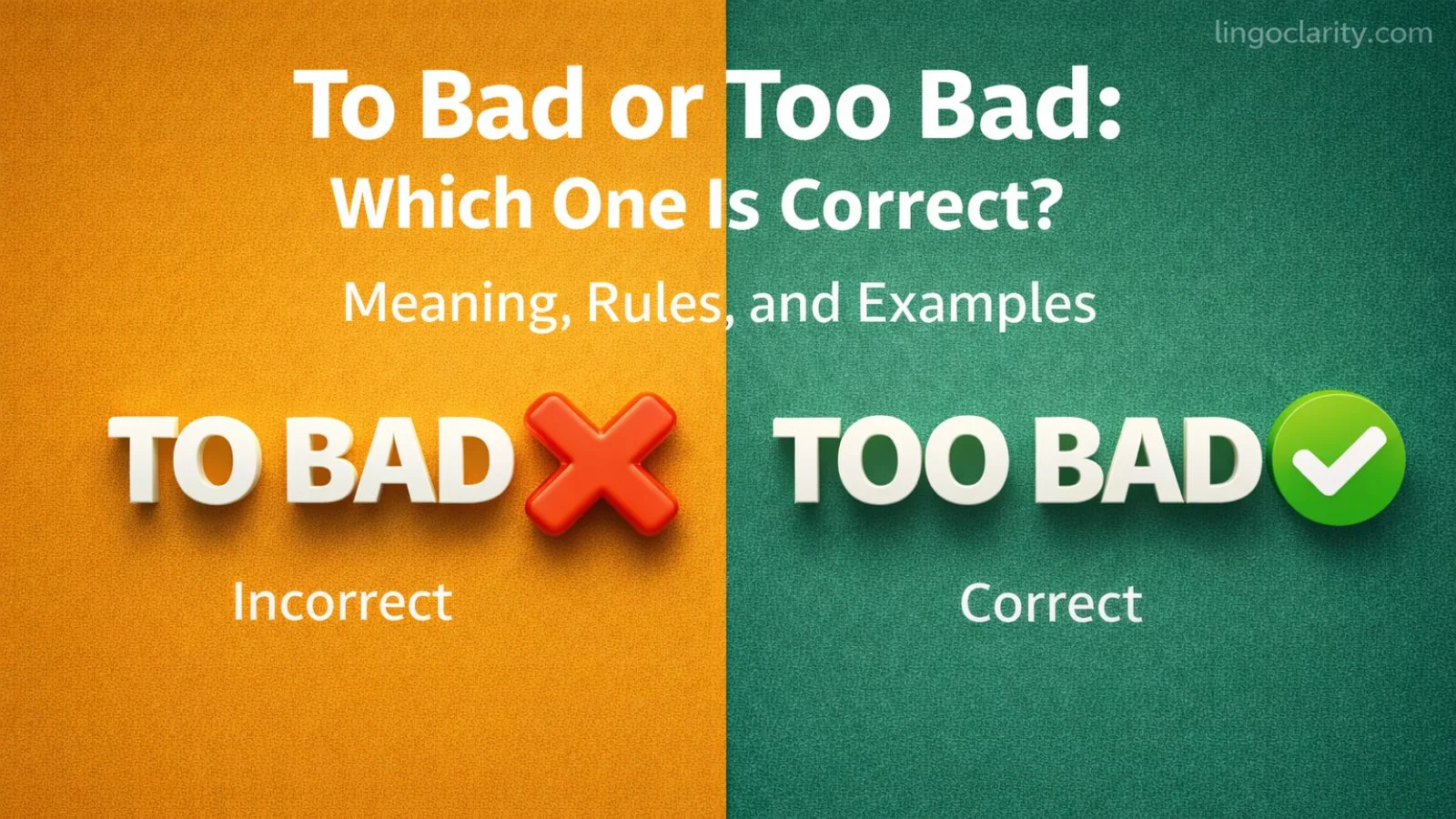
Quick Answer: Too bad is the correct phrase when you mean “unfortunate,” “that’s a shame,” or “not ideal.” To bad is usually a spelling mistake in this context. However, to can correctly appear before bad in sentences that describe a change, such as “The situation went from good to bad.”
Correct: “That’s too bad.”
Incorrect: “That’s to bad.”
Also correct: “Things went from good to bad.”
Why People Confuse “to” and “too”
The words to and too sound exactly alike in spoken English. Words that share the same pronunciation but have different spellings and meanings are called homophones.
Because these words sound identical, it is easy to type the wrong one in text messages, emails, social media posts, and school assignments.
Spellcheck may not catch the error because to is a correctly spelled English word. It simply does not fit when you want to express the meaning of “too bad.”
The easiest way to remember the difference is to focus on the meaning of the sentence rather than how the words sound.
What Does “Too Bad” Mean?
The expression too bad has two common meanings in American English.
Something Is Unfortunate
People often use too bad to express disappointment, sympathy, or regret about an unpleasant situation.
Examples:
“It’s too bad you couldn’t come to the party.”
“That’s too bad. I know you were looking forward to the trip.”
“It’s too bad the concert sold out before we got tickets.”
“Too bad we missed the last bus.”
In these examples, too bad means something like “that’s unfortunate” or “that’s a shame.”
Someone Dismisses a Complaint
The expression can also sound blunt, sarcastic, or dismissive. In this sense, it suggests that someone does not care about another person’s complaint.
Examples:
“You don’t like the rules? Too bad.”
“Too bad you missed the deadline. We cannot accept late submissions.”
“If you don’t want to participate, that’s too bad.”
The meaning depends on the situation, the speaker’s tone, and the relationship between the people involved.
Why “To Bad” Is Usually Wrong
The words to and too perform different grammatical jobs.
Too is an adverb that can mean “excessively,” “more than is desirable,” or “also,” depending on the sentence.
Examples:
“The coffee is too hot.”
“This suitcase is too heavy.”
“I want to come too.”
To is commonly used to show direction, destination, or movement. It also appears before the base form of a verb to create an infinitive.
Examples:
“We are going to school.”
“I need to study.”
“She wants to help.”
When you express disappointment with the phrase too bad, you need too, not to.
Incorrect: “It’s to bad that the event was canceled.”
Correct: “It’s too bad that the event was canceled.”
The second sentence uses the standard expression to describe an unfortunate situation.
When Can “To Bad” Be Correct? (rare, but real)
Although to bad is incorrect as a standalone expression of disappointment, the two words can appear next to each other in a grammatically correct sentence.
This happens when to expresses movement, change, or a range and bad describes the resulting condition.
Examples:
“The situation went from good to bad in a single afternoon.”
“The weather changed from pleasant to bad within hours.”
“Things went from bad to worse after the update.”
In the first two examples, to connects one state with another. It does not mean “excessively” or “unfortunately.”
Remember that this exception does not make “That’s to bad” correct. When you want to express sympathy or disappointment, use too bad.
Fast Tests You Can Use (no grammar stress)
Test 1: Swap in “unfortunate”
If the sentence still makes sense when you replace the expression with unfortunate, you probably need too bad.
Example:
“It’s ___ that you can’t attend.”
“It’s unfortunate that you can’t attend.”
Correct answer: “It’s too bad that you can’t attend.”
Test 2: Replace “Too” With “Excessively”
When too means more than is desirable, try replacing it with excessively.
Example:
“This coffee is ___ hot to drink.”
“This coffee is excessively hot to drink.”
Correct answer: “This coffee is too hot to drink.”
This test works for expressions such as too hot, too loud, and too expensive.
Test 3: Look for a Change From One State to Another
If the sentence describes movement from one condition to another, to may be correct.
Example:
“The situation went from manageable ___ bad.”
Correct answer: “The situation went from manageable to bad.”
Here, to connects the starting condition with the final condition.
Key Differences Between “Too Bad” and “To Bad”
| Feature | Too Bad | To Bad |
|---|---|---|
| Standard expression | Correct | Incorrect when expressing disappointment |
| Meaning | Unfortunate, a shame, or excessively bad | Depends on the sentence structure |
| Common use | Expressing disappointment or describing something unfortunate | Showing a change from one condition to another |
| Example | “That’s too bad.” | “It went from good to bad.” |
| Standalone reaction | Correct | Incorrect for this meaning |
The main rule is simple: use too bad when expressing disappointment, and use to bad only when the surrounding sentence gives to a legitimate grammatical role.
Common Mistakes and How to Fix Them
Even confident English speakers sometimes confuse homophones. Here are common mistakes and their corrections.
| Incorrect | Correct | Explanation |
|---|---|---|
| “It’s to bad you can’t come.” | “It’s too bad you can’t come.” | Use too to express disappointment. |
| “Not to bad.” | “Not too bad.” | The expression means fairly good or acceptable. |
| “I’m coming to.” | “I’m coming too.” | Use too to mean also. |
| “The coffee is to hot.” | “The coffee is too hot.” | Use too to mean excessively. |
| “Things went from good too bad.” | “Things went from good to bad.” | Use to to connect the two conditions. |
One additional point: too much bad news is grammatically correct because much modifies the noun phrase bad news. However, “too much bad” is not a natural substitute for “too bad” when expressing disappointment.
Real-Life Examples of “Too Bad”
Sympathetic Examples
Use too bad to acknowledge someone’s disappointment or an unfortunate event.
- “Oh, that’s too bad. I hope you can reschedule your appointment.”
- “It’s too bad you missed the game. It was exciting.”
- “That’s too bad. I know how much you wanted that job.”
- “It’s too bad the flight was delayed, but at least you arrived safely.”
- When responding to serious news, a warmer expression such as “I’m sorry to hear that” may be more appropriate.
Neutral and Casual Examples
In everyday conversation, too bad can describe an outcome without expressing strong emotion.
- “It’s too bad the store was closed when we arrived.”
- “Too bad we ran out of time before finishing the project.”
- “The tickets are sold out. Too bad we waited so long.”
- “Not too bad, honestly. The movie was better than I expected.”
- The expression not too bad usually means “fairly good,” “acceptable,” or “better than expected.”
Dismissive or Sarcastic Examples
Be careful when using too bad in a disagreement. It can sound rude if it suggests that another person’s concerns do not matter.
- “You don’t like the decision? Too bad.”
- “Too bad. The deadline has already passed.”
- “If you don’t want to follow the instructions, too bad.”
- With coworkers, customers, or people you do not know well, a more professional response is often better.
- For example, instead of saying “Too bad the deadline passed,” you could say, “Unfortunately, the deadline has passed. Let’s discuss the available options.”
“Too bad” vs “Too badly” (quick clarity)
- too bad = common phrase about a situation: “That’s too bad.”
- too badly = when you modify a verb: “He performed too badly to win.”
Comparison Table (Context → Best Choice → Why)
Sometimes too bad sounds too casual or dismissive. Choosing a different expression can help you communicate more clearly.
| Alternative | Best Use | Example |
|---|---|---|
| That’s a shame. | Friendly conversations | “That’s a shame. I hope you can go next time.” |
| I’m sorry to hear that. | Sympathy | “I’m sorry to hear that your flight was canceled.” |
| That’s unfortunate. | Neutral or professional communication | “That’s unfortunate, but we can arrange another meeting.” |
| What a pity. | Mild disappointment | “What a pity we missed the opening performance.” |
| Unfortunately | Emails and formal writing | “Unfortunately, we cannot extend the deadline.” |
| Let’s find another solution. | Problem-solving | “Unfortunately, the room is unavailable. Let’s find another solution.” |
Choose the alternative that fits your audience and purpose. In particular, avoid using a blunt “Too bad” when someone shares serious personal difficulties.
Pronunciation Tips for “Too Bad”
The expression too bad is pronounced /tuː bæd/.
Too: The vowel sound /uː/ is long, similar to the vowel in shoe.
Bad: The vowel sound /æ/ is short, as in cat and map.
To practice, say “too” slowly, keeping the vowel sound long. Then say “bad” with a short vowel sound.
Repeat the phrase naturally: “That’s too bad.”
Remember that to, too, and two sound alike in many varieties of English. Pronunciation alone will not tell you which spelling to choose, so focus on the meaning and grammar.
Frequently Asked Questions
Too bad is correct when you mean “unfortunate,” “that’s a shame,” or “excessively bad.” To bad is usually a spelling error in this context, although the words can appear together correctly in sentences such as “It went from good to bad.”
Not too bad is correct. It is a casual expression meaning “fairly good,” “okay,” or “better than expected.”
Example: “How was the restaurant?” “Not too bad.”
No comma is needed when too bad stands alone as a reaction or forms part of a sentence.
A comma may be appropriate when the expression introduces a separate comment or interruption, depending on the sentence structure. For example: “It’s too bad that we will have to try again next week.” In this sentence, the comma separates the opening reaction from the following statement.
Yes. The words can appear together when to has its normal grammatical function.
Example: “The situation went from good to bad.”
Here, to connects two conditions. It is not the same as the expression too bad, which means “unfortunate.”
No. It can express sympathy, mild disappointment, sarcasm, or dismissal. “That’s too bad. I hope everything works out” sounds sympathetic, while “You don’t like it? Too bad” sounds dismissive.
Not too bad usually means fairly good, acceptable, or better than expected.
Example: “The exam wasn’t too bad.”
This does not mean the exam was excessively bad. It means the exam was manageable or not particularly difficult.
What can I say instead of “too bad”?
Depending on the context, you can say “That’s a shame,” “I’m sorry to hear that,” “That’s unfortunate,” or “Unfortunately.” These alternatives can sound warmer or more professional when the situation calls for it.
Is “too bad” suitable for professional writing?
It can work in casual workplace conversations, but it may sound blunt in formal emails or client communications. In professional writing, expressions such as “Unfortunately,” “That’s unfortunate,” or “I’m sorry to hear that” are often more appropriate.
Practice: Choose Between “To” and “Too”
Test your understanding with these short exercises.
Exercise 1: Choose the Correct Word
Fill in each blank with to or too.
“That’s ___ bad that your flight was delayed.”
“This coffee is ___ hot to drink.”
“We’re heading ___ the park after lunch.”
“I’m coming ___, so please wait for me.”
“The situation went from good ___ bad.”
“It’s ___ bad we couldn’t get tickets.”
Exercise 2: Correct the Spelling
Rewrite each sentence using the correct spelling.
“To bad we missed the concert.”
“It’s to expensive to buy right now.”
“I want to come to.”
“The day went from fine too bad.”
Answers to the Exercises
Exercise 1: Choose the Correct Word (Answers)
“That’s too bad that your flight was delayed.”
“This coffee is too hot to drink.”
“We’re heading to the park after lunch.”
“I’m coming too, so please wait for me.”
“The situation went from good to bad.”
“It’s too bad we couldn’t get tickets.”
Exercise 2: Correct the Spelling (Answers)
“Too bad we missed the concert.”
“It’s too expensive to buy right now.”
“I want to come too.”
“The day went from fine to bad.”
Conclusion
For everyday American English, too bad is the correct expression when you mean “unfortunate,” “that’s a shame,” or a dismissive “I don’t care.” The spelling to bad is usually incorrect when used with this meaning.
However, to bad can be grammatically correct when to connects different conditions, as in “The situation went from good to bad.”
When you are unsure, ask yourself whether you mean “unfortunate.” If you do, choose too bad. With this simple rule and a little practice, you can avoid this common spelling mistake in conversations, emails, and everyday writing.

4 thoughts on “To Bad or Too Bad: Which is Correct? Meaning, Rules, and Examples”
Comments are closed.