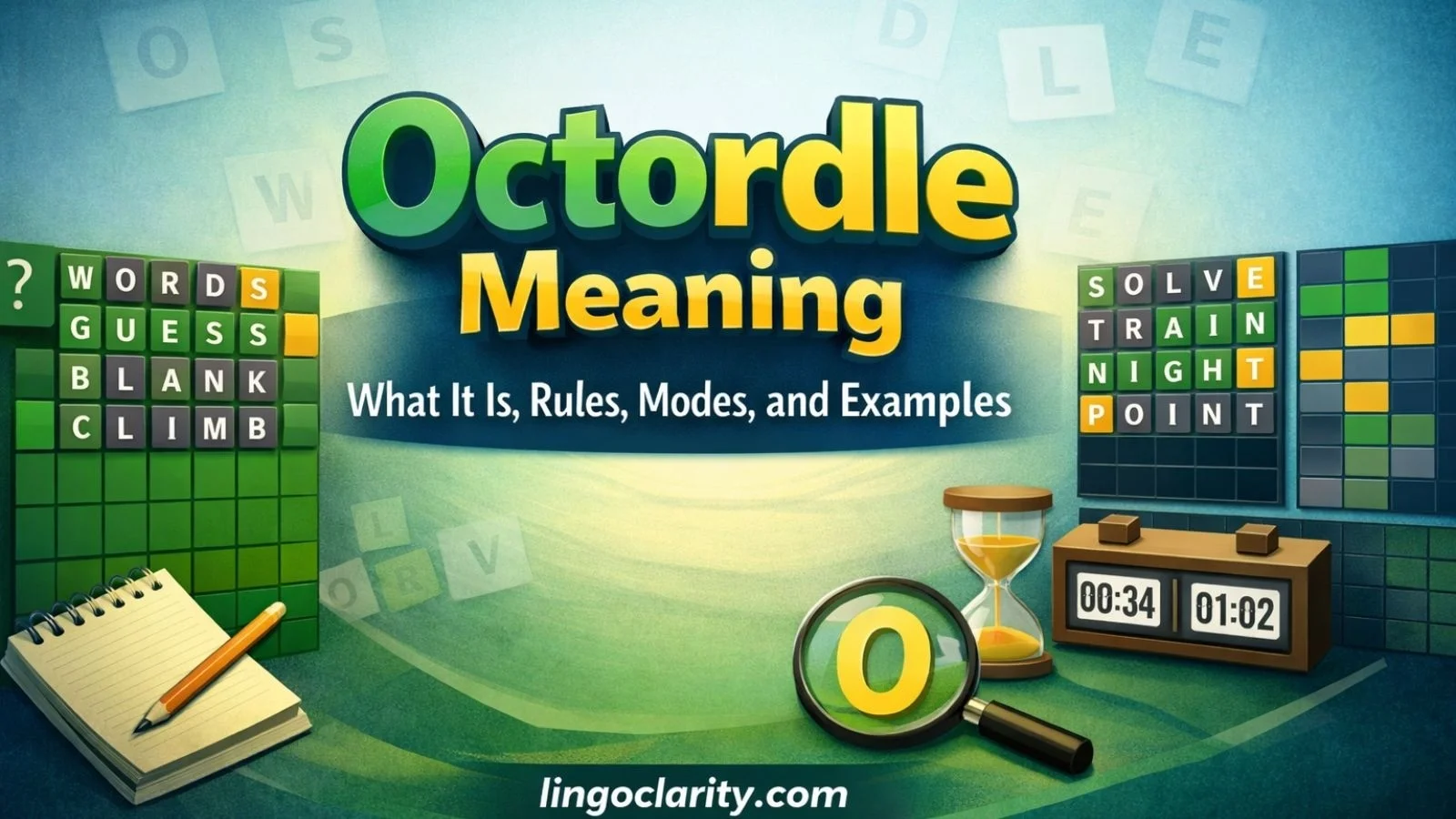
If you’re searching for the octordle meaning, you’re probably seeing the term in puzzle chats, score posts, or word game guides and want a clear answer fast. Octordle is a Wordle-style word puzzle where players solve eight five-letter words at the same time using shared guesses and color clues. It looks familiar if you already know Wordle, but the extra boards make it much more challenging.
In this guide, you’ll learn the octordle meaning in plain English, how the game works, what the colors mean, common modes like Sequence and Rescue, and how to use the term correctly in writing and conversation. Whether you’re a beginner or comparing Octordle with Wordle and Quordle, this article will help you understand it quickly and avoid common confusion.
Quick Answer
Octordle is a Wordle-style word game where you solve eight five-letter words at once using shared guesses and color clues. One guess updates all eight boards in standard play, and the daily/classic game gives you 13 guesses to finish all eight words.
The game is published free by Merriam-Webster (part of Britannica), which also hosts Quordle. People also use “Octordle” as the game’s title in chats, posts, score shares, puzzle guides, and comparison articles.
TL;DR
- Octordle is a Wordle-style game.
- You solve eight words, not one.
- One guess updates all boards in regular play.
- Colors show letter accuracy on each board.
- “Octo-” points to eight.
- Daily/classic play gives 13 guesses.
- Sequence, Rescue, Chill, and Extreme are the common mode names.
What Octordle Means
Octordle is the name of a word puzzle game. In plain English, it means a harder Wordle-style challenge built around eight boards.
The name itself is a clue: the prefix “octo-” means “eight.” That matches the game’s core idea — solving eight hidden words in the same session.
In everyday writing, people use Octordle in a few common ways:
- Game title: “I play Octordle every morning.”
- Search phrase: “What is the Octordle meaning?”
- Comparison term: “Octordle is harder than Wordle.”
- Category label: “This guide explains Wordle, Quordle, and Octordle.”
Capitalization Style Note
Use Octordle (capitalized) when referring to the game title.
Use lowercase octordle only in search-style phrases or informal keyword use, such as:
- “octordle meaning”
- “octordle rules”
- “octordle sequence tips”
Where People See The Term Online
Most people first see “Octordle” in puzzle spaces — not in grammar textbooks. It commonly appears where players share streaks, scores, hints, and daily habits.
You may see it in:
- Group chats (“Anyone finish Octordle today?”)
- Social posts with score screenshots
- Browser game pages
- App and game lists
- “Today’s hints/answers” pages
- Word game comparison guides
- Puzzle forums and comment threads
Natural Usage Examples
- “I can do Wordle, but Octordle melts my brain.”
- “She posted her Octordle score after lunch.”
- “Try Octordle if Quordle feels easy now.”
- “This guide explains Octordle for beginners.”
How Octordle Works
The core idea is simple: one guess feeds multiple boards. That is the part many beginners miss.
In standard Octordle play, you are not typing a different word for each grid. You type one valid five-letter guess, and all boards update together with color clues.
The Basic Formula
- 8 boards
- Shared guesses
- Color clues on each board
- 13 total turns in daily/classic play
- Solve all words to win
What Usually Stays The Same Across Versions
- Hidden answers are five-letter words
- Every guess must be a valid accepted word
- Green = right letter, right spot
- Yellow = right letter, wrong spot
- Gray = letter not in that board’s answer (with duplicate-letter caveats)
Common Confusion
Question: “Do I type a different word for each board?”
Correction: No. In regular Octordle play, one typed guess updates all boards together.
How To Play Octordle Step By Step
If you know Wordle, you already know the foundation. Octordle mainly adds scale, memory, and decision pressure.
Start with information gathering, not speed. With eight answers and only 13 guesses, you can afford roughly five “wasted” turns across the whole board set — so every early guess should earn its place.
Beginner-Friendly Step-By-Step Strategy
- Start with a strong five-letter word.
- Use a second word that tests new common letters.
- Scan all eight boards for obvious greens and useful yellows.
- Solve the clearest boards first to reduce mental load.
- Reposition yellow letters early instead of delaying them.
- Avoid repeating dead letters unless a pattern requires it.
- Keep using guesses that help multiple boards when possible.
- Finish the toughest boards once you have enough constraints.
Practical Beginner Examples
- After SLATE, one board shows A green in spot 3.
- Another board shows L yellow, so you test a new position next turn.
- A third board has no hits, so your next guess should introduce fresh letters.
- Two boards both show R and E, so you try a word that places both.
A Common Beginner Mistake
Mistake: Mentally treating it like eight separate games.
Better Move: Use each guess to create value across multiple boards.
What The Colors Mean In Octordle
Color feedback is the game’s clue system. Read it board by board, not globally.
The same letter can produce different colors on different boards because each board has a different answer. That is normal.
Color Meanings
- Green = correct letter, correct position
- Yellow = correct letter, wrong position
- Gray = letter not in that board’s answer (or not in that quantity/position, depending on duplicate-letter behavior)
Important Accuracy Note About Duplicate Letters
Like Wordle-style games, duplicate letters can make color feedback look confusing. A gray tile does not always mean the letter is completely useless in every situation — sometimes it means you guessed more copies of a letter than the answer contains.
That is why the safest rule is:
- Read colors in context
- Check position
- Consider duplicate-letter possibilities
Example Across Boards
You type CRANE:
- On Board 1, A is green
- On Board 2, A is yellow
- On Board 3, A is gray
These results do not conflict. They belong to different hidden words.
Common Beginner Mistakes (And Fixes)
Octordle punishes rushed habits. Small mistakes compound fast when eight boards are active.
Mistakes You Should Avoid
- Mistake: Chasing one hard board too early — Fix: Build clues across all boards first.
- Mistake: Reusing gray letters too often — Fix: Test fresh letters unless a pattern justifies reuse.
- Mistake: Ignoring yellow letters for too many turns — Fix: Reposition yellows quickly to narrow possibilities.
- Mistake: Reading only colors, not positions — Fix: Track exact slots, not just “good/bad” letters.
- Mistake: Treating keyboard color as universal truth — Fix: Confirm with each board’s tile results before committing.
- Mistake: Panicking after a weak start — Fix: Slow starts are normal in multi-board puzzles.
- Mistake: Confusing “not valid word” with “wrong answer” — Fix: It usually means the guess is not accepted by that version’s word list.
Quick Mindset Reset Example
Wrong Thought: “The game is broken.”
Better Thought: “My guess may not be in this version’s accepted word list.”
Octordle Modes: Daily, Sequence, Rescue, Chill, And Extreme
Many people use “Octordle” to mean the main daily game. Depending on where you play, you may also see extra mode names such as Sequence, Rescue, Chill, and Extreme, plus free/practice versions of the same puzzles.
Commonly Seen Mode Labels
| Mode | What Changes | Guesses |
|---|---|---|
| Daily / Classic | The regular eight-board challenge, all boards visible | 13 |
| Sequence | Boards are solved in order, with one unsolved board active at a time | 13 shared |
| Rescue | Starts from a partially filled state, with the computer choosing your first guesses | Fewer remaining turns |
| Chill | A gentler ruleset for a relaxed solve | 13 or more, depending on version |
| Extreme | Tougher word sets and less assistance | 13 or fewer, depending on version |
Important Rule Variation Note
Rules, layouts, guess counts, and mode names can vary by host and version. Fan sites and clones do not always match the official game. If a page shows a different number of turns or a slightly different mode explanation, follow the rules on that page.
How People Talk About These Modes
- “I beat Daily, but Sequence crushed me.”
- “Rescue is fun because it starts messy.”
- “Sequence feels harder because you unlock boards in order.”
Octordle Vs Wordle, Quordle, And Dordle
These games are related, but they are not the same. The biggest difference is how many words you solve at once.
The Simple Difference
- Wordle = 1 word
- Dordle = 2 words
- Quordle = 4 words
- Octordle = 8 words
- Sedecordle = 16 words
Quick Choice Guide
| Context | Best Choice | Why |
|---|---|---|
| Brand-new player | Wordle | Easiest entry point |
| Wants more challenge, still manageable | Quordle | More boards, but less overload |
| Likes multitasking and harder puzzles | Octordle | Eight boards add complexity |
| Wants a tougher Octordle variant | Octordle Sequence | Ordered solving increases pressure |
| Short practice session with friends | Dordle or Quordle | Faster rounds than Octordle |
Common Comparison Mistake
Mistake: “Octordle is the same as Wordle.”
Correction: Octordle uses similar mechanics, but it is a much larger multi-board challenge.
Related Terms And Alternatives
When someone searches for the Octordle meaning, they often also mean “games like Octordle” or “Octordle terms explained.”
Helpful Related Terms
- Wordle — the well-known one-word daily guessing game
- Dordle — a two-board version
- Quordle — a four-board version
- Sedecordle — a sixteen-board version
- Sequence mode — ordered play with one active board at a time
- Rescue mode — recover a partially started puzzle
- Daily puzzle — a new puzzle released each day
- Practice mode / free play — extra rounds outside the daily puzzle
- Word puzzle game — broad category term
- Five-letter word game — common description of the format
- Tile feedback — colored clues after each guess
- Starter word — your first guess used to gather information
These are not all exact synonyms. Some are mode names, some are category labels, and some are gameplay terms.
How To Use “Octordle” Correctly In Writing And Speech
Use Octordle when you mean the specific game title. Use broader phrases like word puzzle game or Wordle-style game when you mean the genre.
That keeps your writing precise and helpful.
Good Usage Examples
- “Octordle is a Wordle-style game with eight boards.”
- “I play Octordle after breakfast.”
- “This article explains the Octordle meaning for beginners.”
- “She prefers Quordle, but I like Octordle.”
When Not To Use It
- Do not use “Octordle” as a generic term for all word games.
- Do not call it “the NYT Wordle” — Wordle is the New York Times game, while Octordle is published by Merriam-Webster.
- Avoid lowercase in formal references to the game title (except keyword-style phrases).
Common Mistakes And Fixes
Mistake: “I solved a wordle and an octordle.” Better: “I solved Wordle and Octordle.”
Mistake: “Octordle means any hard word game.” Better: “Octordle is a specific multi-board word game.”
Mini Quiz: Check Your Understanding
Try these before checking the answer key.
- In regular Octordle play, does one guess update one board or all boards?
- What does the “octo-” part point to in the name?
- If a letter is gray on Board 2, can it still be useful on Board 5?
- How many guesses does the daily/classic game give you?
- Which is usually harder: regular Octordle or Sequence mode?
Answer Key
- All boards
- Eight
- Yes, because boards have different answers
- 13
- Sequence mode, because you can only work one board at a time
FAQs
What are the rules of Octordle?
The main idea is to solve eight hidden five-letter words using shared guesses. Each guess updates all boards, and colors show how close your letters are. You win by solving all eight within 13 guesses in the standard daily game.
Why is the same word entered in all fields?
That is the core design of Octordle. In regular play, one guess gives clues across all boards at once, which creates the strategy and difficulty.
How many words do you need to guess to win in Octordle?
You need to solve all eight words. Solving only one or a few boards does not count as a full win.
How many guesses do you get in Octordle?
The daily and classic games give you 13 guesses for all eight words. Some modes and third-party clones change that number, so check the rules on the page you are playing.
What does “not valid word” mean in Octordle?
It usually means your guess is not accepted by that version’s word list. It does not always mean the word is impossible in real-world English — just that the game’s dictionary rejected it.
What do the colors mean in Octordle?
Green means the correct letter is in the correct spot. Yellow means the letter is in the word but in the wrong spot. Gray usually means the letter is not in that board’s answer, though duplicate letters can make color feedback more nuanced.
What is Octordle Sequence and why is it harder?
Sequence is a variant where you solve boards in order instead of freely reading all boards at once. You see one active unsolved board at a time while sharing the same guess budget, which limits how much information you can use per turn and makes planning harder.
Is Octordle free to play?
Yes. The daily puzzles are free to play on the official site, with optional paid extras such as ad-free play in some versions.
Conclusion
The Octordle meaning is simple once you see the pattern: it is a Wordle-style game built around eight words, shared guesses, and a 13-guess budget.
If you are new to Octordle, start by learning the color clues, making information-rich guesses, and staying calm across all eight boards. Once regular play feels comfortable, try a harder mode like Sequence for a bigger challenge.
