
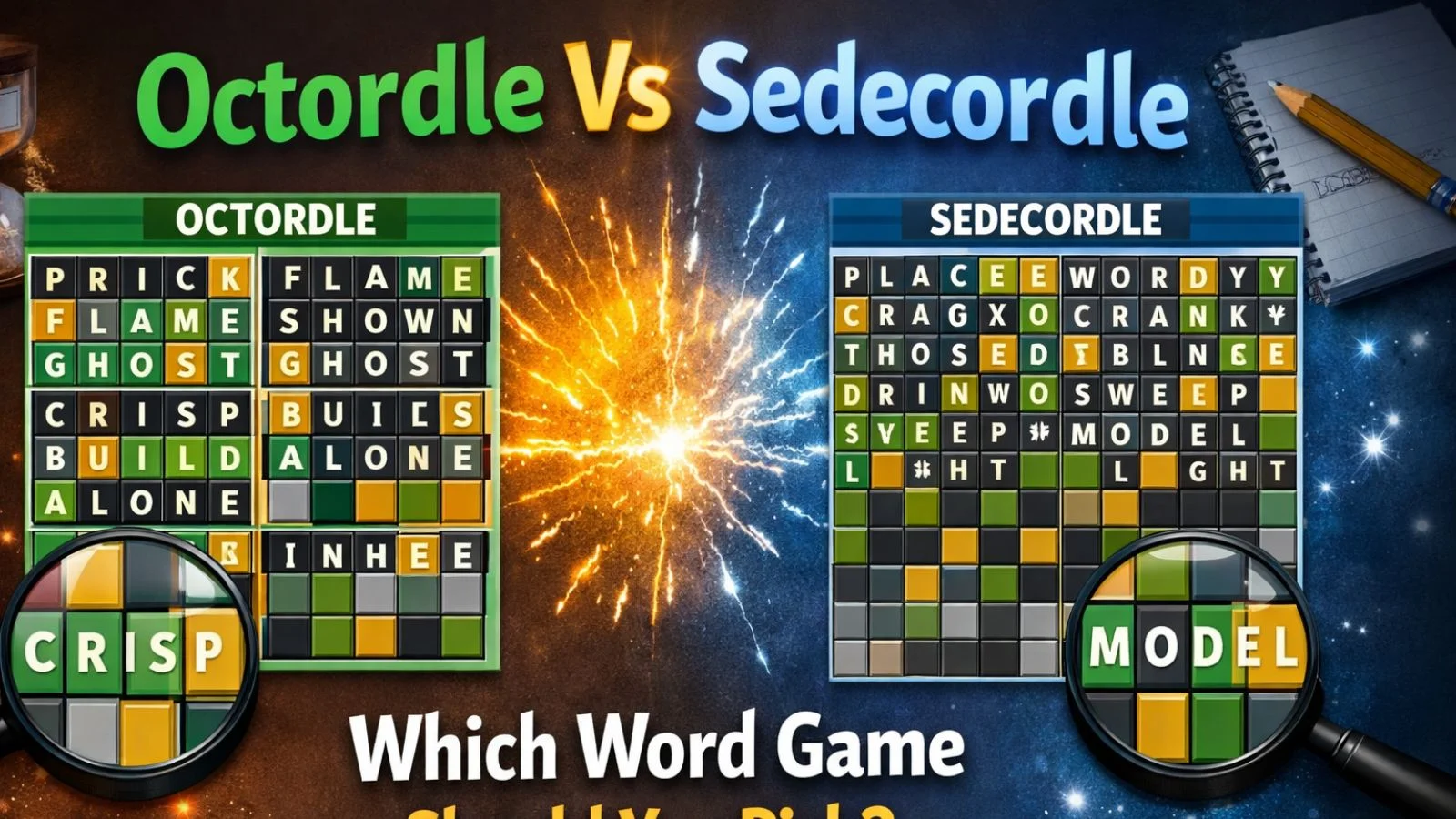
Octordle and Sedecordle belong to the same Wordle-style puzzle family, but they do not feel the same to play. Octordle asks you to solve eight words, while Sedecordle asks you to solve sixteen. On the live game pages, Octordle is presented as an eight-word game with 13 guesses, and Sedecordle as a sixteen-word game with 21 guesses.
That single change in board count affects almost everything else: screen clutter, scan speed, guess management, and how long a session feels. If you want a clearer step up from smaller multi-board games, Octordle is usually the better starting point. If you want a bigger, slower, more demanding puzzle session, Sedecordle is the stronger pick. This second point is an inference based on the live rules and layouts, not an official difficulty rating.
Quick Answer
If you want the more manageable option, start with Octordle. If you already enjoy longer puzzle marathons and heavier grid management, choose Sedecordle. Octordle gives you 8 boards and 13 guesses; Sedecordle gives you 16 boards and 21 guesses.
TL;DR
- Octordle = 8 boards, 13 guesses, easier to scan quickly.
- Sedecordle = 16 boards, 21 guesses, much heavier visual load.
- Both games use the same core idea: one guess updates every active board.
- Octordle currently has side variants such as Sequence and Rescue on Britannica-hosted pages.
- Sedecordle’s official site currently includes Sedec-order, Savior, and Practice options.
- For most players, Octordle is the better “next step”; Sedecordle is the better “bigger test.”
What Each Game Is In Plain English
Octordle is a Wordle-style game where one guess applies across eight hidden words. Britannica’s live game page says you have 13 guesses to solve all eight.
Sedecordle is the same basic idea stretched to sixteen hidden words. The official Sedecordle page says you must guess all sixteen words in 21 tries, and that each guess is entered across all sixteen boards.
So this is not just a name-choice issue. It is a format-choice issue.
Key Differences At A Glance
The biggest difference is simple: Octordle is the 8-board version; Sedecordle is the 16-board version. That doubles the number of targets you are tracking, while the guess budget rises from 13 to 21, not from 13 to 26. That is why Sedecordle often feels more demanding even though it gives you more guesses.
A practical way to think about it is this:
- Octordle feels busy, but still readable on a laptop or larger phone.
- Sedecordle feels more like a full puzzle session than a quick round.
- Octordle is easier to scan between boards.
- Sedecordle rewards players who are comfortable juggling many partial clues at once.
The last three points are reasoned judgments based on the official board counts, guess limits, and mode layouts.
How The Rules Compare
Both games share the same core mechanic: you type one valid five-letter guess, and that guess updates every active board. Sedecordle’s official page states this explicitly for all sixteen words, and Octordle’s rule pages and mirror explanations describe the same shared-guess structure for all eight boards.
That means the real strategic question is not “Do I know word games?” It is “How much information can I track at once?”
In both games, early guesses work best when they reveal broad letter coverage. But Sedecordle punishes sloppy guess management more harshly because there are simply more boards competing for your attention. That is a strategy inference drawn from the live formats, not a formal rule.
If Sedecordle feels like too big a leap, Octordle Vs Quordle offers a more gradual step up.
How The Modes Change The Choice
This comparison is no longer just 8 vs 16. The mode menus matter too.
On Britannica-hosted Octordle pages, the current ecosystem includes the main daily game plus Rescue and Sequence-related pages.
On the official Sedecordle site, the current homepage lists:
- Sedecordle (original)
- Sedec-order (“words must be solved one at a time”)
- Savior (“the first four words are chosen for you”)
- Practice options for those modes
- additional Variations with different word lengths.
That matters because your best pick may depend less on the brand name and more on the play style you enjoy:
- If you like solving boards in sequence, Sedec-order or Octordle’s Sequence-style play may suit you better.
- If you like starting from a partially helped position, Savior or Rescue may feel more forgiving.
- If you mainly want a clean daily challenge, the standard versions are the clearest comparison.
Which One Should You Pick
Choose Octordle if you want a serious puzzle that still feels manageable. With eight boards and thirteen guesses, it is demanding without becoming overwhelming for most players.
Choose Sedecordle if you enjoy high-load puzzle sessions, do not mind visual crowding, and want a longer solving arc. The official format doubles the boards to sixteen and gives you twenty-one guesses, which creates a much bigger clue-management job.
A good rule of thumb:
- Coming from Quordle or smaller variants? Pick Octordle first.
- Already comfortable with Octordle-style pressure? Move to Sedecordle.
- Mostly play on a phone during short breaks? Octordle is usually the safer choice.
- Play on desktop and enjoy puzzle marathons? Sedecordle makes more sense.
The last two recommendations are practical inferences from the live layouts and board counts.
When To Avoid Both
Skip both games if your main goal is a fast, low-pressure coffee-break puzzle. Even Octordle is still an 8-board challenge, and Sedecordle is much larger again.
You may also want to avoid both on smaller screens if you dislike crowded interfaces. In that case, a smaller multi-board game is usually the better fit.
Common Mistakes (And Quick Fixes)
Mistaking Sedecordle For “Just Octordle With More Boards”
That is only partly true. The extra boards do not just add size; they change the pace, scan pattern, and pressure level. Octordle and Sedecordle share a rules family, but they do not create the same play experience.
Choosing By Guess Count Alone
It is easy to see 21 guesses and assume Sedecordle must be easier. But Sedecordle also asks you to manage 16 words, not 8. The higher guess count does not cancel out the doubled board load.
Ignoring The Mode Menu
Octordle and Sedecordle both now offer more than one style of play. If you only compare the headline daily formats, you may miss the version that actually suits you best.
Everyday Examples (Real Contexts)
Office Break:
You have ten minutes before your next meeting. Octordle usually makes more sense because it is easier to scan and finish in a shorter session. This is a practical inference from the smaller 8-board format.
Weekend Puzzle Session:
You want a longer challenge with more moving parts. Sedecordle is the better fit because the official game is built around sixteen simultaneous targets.
Phone Play:
If you dislike crowded screens, Octordle is usually the easier recommendation. Eight boards are still busy, but sixteen are much harder to scan comfortably on a small display. This is an inference from the live layouts.
Desktop Play:
If you enjoy longer, more strategic puzzle sessions, Sedecordle can feel more rewarding because it keeps more clue threads active at once.
Example Sentences
- “I play Octordle when I want a harder puzzle without turning it into a full marathon.”
- “Sedecordle feels longer because I keep jumping between sixteen grids.”
- “If you have only played smaller Wordle-style games, Octordle is usually the smarter next step.”
- “If you want the bigger test, Sedecordle is the one to try.”
Mini Quiz
Pick the better choice.
- You want the more manageable step up from smaller multi-board games.
- You want the biggest standard board load of the two.
- You mostly play on a phone during short breaks.
- You want a longer puzzle session on a desktop.
- You want the game with sixteen boards.
Answer Key
- Octordle
- Sedecordle
- Octordle
- Sedecordle
- Sedecordle
FAQs
Is Octordle easier than Sedecordle?
Usually, yes. Octordle has 8 boards and 13 guesses, while Sedecordle has 16 boards and 21 guesses. Because Sedecordle doubles the number of active boards, it usually feels harder to scan and manage. The difficulty judgment is an inference from the live formats rather than an official ranking.
Does Sedecordle give more guesses?
Yes. Sedecordle’s official page gives you 21 guesses to solve all 16 words. Octordle’s live Britannica page gives 13 guesses for 8 words.
Do both games use one guess across every board?
Yes. That shared-guess mechanic is one of the main reasons people group these games together. Sedecordle states it directly on its homepage, and Octordle uses the same parallel-board structure.
Which one is better for beginners?
For most players, Octordle is the better starting point. It is still hard, but it is more manageable than a sixteen-board puzzle. That recommendation follows from the smaller official format.
Are Octordle and Sedecordle just different names for the same game?
No. They belong to the same Wordle-style family, but they are different games with different board counts, guess limits, and current side modes.
Do both games have extra modes beyond the main daily puzzle?
Yes. Current Octordle pages include Sequence and Rescue-related pages, while Sedecordle’s official site currently lists Sedec-order, Savior, and Practice options.
Conclusion
Octordle and Sedecordle are close relatives, but they serve different players.
For most people, Octordle is the stronger pick because it balances challenge and control. Sedecordle is the better choice when you want a true puzzle marathon and do not mind heavier visual load.
If you want the cleaner next step, choose Octordle. If you want the bigger test, choose Sedecordle.
Read More Related Article
- To make this comparison easier to follow, start with Octordle Meaning
- Sedecordle Meaning: What It Is, Rules, And How To Use It
- If Sedecordle feels like too big a leap, Octordle Vs Quordle offers a more gradual step up.
- Players looking for a more manageable challenge may also prefer Octordle Vs Dordle.

1 thought on “Octordle Vs Sedecordle: Which Word Game Should You Pick?”
Comments are closed.