
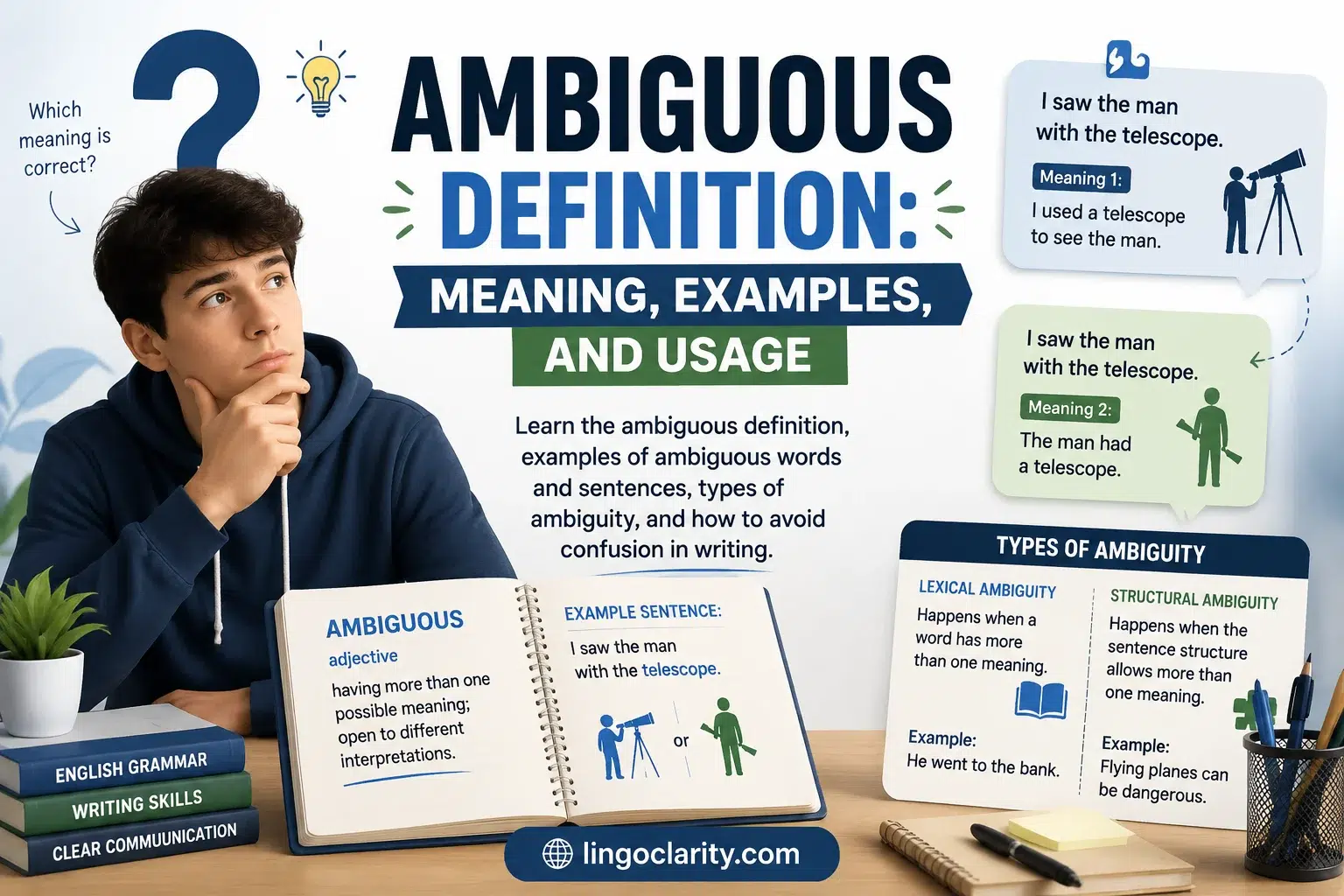
Student examining a sentence that can be interpreted in two different ways.

Ambiguous Definition: Meaning, Examples, And Clear Explanation

Language helps people communicate ideas, instructions, emotions, and information. However, sometimes a sentence that appears clear at first can actually have more than one possible meaning. As a result, readers or listeners may interpret the message differently.

This situation is called ambiguity. Ambiguous language appears in everyday conversations, school assignments, online messages, advertisements, and even professional documents. Because English contains many words with multiple meanings and flexible sentence structures, ambiguity can occur easily.

For example, a sentence might contain a word with several definitions. Alternatively, the structure of the sentence might allow more than one interpretation. Therefore, without enough context, readers may misunderstand the intended message.

Learning about ambiguous language helps both writers and readers. For instance, writers can produce clearer sentences, while readers can recognize when language might have multiple interpretations. Consequently, communication becomes more effective.

In this guide, you will learn the ambiguous definition, how ambiguity works, common examples, types of ambiguity, and practical strategies for avoiding confusion in writing.


Quick Answer

The ambiguous definition refers to language—such as a word, phrase, or sentence—that has more than one possible meaning. Therefore, because multiple interpretations exist, the exact meaning usually depends on context.


TL;DR

  • First, ambiguous language has more than one possible meaning.
  • As a result, words or sentences may lead to different interpretations.
  • Usually, context clarifies the intended meaning.
  • In addition, ambiguity appears in both speech and writing.
  • Therefore, clear wording helps prevent misunderstandings.

Ambiguous Definition In Plain English

An ambiguous word or sentence allows readers to understand it in more than one way. In other words, ambiguity occurs when the meaning is unclear because several interpretations are possible.

Importantly, this does not necessarily mean the sentence is incorrect. Instead, it means the wording allows different meanings.

Consider the following examples:

  • “The chicken is ready to eat.”
  • “I saw the man with the telescope.”
  • “Visiting relatives can be annoying.”

At first glance, these sentences appear simple. However, each one can be interpreted in two ways.

For instance, the sentence “The chicken is ready to eat” may mean:

  • The chicken has been cooked and is ready for someone to eat.
  • Alternatively, the chicken itself wants food and is ready to eat something.

Because both meanings are grammatically possible, the sentence becomes ambiguous.


Why Words And Sentences Become Ambiguous

Ambiguity usually occurs when language lacks enough context or clarity. Consequently, readers may struggle to determine the intended meaning.

Several factors commonly cause ambiguity.

For example, ambiguity may occur when:

  • A word has multiple meanings
  • The sentence structure is unclear
  • Punctuation is missing or misplaced
  • Modifiers are placed incorrectly
  • Context is limited or incomplete

Consider the sentence:

“I watched her duck.”

At first, the meaning may seem obvious. However, the sentence actually has two interpretations.

It could mean:

  • She suddenly lowered her head to avoid something.
  • Alternatively, she owns a duck, and the speaker watched the animal.

Therefore, without additional context, both meanings remain possible. As a result, the sentence becomes ambiguous.


Ambiguous Definition In Plain English

An ambiguous word or sentence allows readers to understand it in more than one way. In other words, ambiguity occurs when the meaning is unclear because several interpretations are possible.

Importantly, this does not necessarily mean the sentence is incorrect. Instead, it means the wording allows different meanings.

Consider these examples:

  • “The chicken is ready to eat.”
  • “I saw the man with the telescope.”
  • “Visiting relatives can be annoying.”

Each sentence can be interpreted in two ways.

For instance, the sentence “The chicken is ready to eat” may mean:

  • The chicken has been cooked and is ready for someone to eat.
  • Alternatively, the chicken itself wants food and is ready to eat something.

Because both meanings are grammatically possible, the sentence is ambiguous.


Why Words And Sentences Become Ambiguous

Ambiguity usually occurs when language lacks enough context or clarity. As a result, readers may struggle to determine the intended meaning.

Common causes include:

  • Words that have multiple meanings
  • Unclear sentence structure
  • Missing punctuation
  • Poor modifier placement
  • Lack of surrounding context

Consider the sentence:

“I watched her duck.”

This sentence can mean:

  • She suddenly lowered her head to avoid something.
  • Alternatively, she owns a duck, and the speaker watched the animal.

Therefore, without context, both interpretations are valid.


Simple Examples Of Ambiguous Words

Many English words naturally have more than one meaning. Consequently, these words can create ambiguity if the surrounding context does not clarify which meaning is intended.

Some common examples include:

Bank

  • A financial institution
  • The side of a river

Example:
“She sat near the bank.”

Bat

  • A flying mammal
  • A piece of sports equipment used in baseball

Example:
“He picked up the bat.”

Light

  • Not heavy
  • Illumination from a lamp or the sun

Example:
“Turn on the light.”

In each case, the surrounding context determines which meaning is correct.


Ambiguous Sentence Examples Explained

Sometimes the ambiguity comes from the structure of the sentence, not just the meaning of individual words.

For example:

“I saw the man with the telescope.”

Two interpretations exist:

  • The speaker used a telescope to see the man.
  • The man had a telescope.

Another example:

“Kids make nutritious snacks.”

This sentence can mean:

  • Children prepare healthy snacks.
  • Children themselves are nutritious snacks.

Although the second interpretation is clearly unintended, the wording technically allows it.

A clearer version might be:

“Kids prepare nutritious snacks after school.”

Therefore, adding context removes the ambiguity.


The Two Main Types Of Ambiguity

Linguists generally divide ambiguity into two major categories.

Lexical Ambiguity

Lexical ambiguity occurs when a single word has multiple meanings.

Examples:

“The bark was loud.”
“She left the club early.”

Possible interpretations:

  • Bark may refer to the sound of a dog or the outer layer of a tree.
  • Club may refer to a social organization, a nightclub, or sports equipment.

Usually, surrounding context clarifies the intended meaning.


Structural Ambiguity

Structural ambiguity happens when the arrangement of words in a sentence allows multiple interpretations.

Example:

“Flying planes can be dangerous.”

This sentence may mean:

  • Piloting airplanes can be dangerous.
  • Airplanes that are flying can be dangerous.

A clearer sentence would be:

“Piloting airplanes can be dangerous.”

Thus, changing the structure eliminates confusion.


Ambiguous Vs Vague Language

Although the terms are sometimes confused, ambiguous and vague language are different.

Ambiguous language has multiple possible meanings.

Example:
“Alex saw the girl with the binoculars.”

Two interpretations exist.

Vague language, on the other hand, lacks enough information to be precise.

Example:
“Alex saw something interesting.”

Here, the meaning is unclear because important details are missing.


Why Ambiguity Matters In Writing And Communication

Ambiguous language can create confusion, misunderstandings, and incorrect interpretations. While ambiguity might be harmless in casual conversations, it can cause serious problems in professional contexts.

Ambiguity can affect:

  • Legal documents
  • Contracts
  • Instructions
  • News headlines
  • Academic writing

For example, unclear instructions may cause someone to perform the wrong task. Similarly, ambiguous wording in legal writing may lead to disputes about interpretation.

Because of this, professional writers often revise sentences carefully to remove ambiguity.


How To Avoid Ambiguity In Writing

Writers can reduce ambiguity by improving clarity and structure.

Helpful strategies include:

  • Place modifiers next to the words they describe
  • Use precise vocabulary instead of general terms
  • Add context when necessary
  • Break long sentences into shorter ones
  • Review sentences for possible double meanings

Example:

Ambiguous sentence:
“Students who study rarely fail.”

Possible meanings:

  • Students who study seldom fail exams.
  • Students rarely study and therefore fail.

Clear version:

“Students who study regularly pass their exams.”

This revision makes the intended meaning obvious.


Related Words And Alternatives

Several related terms often appear when discussing ambiguous language.

These include:

  • unclear — difficult to understand
  • vague — lacking specific detail
  • confusing — difficult to interpret
  • uncertain — not definite
  • double meaning — two possible interpretations
  • misleading — likely to cause misunderstanding
  • obscure — difficult to understand
  • indefinite — not clearly defined

Understanding these terms helps readers discuss writing clarity more effectively.


Ambiguous Language In Everyday Situations

Ambiguity is common in daily communication.

For example, someone might say:

“I’m going to meet her brother.”

This statement raises questions such as:

  • Which brother?
  • When will the meeting occur?

Text messages can also be ambiguous.

Example:

“I’ll call you later.”

The word later might mean:

  • In an hour
  • This evening
  • Tomorrow

Therefore, adding more details often improves communication.


Quick Comparison Table For Word Choice

ContextBest ChoiceWhy
Writing instructionsPrecise wordingPrevents confusion
Legal documentsClear definitionsAvoids misinterpretation
Casual conversationContext cluesHelps listeners understand
Academic writingSpecific languageImproves clarity

Mini Quiz: Can You Spot The Ambiguity?

1. Identify the ambiguity in this sentence:
“I saw her duck.”

2. Consider the meaning of the following sentence:
“The chicken is ready to eat.”

3. Examine this example of ambiguous wording:
“Visiting relatives can be annoying.”

4. Look at the sentence below and find the ambiguity:
“Old men and women sat quietly.”


Answer Key

  • Could mean she lowered her head or the speaker saw her pet duck.
  • Could refer to cooked chicken or a hungry chicken.
  • Could refer to visiting relatives or relatives who visit.
  • Could refer to elderly men and women together or only elderly men with women of any age.

FAQs About Ambiguous Meaning

What does ambiguous mean in simple terms?

Ambiguous means something has more than one possible meaning. Therefore, the exact interpretation depends on context.

What is an example of ambiguous language?

“I saw the man with the telescope.”
This sentence may mean the speaker used a telescope or the man had one.

What causes ambiguous sentences?

Ambiguity often occurs because of unclear word placement, missing context, or words that have multiple meanings.

What are the types of ambiguity?

The two main types are lexical ambiguity and structural ambiguity.

Is ambiguity always a problem?

Not always. In fact, writers sometimes use ambiguity intentionally in humor, poetry, literature, or wordplay.

How do you fix ambiguous sentences?

Writers can remove ambiguity by adding context, changing word order, clarifying modifiers, or rewriting the sentence more precisely.


Conclusion

The ambiguous definition refers to language that allows more than one possible interpretation. Because English contains many words with multiple meanings and flexible sentence structures, ambiguity appears naturally in both speech and writing.

However, clear communication depends on precise wording and careful sentence structure. Therefore, by recognizing ambiguous language and revising sentences when necessary, writers can express their ideas more clearly and help readers understand the intended meaning.ly and help readers understand the intended meaning.

About the author
Owen Parker
Owen Parker is a language writer and editor at Lingoclarity, where he covers English meanings, grammar, spelling differences, word choice, and modern usage in clear, reader-friendly US English. He specializes in turning confusing, sensitive, or commonly misused terms into practical explanations that readers can understand quickly and use with confidence. His work focuses on clarity, accuracy, context, respectful wording, and real-world usefulness so each guide answers the main question directly and helps readers make better language choices.