
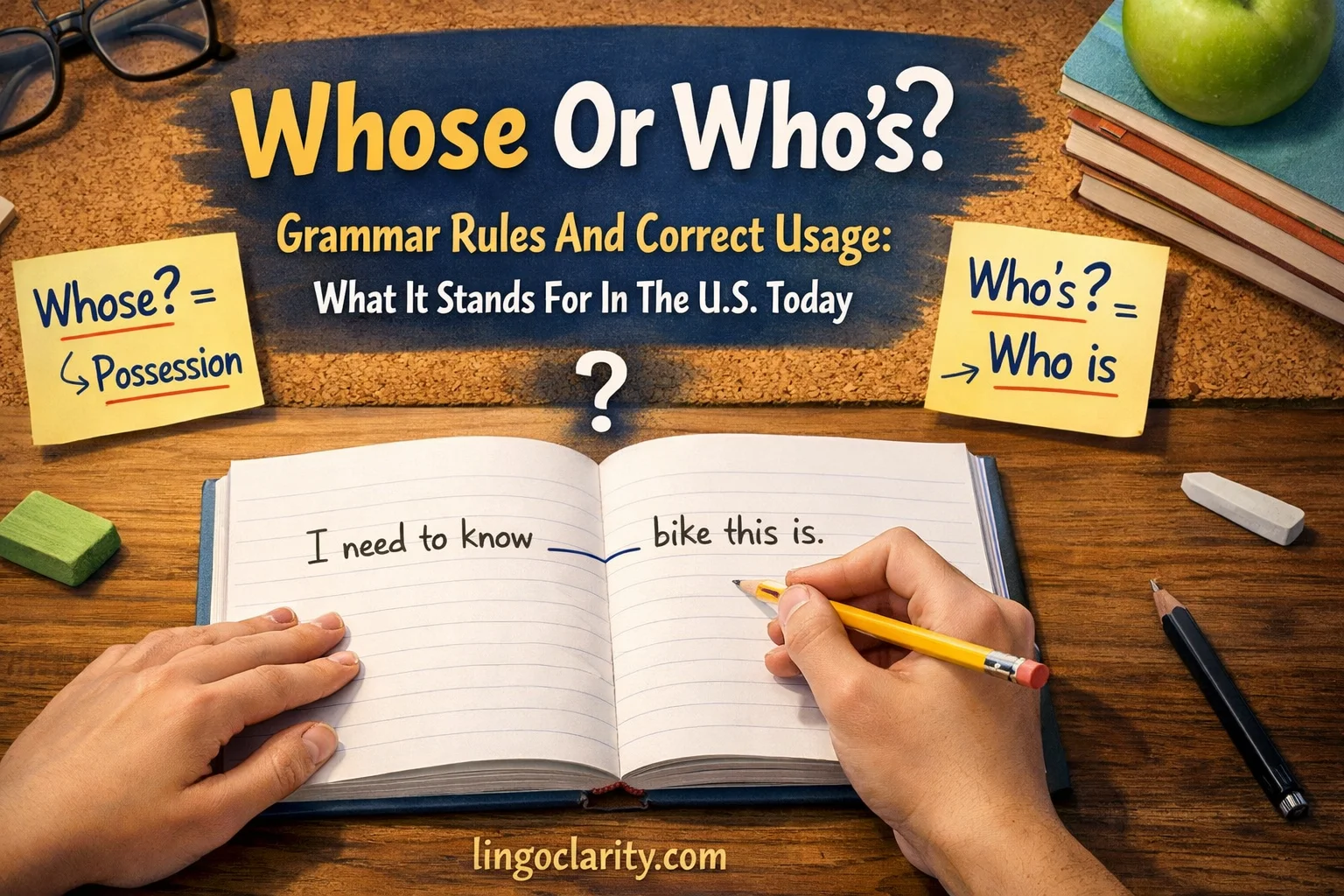
Many writers confuse whose vs who’s because the two words sound exactly the same when spoken. However, they have completely different meanings and grammatical functions.
The simple rule is:
Whose shows possession or belonging.
Who’s is a contraction of who is or who has.
Once you understand this difference, choosing the correct word becomes much easier.
Quick Answer
Use whose when you are asking or showing who owns something.
Use who’s when you can replace it with who is or who has.
Examples:
- Whose phone is on the table?
- Who’s coming to the event?
Although they sound identical, they cannot be used interchangeably.
Whose Vs Who’s Comparison Table
| Word | Meaning | Grammar Use | Example |
|---|---|---|---|
| Whose | Belonging to whom | Shows possession | Whose jacket is this? |
| Who’s | Who is / Who has | Contraction | Who’s calling you? |
What Does Whose Mean?
Whose is the possessive form of who. It is used when asking about ownership, relationships, or connection.
It answers the question:
“Who does this belong to?”
Examples:
- Whose keys are these?
- Whose car is parked outside?
- I met the writer whose book became famous.
In each example, whose connects something with the person who owns or relates to it.
What Does Who’s Mean?
Who’s is a contraction. The apostrophe shows that letters have been removed.
It can mean:
- Who is
- Who has
Examples:
- Who’s at the door?
- Who is at the door?
- Who’s finished the assignment?
- Who has finished the assignment?
If you can replace the word with who is or who has, then who’s is correct.
When To Use Whose
Use whose when the sentence involves ownership.
Examples:
- Whose backpack is this?
- Do you know whose dog is barking?
- She is the teacher whose advice helped me.
Whose Can Refer To Things Too
Some writers think whose only applies to people, but modern English also uses it with things and organizations.
Examples:
- This is the company whose products changed the industry.
- I found the phone whose battery was damaged.
This usage is widely accepted in English.
When To Use Who’s
Use who’s when the meaning is who is or who has.
Examples:
- Who’s joining us for dinner?
- Who’s responsible for this project?
- The student who’s leading the team won an award.
Quick test:
Replace who’s with who is.
If the sentence still works, the contraction is correct.
Common Mistakes With Whose And Who’s
Incorrect:
Who’s book is this?
Correct:
Whose book is this?
Why?
The sentence asks about ownership, so it needs whose.
Incorrect:
Whose coming to the party?
Correct:
Who’s coming to the party?
Why?
The sentence means:
Who is coming to the party?
Why Does Who’s Have An Apostrophe?
The apostrophe in who’s does not show ownership.
Instead, it shows that the word is shortened.
Examples:
- who is → who’s
- who has → who’s
This is different from nouns where apostrophes often show possession:
- Sarah’s book
- The dog’s toy
Easy Trick To Remember Whose Vs Who’s
Use this simple rule:
Who’s = Who Is / Who Has
Whose = Ownership
Examples:
Who’s calling?
→ Who is calling? ✅
Whose phone is ringing?
→ Ownership ✅
Whose Vs Who’s Vs Who
These words are related but serve different purposes.
| Word | Use | Example |
|---|---|---|
| Who | Refers to a person | Who called you? |
| Whose | Shows ownership | Whose bag is this? |
| Who’s | Short for who is/has | Who’s coming? |
Examples In Everyday English
Workplace Examples
- The team asked whose presentation was scheduled next.
- Everyone wanted to know who’s leading the meeting.
School Examples
- The teacher searched for the student whose homework was missing.
- The class waited to see who’s answering the question.
Home And Daily Life Examples
- Nobody knew whose shoes were left near the door.
- The family discussed who’s making dinner tonight.
Frequently Asked Questions
Is whose the same as who’s?
No. Whose shows possession, while who’s means who is or who has. They sound the same but have different grammatical purposes.
Can whose be used for objects?
Yes. English commonly uses whose with objects, companies, and ideas.
Example:
The house whose roof was damaged needs repairs.
Why do people confuse whose and who’s?
People confuse them because they are homophones, meaning they have the same pronunciation but different meanings.
How can I quickly tell if I need whose or who’s?
Try replacing the word with who is or who has.
If the sentence works, use who’s. Otherwise, use whose.
Is who’s formal English?
Yes. Who’s is standard English, although some formal writing may choose the full forms who is or who has.
Which is correct: whose name or who’s name?
The correct form is whose name because it shows possession.
Example:
I met the author whose name you mentioned..
Conclusion
The difference between these two commonly confused words comes down to one simple rule.
If you are talking about ownership, choose whose. If you can expand the word into who is or who has, choose who’s. Once you learn this small rule, you can avoid one of the most common English grammar mistakes.
FAQs
What is the difference between whose and who’s?
The possessive form shows ownership, while the contraction represents who is or who has.
Is “who’s name” correct?
No. The correct phrase is whose name because the sentence refers to ownership.
Can whose refer to things as well as people?
Yes. In modern English, the possessive form can refer to objects or animals, particularly in relative clauses.
Example:
The house whose roof collapsed was recently renovated.
How can I remember the difference easily?
Use the “who is” test. If replacing the word with who is makes sense, use the contraction. Otherwise, use the possessive form.
Is who’s formal or informal?
The contraction is common in everyday writing and conversation. However, extremely formal writing sometimes prefers who is instead.
