
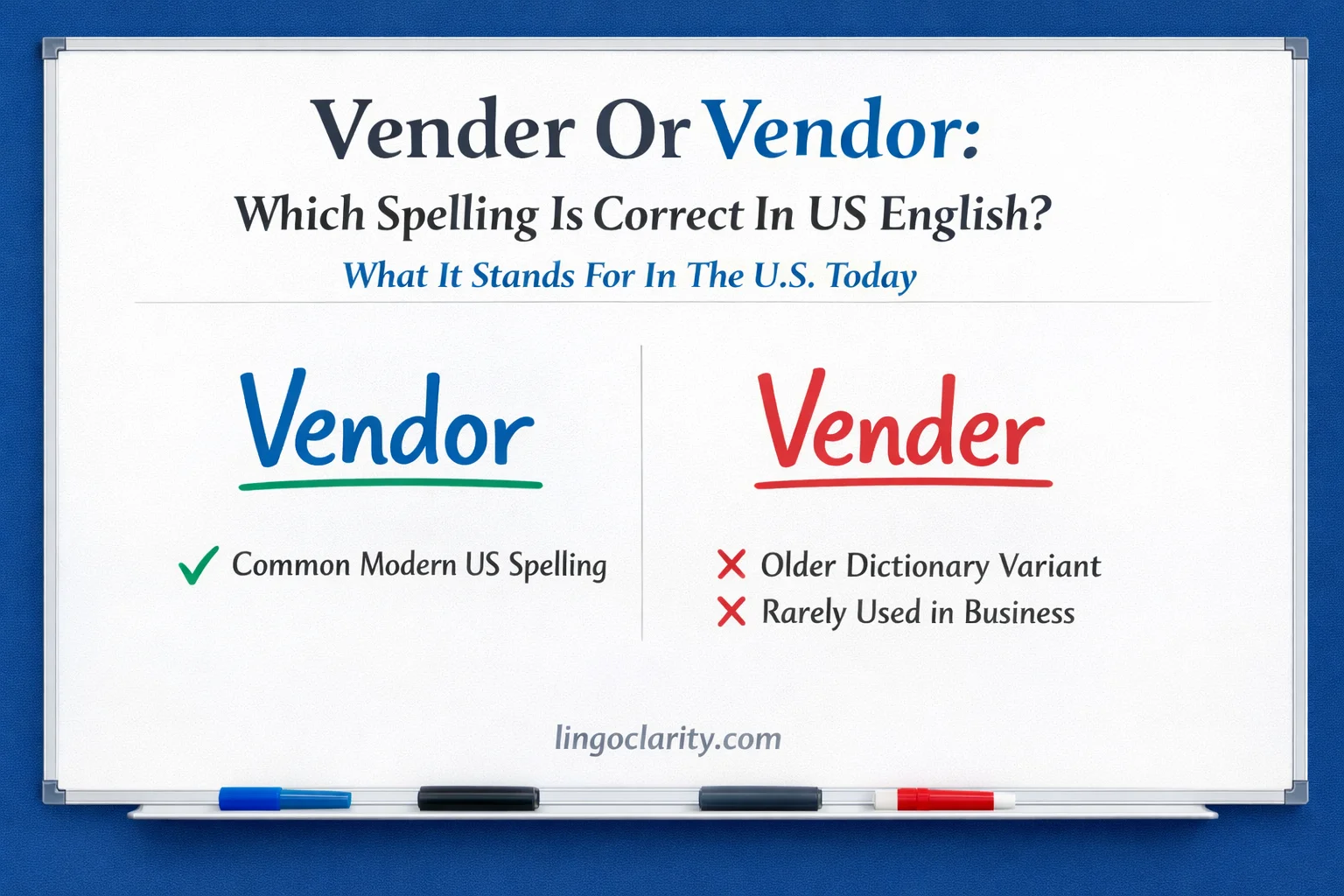
Many writers stop when they see vender and vendor side by side. Both forms relate to the idea of selling, so at first they can seem equally correct. However, in modern American English, they do not carry the same level of acceptance.
If you are writing for a US audience, the safer and more natural choice is almost always vendor. Major dictionaries treat vender as a variant, while vendor is the main modern entry and the form most readers expect.
Quick Answer
Use vendor in US English.
Vender exists, and some dictionaries record it as a variant spelling, but it is much less common and often looks unusual in modern writing. For business, academic, legal, and everyday US usage, vendor is the standard choice.
Why People Confuse Vender And Vendor
The confusion is understandable. Both spellings come from the same word family built around vend, which means “to sell.” Because English often forms nouns with endings like -er and -or, both words can look plausible.
That said, plausible does not always mean standard. In current usage, vendor is the spelling most dictionaries foreground, and it is the version readers are far more likely to recognize immediately.
Key Difference At A Glance
| Context | Best Choice | Why |
|---|---|---|
| Business writing | vendor | Standard modern spelling |
| Contracts and procurement | vendor | Most familiar professional form |
| Website copy | vendor | Looks natural to readers |
| School or formal writing | vendor | Preferred default |
| Rare dictionary variant note | vender | Accepted as a variant, but uncommon |
Are Vender And Vendor The Same Word?
Yes. In meaning, they refer to the same basic idea: a person or company that sells something.
The difference is not about meaning. It is about spelling preference and frequency. American Heritage defines vender as a variant of vendor, and Merriam-Webster lists vender as the less common form under vendor.
Pronunciation does not help much here either. These words are pronounced the same in standard English, so the spelling choice comes down to convention, not sound.
Is This A US Vs UK Difference?
Not really.
This is not a strong American-versus-British spelling split like color/colour or organize/organise. The clearer point is that vendor is the standard modern form, while vender is usually treated as a variant rather than the default spelling. Oxford lists vendor as the headword, and major American dictionaries do the same.
So whether you are writing for US readers or a broader English-speaking audience, vendor is usually the best choice.
Which Spelling Should You Use?
Use vendor in almost every situation.
Choose it for:
- business documents
- contracts
- procurement language
- email communication
- website copy
- product pages
- school assignments
- general professional writing
This spelling is clearer, more familiar, and more credible for modern readers. Since dictionaries consistently present vendor as the main form and vender as the variant, vendor is the strongest default.
Why Vender Often Looks Wrong
In modern US English, vender often looks like a misspelling even though it has dictionary support. That reaction happens because readers encounter vendor far more often in business, legal, retail, and everyday contexts.
So the problem with vender is not that it is impossible. The problem is that it can distract readers and weaken polish. If your goal is clarity, vendor is the better choice.
Common Mistakes And Quick Fixes
A common mistake is assuming that vender and vendor have different meanings. They do not. The difference is mainly one of standard usage, not definition.
Another mistake is choosing vender because it seems more closely tied to the verb vend. While that may look logical, it is not the form most readers expect. In polished modern writing, switching to vendor is usually the right edit.
| Feature | vender | vendor |
|---|---|---|
| Meaning | Same basic meaning | Same basic meaning |
| Dictionary treatment | Variant form | Main standard form |
| Modern US preference | Rare | Strongly preferred |
| Reader reaction | May look unusual | Looks normal |
| Best default | Usually avoid | Use this form |
Examples In Everyday US English
Here are examples that sound natural in modern American writing:
- Our company signed a contract with a new software vendor.
- The city approved permits for several food vendors.
- Please send the invoice to the listed vendor.
- She compared three wedding vendors before making a decision.
- Each vendor must follow the event’s safety rules.
You may occasionally see a sentence like this in older or less common usage:
- The vender of the property accepted the offer.
That sentence is understandable, but most US editors would still change vender to vendor for a modern audience. Merriam-Webster and American Heritage both support the idea that vender is a variant rather than the primary form.
Dictionary Notes That Matter
Vendor
Vendor is the standard noun. Merriam-Webster defines it as “one that vends” or “seller,” and also notes a secondary meaning related to a vending machine. Oxford also lists vendor as the main entry.
Vender
Vender is recorded in some dictionaries, but usually as a variant spelling of vendor rather than the preferred modern form. American Heritage states this directly, and Collins also labels it as a variant or alternative spelling.
Verb Form
The verb is vend, not vendor or vender. So if you need the action word, write:
- The company vends medical equipment.
- Street sellers vend snacks near the stadium.
Synonyms And Related Words
Depending on context, close alternatives include:
- seller
- supplier
- merchant
- dealer
- retailer
These are not always perfect substitutes, but they may work depending on your sentence. Merriam-Webster’s thesaurus lists seller among the closest synonyms for vendor.
Common Phrases With Vendor
In modern US English, vendor appears naturally in phrases such as:
- software vendor
- street vendor
- vendor agreement
- vendor list
- vendor management
- approved vendor
These combinations are common because vendor is the standard spelling in both general and professional use. Legal and business dictionaries also use vendor as the headword.
Word History
Both spellings have historical roots, but vendor became the standard modern form. Merriam-Webster traces vendor to 1594 and connects it to Anglo-French forms related to selling. Collins also records vender historically, but as an alternative spelling rather than the dominant modern form.
The practical takeaway is simple: both forms exist, but vendor is the spelling modern readers expect.
Conclusion
If you are writing in US English, choose vendor.
It is the standard modern spelling, the one dictionaries prioritize, and the one that looks right in professional and everyday writing. Vender is not a different word in meaning, but it is uncommon enough that many readers will treat it as an error or an outdated variant. For clarity, credibility, and natural US usage, vendor is the correct choice.
FAQs
Is vender ever correct?
Yes. Vender is recognized by some dictionaries as a variant spelling of vendor. However, it is much less common in modern US English, so vendor is the better default.
Which spelling should I use in business writing?
Use vendor. It is the standard spelling in contracts, procurement, software, retail, and general professional communication.
Do vender and vendor mean different things?
No. They mean the same thing. The difference is mainly that vendor is standard, while vender is a rare variant.
Is vender more British than vendor?
Not in any strong or useful way. This is not a major US-versus-UK spelling split. Vendor is the standard modern form across major dictionary references.
What is the verb form of vendor?
The verb is vend. Neither vendor nor vender is the normal verb form in standard English.
Why does vender look like a mistake?
Because most readers are used to seeing vendor. Even though vender appears in some dictionaries, it is uncommon enough that it often looks incorrect in modern writing.
