
Many writers pause when choosing between fourth and forth. At first glance, the confusion is understandable because the two words sound the same in spoken English. However, on the page, they have very different meanings and uses.
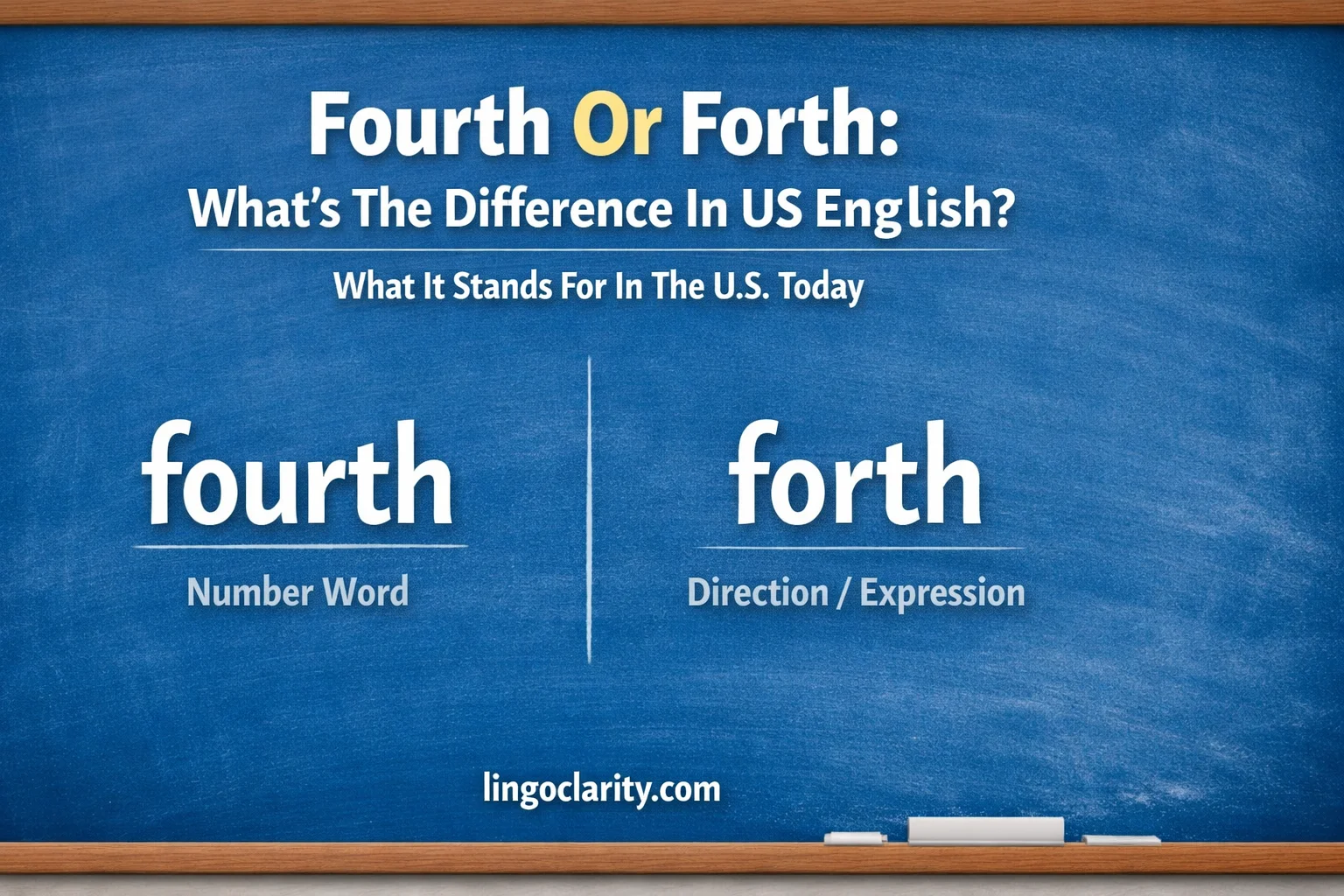
In general, fourth is the word you use for a number in order, a date, or one of four equal parts. By contrast, forth is the word you use when you mean forward or outward, or when it appears in established expressions such as bring forth, set forth, and and so forth.
Quick Answer
Use fourth when you are referring to:
- the ordinal form of four
- a position in a sequence
- a date such as July Fourth
- one of four equal parts
Use forth when you mean:
- forward
- outward
- into view
- part of a fixed phrase such as go forth, bring forth, or and so forth
Fourth Vs. Forth At A Glance
| Context | Correct Word | Why |
|---|---|---|
| A position in order | fourth | It means number four in a sequence. |
| A date | fourth | It is the ordinal form of 4. |
| One of four equal parts | fourth | It refers to a quarter. |
| Movement forward or outward | forth | It means forward, onward, or out. |
| A fixed phrase like “and so ___” | forth | This is the standard expression. |
Why People Mix Up Fourth And Forth
These words are often confused because they are homophones, which means they sound alike but have different meanings and spellings.
They also look nearly identical. In fast writing, it is easy to drop or misplace the u in fourth. That single letter matters because fourth is tied directly to the number four, while forth is not connected to numbers at all.
A useful visual reminder is this:
fourth = four + th
forth = forward-type meaning
What Fourth Means
Fourth is the ordinal form of four. It tells you where something falls in a sequence.
You use fourth for:
- rank or position
- dates
- chapter or section numbers
- one quarter of something
Examples:
- She finished in fourth place.
- Today is the fourth of July.
- He read the fourth chapter first.
- About one-fourth of the staff was out sick.
In modern US English, fourth is common in everyday, academic, professional, and formal writing.
What Forth Means
Forth usually means forward, out, onward, or into view. It is most often used in established expressions rather than as a standalone everyday word.
Examples:
- The speaker stepped forth to answer questions.
- The tree put forth new leaves in spring.
- The report sets forth the company’s goals.
- She brought forth a strong argument.
- We discussed pricing, deadlines, staffing, and so forth.
In current US English, forth is standard, but it often sounds more formal, literary, or traditional when used by itself.
The Main Difference In Meaning
The difference is straightforward:
- Fourth relates to number, order, date, or fraction
- Forth relates to movement, appearance, or fixed expressions
That means the right choice depends on the job the word is doing in your sentence.
Compare these examples:
- He came in fourth.
- He stepped forth.
- The fourth page is missing.
- New evidence came forth.
- July Fourth is a holiday in the United States.
- The company set forth its policy in writing.
Which Word Should You Use?
A quick test can help.
Use fourth if your sentence is about:
- which number something is in order
- a date
- a fraction or quarter
Use forth if your sentence means:
- forward
- outward
- into view
- part of a familiar phrase
Here is an easy shortcut:
If you could replace the word with 4th, use fourth.
If you could replace it with forward or it belongs to a set phrase, use forth.
Common Mistakes And How To Fix Them
Writers most often make two kinds of errors: using forth where a number is needed, or using fourth where movement or a fixed phrase is intended.
Mistake 1: Using Forth For Rank Or Dates
Wrong: She finished in forth place.
Right: She finished in fourth place.
Wrong: The parade is on July Forth.
Right: The parade is on July Fourth.
Why it is wrong: rank and dates require the number word, not the directional word.
Mistake 2: Using Fourth In Directional Expressions
Wrong: Go fourth and do your best.
Right: Go forth and do your best.
Wrong: The report brings fourth several new ideas.
Right: The report brings forth several new ideas.
Why it is wrong: these expressions involve forward or outward meaning, so forth is the standard choice.
A Simple Memory Trick
The easiest way to remember the difference is this:
- Fourth contains four
- Forth does not
So if your sentence connects to the number 4, use fourth.
Everyday Example Sentences
Here are clear examples of each word in natural US English.
Examples With Fourth
- This is my fourth visit to Boston.
- She came in fourth in the state competition.
- The meeting is scheduled for the fourth of May.
- A fourth of the pizza was left.
Examples With Forth
- Please step forth when your name is called.
- The author sets forth her main argument in the opening chapter.
- The garden put forth bright green shoots.
- They talked about budget cuts, hiring, deadlines, and so forth.
Tone, Context, And Formality
Fourth is neutral and common everywhere. You can use it in casual writing, business documents, school assignments, journalism, and formal prose without any problem.
Forth is also correct standard English, but its tone depends on the sentence. In everyday conversation, it appears most naturally in common phrases like:
- and so forth
- back and forth
- set forth
- put forth
- bring forth
- go forth
Outside those expressions, it can sound more literary or formal.
Grammar And Word Class
Understanding the grammatical role of each word can make the distinction even clearer.
Fourth As An Adjective Or Noun
Fourth commonly works as:
- an adjective: the fourth chapter
- a noun: he finished a close fourth
- a fractional noun in some contexts: one fourth of the total
Forth As An Adverb
Forth is mainly an adverb. It describes movement or emergence:
- come forth
- step forth
- move forth
In modern US English, forth is mainly used as an adverb. Noun use is uncommon, and it does not usually function as a standalone verb, though it appears in established verb phrases such as bring forth and set forth.
Common Phrases With Fourth
Some frequent examples include:
- Fourth of July
- fourth place
- fourth grade
- the fourth quarter
- the fourth chapter
Common Phrases With Forth
Some standard expressions include:
- go forth
- bring forth
- put forth
- set forth
- come forth
- and so forth
- back and forth
These fixed phrases are one reason forth still appears regularly in modern writing.
Fourth Or Forth In Dates
This is a common trouble spot, so it deserves special attention.
For dates, use fourth, not forth.
Correct:
- July Fourth
- the fourth of November
- her birthday is on the fourth
Incorrect:
- July Forth
- the forth of November
That is because dates use ordinal numbers, and fourth is the ordinal form of four.
Fourth Or Forth In Fractions
Use fourth when you mean one of four equal parts.
Examples:
- One-fourth of the land was sold.
- She drank a fourth of the bottle.
- A fourth of the class missed the quiz.
You would not use forth in this sense.
Word History In Brief
Fourth comes from the number four and has long been the standard ordinal form in English.
Forth is an older directional word meaning forward or outward. In modern English, it survives strongly in established expressions and more formal or literary phrasing.
This background helps explain why the two words sound alike but do completely different jobs.
Conclusion
The difference between fourth and forth is simple once you tie each word to its meaning.
Use fourth for numbers, order, dates, and fractions.
Use forth for forward or outward meaning and in fixed expressions such as bring forth, set forth, and and so forth.
When in doubt, check the sentence’s purpose. If it relates to the number 4, choose fourth. If it suggests movement or belongs to a standard phrase, choose forth.
FAQs
Is fourth or forth correct for dates?
Use fourth for dates. For example, write July Fourth or the fourth of June.
Is “and so fourth” correct?
No. The correct phrase is and so forth.
What is the main difference between fourth and forth?
Fourth is a number word. Forth means forward, outward, or appears in set expressions.
Is “go fourth” ever correct?
Not when you mean forward. The correct expression is go forth. Go fourth would only make sense in a very unusual context involving the number four.
How can I remember the difference quickly?
Remember that fourth contains the word four. That is your clue that it relates to number, order, dates, or fractions.
