
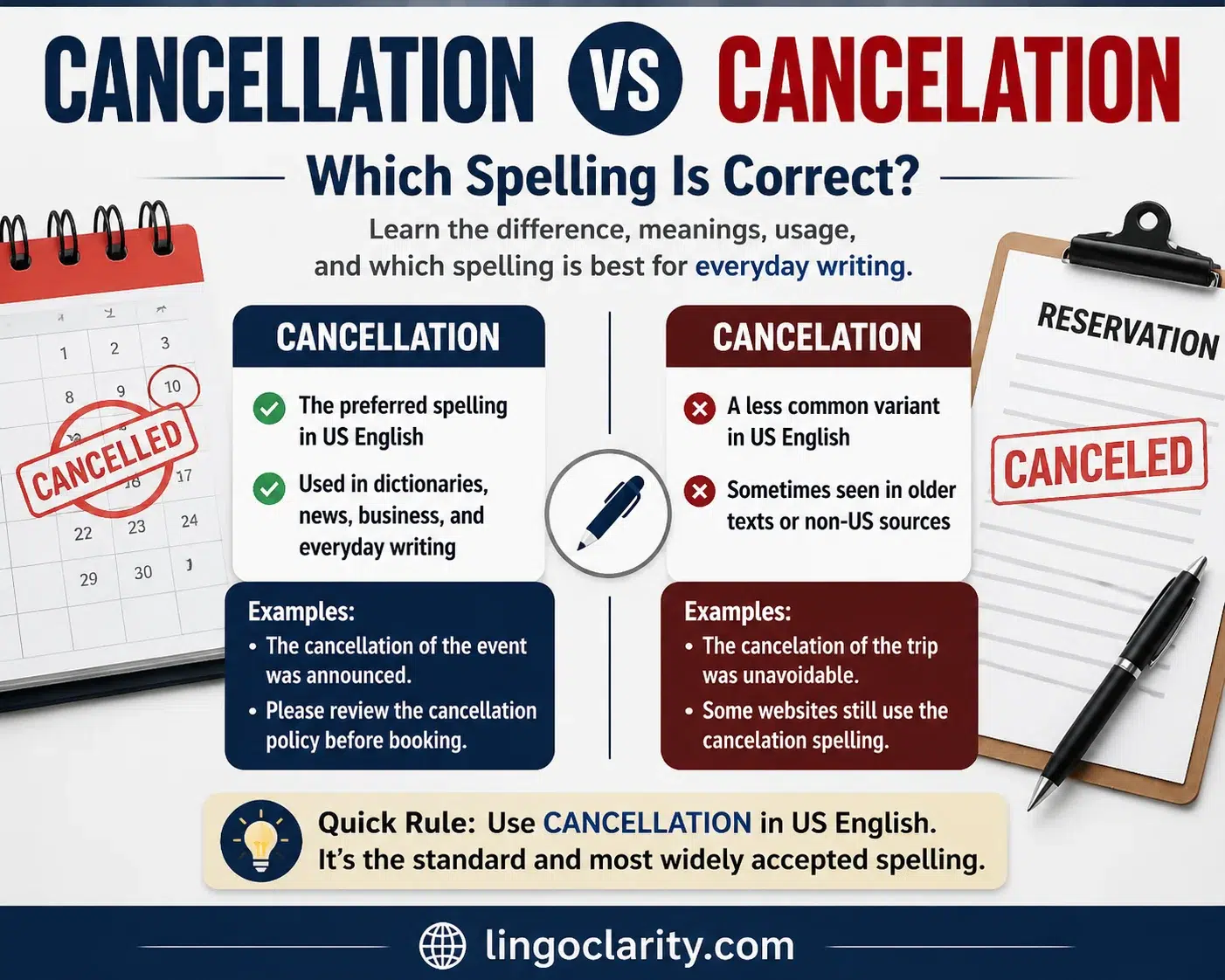
Many writers hesitate between cancellation and cancelation because English spelling does not always follow a perfect pattern. The confusion usually comes from the verb cancel, which commonly appears as canceled and canceling in American English with one l.
That makes many people wonder why the noun is usually spelled cancellation with two l’s.
The answer is simple: cancellation is the standard and most widely accepted spelling in US English. Cancelation is a real spelling variant, but it is much less common and is rarely the best choice for everyday writing.
For professional documents, websites, school assignments, emails, and published content, cancellation is the safer and more natural option.
Quick Answer: Cancellation Or Cancelation?
Use cancellation in standard US English.
Cancellation is the preferred spelling for:
- business writing
- academic writing
- websites
- emails
- policies
- news articles
- everyday communication
Cancelation is not completely wrong. Some dictionaries recognize it as a variant spelling, but most readers expect to see cancellation.
Examples:
✅ The airline sent a cancellation notice.
✅ Please check the cancellation policy before booking.
❌ The airline sent a cancelation notice. (Recognized but uncommon)
TL;DR: Cancellation vs Cancelation
- Cancellation is the standard spelling in American English.
- Cancelation is a recognized but uncommon spelling variant.
- Both words have the same meaning and pronunciation.
- Use cancellation in most professional and public writing.
- Do not confuse canceled/canceling with the noun cancellation.
- Consistency matters more than choosing a rare variant.
Why Do People Confuse Cancellation And Cancelation?
The confusion comes from the spelling of the verb cancel.
In American English, many writers use:
- canceled
- canceling
Both forms remove the second l before adding endings.
Because of this pattern, people often assume the noun should also become:
- cancel + ation = cancelation
However, English word formation does not always work that way. Some related words keep different spelling patterns because they developed through common usage over time.
The noun that became standard in modern English is:
cancel + lation = cancellation
That is why American readers usually expect:
- canceled flight ✅
- cancellation notice ✅
Even though the spelling pattern looks inconsistent, both forms are standard in their own contexts.
Cancellation vs Cancelation: Key Differences
| Feature | Cancellation | Cancelation |
|---|---|---|
| Standard US spelling | ✅ Yes | No |
| Recognized spelling | ✅ Yes | ✅ Yes |
| Meaning | Same | Same |
| Pronunciation | Same | Same |
| Professional writing choice | Best option | Usually avoid |
| Common usage | Very common | Rare |
The main difference is not meaning. The difference is frequency and preference.
Are Cancellation And Cancelation The Same Word?
Yes. Both words have the same meaning.
They describe:
- the act of canceling something
- the ending of an arrangement
- the removal of a planned event, service, or agreement
Examples:
- cancellation of a flight
- cancellation of a reservation
- cancellation of an appointment
- cancellation of a subscription
The spelling does not change the definition.
However, the two forms do not have the same level of acceptance in everyday writing. Cancellation is the form most readers recognize immediately.
Is Cancellation A US Vs UK English Difference?
Not exactly.
Many writers assume this is another American and British spelling difference, similar to:
- canceled (US)
- cancelled (UK)
or:
- traveling (US)
- travelling (UK)
But cancellation does not follow the same pattern.
Both American and British English commonly use:
✅ cancellation
British English often uses:
- cancelled
- cancelling
while American English often uses:
- canceled
- canceling
But the noun remains:
✅ cancellation
So the difference is not really between US and UK spelling. It is mainly about a common spelling pattern versus a less common variant.
Which Spelling Should You Use?
For almost every situation, choose:
Cancellation
Use it in:
- emails
- contracts
- websites
- customer service messages
- school assignments
- reports
- marketing content
- booking pages
- official documents
Examples:
- Our cancellation policy allows refunds within 24 hours.
- The event cancellation was announced yesterday.
- Customers received a cancellation notice.
Using the standard spelling helps your writing look more professional and familiar.
Why Cancelation Often Looks Wrong To Readers
A word can be technically correct but still feel unusual.
That is exactly what happens with cancelation. Because cancellation is the spelling most people see in books, websites, emails, and official documents, many readers automatically assume cancelation is a mistake.
However, cancelation is not an invented spelling. Some dictionaries recognize it as a valid variant. The issue is that it is far less common than cancellation.
In practical writing, the best choice is usually the spelling your audience expects. For American readers, that spelling is:
cancellation
Using the standard form helps your writing look natural and avoids unnecessary distractions.
Common Mistakes With Cancellation And Cancelation
Assuming Canceled Means Cancelation
This is the most common mistake.
Writers often think:
- canceled → cancelation
because the verb uses one l in American English.
However, the standard noun is:
- canceled flight ✅
- cancellation notice ✅
The spelling of a related word does not always follow the same pattern.
Thinking Cancelation Is Always Wrong
Although cancelation is uncommon, it is not automatically incorrect.
It is better described as:
- a recognized spelling variant
- a less common form
- a spelling that appears occasionally
The problem is not accuracy. The problem is usage.
If you write for a general US audience, cancellation is almost always the better choice.
Using Both Spellings In One Document
Consistency matters.
A document that uses:
- cancellation in one paragraph
- cancelation in another paragraph
can look careless.
Choose one spelling and use it consistently. In most cases, choose:
cancellation
Everyday Examples Of Cancellation In US English
These sentences use the standard spelling:
- The airline sent a cancellation email after the storm.
- Customers received a full refund after the cancellation of the event.
- Please review our cancellation policy before purchasing.
- The doctor’s office called about an appointment cancellation.
- The company announced the cancellation of the service.
- Several flight cancellations happened because of bad weather.
These examples reflect the spelling most commonly used in professional American English.
Examples Using Cancelation
Although less common, cancelation can appear in writing.
Examples:
- The document used the spelling cancelation instead of the more common cancellation.
- Some dictionaries list cancelation as a variant spelling.
- A company may use cancelation if it follows a specific internal style guide.
For normal writing, replacing it with cancellation is usually the better choice.
Word Details: Cancellation And Cancelation
Part Of Speech
Both cancellation and cancelation are nouns.
They describe the act of canceling something.
Examples:
- cancellation of a meeting
- cancellation of a reservation
- cancellation of an order
Meaning
Both spellings can describe:
- stopping an event
- ending a service
- removing a booking
- ending an agreement
- giving up a planned activity
Examples:
- flight cancellation
- membership cancellation
- subscription cancellation
- event cancellation
The meaning stays the same.
Pronunciation
Both words are pronounced the same in normal English.
The difference exists only in spelling.
Readers will usually pronounce:
- cancellation
- cancelation
in the same way.
Synonyms For Cancellation
Depending on the context, you may replace cancellation with:
- termination
- withdrawal
- revocation
- removal
- calling off
- abandonment
- rescission
However, the best synonym depends on the situation.
Examples:
- A contract cancellation → termination or rescission
- An event cancellation → calling off
- A subscription cancellation → termination
Opposites Of Cancellation
There is no single opposite for every situation.
Possible opposites include:
- confirmation
- approval
- continuation
- renewal
- reinstatement
- acceptance
Examples:
- The opposite of a reservation cancellation may be a confirmation.
- The opposite of a subscription cancellation may be renewal.
Common Phrases With Cancellation
These are the phrases you will see most often:
- cancellation policy
- cancellation fee
- cancellation notice
- flight cancellation
- appointment cancellation
- order cancellation
- event cancellation
- subscription cancellation
These phrases strongly favor the spelling cancellation.
Frequently Asked Questions (FAQs)
Is cancelation a correct spelling?
Yes. Cancelation is a recognized spelling variant, but it is much less common than cancellation. For normal US English writing, cancellation is the preferred choice.
Which spelling should I use in American English?
Use cancellation.
It is the standard spelling used in professional writing, online content, education, and everyday communication.
Why is it canceled but cancellation?
English spelling does not always follow perfect patterns. American English commonly uses canceled for the verb, but the noun has remained cancellation.
Is cancelation a spelling mistake?
Not necessarily.
It can be a valid variant spelling. However, many readers may think it is incorrect because cancellation is much more familiar.
Do cancellation and cancelation have different meanings?
No.
Both words have the same meaning. The difference is only spelling preference and frequency of use.
What is the plural form of cancellation?
The plural form is:
cancellations
Examples:
- Several flight cancellations were announced.
- The company reported multiple order cancellations.
Final Conclusion: Cancellation Or Cancelation?
If you are choosing between cancellation and cancelation, use:
Cancellation
It is the standard spelling in US English and the form most readers expect to see.
Cancelation is not a different word and does not have a different meaning, but it remains a rare spelling variant. For websites, professional writing, school work, and everyday communication, cancellation is the clearer and safer choice.
Remember the simple rule:
Canceled may use one L, but cancellation is usually spelled with two Ls.
