
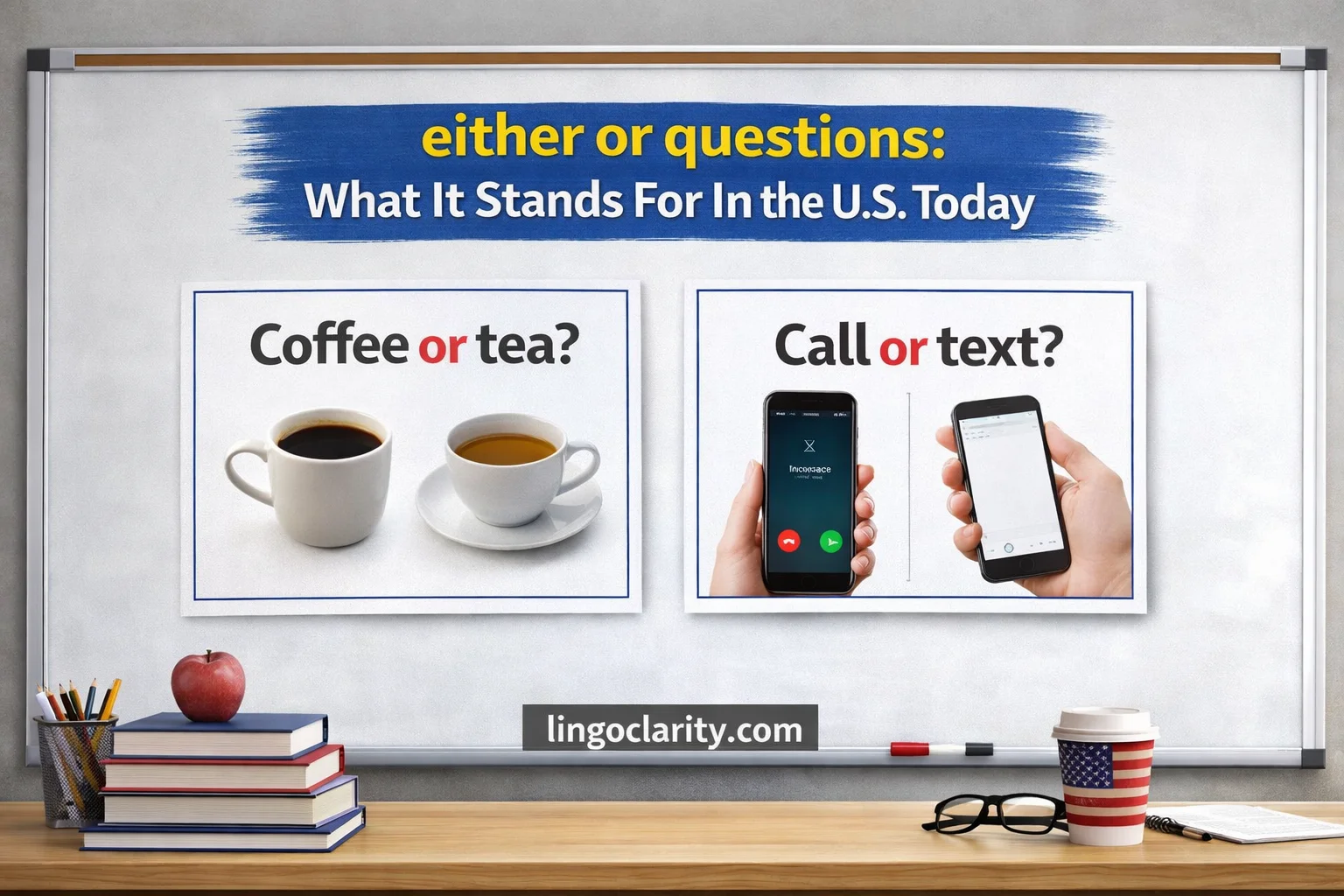
Either-or questions are everywhere. You hear them in classrooms, meetings, games, text messages, polls, and everyday conversation. They work because they do one simple thing well: they narrow the answer to two clear choices.
That makes them useful for quick decisions, easy conversation, and beginner-friendly speaking practice. They are especially helpful for English learners because the structure is easy to recognize and easy to answer. At the same time, many people still wonder what the phrase either or questions really means. Do you have to use the word either? Is it an official grammar term? How is it different from this or that or would you rather? The grammar behind the pattern is the standard either…or construction, which major grammar references treat as a pair that connects two alternatives.
This guide explains the pattern in plain English. You will learn what these questions mean, how they work, when they sound natural, how to punctuate them, and which common mistakes to avoid.
Quick Answer
An either-or question asks someone to pick between exactly two stated options — for example, “Do you want tea or coffee?” It’s different from an open-ended question because it narrows the response down to A or B, which makes it useful in conversation, surveys, and decision-making. It’s also narrower than a this-or-that prompt (often playful or hypothetical) and less exaggerated than a would-you-rather question (which usually pits two extreme or absurd scenarios against each other).
Real-Life Examples
- Everyday conversation: “Would you like paper or plastic?”
- Customer service/survey: “Do you prefer email updates or phone calls?”
- Parenting: “Do you want the blue shirt or the red shirt today?”
- Workplace decision: “Should we launch the campaign Monday or Wednesday?”
- Dating/relationship: “Movie night or dinner out?”
What Either-Or Questions Mean
An either-or question is a two-choice question. The speaker presents two options, and the listener is expected to choose one.
For example:
- Coffee or tea?
- Do you want coffee or tea?
- Should we call or text?
All three questions point to a choice between two possibilities. That is the core meaning.
In practical usage, either-or question is a helpful descriptive label, but the grammar references you are most likely to consult usually explain the pattern under either…or, not under a separate formal category called either-or questions.
Is This A Formal Grammar Term?
Not exactly.
The formal grammar point is either…or. Cambridge explains that either…or connects two choices, and Merriam-Webster identifies either and or as correlative conjunctions when they work together as a pair. That means the expression either-or questions is useful and understandable, but it is better treated as a plain teaching label than as a strict grammar term you would expect to see as a main textbook heading.
So if you are writing for learners, either-or questions is fine as a clear label. If you are explaining the grammar precisely, call the structure either…or.
Pronunciation, Hyphenation, And Part Of Speech
The word either has two common pronunciations in English, and both are accepted in American dictionaries: roughly EE-ther and EYE-ther.
You may also see either-or with a hyphen. In that form, Cambridge lists it as an adjective meaning a situation where one of two choices must be selected, but not both. For example:
- This is an either-or decision.
- We are in an either-or situation.
That hyphenated form is useful when the phrase directly modifies a noun such as choice, decision, or question.
One small note: do not confuse the choice meaning of either with its other common use in negative sentences, where it can mean something like also, as in “I don’t want it either.”
How Either…Or Works In A Question
The structure is simple: it presents two alternatives.
Cambridge’s grammar guidance also emphasizes that either…or connects items of the same grammatical type. In other words, the two sides should match. You should connect noun with noun, verb phrase with verb phrase, or clause with clause. Purdue OWL gives the same general principle under parallel structure: matched ideas should be built in matched forms.
- Do you want soup or salad?
- Would you rather walk or drive?
- Should we meet on Tuesday or Wednesday?
- We can either stay home or go out.
Less natural or incorrect examples:
- We can either go by train or a car.
- She wants either to call him or texting him.
Better versions:
- We can either go by train or go by car.
- She wants either to call him or to text him.
- She wants to either call him or text him.
The reason the improved versions work better is that the paired choices are parallel.
Do You Always Need The Word Either?
No.
In everyday questions, speakers often leave out either because the choice is already clear from or. A short question like “Tea or coffee?” still functions as a two-choice question because or introduces the alternative. The full either…or version is grammatically possible, but it usually sounds more deliberate or more formal in ordinary conversation.
Compare:
- Tea or coffee?
- Do you want tea or coffee?
- Do you want either tea or coffee?
All three point to a choice, but the first two are more natural in most casual situations.
When To Use Either-Or Questions
Use this format when you want a fast, clear answer and the options are genuinely limited to two.
It works especially well for:
- quick decisions
- preference checks
- classroom warm-ups
- icebreakers
- social media polls
- casual conversation
- beginner speaking practice
Examples:
- Morning class or evening class?
- Call or text?
- Pasta or rice tonight?
- In person or virtual?
- Beach or mountains?
This is one reason the pattern is so common: it reduces the pressure of answering. Instead of building a long response, the other person can simply choose one option.
When Not To Use Either-Or Questions
This pattern is not ideal when the real answer is more complex than two choices.
If you actually have three or more realistic options, a regular list is usually clearer than forcing the sentence into an either…or frame. Cambridge’s grammar explanation centers the structure on two choices, so that is the clearest and safest way to teach and use it.
For example, this is awkward:
- Do you want either pizza or sushi or tacos?
A clearer version is:
- Do you want pizza, sushi, or tacos?
- Which would you like: pizza, sushi, or tacos?
Either-or questions are also a poor fit when you want explanation, nuance, or discussion.
Too narrow:
- Should I quit or stay?
Better:
- What do you think I should do next?
That broader wording leaves room for advice, conditions, and alternatives.
Punctuation And Comma Rules
Most short either-or questions do not need a comma.
Correct:
- Coffee or tea?
- Call or text?
- Do you want soup or salad?
Purdue OWL explains that commas are used before coordinating conjunctions such as or when they join independent clauses. That is why a sentence like the following may need a comma:
- Either we leave now, or we miss the bus.
In simple paired choices, though, there are no two full independent clauses, so a comma is usually unnecessary.
Subject-Verb Agreement With Either…Or
When either…or joins two subjects, standard guidance says the verb usually agrees with the subject that is closer to it.
Examples:
- Either the teacher or the students are presenting.
- Either the students or the teacher is presenting.
Britannica gives this “nearer subject” rule directly.
That said, if a sentence starts sounding clumsy, the cleanest fix is often to rewrite it:
- The teacher or the students will present.
- One of them will present.
That approach can make formal writing smoother.
Common Mistakes And Easy Fixes
Using More Than Two Options
Either-or questions work best when there are two real alternatives.
Awkward:
- Do you want either coffee or tea or juice?
Better:
- Do you want coffee, tea, or juice?
Mixing Unmatched Structures
Because either…or works best with parallel structure, mismatched grammar makes the sentence feel off.
Wrong:
- We can either drive or by train.
Better:
- We can either drive or take the train.
- We can go either by car or by train.
Adding Unnecessary Commas
Wrong:
- Do you want coffee, or tea?
Better:
- Do you want coffee or tea?
Use a comma only when you are joining full clauses, not simple paired options.
Forcing A False Choice
Sometimes the real problem is not grammar but meaning. A question can sound unfair or unrealistic if it pretends there are only two options when the situation is more open.
Too narrow:
- Are you with us or against us?
Better:
- How do you see the issue?
That change removes the false either-or framing.
Either-Or Questions Vs. This-Or-That Vs. Would You Rather
These terms overlap, but they are not always identical.
Either-or questions are the broadest label here for a two-choice question pattern. The underlying grammar explanation is either…or.
This-or-that is best treated as an informal content label for light, quick preference prompts. It often refers to the same general two-choice idea, but it is more common in games, quizzes, social posts, and icebreakers than in formal grammar explanation. That is an editorial inference from how major grammar sources discuss either…or and would rather, not a separate textbook category.
Would you rather questions are different in structure because would rather expresses preference. Cambridge and Merriam-Webster both define it as a way to say what someone prefers to do or have. These questions often sound more playful, more hypothetical, or more discussion-based than a basic two-option prompt.
Compare:
- Coffee or tea?
- Would you rather drink coffee or tea?
- Would you rather live by the beach or in the mountains?
The first is a direct choice. The second expresses preference more explicitly. The third often feels more like a game or personality prompt.
Either…Or And Neither…Nor
A closely related grammar pattern is neither…nor.
The difference is simple: either…or offers a choice between two possibilities, while neither…nor rejects both. Britannica explains the contrast directly in its usage note on either and neither.
Examples:
- Either tea or coffee is fine.
- Neither tea nor coffee sounds good right now.
That makes neither…nor a useful contrast, but not the same kind of question pattern.
Mini Quiz
Question 1
Which sentence is an either-or question?
A. Why did you leave early?
B. Tea or coffee?
C. What happened next?
Answer: B
Question 2
Which sentence uses matching structure?
A. We can either drive or by train.
B. We can either drive or take the train.
C. We can either take the train or by car.
Answer: B
Question 3
Which sentence may need a comma?
A. Do you want soup or salad?
B. Either we stay here, or we leave now.
C. Call or text?
Answer: B
Question 4
What is the clearest contrast to an either-or question?
A. Open-ended question
B. Past tense question
C. Tag question
Answer: A
FAQs
What are either-or questions?
Either-or questions are questions that give a person two choices and ask for one answer. They are common in conversation, classroom activities, polls, and quick decision-making.
How do you use either…or in a sentence?
Use either before the first option and or before the second. Keep the two sides parallel in structure. For example: “You can either stay home or come with us.” Cambridge specifically notes that either…or connects items of the same grammatical type.
Are either-or questions the same as this-or-that questions?
Often, yes in casual use. Both labels usually point to a two-choice prompt. But this-or-that is more informal and more associated with games, social content, or light conversation, while either…or is the actual grammar pattern behind the structure.
Can either…or be used for more than two options?
For clear teaching and clean writing, it is best to use either…or for two alternatives. If you have three or more options, a regular list is usually easier to read and understand. That fits the way major grammar references describe either…or as a two-choice structure.
Do you need a comma in either…or?
Usually not in short paired choices such as “coffee or tea.” A comma is used when or joins independent clauses, as in “Either we leave now, or we miss the bus.”
What is the opposite of either…or?
The closest grammar opposite is neither…nor, which rejects both options instead of offering a choice between them.
Conclusion
Either-or questions are one of the simplest and most useful question types in English. They help speakers limit a choice to two options, make conversations faster, and make answers easier.
The key point is this: the grammar behind them is either…or, a pattern used to connect two matching alternatives. In everyday speech, the word either is often left out, but the two-choice meaning remains clear. Once you understand that, these questions become easy to read, ask, and answer with confidence.
