
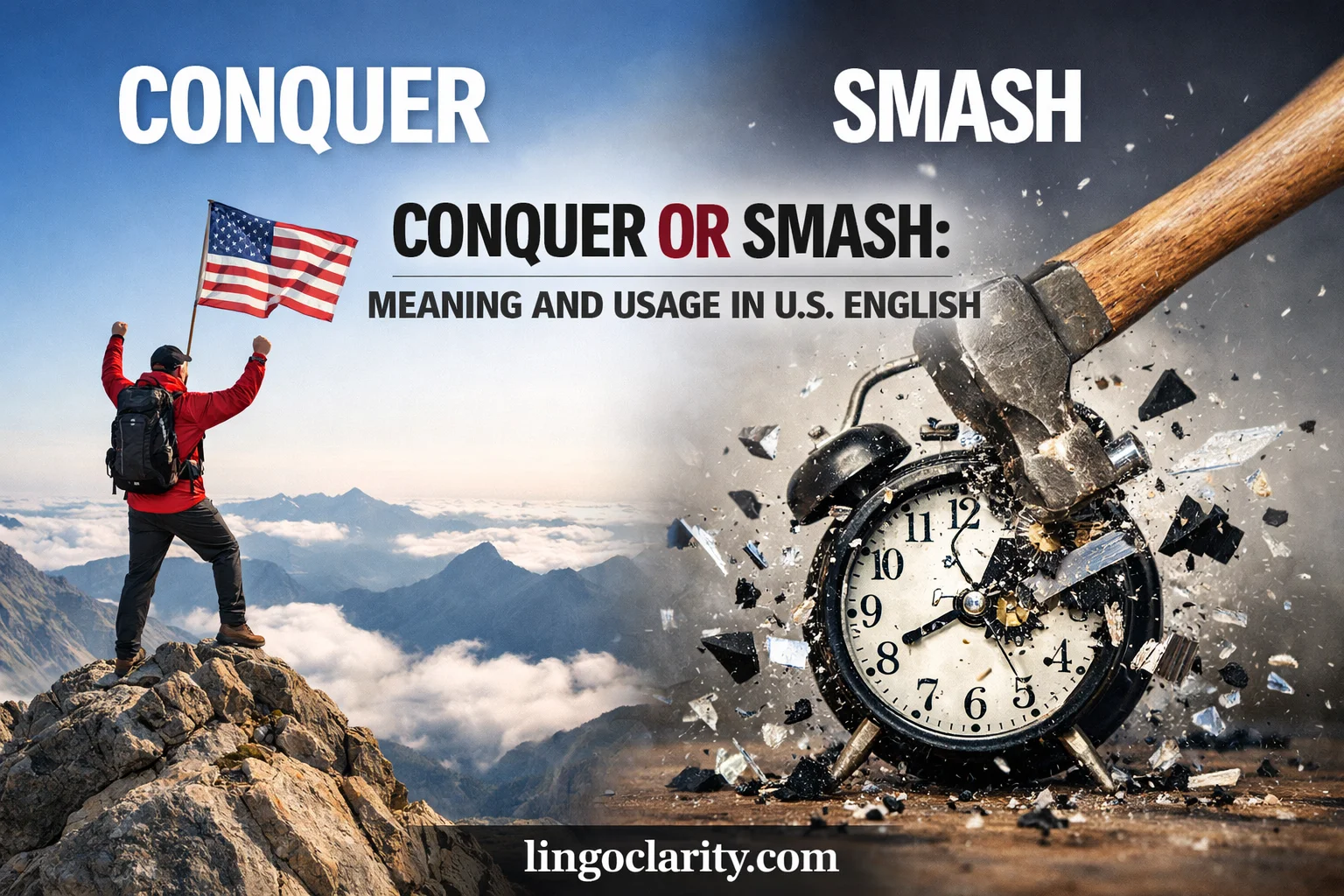
Conquer and smash are both strong English words, but they do very different jobs. That is the main reason people mix them up. Each word can appear in sentences about conflict, effort, victory, and force, so at first glance they may seem close. But once you look at their actual meanings, they stop being interchangeable. Conquer is mainly about defeating something and ending up in control or in command of it, or about overcoming a fear, obstacle, or challenge. Smash is mainly about breaking, crashing, hitting with violent force, or defeating something in a way that sounds forceful, dramatic, or destructive. Major dictionary entries separate them in exactly that way, with conquer tied to subduing, mastering, or surmounting, and smash tied to violent breaking, crashing, wrecking, or complete defeat.
Quick Answer
Use conquer when you mean defeat and gain control, gain mastery, or overcome a challenge or fear. Use smash when you mean break something violently, crash into something, destroy something completely, or defeat someone in an emphatic, forceful way. If your sentence is about control, mastery, or overcoming, conquer is usually the better choice. If your sentence is about impact, shattering, wrecking, or a crushing blow, smash is usually the better choice.
Why These Words Get Confused
People confuse these words because they overlap in high-energy situations. Both can appear in headlines, sports talk, history writing, motivational language, and dramatic speech. A team can “conquer the odds,” and another team can “smash its rivals.” A person can “conquer fear,” while a government can try to “smash a rebellion.” The overlap is real, but the mental pictures are not the same. Conquer suggests a result in which someone gains command, mastery, or control. Smash suggests violent force, impact, destruction, or a crushing effect. That is why swapping one for the other often makes a sentence sound off, even if the general idea of winning is still there.
What Conquer Really Means
In standard English, conquer is first and most clearly a verb of defeat plus control. Merriam-Webster defines it with meanings such as gaining or acquiring by force of arms, overcoming by force of arms, gaining mastery by overcoming obstacles, and overcoming by mental or moral power. Cambridge likewise includes defeating a place or people and also successfully dealing with a problem or an unreasonable fear. Put simply, conquer is not just about hitting harder than something else. It is about prevailing over it and, in many contexts, mastering it. That is why phrases such as conquer a territory, conquer the enemy, conquer the mountain, and conquer your fear all sound natural.
This word often carries a broad, strategic feeling. It works naturally in history, politics, self-improvement, and figurative writing because it can describe both literal control and inner victory. A person may conquer stage fright. A business may try to conquer a market in a figurative sense. A military force may conquer a city. In each case, the core idea is not noise, collision, or shattering. It is winning in a way that produces mastery, possession, or command. That is the shade of meaning you should keep in mind whenever you consider using it.
What Smash Really Means
Smash belongs to a different semantic world. Merriam-Webster gives core senses such as break or crush by violence, throw or drive violently, hit violently, wreck, and move with crashing effect, including the familiar pattern smash into. Cambridge also includes the sense to defeat someone or destroy something completely. So even when smash is used figuratively, it still tends to carry the sound of force, collision, or destructive power.
That is why smash fits sentences like smash a window, smash a phone, smash into a tree, smash the door down, or smash the opposition. It is vivid and physical even when the object is not literally breaking. In sports or headlines, saying one side smashed another suggests an emphatic, one-sided defeat, not a measured strategic victory. In entertainment language, the noun smash can also mean a major success, as in a box-office smash or smash hit. That noun use is standard and well established in major dictionaries.
The Real Difference Between Conquer And Smash
The clearest way to separate these words is this:
Conquer = defeat and gain control, mastery, or command.
Smash = break, crash, destroy, or defeat with violent force.
That difference may look simple, but it explains almost every good or bad usage choice. If the sentence is about overcoming, subduing, or mastering, then conquer usually fits. If the sentence is about shattering, wrecking, slamming, or crushing, then smash usually fits. Even when both words could involve winning, the emotional effect is different. Conquer feels broader and more controlled. Smash feels more immediate, physical, and dramatic.
This is also why these are not simple synonyms in modern US English. You can say She conquered her fear of public speaking, because fear is something you overcome or master. You can say He smashed the bottle, because a bottle is something that can break under force. But crossing those patterns usually fails. She smashed her fear sounds odd in standard usage, and He conquered the bottle makes no normal sense unless the writer is joking or being highly figurative. The wrong word changes the image, not just the tone.
Tone, Register, And Formality
In practice, conquer usually sounds more formal, more strategic, and often more elevated. It fits historical writing, serious commentary, motivational writing, and broad figurative statements. It can sound dramatic, but it is usually not noisy. The word points to the end result: domination, command, mastery, or successful overcoming. That is why it works well in sentences about ambition, fear, endurance, and large-scale victory.
Smash, by contrast, tends to sound more physical, more vivid, and often more informal or headline-friendly. It is a strong word for damage, impact, and emphatic defeat. Even when it is perfectly standard, it often feels more cinematic than conquer. Saying a team smashed another team feels punchier than saying it conquered the other team. Saying a car smashed into a barrier creates a concrete visual image that conquered never could.
Grammar And Part-Of-Speech Differences
A useful grammar point is that conquer is ordinarily treated as a verb, while the related noun is conquest. Merriam-Webster defines conquest as the act or process of conquering, or something conquered. So if you need a noun, standard English usually moves away from conquer and toward conquest, conqueror, or another noun such as victory or mastery.
Smash, however, works comfortably as both a verb and a noun. As a noun, it can mean a crash, a violent blow, or a major success. Cambridge and Merriam-Webster both record the “success” sense, which is why expressions like a Broadway smash and a smash hit are standard. That creates an important usage contrast: you can naturally write The show was a smash, but you would not naturally write The show was a conquer.
When To Use Conquer
Choose conquer when your sentence involves one of these ideas:
A person or force defeats another and ends up in control.
A person overcomes fear, pain, doubt, or a difficult challenge.
The tone is serious, broad, strategic, or figurative.
You want the idea of mastery rather than blunt force.
These examples sound natural:
She worked for a year to conquer her fear of heights.
The hikers were determined to conquer the final climb.
The general hoped to conquer the region before winter.
After several failed attempts, he finally conquered his addiction to procrastination.
In each sentence, the focus is not on breaking something apart. It is on prevailing over it.
When To Use Smash
Choose smash when your sentence involves one of these ideas:
Something breaks violently into pieces.
A vehicle, person, or object crashes hard into something else.
Someone destroys or crushes something completely.
A person, team, or group wins in a forceful, emphatic way.
You want a vivid, physical, or dramatic effect.
These examples sound natural:
The storm smashed several windows.
A motorcycle smashed into the guardrail.
The champion smashed the field in the final round.
The movie became a box-office smash.
Here the energy comes from impact, damage, or a crushing result.
Contexts Where One Word Sounds Wrong
Some incorrect choices stand out immediately.
She conquered the glass is wrong in normal usage because glass is not something you master or take control of in that sense. If the glass broke, you want smashed or broke.
He smashed his fear of failure is possible only in very informal, slangy, or deliberately aggressive language. In normal edited prose, conquered his fear of failure is the natural choice because fear is something you overcome.
The empire smashed the province may be possible if the point is destruction, but it does not naturally express occupation or rule. If the point is military takeover and control, conquered is the better fit.
The child conquered the toy does not work in ordinary English. If the child broke it, say smashed the toy. If the child figured out how to use it, say mastered it instead.
Better Alternatives When Neither Word Is Ideal
A common writing problem is overusing strong verbs when a simpler one would sound more natural. Not every victory is a conquest, and not every big win is a smashing. Sometimes win, beat, defeat, overcome, break, crash, destroy, or master is better.
For example, instead of Our company will conquer the software sector, a business article may sound steadier with expand into or compete in unless the dramatic tone is deliberate. Instead of She smashed the test, conversational American English may accept it, but in neutral prose aced, did very well on, or passed may read more cleanly. Strong verbs are useful, but precision is better than force for its own sake. The dictionary record supports this distinction by showing that conquer and smash each carry fairly specific meaning patterns, not just generic intensity.
Common Mistakes And Quick Fixes
One common mistake is using smash for any kind of success. That can make writing sound exaggerated. If the point is mastery, persistence, or overcoming, choose conquer or a simpler verb like overcome.
Another common mistake is using conquer for broken objects. If something is shattered, damaged, or hit with force, smash, break, or crash into is more natural.
A third mistake is forgetting the noun pattern. Conquer is usually a verb, while conquest is the noun. Smash can function as both. So write a military conquest or a box-office smash, not a military conquer.
Natural Example Sentences In Modern US English
Here are clean examples that show the difference clearly:
She finally conquered her fear of public speaking.
The climbers hoped to conquer the summit before sunset.
The campaign could not conquer public distrust overnight.
The invading force conquered the city after a long siege.
The toddler smashed a plate on the kitchen floor.
A truck smashed into the fence during the storm.
Our team smashed its biggest rival in the semifinals.
The new musical was an instant smash.
Notice how conquer points to command, control, or overcoming, while smash points to violent force, breaking, crashing, or emphatic defeat. That is the pattern you should remember.
Word History And Established Phrases
The historical background also supports the modern difference. Etymonline traces conquer back to medieval forms associated with winning, subduing, and making a conquest, while Merriam-Webster’s definitions still preserve that connection to subjugation, mastery, and surmounting. Smash, by contrast, is described by Etymonline as a word associated with violent blows and breaking, and Merriam-Webster’s word history notes the likely blend-like, sound-driven character behind it. In other words, the history of conquer points toward victory and possession, while the history of smash points toward forceful impact and breakage.
Both words also appear in familiar phrases, but again the meanings stay separate. Merriam-Webster records divide and conquer, a phrase about strategy and control. Cambridge records smash hit, where smash means a major popular success. These fixed phrases reinforce the same usage split you see in ordinary prose.
Frequently Asked Questions
Is “conquer” stronger than “smash”?
Not automatically. They are strong in different ways. Conquer is stronger for ideas of mastery, domination, and overcoming. Smash is stronger for ideas of physical force, breakage, collision, and crushing impact.
Can “smash” mean “defeat”?
Yes. Cambridge explicitly includes a sense of smash meaning to defeat someone or destroy something completely. In sports and headlines, it often suggests an emphatic or one-sided win.
Can “conquer” be used for fear or anxiety?
Yes. Both Merriam-Webster and Cambridge include figurative uses in which someone conquers fear or overcomes a difficult problem. That is one of the most natural modern uses of the word.
Is “conquer” a noun?
In standard current usage, conquer is mainly a verb. The normal noun is conquest, and related forms such as conqueror are also standard.
Can “smash” be a noun?
Yes. Smash can be a noun for a crash or violent break, and it can also mean a major success, especially in entertainment language.
Which word should I use in everyday writing?
Use conquer when the idea is control, mastery, or overcoming. Use smash when the idea is breaking, crashing, or forceful defeat. If neither exact meaning fits, choose a simpler verb like win, beat, overcome, break, or crash.
Conclusion
If you are deciding between conquer and smash, do not ask which one sounds more powerful. Ask what kind of action you actually mean.
Choose conquer when the point is defeat with control, mastery, or overcoming. Choose smash when the point is breaking, crashing, wrecking, or crushing with force. That single distinction will make most sentences easier to fix.
When you keep that difference in mind, your writing becomes more precise right away. Conquer gives readers the idea of command and mastery. Smash gives readers the idea of impact and destruction. They may both sound intense, but they are not the same word, and strong writing depends on knowing exactly why.
