
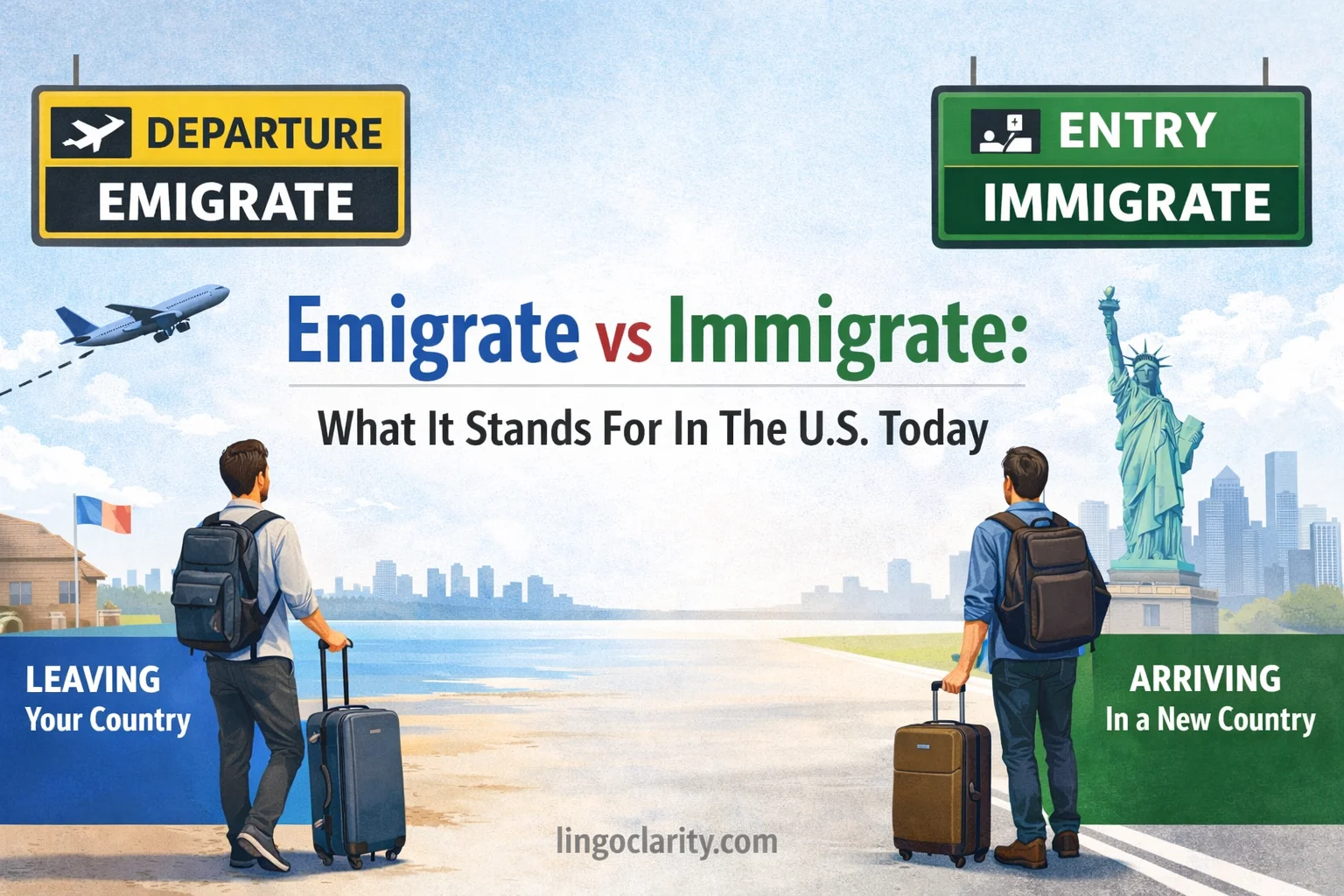
Most English learners know that emigrate and immigrate both relate to moving from one country to another. The confusion starts when they need to choose the correct word in a sentence.
These two verbs look almost identical, sound similar, and describe the same type of life change. The difference is not the movement itself — it is the viewpoint.
Emigrate focuses on the country a person leaves.
Immigrate focuses on the country a person enters to live there.
The same person can do both. Someone can emigrate from India and immigrate to the United States during the same move. The action is the same, but the sentence looks at it from two different sides.
The easiest rule to remember is:
Leaving a country = emigrate.
Entering a country = immigrate.
This guide explains the difference, common patterns, examples, mistakes, and simple memory tricks so you can choose the right word confidently.
Quick Difference
| Word | Meaning | Focus |
|---|---|---|
| Emigrate | To leave a country to live somewhere else | The country left behind |
| Immigrate | To enter a new country to live there | The destination country |
Example:
- She emigrated from Brazil.
- She immigrated to Portugal.
Both sentences describe the same person and the same move.
Quick Answer
Use emigrate when your sentence focuses on leaving a country.
Use immigrate when your sentence focuses on entering a new country to live there.
The safest patterns are:
- emigrate from + country
- immigrate to + country
Example:
My grandparents emigrated from Italy and immigrated to the United States.
Pronunciation:
- Emigrate: EM-ih-grayt
- Immigrate: IM-ih-grayt
Both words are standard, neutral English verbs. Neither one is more formal than the other.
TL;DR
- Emigrate means leave a country permanently or for long-term settlement.
- Immigrate means enter another country to live there.
- The difference is based on viewpoint, not the action.
- Remember: emigrate from, immigrate to.
- A person can be both an emigrant and an immigrant.
- Migration is the broader term for movement.
- Use migrate when the direction or destination is not important.
Why People Confuse Emigrate and Immigrate
Many learners mix up these words because they describe the same event from different angles.
They Look Almost the Same
The biggest problem is their spelling.
The only major difference is the first letter:
- Emigrate
- Immigrate
When people read quickly, those small differences are easy to miss.
They Describe One Movement
Imagine a family moving from Mexico to Canada.
From Mexico’s perspective:
The family emigrated from Mexico.
From Canada’s perspective:
The family immigrated to Canada.
The movement is identical. The viewpoint changes.
The Memory Trick Is Helpful, But Not Enough
Many learners remember:
- E = Exit
- I = Into
This is a useful shortcut.
However, the real rule is about the sentence viewpoint.
If your sentence focuses on the place someone left, use emigrate.
If it focuses on the place someone entered, use immigrate.
Emigrate vs Immigrate: Key Difference at a Glance
| Feature | Emigrate | Immigrate |
|---|---|---|
| Main focus | Leaving a country | Entering a country |
| Viewpoint | Country of origin | Destination country |
| Common pattern | emigrate from | immigrate to |
| Person noun | emigrant | immigrant |
| Process noun | emigration | immigration |
| Root meaning | Move out | Move into |
| Common topics | Departure, population loss, family history | Settlement, visas, citizenship |
These words are not opposites like hot and cold. They are two ways to describe the same movement.
What Does Emigrate Mean?
Emigrate means to leave your country in order to live somewhere else.
The focus is on the place a person leaves.
Examples:
- My grandparents emigrated from Italy in the 1960s.
- Many workers decided to emigrate from the country for better opportunities.
- She plans to emigrate from Pakistan after completing her studies.
- Thousands emigrated during the economic crisis.
Notice that the destination does not always need to be mentioned.
Example:
Many families emigrated during the war.
The sentence focuses on people leaving, so emigrated is correct.
Grammar Note: How to Use Emigrate Correctly
Emigrate is normally used without a direct object.
Correct:
✅ They emigrated from Spain.
Incorrect:
❌ The company emigrated its employees.
Better:
✅ The company relocated its employees abroad.
You can say a person emigrates, but you usually do not say someone emigrates another person.
What Does Immigrate Mean?
Immigrate means to enter a new country in order to live there, usually permanently or for a long period.
The focus is on the destination — the country a person enters.
Examples:
- Her family immigrated to Canada when she was young.
- He hopes to immigrate to Australia next year.
- Thousands of people immigrated to the United States during that decade.
- My neighbor immigrated in 1998 and later became a citizen.
In the last example, the destination is understood from the context. The sentence focuses on arrival, so immigrated is correct.
Remember that immigrate is about settling, not short visits.
Correct:
✅ She immigrated to France.
Incorrect:
❌ She immigrated to France for a two-week vacation.
Better:
✅ She traveled to France for a two-week vacation.
Grammar Note: How to Use Immigrate Correctly
Like emigrate, immigrate usually does not take a direct object.
Correct:
✅ They immigrated to the United States.
Incorrect:
❌ The organization immigrated 50 workers.
Better:
✅ The organization helped 50 workers immigrate.
or
✅ The organization sponsored 50 workers.
The Real Difference Is Viewpoint
This is the main idea that solves the confusion.
The difference between emigrate and immigrate is not the action. The action is the same: a person moves from one country to another.
The difference is the viewpoint.
Think of two reporters covering the same event.
One reporter stands in the country someone leaves.
The other reporter stands in the country someone enters.
The first reporter says:
They emigrated from Mexico.
The second reporter says:
They immigrated to Canada.
Both statements can be true at the same time.
The words simply place the reader on different sides of the border.
Sentence Patterns That Sound Natural
Most everyday examples follow two simple patterns.
1. Emigrate From + Place
Use this when the focus is the country someone left.
Examples:
- She emigrated from India.
- His family emigrated from Poland.
- Many people emigrated from the region during the crisis.
2. Immigrate To + Place
Use this when the focus is the country someone entered.
Examples:
- She immigrated to Canada.
- They immigrated to the United States.
- Thousands of families immigrated to Australia.
Using Both Countries in One Sentence
You can mention both the original country and the destination.
Both versions below are correct:
✅ They emigrated from Brazil to Portugal.
Focus: leaving Brazil.
✅ They immigrated to Portugal from Brazil.
Focus: arriving in Portugal.
The verb decides which side of the journey receives more attention.
Can You Say “Emigrate To”?
Yes.
The phrase emigrate to is accepted English, especially in some British English contexts.
Example:
She emigrated to Canada.
This sentence is understandable and grammatically acceptable.
However, for most learners, especially in American English, the clearest patterns are:
- emigrate from
- immigrate to
These patterns make the viewpoint obvious and reduce mistakes.
Which One Should You Use?
Ask one simple question:
Which country is my sentence looking at?
Choose Emigrate When:
- You focus on the country someone left.
- You discuss departure.
- You talk about people leaving a region.
- You describe family history from the original country.
Examples:
- Many scientists emigrated from the country.
- My ancestors emigrated from Ireland.
Choose Immigrate When:
- You focus on the country someone entered.
- You discuss settlement.
- You mention citizenship, visas, or joining a community.
- You describe arrival.
Examples:
- My parents immigrated to the United States.
- She immigrated to Germany and started a new life.
Emigrate From vs Immigrate To: The Rule to Remember
For most situations, this rule works:
People emigrate from a country.
People immigrate to a country.
Examples:
- My grandparents emigrated from Italy.
- My grandparents immigrated to America.
If you remember only one thing, remember these two prepositions:
From = Emigrate
To = Immigrate
Common Mistakes Writers Make
Mistake 1: Treating Them as Synonyms
Wrong idea:
Emigrate and immigrate mean exactly the same thing.
They are related, but the viewpoint changes.
Better:
- He emigrated from China.
- He immigrated to Canada.
Mistake 2: Mixing Up the Nouns
The noun forms follow the same rule.
Leaving a country:
✅ emigrant
Arriving in a country:
✅ immigrant
Example:
My grandfather was an emigrant from Italy and an immigrant in America.
Mistake 3: Using Migrate When a Specific Word Is Better
Migrate is the broad term.
It can describe:
- people moving
- animals traveling
- seasonal movement
- data transfers
Example:
Birds migrate south every winter.
For international settlement:
She immigrated to Canada.
is more precise.
Mistake 4: Using Them With Short Trips
Neither word means a temporary visit.
Incorrect:
❌ I immigrated to France for vacation.
Correct:
✅ I traveled to France for vacation.
Mistake 5: Using “Immigrate Into”
Because immigrate already contains the idea of entering, “into” is usually unnecessary.
Less natural:
❌ He immigrated into the country.
Better:
✅ He immigrated to the country.
Quick Comparison: Related Words
| Word | Meaning | Example |
|---|---|---|
| Emigrate | Leave a country | She emigrated from Brazil |
| Immigrate | Enter a country | She immigrated to Canada |
| Migrate | Move generally | Birds migrate south |
| Expat | Person living abroad, often temporarily | He works as an expat overseas |
| Refugee | Person forced to leave for safety | Refugees crossed the border |
These words are related, but they are not interchangeable.
Word Origins: Why They Are Different
Both words come from the Latin word migrare, meaning “to move.”
The prefixes create the difference:
- ex- = out of
→ emigrate = move out - in- = into
→ immigrate = move into
Once you understand the roots, the spelling becomes easier to remember.
The first letter is not random — it shows the direction of movement.
A Simple Memory Trick
Memory tricks can help, but they work best when you understand the real rule behind them.
Use these reminders:
- E = Exit → Emigrate
- I = Into → Immigrate
Think of it this way:
Emigrate = Exit a country
Immigrate = Go Into a country
Example:
She emigrated from India and immigrated to Canada.
The memory trick helps you remember the direction, but always check the viewpoint when both countries appear in the sentence.
Is One More Formal Than the Other?
No.
Both emigrate and immigrate are standard, neutral English words.
Neither word is:
- more formal
- more academic
- more polite
- outdated
You can use both in:
- school essays
- news writing
- history articles
- professional documents
- everyday conversations
The difference is meaning, not style.
Example:
Formal:
Many families emigrated from the region during the economic crisis.
Everyday:
My grandparents immigrated to the United States years ago.
Both are normal English.
Can the Same Person Be Both an Emigrant and an Immigrant?
Yes.
This is one of the easiest ways to understand the difference.
A person can leave one country and enter another at the same time.
Example:
Maria emigrated from Mexico.
This describes Maria from Mexico’s viewpoint.
Maria immigrated to the United States.
This describes Maria from the United States’ viewpoint.
Both sentences are correct.
The person did not change. Only the perspective changed.
Emigrant, Immigrant, Emigration, and Immigration
The related words follow the same pattern.
Emigrant
An emigrant is a person who leaves a country.
Example:
My great-grandfather was an emigrant from Ireland.
The focus is on the place he left.
Immigrant
An immigrant is a person who enters a new country to live there.
Example:
My great-grandfather became an immigrant in America.
The focus is on the place he entered.
Emigration
Emigration means the process of leaving a country.
Example:
The country experienced high emigration during the economic downturn.
Immigration
Immigration means the process of entering a country.
Example:
Immigration has changed the city’s population over time.
Migration, Expat, and Refugee: What Is the Difference?
These words are connected, but they do not mean the same thing.
| Word | Meaning | Example |
|---|---|---|
| Migrant | A person who moves from one place to another | Seasonal farm workers are migrants |
| Expat | A person living outside their home country, often temporarily | A US worker living in Japan may be an expat |
| Refugee | A person forced to leave because of danger or persecution | Refugees may seek safety in another country |
Do not replace one word with another without checking the situation.
For example:
- A person moving for a job may be a migrant.
- A person escaping danger may be a refugee.
- A person leaving and settling in another country may be an immigrant.
Quick Practice Quiz
Choose the correct word.
1. Thousands of people decided to ______ from Ireland during the famine.
2. Her family ______ to Canada when she was five years old.
3. After arriving in Australia, he became an ______.
4. From his hometown’s viewpoint, he was an ______ who left many years ago.
5. They ______ from Vietnam to France in the 1980s.
Answers
- emigrate
- immigrated
- immigrant
- emigrant
- emigrated
Score:
- 5/5 → Excellent
- 3–4/5 → Almost there
- Below 3 → Review the viewpoint rule
The main question is always:
Are you talking about leaving or arriving?
Common Questions About Emigrate vs Immigrate
What is the difference between emigrate and immigrate?
Emigrate means leaving a country to live somewhere else.
Immigrate means entering a new country to live there.
The difference is the viewpoint:
- Emigrate = looking at the country left behind.
- Immigrate = looking at the destination country.
Do you emigrate from or to a country?
The most common pattern is:
Emigrate from + country
Examples:
- She emigrated from India.
- They emigrated from Spain.
You may also see emigrate to, especially in some British English writing, but emigrate from is the clearest pattern for most learners.
Do you immigrate to or from a country?
The standard pattern is:
Immigrate to + country
Examples:
- He immigrated to Canada.
- They immigrated to the United States.
If you mention the original country, add it after:
They immigrated to Canada from India.
Can someone emigrate and immigrate at the same time?
Yes.
A person can:
- emigrate from one country
- immigrate to another country
during the same move.
Example:
She emigrated from Brazil and immigrated to Portugal.
Both descriptions are correct.
What is the noun form of emigrate?
The noun forms are:
- Person: emigrant
- Process: emigration
Example:
His grandparents were emigrants from Poland.
What is the noun form of immigrate?
The noun forms are:
- Person: immigrant
- Process: immigration
Example:
Immigration has shaped many countries throughout history.
What is the difference between migrate and immigrate?
Migrate is a broad word for movement.
It can describe:
- people
- animals
- seasonal movement
- technology transfers
Immigrate specifically means entering another country to settle.
Example:
- Birds migrate south.
- She immigrated to Canada.
Conclusion
The difference between emigrate and immigrate is simple once you remember the viewpoint.
Use emigrate when you focus on leaving a country.
Use immigrate when you focus on entering a new country.
The easiest patterns are:
- emigrate from
- immigrate to
A person can do both at the same time because every international move has two sides.
Someone can emigrate from India and immigrate to the United States. The person is the same; only the perspective changes.
When you are unsure, ask:
Is my sentence looking at the place someone left or the place someone entered?
Leaving → emigrate
Entering → immigrate
That one question will help you choose the correct word almost every time.
