
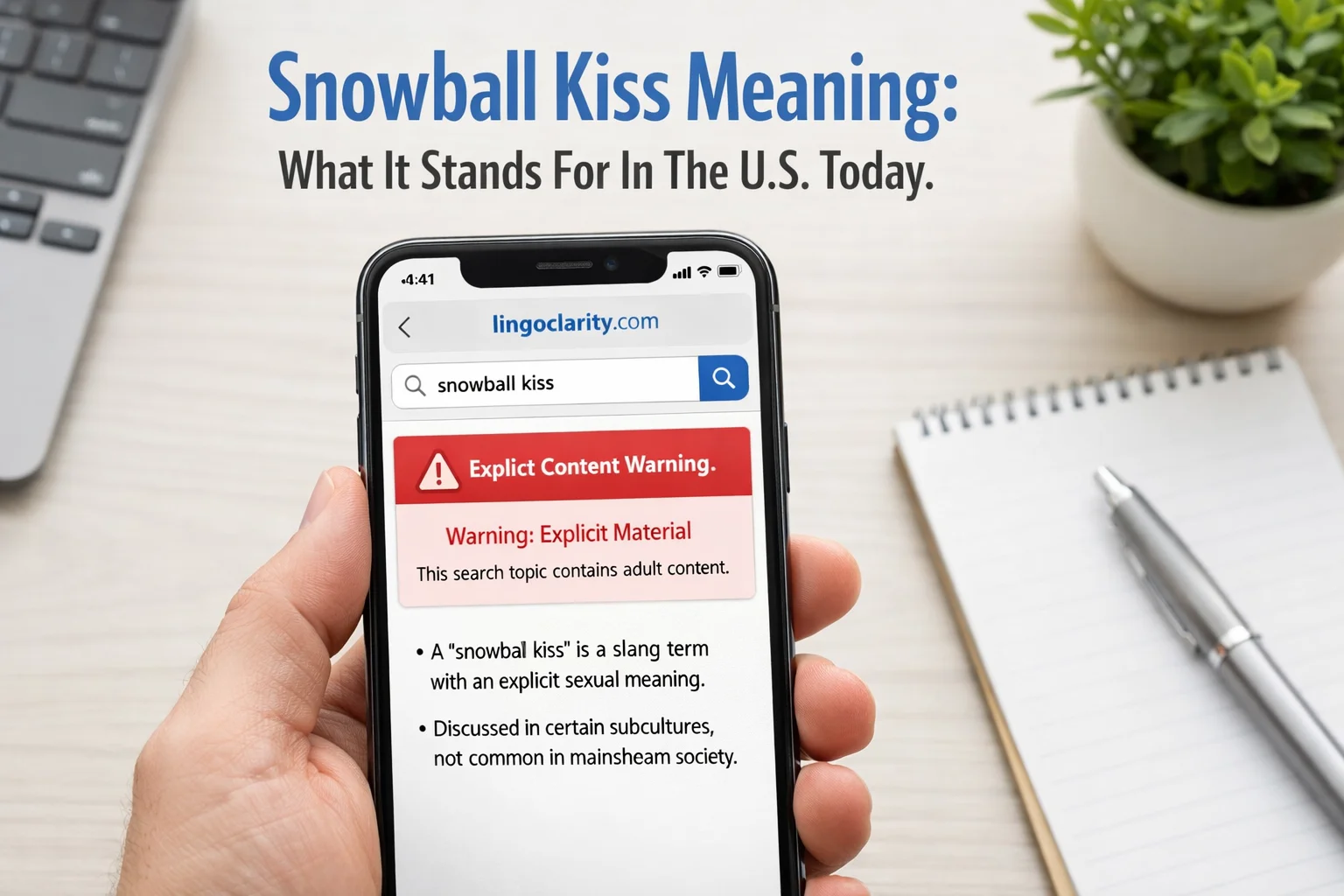
You may have seen snowball kiss on TikTok, in a meme, or in a comment section and wondered what it actually means.However, its established meaning is explicit adult slang, not a normal romantic kiss. The related term snowball is documented as vulgar sexual slang.
More recently, some social-media posts have also used snowball kiss for a playful ice or cold-drink kissing challenge. Because these meanings are very different, context matters.
This guide explains snowball kiss meaning in simple English, including its slang use, newer online meaning, and when the phrase should be avoided.
Quick Answer
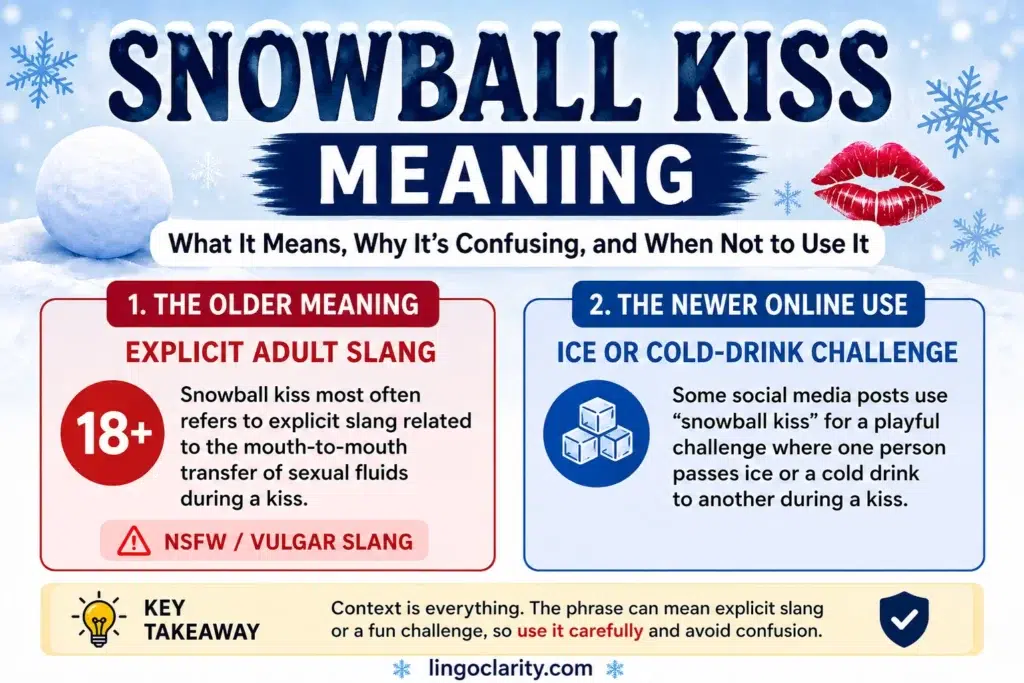
Snowball kiss meaning usually refers to explicit adult slang involving mouth-to-mouth transfer of sexual fluid during a kiss. It is not standard polite English. However, some newer social-media posts use the phrase for a playful ice or cold-drink transfer kiss, so context is important.
TL;DR
- The older and more established meaning is explicit adult slang.
- It is not standard formal English.
- Some newer online content uses it for an ice or cold-drink kiss challenge.
- The phrase can be easily misunderstood.
- Kiss in the snow, winter kiss, or ice kiss challenge are clearer alternatives when you mean something innocent.
What Does Snowball Kiss Mean?
In its older and more established slang sense, snowball kiss refers to an explicit adult act involving the transfer of sexual fluid from one person’s mouth to another during a kiss.
The related verb snowball is specifically labeled by Wiktionary as slang, sexual, and vulgar for this meaning.
For everyday readers, the simplest explanation is:
A snowball kiss is primarily adult sexual slang, not a standard term for an ordinary romantic kiss.
That distinction is important because the words themselves sound harmless. Someone unfamiliar with the slang could reasonably assume that a snowball kiss means kissing while it is snowing or sharing a cute winter moment.
Online slang gives the phrase a very different meaning.
Why Does Snowball Kiss Sound So Innocent?
The confusion comes from the two words that form the phrase: snowball and kiss.
A snowball normally brings to mind winter, snowball fights, holidays, or cold weather. A kiss usually suggests affection or romance. Together, the words sound playful and harmless.
However, slang expressions do not always have meanings that can be guessed from their individual words.
That is why many people encounter snowball kiss in a meme or comment, assume it means something romantic, and then search for the definition.
The contrast between the innocent wording and the adult meaning also explains why the phrase appears in reaction memes and “don’t Google this” jokes.
Is Snowball Kiss Slang or Standard English?
Snowball kiss is slang, not standard general English.
Mainstream dictionaries define snowball primarily through its ordinary meanings, including a ball of snow and the verb meaning to increase or grow rapidly. Merriam-Webster, for example, gives these standard literal and figurative meanings.
The sexual meaning appears in slang-oriented or collaborative references instead. Wiktionary specifically identifies the sexual sense as vulgar slang.
Because of that, snowball kiss is generally unsuitable for:
- School assignments
- Professional emails
- Workplace conversations
- Formal writing
- Classroom materials
- Family-friendly websites
- Brand or business content
If you encounter the phrase in one of those settings, it is usually better to replace it with clearer language.
Does Snowball Kiss Have Two Meanings Online?
Yes. This is the most important point to understand about snowball kiss meaning today.
1. The Adult Slang Meaning
The older meaning is explicit sexual slang associated with snowballing. It refers to the transfer of semen from one person’s mouth to another person’s mouth.
Wiktionary documents the corresponding sexual meaning of snowball and labels it vulgar slang. Know Your Meme also documents the term’s long-running online association with the explicit meaning.
This is the meaning readers should be aware of before casually using the phrase.
2. The Ice or Cold-Drink Trend Meaning
A separate newer use has appeared in social-media coverage.
A March 2025 guide describing a TikTok trend used snowball kiss for a challenge in which people transfer ice or a cold beverage during a kiss. Examples mentioned ice, iced coffee, slushies, and similar cold drinks.
This version is playful rather than sexual.
However, the newer meaning does not erase the older adult meaning. If someone uses snowball kiss without context, readers may interpret it very differently.
For that reason, context remains essential.
Snowball Kiss Meaning on TikTok
The snowball kiss meaning on TikTok can depend heavily on the video or conversation.
Some TikTok-related discussions use the phrase in connection with its established adult slang meaning, particularly in reaction posts or “don’t search this” content.
Other social-media coverage has described a completely different cold-kiss challenge involving ice or chilled drinks. A 2025 report described users transferring ice or a cold beverage during a kiss and recording the reaction.
Therefore, seeing snowball kiss on TikTok does not automatically tell you which meaning is intended.
Look at the surrounding context before interpreting it.
Snowball Kiss Meaning in Texting
In texting, snowball kiss usually requires context because it is not a standard everyday expression.
If someone sends the phrase during a discussion of adult slang, memes, or NSFW terminology, the explicit meaning is probably intended.
If the conversation is clearly about a viral ice challenge, cold drinks, or a specific social-media video, the newer playful meaning may be intended instead.
Because the phrase is ambiguous, it is a poor choice when you want your message to be immediately clear.
Part of Speech, Form, and Pronunciation
Snowball kiss functions mainly as a noun phrase. It names a particular type of kiss or act.
The related word snowballing may also appear when people discuss the older slang meaning.
For pronunciation, Dictionary.com gives the American pronunciation of snowball as approximately SNOH-bawl. Therefore, the full phrase can be pronounced:
SNOH-bawl kiss
Where Do People Usually Encounter the Term?
Most people do not learn snowball kiss through ordinary face-to-face conversation.
Instead, they may encounter it through:
- TikTok videos
- Meme pages
- Comment sections
- Slang dictionaries
- Reaction posts
- Private messages
- Online forums
- “Don’t Google this” jokes
- Slang explanation articles
This matters because internet exposure can make niche vocabulary seem more common than it really is.
Seeing a phrase repeatedly in memes does not necessarily mean Americans regularly use it in everyday conversation.
Snowball kiss remains highly context-dependent slang.
How to Use Snowball Kiss Correctly
In most situations, snowball kiss is best used only when you are explaining or discussing the term itself.
For example:
- I saw the phrase snowball kiss online and wanted to know what it meant.
- The article explains why snowball kiss is considered adult slang.
- Some social-media posts use snowball kiss for an ice-transfer challenge.
These examples work because they discuss the phrase neutrally rather than using it as ordinary romantic language.
| Context | Better Wording | Why |
|—|—|—|
| Explaining adult slang | snowball kiss | Uses the recognized slang label |
| Romantic winter scene | kiss in the snow | Clear and non-explicit |
| Cold social-media trend | ice kiss challenge | Reduces ambiguity |
| Cute seasonal caption | winter kiss | Sounds natural and romantic |
| School or workplace writing | Use plain wording | Avoids inappropriate associations |
Common Mistakes With Snowball Kiss
Assuming It Means a Kiss in the Snow
This is probably the most understandable mistake.
The wording sounds seasonal, but snowball kiss usually carries a different meaning in established adult slang.
If you mean two people kissing outdoors during snowfall, simply write kiss in the snow.
Using It as a Joke Without Knowing the Meaning
Someone may repeat the phrase after seeing it in a meme without understanding it.
Because of its explicit association, that can quickly create an awkward situation.
Always check unfamiliar internet slang before using it publicly.
Assuming TikTok Changed the Meaning Completely
The newer ice or cold-drink use does not mean the established sexual meaning disappeared.
Both interpretations may exist online, which makes the phrase especially dependent on context.
Treating It as Normal Romantic Vocabulary
Snowball kiss is not comparable to ordinary expressions such as French kiss, goodnight kiss, or kiss in the snow.
Its slang association makes it unsuitable as a neutral romance term.
Safer Alternatives to Snowball Kiss
If your intended meaning is innocent, clearer wording is usually better.
Good alternatives include:
- Kiss in the snow
- Winter kiss
- Cold kiss challenge
- Ice kiss challenge
- Ice-transfer kiss
- Snowy kiss
These phrases communicate the intended idea without accidentally suggesting the older adult slang meaning.
Clear wording is particularly important for headlines, captions, educational content, school materials, brand content, and family-friendly websites.
Snowball Kiss vs Snowballing
Snowball kiss and snowballing are closely connected when the adult slang meaning is intended.
Wiktionary defines a vulgar sexual sense of snowball and lists snowballing as a derived noun.
However, snowballing also has completely ordinary meanings.
For example:
- The problem started snowballing.
- Her small business quickly snowballed into a national company.
In these sentences, snowball simply means to increase, expand, or grow rapidly. Merriam-Webster recognizes this common figurative sense.
Therefore, you must use context when interpreting snowballing as well.
Snowball Kiss vs Snowball Effect
Do not confuse snowball kiss with the common expression snowball effect.
A snowball effect describes something that starts small and becomes progressively larger or more significant.
For example:
One missed deadline created a snowball effect that delayed the entire project.
That meaning comes from the image of a snowball becoming larger as it rolls and collects more snow.
It has no connection to the sexual slang meaning of snowball kiss.
Should You Use Snowball Kiss in Normal Conversation?
Usually, no.
The phrase is too ambiguous and carries an established explicit meaning.
You may encounter it among friends discussing internet slang, memes, or a specific viral trend. However, outside that context, using the phrase casually could confuse or embarrass people.
For an innocent winter moment, kiss in the snow is the clearest choice.
A cold social-media challenge is better described as an ice kiss challenge.
When discussing the slang term itself, you can use snowball kiss as long as you clearly explain its meaning.
That approach keeps your message accurate and reduces unnecessary misunderstanding.
Is Snowball Kiss Appropriate for School or Work?
Generally, no.
Because the established slang meaning is sexual and vulgar, snowball kiss should normally be avoided in professional, academic, classroom, or family-friendly communication unless the term itself is being discussed for a legitimate educational reason.
Even then, neutral and non-graphic wording is the safest approach.
Mini Quiz
1. Is snowball kiss standard formal vocabulary?
No. It is primarily an internet and adult slang expression.
2. What is the older meaning of snowball kiss?
It refers to explicit adult slang involving sexual fluid transfer during a kiss.
3. Does snowball kiss have another meaning online?
Yes. Some newer social-media coverage uses it for a kiss involving ice or a cold drink.
4. What should you say if you simply mean two people kissing in snowy weather?
Kiss in the snow or winter kiss is much clearer.
5. Is snowballing always sexual?
No. Snowballing can also simply mean increasing or developing rapidly.
FAQs
Snowball kiss meaning most commonly refers to explicit adult slang involving the mouth-to-mouth transfer of sexual fluid during a kiss. A newer online use can also describe a playful ice or cold-drink kiss challenge, so context matters.
Yes, but it is slang rather than standard formal English. Its established adult meaning is considered vulgar, so the phrase should be used cautiously.
They can refer to the same adult slang concept. Wiktionary documents the vulgar sexual sense under snowball and lists snowballing as a derived form. However, snowballing also has ordinary non-sexual meanings.
No. Some 2025 social-media coverage used the phrase for an ice or cold-drink transfer kiss challenge. However, the adult slang meaning remains important, so you should not assume the phrase is innocent without checking the context.
On TikTok-related content, it can refer either to the established adult slang expression or, in some posts and trend coverage, to a playful kiss involving ice or a cold beverage. The surrounding video, caption, and comments usually reveal which meaning is intended.
The phrase attracts curiosity because its wording sounds innocent while its established slang meaning is explicit. Memes, reaction posts, slang explainers, and viral social-media discussions have also helped spread curiosity around the term.
Usually not. Because the phrase has a strong adult slang association, it can sound inappropriate or distracting in professional, academic, or family-friendly settings.
Use kiss in the snow, winter kiss, or snowy kiss. These phrases communicate the romantic meaning clearly without the adult slang association.
Conclusion
Snowball kiss meaning usually refers to explicit adult slang, even though the phrase sounds innocent and romantic at first. That established meaning is the main one readers should understand before using the expression.
At the same time, newer social-media coverage has documented another use involving an ice or cold-drink transfer kiss. That newer meaning explains why people may encounter the phrase in apparently harmless TikTok-style content.
Because both meanings can appear online, context matters. The safest approach is to use snowball kiss only when discussing or explaining the term itself. If you mean an ordinary romantic winter kiss or an ice challenge, choose clearer wording instead.
That keeps your meaning direct, your tone appropriate, and your reader from getting an unexpected surprise.

2 thoughts on “Snowball Kiss Meaning: Slang, TikTok Use, and What It Really Means”
Comments are closed.