
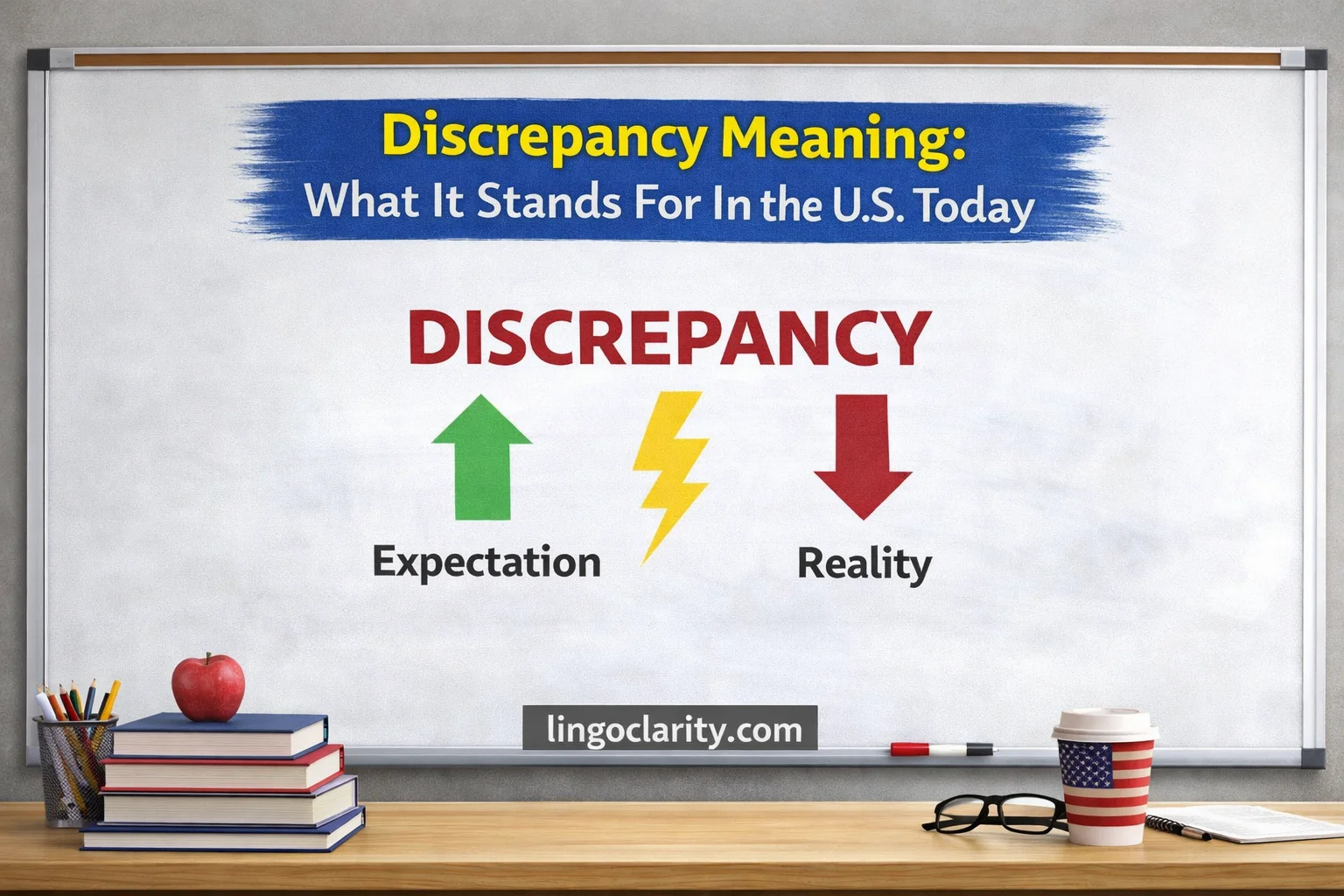
You may see the word discrepancy in bank alerts, office emails, school records, audit reports, legal documents, medical notes, and research papers. It usually appears when two details do not line up even though they should. That is why the word often shows up in writing about numbers, facts, totals, statements, dates, and records. Major dictionaries define discrepancy as a difference between things that are expected to be the same, and Cambridge also notes it in business and academic use.
Many learners understand the basic idea but still hesitate to use the word. That happens because discrepancy sounds more formal than common words like difference or mismatch. It also gets confused with disparity, even though the two words are not the same. Collins specifically explains that a discrepancy exists between things that ought to be the same, while a disparity is a larger difference between measurable things such as wages, rank, or age.
This guide explains the discrepancy meaning in plain English. You will learn the definition, pronunciation, part of speech, plural form, common sentence patterns, synonyms, opposites, real-life examples, and common mistakes. By the end, you should feel comfortable using the word correctly in both formal writing and everyday reading.
Quick Answer
Discrepancy means a difference or mismatch between things that should match. It is a formal noun and commonly appears in writing about figures, results, facts, claims, and records.
TL;DR
• Discrepancy means a mismatch that needs attention.
• It is a formal standard English noun.
• It often appears in reports, records, data, and statements.
• The most common patterns are discrepancy between and discrepancy in.
• It is not the same as disparity.
• The plural form is discrepancies.
What Discrepancy Means In Plain English
In plain English, discrepancy means that two or more things do not agree when they are supposed to agree. One number may say one thing while another number says something else. One report may show one result while a second report shows a different result. One person’s version of events may not match another person’s version. That mismatch is a discrepancy.
The word often suggests more than a simple difference. It usually hints that something may be wrong, unclear, incomplete, or in need of explanation. Cambridge’s American Dictionary says it is an unexpected difference in amounts, facts, or conditions that suggests something is wrong and has to be explained. That idea is important because it shows why the word sounds precise and serious.
So if your receipt says one total but your payment app shows another, that is a discrepancy. If two records list different dates for the same event, that is also a discrepancy. In both cases, the problem is not just that two things are different. The problem is that they were supposed to match.
Simple Definition
A simple definition is:
Discrepancy means a difference that should not be there because two things are expected to match.
That short meaning is often the easiest one to remember. If something should agree but does not, you may have a discrepancy.
Pronunciation, Part Of Speech, And Forms
The usual pronunciation is dis-KREP-un-see. Merriam-Webster gives it as di-ˈskre-pən-sē, and Cambridge gives the American pronunciation as /dɪˈskrep.ən.si/. The strongest stress falls on KREP, which is the middle part of the word.
Discrepancy is a noun. The plural form is discrepancies. Cambridge lists it as countable or uncountable in business English, while Collins and Merriam-Webster show the regular plural form clearly.
Here is how the forms work:
Singular:
• There is a discrepancy in the report.
Plural:
• The auditor found several discrepancies.
General use:
• There is some discrepancy in the data.
Those patterns are useful because learners often need to know whether the word can take a plural. Yes, it can.
Why Discrepancy Sounds Formal
This is not slang or casual chat language. It is a formal word that appears more often in reports, research writing, legal language, accounting, administrative notes, and professional emails. Cambridge marks the word in learner and business contexts, while Collins shows it in examples involving claims, facts, figures, and payments.
That does not mean you cannot say it aloud in everyday life. You can. Still, in casual conversation, people often prefer simpler words such as difference, mix-up, or mismatch. For example:
Formal: There is a discrepancy in the list.
Casual: The list does not match.
Both are correct. The first one simply sounds more professional.
How To Use Discrepancy Correctly
Use discrepancy when two things should match but do not. The word works best when accuracy matters.
The most common patterns are:
• a discrepancy between two things
• a discrepancy in a report, record, figure, or result
• explain a discrepancy
• resolve a discrepancy
• notice a discrepancy
• report a discrepancy
Here are some clear sentence models:
• There was a discrepancy between the invoice and the payment.
• The team found a discrepancy in the survey totals.
• We need to explain the discrepancy before the meeting.
• A small discrepancy in the data delayed the report.
• The company resolved the discrepancy in its records.
These sentences work well because they all involve facts, records, or numbers that are expected to line up.
Real-Life Example
Imagine that you order ten books for your office. The invoice says 10, but the box contains only 8. When you compare the order to the delivery, you find a discrepancy.
Now imagine a student opening a grade portal. The screen shows 91, but the printed report card shows 87. That is also a discrepancy.
Here is one more example from a workplace setting. A payroll sheet says an employee worked 40 hours, but the time-tracking system shows 37 hours. That difference needs checking because the records should match. In formal writing, that is exactly the kind of situation where discrepancy fits naturally.
Common Contexts Where You See Discrepancy
Money And Accounting
This is one of the most common areas for the word. A discrepancy may appear in a balance sheet, invoice, payment record, tax file, inventory count, or payroll report. Cambridge’s business examples specifically show discrepancies in figures, records, and accounts.
Data And Research
Researchers may mention a discrepancy between expected results and actual results. They may also note a discrepancy in measurements, reporting methods, or sample counts. Merriam-Webster and Collins both show example uses in statements and financial records, which fit this careful, evidence-based style.
Statements And Reports
In legal writing, journalism, and investigations, a discrepancy may exist between two witness statements or two versions of the same event. Collins gives an example involving press and radio reports, and Merriam-Webster gives an example involving accounts of an accident.
School And Office Work
Teachers, managers, and assistants may use the word when dates, names, deadlines, figures, or records do not agree. It is especially useful when the issue needs a professional explanation.
Discrepancy Vs Difference Vs Disparity
These words are related, but they are not interchangeable.
| Word | Best Use | Main Idea |
|---|---|---|
| Discrepancy | When two things should match but do not | mismatch or lack of agreement |
| Difference | When you want the broadest and simplest word | any contrast |
| Disparity | When you mean a wider gap or inequality | imbalance or unequal levels |
A difference is the broadest word. It can describe almost any contrast at all. Two opinions can be different. Two colors can be different. Two methods can be different.
A discrepancy is narrower. It usually points to an inconsistency between things that should agree, balance, or harmonize. Collins and Dictionary.com both explain that idea clearly.
A disparity is different again. Collins explains that disparity usually means a large difference between measurable things such as age, rank, or wages. That is why a pay disparity sounds natural, while a record discrepancy sounds natural in accounting or reporting.
Synonyms Of Discrepancy
Common synonyms include:
• mismatch
• inconsistency
• difference
• variance
• disagreement
• divergence
Merriam-Webster and Collins both connect discrepancy with words like difference, variance, and inconsistency. Still, the best synonym depends on the sentence.
Here is a quick guide:
Mismatch is plain and direct.
Inconsistency often works well for logic, facts, or behavior.
Variance sounds more technical or statistical.
Difference is the broadest and simplest choice.
For example:
• There is a discrepancy in the record.
• There is a mismatch in the record.
Both are possible, but discrepancy sounds more formal.
Opposites Of Discrepancy
There is no single perfect opposite for every context, but these words often work well:
• agreement
• consistency
• correspondence
• accord
• match
For example:
• There is a discrepancy between the two reports.
• There is strong agreement between the two reports.
Or:
• We found a discrepancy in the totals.
• The totals are consistent.
These opposites work because they express the idea of things lining up correctly.
Sentence Usage You Can Copy
Here are natural sentence patterns you can use in writing:
• There is a discrepancy between the two totals.
• We found a discrepancy in the customer file.
• The report shows a discrepancy in last month’s figures.
• Please review the record and explain the discrepancy.
• A discrepancy between the two versions delayed approval.
• The lab is checking a discrepancy in the results.
• Even a small discrepancy can create confusion later.
• The audit uncovered several discrepancies in the accounts.
These patterns are clear, formal, and easy to adapt for essays, reports, emails, and professional notes.
Common Mistakes And Easy Fixes
Using It For Every Kind Of Difference
Do not use discrepancy for every kind of difference.
Too broad: There is a discrepancy between tea and coffee.
Better: There is a difference between tea and coffee.
Tea and coffee are simply different things. They are not expected to match. That is why difference is the better word here.
Mixing It Up With Disparity
This is one of the most common mistakes.
Less accurate: There is a discrepancy in income levels across the region.
Better: There is a disparity in income levels across the region.
Use discrepancy for mismatches in things that should agree. Use disparity for wider gaps or inequalities. Collins states this distinction directly.
Using The Wrong Sentence Pattern
The safest patterns are:
• a discrepancy between A and B
• a discrepancy in something
These patterns appear in dictionary examples and are the most natural ones for learners.
Making Your Tone Too Formal
In office writing, discrepancy is useful and precise. In casual speech, it may sound heavier than needed.
Formal: There is a discrepancy in the list.
Casual: The list does not match.
Choose the tone that fits your audience.
Being Too Vague
Try not to leave the reader guessing.
Weak: There is a discrepancy.
Better: There is a discrepancy between the website total and the printed invoice.
The second version is much clearer because it explains exactly what does not match.
Etymology And Word History
If you like word origins, discrepancy comes from Latin roots connected to disagreeing or sounding differently. Merriam-Webster traces it to Latin discrepantia, and Collins also gives a Latin origin through discrepare. This history matches the modern meaning because the word still carries the idea of lack of agreement.
You do not need the word history to use discrepancy well. Still, it helps explain why the word feels more formal than short everyday options like gap, difference, or mix-up.
Mini Quiz
Choose the best answer.
1. Which sentence uses discrepancy correctly?
A. She wore a discrepancy jacket to class.
B. There was a discrepancy between the two reports.
2. Which word fits best?
There is a ___ in the payment record.
A. discrepancy
B. picnic
3. Which word is closest in meaning to discrepancy?
A. mismatch
B. holiday
4. Which word fits better for a large pay gap?
A. discrepancy
B. disparity
Answer Key
1. B
2. A
3. A
4. B
FAQs
What does discrepancy mean in simple English?
In simple English, discrepancy means a difference or mismatch that should not be there. It usually means that two things do not agree even though they are expected to match.
Is discrepancy a formal word?
Yes. It is usually a formal word and appears often in reports, research, office communication, accounting, legal writing, and technical contexts. Cambridge and Collins both present it in formal-style examples about figures, facts, conditions, and records.
How do you use discrepancy in a sentence?
The most common patterns are discrepancy between and discrepancy in. For example: “There was a discrepancy between the two reports” or “We found a discrepancy in the figures.” These patterns are supported by dictionary examples.
What is the difference between discrepancy and disparity?
A discrepancy is a mismatch between things that should match. A disparity is usually a larger gap or inequality between measurable things such as wages, status, or age. Collins explains this distinction directly in its usage note.
Is discrepancy countable or uncountable?
It can be both. You can say a discrepancy, several discrepancies, or some discrepancy, depending on the meaning and structure of the sentence. Cambridge lists it as countable or uncountable in business English.
What does discrepancy mean in accounting?
In accounting, discrepancy usually means that numbers or records do not match. A payment, invoice, account, or balance may show a discrepancy that needs review or explanation. Cambridge’s business examples use the word exactly in this kind of context.
Does discrepancy always mean something is wrong?
Not always, but it usually signals that something needs attention or explanation. The reason may be small, such as a typo or delay, or more serious, such as an error in records. Cambridge’s definition says the difference suggests that something is wrong and has to be explained.
Conclusion
Discrepancy is a formal English noun that means a mismatch between things that should line up. It is especially useful in writing about figures, records, reports, facts, and statements. Once you connect the word with the idea of “things that should match but do not,” it becomes much easier to understand and use.
The safest way to use it is simple: think of two details that ought to agree, then describe the problem with a pattern like discrepancy between or discrepancy in. Use difference when you want a broader everyday word. Use disparity when you mean a larger inequality. That one distinction will help you use discrepancy clearly, naturally, and correctly.
