
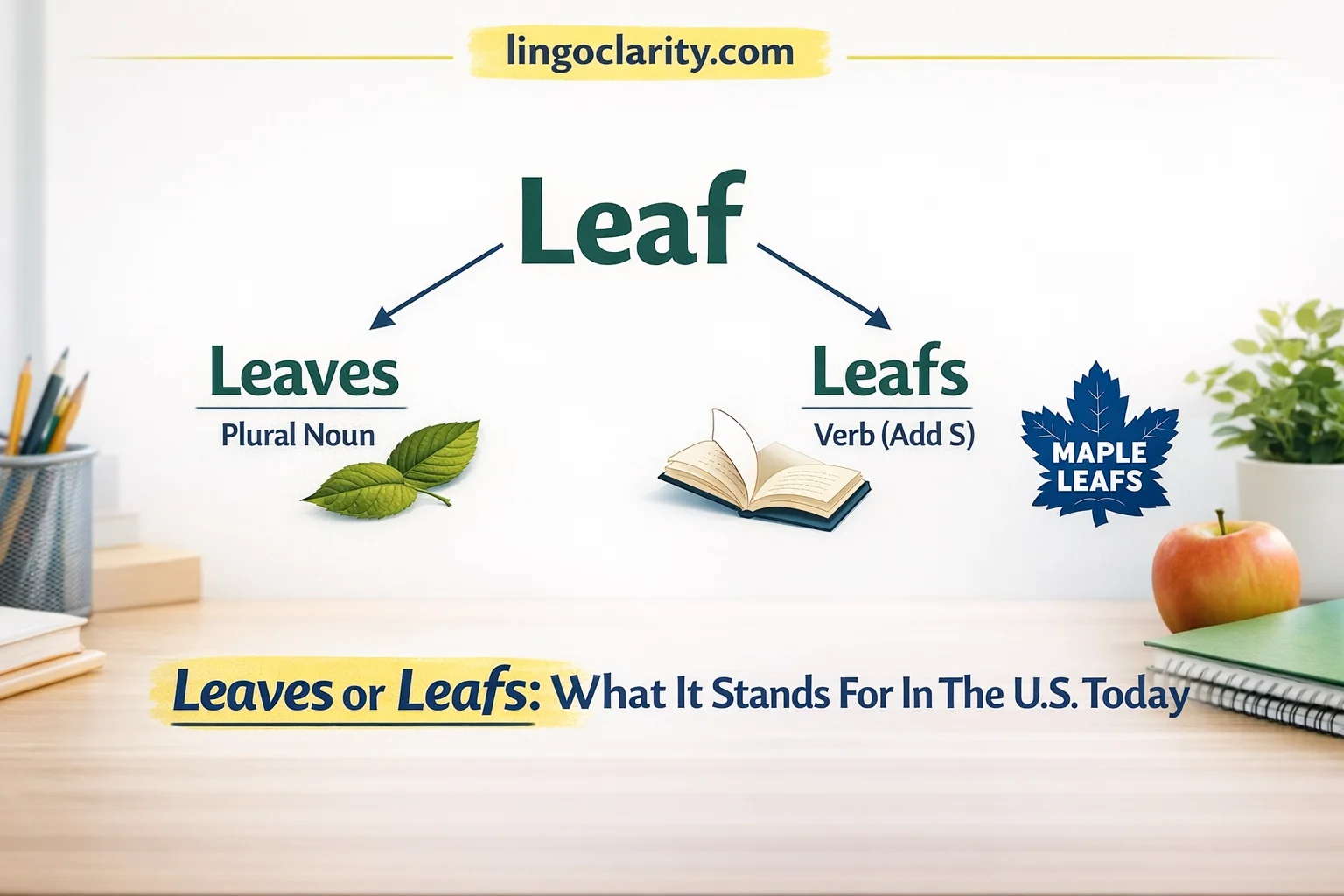
Many English words look simple at first. However, once you try to use them in a sentence, they can become surprisingly tricky. Leaf is one of those words.
At first glance, you may assume the plural should be leafs because many English nouns simply add -s. However, standard US English usually does not follow that pattern here. Instead, the normal plural noun is leaves.
That said, leafs is not always wrong. In fact, it can be correct in certain situations, especially when leaf is used as a verb. In addition, you may see Leafs in a fixed proper name such as Toronto Maple Leafs. Because both forms exist, many writers hesitate and wonder which one belongs in everyday writing.
Fortunately, the answer becomes much easier once you know the grammar role of the word. In other words, you need to ask whether you are using leaf as a noun, a verb, or part of a name. Once you make that distinction, the confusion mostly disappears.
Quick Answer
If you mean more than one leaf, the correct plural noun in standard US English is leaves.
Use leafs only in narrower cases, such as:
- the third-person singular form of the verb leaf
- a fixed proper name, such as Toronto Maple Leafs
So, in ordinary writing about plants, pages, or table parts, leaves is almost always the correct choice.
| Form | Best Use | Example |
|---|---|---|
| leaves | plural noun | The tree dropped its leaves. |
| leafs | verb form | She leafs through the catalog. |
| Leafs | fixed proper name | The Maple Leafs won in overtime. |
What Is Correct?
In normal US English, leaves is the correct plural of leaf. For example, you would write about autumn leaves, loose leaves of paper, or table leaves that extend a dining table.
By contrast, leafs is usually not the correct plural noun in everyday writing. If you write, “The yard is full of leafs,” most readers will notice the form immediately and treat it as a mistake.
Still, context matters. While leafs is usually wrong as a plural noun, it can be correct as a verb. For instance, “He leafs through the newspaper” is correct because the word is not acting as a plural noun there. Instead, it is the present-tense verb form.
Therefore, the real issue is not just spelling. Rather, it is grammar.
The Core Grammar Rule
The noun leaf usually forms its plural by changing -f to -ves:
- leaf → leaves
This pattern appears in several common English nouns. For example:
- calf → calves
- half → halves
- knife → knives
- shelf → shelves
- wolf → wolves
Because of that pattern, leaves is the standard plural form.
Even so, not every English word ending in -f changes to -ves. Some nouns simply add -s instead. That is why many writers get unsure. Nevertheless, for leaf, standard US English clearly prefers leaves when you mean more than one.
So, if the word is a plural noun, leaves is the safe and correct form.
Why This Pair Causes Confusion
This pair confuses writers for several reasons. First, the spelling looks as though it should follow the common add-s pattern. As a result, many people naturally write leafs before stopping to think.
Second, leafs is a real English word. Therefore, it does not always look obviously wrong. In fact, some spellcheck tools may let it pass, especially if the sentence structure does not make the error clear.
Third, leaves has another job in English. It can also be the third-person singular form of the verb leave, as in “She leaves at noon.” Because of that, writers sometimes second-guess themselves.
Finally, the proper name Toronto Maple Leafs makes the confusion even stronger. Since that form is widely seen in sports coverage, some people assume it must also be the normal plural noun. However, that conclusion is incorrect.
Simple Definition
Here is the easiest way to remember the difference:
- leaf = one leaf
- leaves = more than one leaf
- leafs = a verb form, usually meaning flips through pages or produces leaves
That simple distinction will solve most cases.
When To Use Leaves
Use leaves when you are talking about more than one leaf as a noun. This is the standard plural form in modern US English.
Leaves In Nature
Most often, people use leaves for the green or dry parts of plants and trees.
For example:
- The wind blew the leaves across the yard.
- Bright yellow leaves covered the sidewalk.
- By October, the maple tree had already lost many of its leaves.
In each case, the word refers to more than one plant leaf. Therefore, leaves is correct.
Leaves As Pages Or Sheets
In addition, leaf can mean a sheet of paper, especially in books, manuscripts, or printed materials. In that sense, the plural is still leaves.
For example:
- Several loose leaves were missing from the binder.
- The librarian repaired the torn leaves of the old book.
- Please place the extra leaves in the correct folder.
Again, the plural noun form is leaves.
Leaves As Table Extensions
Likewise, a table leaf is the extra section that makes a table longer. When you mean more than one, the plural is also leaves.
For example:
- We added two leaves to the dining table.
- The extra leaves are stored in the closet.
- During the holidays, the table leaves help us seat everyone.
So, whether you mean plant parts, pages, or table sections, the standard plural noun remains leaves.
When To Use Leafs
Use leafs when leaf is acting as a verb, especially in the third-person singular present tense.
In everyday English, that usually means:
- flips through pages
- browses quickly
- produces leaves
For example:
- He leafs through the sports section every morning.
- She leafs through her planner before meetings.
- In spring, the tree leafs out quickly.
Here, leafs is correct because the word is not a plural noun. Instead, it is a verb.
This point matters a lot. Many writers know that leaves is common, so they use it everywhere. However, in a sentence like “He leafs through the magazine,” leaves would be wrong because the sentence needs the verb leaf, not the verb leave.
Why Maple Leafs Is Different
The phrase Toronto Maple Leafs is an official team name. Therefore, it keeps its own fixed spelling.
That means this sentence is correct:
- The Maple Leafs have a loyal fan base.
However, that does not change the general grammar rule. In other words, you should not copy the team spelling into ordinary noun use.
So this is still wrong:
- The driveway was covered with leafs. ❌
And this is still correct:
- The driveway was covered with leaves. ✅
Proper names often preserve unusual spellings or older patterns. Therefore, the team name is a special case, not a model for everyday grammar.
Meaning And Grammar Role
The difference between leaves and leafs is not only about spelling. More importantly, it is about grammar role.
Leaves As A Noun
Most often, leaves works as a plural noun:
- The children gathered red leaves.
- The printer mixed up the loose leaves.
Leaves As A Verb
At the same time, leaves can also be a verb form of leave:
- She leaves for work at eight.
- My brother leaves early on Fridays.
Leafs As A Verb
Meanwhile, leafs usually works as a verb form of leaf:
- He leafs through the mail.
- The bush leafs out in warm weather.
Because these forms come from different base words, context is everything. Therefore, the smartest move is to check the job the word is doing in the sentence.
Real-Life Example
Imagine a normal fall weekend.
First, your children go outside and collect colorful leaves for a school project. Later, you prepare the dining room for dinner and add two leaves to the table. After that, your father sits in the living room and leafs through the Sunday paper.
All three sentences are correct. Even better, they show the pattern clearly:
- leaves = plural noun
- leafs = verb
Because the difference appears in real-life situations, it becomes easier to remember.
Sentence Usage
These examples show how leaves and leafs work in real sentences.
Correct Use Of Leaves
- For their art project, the children collected colorful leaves.
- By late afternoon, autumn leaves covered the front steps.
- After the storm, three leaves fell onto the porch.
- Before printing, the editor checked the loose leaves.
- To make room for guests, we added the table leaves.
Correct Use Of Leafs
- Every morning, he leafs through the sports section.
- Before meetings, she leafs through her planner.
- In warm weather, the rose bush leafs out quickly.
Correct Use Of Leafs As A Name
- The Maple Leafs have a loyal fan base.
Common Mistakes
Writers often make the same mistakes with this pair. Fortunately, each one has a simple fix.
Mistake 1: Using Leafs As The Plural Noun
Incorrect:
- The ground was covered with leafs.
Correct:
- The ground was covered with leaves.
Why It Happens:
Many writers follow the usual add-s pattern too quickly. However, leaf is one of the nouns that changes to -ves in the plural.
Mistake 2: Using Leaves When The Sentence Needs The Verb Leaf
Incorrect:
- He leaves through the magazine every Sunday.
Correct:
- He leafs through the magazine every Sunday.
Why It Happens:
Because leaves looks more familiar, some writers choose it without checking the base word. In reality, the sentence needs the verb leaf.
Mistake 3: Copying The Team Name Into Normal Writing
Incorrect:
- I cleaned the leafs from the gutter.
Correct:
- I cleaned the leaves from the gutter.
Why It Happens:
The proper name Maple Leafs is memorable. As a result, some people carry that spelling into ordinary writing, where it does not belong.
Mistake 4: Forgetting That Leaves Has More Than One Meaning
Some writers avoid leaves because they know it can also be a form of leave. Even so, context makes the meaning clear.
For example:
- She leaves at noon.
- The tree has bright green leaves.
Both sentences are correct. They simply come from different base words.
Synonyms
Because leaf has several meanings, the best synonym depends on the context. A word that fits a plant sentence may not fit a book sentence. Therefore, it helps to choose the synonym carefully.
Synonyms For Leaf Or Leaves In The Plant Sense
When leaf refers to the flat green part of a plant, these synonyms may work depending on the context:
- foliage
- greenery
- frond, in some contexts
- blade, in some botanical contexts
For example:
- The garden was filled with thick foliage.
- Fresh greenery lined the walkway.
Synonyms For Leaf As A Page
When leaf means a sheet of paper in a book, file, or manuscript, these alternatives may fit:
- sheet
- page
- folio, in technical contexts
For example:
- One page was torn from the notebook.
- The report arrived as a loose sheet.
Synonyms For Leaf As A Verb
When leaf means to move through pages quickly, these are often the most natural alternatives in everyday US English:
- flip through
- browse
- thumb through
- look through
For example:
- He leafs through the magazine.
- He flips through the magazine.
Opposites
There is no single perfect opposite for leaf in every sense. Still, some contrasting terms can help clarify the meaning.
Opposites Or Contrasts In The Plant Sense
Depending on the sentence, the contrast may be:
- bare branch
- trunk
- root
- stem
For example:
- In winter, the branches are bare, with no leaves left.
Opposites Or Contrasts In The Verb Sense
If leaf through means to browse quickly, then a rough opposite might be:
- study carefully
- examine closely
- focus on
- read in detail
For example:
- She did not just leaf through the report; instead, she studied it carefully.
These are not perfect dictionary opposites in every case. However, they do help show the contrast in meaning.
A Quick Memory Trick
A simple memory trick can make this choice easier.
If you mean many, think -ves:
- one leaf
- two leaves
Then remember this:
- if someone flips pages, that person leafs through them
So the pattern becomes clear:
- plural noun = leaves
- verb form = leafs
Because the two forms do different jobs, they should not be swapped.
Why Leaves Is The Safer Choice In Most Sentences
If you are writing a normal sentence and feel unsure, leaves is usually the safer choice when the word is a noun. That is especially true in school writing, blog posts, formal documents, and edited content.
Readers expect the standard plural right away. Therefore, leaves sounds natural and polished. By contrast, leafs in a noun sentence often interrupts the reader and draws attention for the wrong reason.
Good grammar should support your writing quietly. As a result, choosing the standard form helps your sentence feel smooth and professional.
Conclusion
For everyday US English, the answer is straightforward: leaves is the correct plural of leaf.
Use leaves when you mean more than one plant leaf, page leaf, or table leaf. Use leafs only when the sentence calls for the verb form, such as “He leafs through the paper,” or when you are writing a fixed proper name like Toronto Maple Leafs.
So, if your sentence means more than one leaf, choose leaves. In nearly every ordinary noun sentence, that is the correct and natural form.
FAQs
Is leaves the correct plural of leaf?
Yes. In standard US English, leaves is the normal plural noun form of leaf.
Is leafs ever correct?
Yes. Leafs can be correct as the third-person singular form of the verb leaf. In addition, it is correct in fixed names such as Toronto Maple Leafs.
Why do some people write leafs?
Usually, people apply the common add-s plural pattern by instinct. In other cases, they may be influenced by the verb form leafs or the team name Maple Leafs.
Do book pages and table parts also use leaves?
Yes. In standard usage, the plural of a book leaf and a table leaf is also leaves.
Is leafs wrong in every situation?
No. It is not wrong in every situation. However, it is usually wrong as the ordinary plural noun in modern US English.
Can leaves also be a verb?
Yes. Leaves can also be the third-person singular form of leave, as in “She leaves early on Fridays.” However, that meaning is separate from the plural noun of leaf.
What should I use in formal writing?
In formal writing, use leaves whenever you mean the plural noun. That is the standard and safest choice.
Does the Maple Leafs team name change the grammar rule?
No. Maple Leafs is a proper name. Therefore, it does not change the general rule that the normal plural noun is leaves.
