
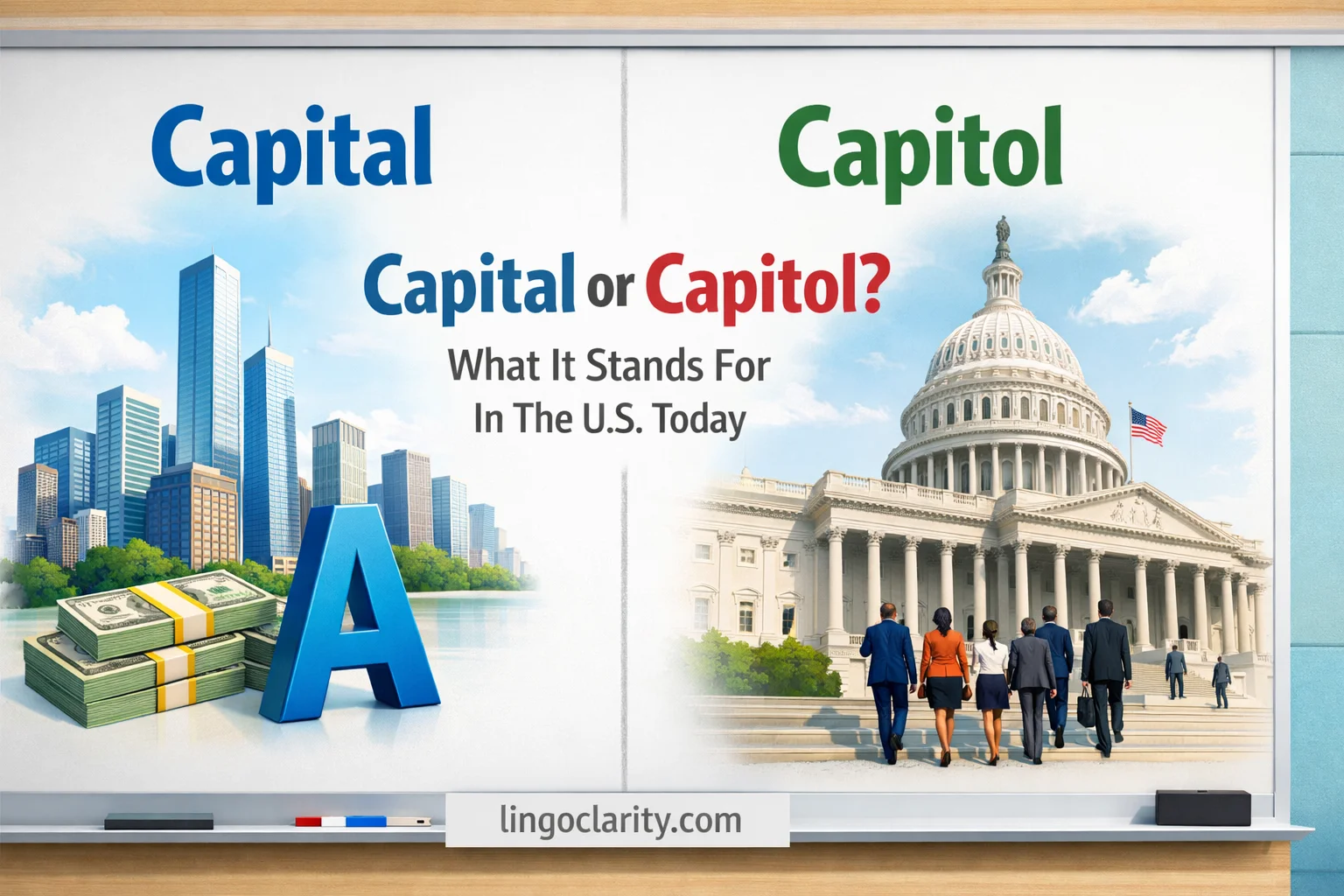
Capital and capitol sound exactly the same, which is why so many writers stop and second-guess themselves. The spelling difference is tiny, yet the meaning difference matters. In US English, these two words are not interchangeable. One is broad and common. The other is narrow and specific.
The easiest way to remember the rule is this: capital usually refers to a city, money, an uppercase letter, or something main or serious, while capitol refers to a legislative building. That single contrast clears up most mistakes right away.
You can see the difference in one sentence: Washington, D.C., is the capital of the United States, but Congress meets in the Capitol. The first word names the government city. The second names the building used by the legislative branch.
Quick Answer
Use capital when you mean:
- a country’s, state’s, or region’s main government city
- money or business resources
- an uppercase letter
- something chief, principal, or very serious
Use capitol when you mean:
- the building where a legislature meets
- the U.S. Capitol
- a state capitol
So, if you mean the city, write capital. If you mean the government building, write capitol.
Simple Definition
Here is the simplest way to separate the two words:
Capital = a city, money, a capital letter, or something important, chief, or severe
Capitol = a lawmaking building
That is the core rule in plain English. Moreover, it works in nearly every situation. If your sentence is about a place on the map, money, grammar, or a general idea, capital is usually right. If your sentence is about the building where lawmakers meet, capitol is the right spelling.
Why People Confuse Capital And Capitol
These words are easy to mix up for three reasons. First, they are homophones, so they sound the same when spoken. Second, they differ by just one letter. Third, they often appear in similar topics, especially politics, government, civics, and news writing.
Because of that overlap, people often write capital building when they mean the legislature’s building, or capitol city when they mean the seat of government. Even careful writers make this mistake because the surrounding topic feels political in both cases. Still, the spelling depends on meaning, not on sound or subject area.
Key Difference At A Glance
Think of the contrast this way:
- capital = city, money, uppercase letter, chief, principal, or severe
- capitol = the building where lawmakers meet
- Capital with a capital C can be part of a proper name, but the Capitol specifically refers to the U.S. Capitol in Washington, D.C.
- capitol stays narrow in meaning, while capital covers several everyday meanings
That broad-versus-narrow contrast is what makes the pair easier to remember.
What Capital Means In US English
Capital is the more flexible word. It can be a noun or an adjective, and it appears in far more contexts than capitol. Merriam-Webster defines it with several established meanings, including a seat of government, accumulated wealth or resources, and an uppercase letter. It also appears in adjective uses such as capital punishment and capital crime.
In geography, capital means the main city where a government is based. For example, Austin is the capital of Texas, and Washington, D.C., is the capital of the United States. In business, capital refers to money or assets used to run or grow an organization. In writing and grammar, a capital letter means an uppercase letter.
You also see capital in fixed expressions such as capital gains, political capital, capital punishment, and capital letter. So, in real writing, this is the word most people will use far more often.
What Capitol Means In US English
Capitol is much more limited. Merriam-Webster defines it as a building where a state legislative body meets, and when capitalized as Capitol, it can refer specifically to the building where the U.S. Congress meets in Washington. The Architect of the Capitol also describes the U.S. Capitol as the focal point of the legislative branch and the building that houses the meeting chambers of the Senate and the House of Representatives.
That narrow meaning is useful because it removes guesswork. If you are talking about lawmakers gathering, voting, debating, or entering a government building, capitol is probably the word you want. If you are not talking about a legislative building, then capital is usually the correct choice instead.
Real-Life Example
Here is the most helpful real-life example:
Washington, D.C., is the capital. The Capitol is the building where Congress meets.
This example works so well because it shows both words in one place. Washington, D.C., is the city that serves as the nation’s seat of government. Meanwhile, the Capitol is one specific building inside that city. Once you see that city-versus-building distinction in a real sentence, the difference becomes much easier to remember.
How To Choose The Right Word Every Time
A fast editing check can solve this problem in seconds.
Ask yourself: Am I writing about a city or a building?
If the answer is city, choose capital.
If the answer is building, choose capitol.
If the sentence is about money, grammar, or a phrase like capital punishment, then the answer is also capital. In other words, capitol has one main job, while capital handles the rest.
A Memory Trick That Actually Helps
A popular memory trick is the o in capitol. Many capitol buildings have a dome, and the round o can remind you of that shape. Merriam-Webster specifically notes this dome-based reminder in its guidance, which is why so many teachers and editors still use it.
Another easy trick is even simpler: capital is the common word, and capitol is the building word. That rule is less visual, but it is practical and usually faster when you are editing quickly.
Sentence Usage
Here are natural examples that show how each word works in real US English.
Correct Use Of Capital
- Albany is the capital of New York.
- The company needs more capital before it can expand.
- Please write your full name in capital letters.
- The report called it a capital mistake.
- The article discussed capital punishment.
These are all standard uses of capital, and each one matches a recognized dictionary meaning.
Correct Use Of Capitol
- Visitors lined up outside the state capitol.
- The governor gave a speech at the capitol.
- Tour groups visited the U.S. Capitol in Washington, D.C.
- News crews waited near the Capitol after the vote.
- Lawmakers returned to the capitol after recess.
These examples fit the building meaning of capitol and the proper-name use of the Capitol in Washington.
Synonyms
The best synonyms depend on which meaning you need.
Synonyms Of Capital
For the city sense:
- seat of government
- capital city
For the money sense:
- funds
- assets
- financing
- investment
For the uppercase-letter sense:
- capital letter
- uppercase letter
For the chief or main sense:
- principal
- main
- leading
- chief
These are not perfect replacements in every sentence, but they are close depending on context.
Synonyms Of Capitol
Because capitol has a narrower meaning, it has fewer natural synonyms. Merriam-Webster’s thesaurus points to close alternatives such as statehouse. Depending on context, you may also see legislative building or government building, although those are broader and less exact.
Opposites
These words do not always have neat opposites, but some contexts do.
Opposites Of Capital
- For capital letter, the opposite is lowercase letter
- For chief or main, an opposite could be minor or secondary
- For financial capital, the opposite depends on the sentence and does not have one fixed everyday antonym
Opposites Of Capitol
There is no true everyday antonym for capitol. It names a specific kind of building, so English usually describes contrast with a phrase instead of a direct opposite word. That is normal for many concrete nouns.
Common Mistakes
One very common mistake is using capitol for a city.
Incorrect: Paris is the capitol of France.
Correct: Paris is the capital of France.
That is wrong because Paris is a city, not a legislature building.
Another common mistake is using capital for a government building.
Incorrect: The protest happened at the state capital.
Correct: The protest happened at the state capitol.
That is wrong because the sentence refers to the building where lawmakers meet.
A third mistake involves capitalization.
Incorrect: Congress met at the capitol in Washington.
Correct: Congress met at the Capitol in Washington.
The lowercase form works for general references such as the state capitol, but the specific building where Congress meets is the Capitol.
Capitalization Rules That Matter
This topic gets confusing because capital and capitalized are not the same issue.
Use lowercase capital in general uses:
- the capital of Ohio
- startup capital
- capital letters
Use lowercase capitol for a general state legislative building:
- the state capitol
- the downtown capitol
Use uppercase Capitol when it is part of a proper name or when you mean the U.S. Capitol:
- the U.S. Capitol
- Capitol Hill
- the Capitol dome
That pattern reflects both dictionary usage and official federal wording.
Why Capital Appears More Often Than Capitol
In everyday writing, capital is simply the more useful word. It shows up in geography, education, law, business, economics, and grammar. By contrast, capitol appears mainly in government and civics contexts. That is why many writers default to capital even when it is wrong. The word is familiar, broad, and more common overall.
However, when the sentence is about the building where legislators work, that broader familiarity can lead to a mistake. So, it helps to pause whenever the sentence includes lawmakers, chambers, government tours, or public speeches at a government building. In those cases, capitol deserves a second look.
Final Verdict
If you want one simple rule that solves almost everything, use this: capital is the broad word, and capitol is the building word. A capital can be a city, money, an uppercase letter, or something principal or serious. A capitol is the place where a legislature meets. The U.S. Capitol is in the nation’s capital, but the two words do not mean the same thing.
Once you lock in that contrast, the choice becomes much easier. When you mean the city, write capital. When you mean the building, write capitol. That is the rule most readers expect, and it is the one that keeps your writing clear and correct.
FAQs
Is it the capital or the capitol of a state?
It is the capital of a state when you mean the main government city. It is the state capitol when you mean the building where the legislature meets.
Is Washington, D.C., the capital or the Capitol?
Washington, D.C., is the capital of the United States. The Capitol is the building in Washington where the U.S. Congress meets.
Can capital and capitol ever mean the same thing?
No. They may appear in the same topic area, especially government writing, but they have different meanings. Capital is broad, while capitol refers to a legislature building.
Why is Capitol sometimes capitalized?
It is capitalized when it is part of a proper name or when it specifically refers to the U.S. Capitol. General uses, such as state capitol, are usually lowercase unless they appear in an official name.
What is the easiest trick for remembering capital vs. capitol?
Think of the o in capitol as a dome. That helps many writers remember that capitol is the building word. Then remember that capital covers the broader meanings, including city, money, and uppercase letter.
