

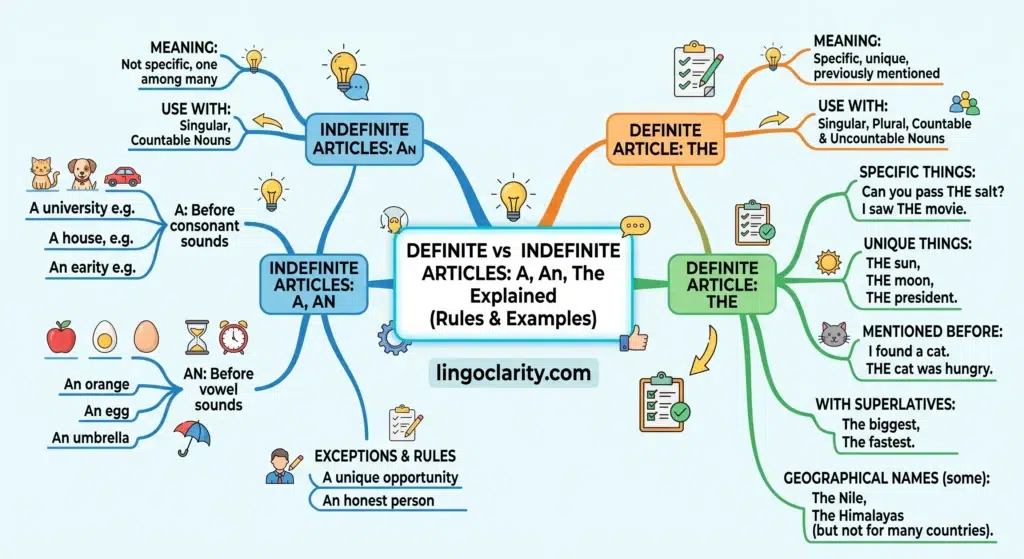
Articles are tiny words, yet they can change the meaning of a sentence very quickly. In English, the indefinite articles are a and an, while the definite article is the. Although these words seem simple, they help readers and listeners understand whether you mean something general, something non-specific, or something already known.
For example, there is an important difference between I need a charger and I need the charger. In the first sentence, any charger will do. In the second sentence, one specific charger is meant.
At first, many learners think article choice is just a grammar detail. However, it actually affects clarity, precision, and tone. In addition, English sometimes uses no article at all, which can make the topic even more confusing.
Because of that, this guide is not only about memorizing three short words. Instead, it is about understanding how English signals meaning. Once you understand the pattern, article choice starts to feel much more natural.
Quick Answer
Use a/an for one non-specific singular count noun. Choose the for a specific noun. Meanwhile, use no article with plural nouns or uncountable nouns when the meaning is general.
| Form Or Pattern | Best Use | Example |
|---|---|---|
| a/an + singular count noun | One non-specific thing | a book, an apple |
| the + noun | A specific or known thing | the book, the apple on the desk |
| no article + plural or uncountable noun | General meaning | Books are useful, Water matters |
Simple Definition
A definite article points to a noun that is specific. In English, that article is the.
An indefinite article points to a noun that is not specific. In English, those articles are a and an.
English also has a zero article pattern. In other words, sometimes no article appears before the noun at all. Usually, that happens with plural nouns and uncountable nouns when the statement is general.
What Is The Main Difference?
The main difference is specificity.
When you use a or an, you mean one person or thing, but not one clearly identified person or thing. By contrast, when you use the, you mean a noun that the reader or listener can identify.
Look at this pair:
- I saw a dog outside.
- I saw the dog outside.
In the first sentence, the dog is new information. In the second sentence, the dog is specific. As a result, the second sentence points to a dog that is already known, already mentioned, or obvious in the situation.
So, article choice is not random. Instead, it depends on what meaning you want the sentence to carry.
The Core Grammar Rule
The rule becomes easier when you break it into two questions.
First, ask whether the noun is specific. If the reader or listener can identify it, use the. If not, and the noun is singular and countable, use a or an.
Next, ask what kind of noun you have. A singular countable noun usually cannot stand alone in standard English. Therefore, it normally needs a/an, the, or another determiner such as my, this, that, or each.
That is why these are correct:
- I bought a car.
- I bought the car we discussed.
- She is a teacher.
However, these are not standard:
- I bought car.
- She is teacher.
Meanwhile, plural nouns and uncountable nouns often appear with no article when the meaning is general:
- Cars are expensive.
- Water is important.
- Teachers need patience.
So, the real rule is larger than a/an vs the. You also need to notice when English prefers no article.
When To Use A Or An
Use a or an with a singular count noun when you mean one non-specific person, place, or thing.
This happens in several common situations. For example, you use a/an for first mention, for classification, for jobs, and for one example of a larger group.
Examples:
- I need a pen.
- She is a doctor.
- He bought an electric bike.
- We watched a movie last night.
- She offered an idea.
In each case, the noun is singular, countable, and not specific.
How To Choose Between A And An
The choice depends on sound, not spelling. That point matters a lot.
Use a before a consonant sound:
- a university
- a user
- a one-time fee
Use an before a vowel sound:
- an hour
- an honest mistake
- an MBA
Even though university begins with the letter u, it starts with a y sound. Therefore, a university is correct. On the other hand, hour begins with a vowel sound because the h is silent. As a result, an hour is correct.
When To Use The
Use the when the noun is specific. In other words, the reader or listener can identify exactly what you mean.
That happens in a few common ways.
When The Noun Was Mentioned Earlier
- I bought a laptop yesterday.
- The laptop is already running slowly.
At first, the laptop is new information. After that, the noun becomes specific. Therefore, the is the natural choice in the second sentence.
When The Situation Makes The Meaning Clear
Sometimes a noun is specific even on first mention.
Examples:
- Please close the door.
- Turn off the light.
- Put it on the table.
In each case, the speaker assumes the listener knows which door, light, or table is meant. So, even without earlier mention, the works naturally.
When The Noun Is Unique In Context
Some nouns are specific because there is only one relevant example in that context.
Examples:
- The sun is bright today.
- The moon looks beautiful tonight.
- Who is the principal at your school?
Here, uniqueness makes the noun definite.
When To Use No Article
Sometimes the correct choice is no article at all.
Use no article with plural nouns or uncountable nouns when the meaning is general.
Examples:
- Dogs are friendly.
- Teachers work hard.
- Water is essential.
- Music helps me focus.
- Coffee keeps him awake.
These sentences do not refer to one specific dog, teacher, or type of water. Instead, they describe a whole category or substance.
Now compare these two sentences:
- Music helps me focus.
- The music in this café is too loud.
The first sentence is general. The second sentence is specific. Because of that, only the second one needs the.
Why Singular Countable Nouns Need Extra Attention
Singular countable nouns are important because they usually need something before them. That “something” may be an article, or it may be another determiner.
- a car
- the car
- my car
- this car
- each car
Incorrect example:
- car
That is why learners often write sentences like He bought laptop or She is teacher. However, in standard English, those nouns need an article or another determiner.
Real-Life Example
Imagine you are at work and say:
- We need a solution by Friday.
That means any workable solution is fine.
Now imagine you say:
- We need the solution by Friday.
This version feels more specific. In that case, you probably mean one known answer, one final fix, or one agreed plan.
Here is another example from daily life:
- Can you bring me a towel?
- Can you bring me the towel?
In the first sentence, any towel will work. In the second, one particular towel is already understood.
So, even though the article changes only one word, the meaning changes right away.
Meaning Changes Created By Article Choice
Articles do more than make grammar correct. They also shape meaning.
Compare these pairs:
- I need a manager.
- I need the manager.
The first sentence means any manager can help. By contrast, the second sentence means one specific manager is needed.
Now look at another pair:
- Kids need structure.
- The kids need structure.
The first sentence is general. The second sentence refers to a specific group of children.
Here is one more:
- She went to a hospital.
- She went to the hospital.
The first sentence presents one hospital among many. Meanwhile, the second assumes the listener already knows which hospital is meant, or that the place is obvious from the situation.
Therefore, article choice affects both grammar and precision.
Sentence Usage
Here are useful sentence patterns that show natural article use in everyday US English.
With A Or An
- He wants a new laptop.
- She had an interview this morning.
- We found a better route.
- My aunt is an engineer.
- I need a minute.
With The
- The laptop on the desk is mine.
- The interview went well.
- I found the route you mentioned.
- Please wash the dishes.
- She called the teacher after school.
With No Article
- Laptops are expensive.
- Interviews can be stressful.
- Engineers solve problems.
- Patience matters.
- Homework takes time.
As you can see, the noun stays the same in some cases, but the article changes the meaning.
Synonyms
Articles themselves do not have exact synonyms. Still, the ideas behind them can be explained with related words.
- specific
- known
- clear
- identified
- particular
Indefinite often means:
- non-specific
- general
- any one
- one of many
- not yet identified
These near-equivalents help because article choice is really a meaning choice.
Opposites
Here are the key opposite ideas behind article use:
- definite ↔ indefinite
- specific ↔ general
- known ↔ unknown
- identified ↔ non-specific
Although these are not grammar rules by themselves, they help you remember the contrast more clearly.
Common Mistakes
Article mistakes are very common. Fortunately, most of them are easy to fix once you know what to watch for.
Using A Or An Based On Spelling
Wrong:
- an university
- a hour
Correct:
- a university
- an hour
Always choose a or an by sound, not by spelling.
Using A Or An With Plural Nouns
Wrong:
- a books
- an apples
Correct:
- books
- the books
- two books
Remember, a/an only works with singular count nouns.
Dropping The Article Before A Singular Count Noun
Wrong:
- She bought laptop.
- He is teacher.
Correct:
- She bought a laptop.
- He is a teacher.
This mistake is common because many languages allow singular nouns to stand alone more often than English does.
Overusing The In General Statements
Less natural:
- The dogs are loyal animals.
Better:
- Dogs are loyal animals.
When you mean a whole group in general, English often prefers no article.
Depending Too Much On The First-Mention Rule
The “first mention, second mention” rule can help. However, it is only a shortcut.
For instance, this sentence is natural:
- Please open the window.
Even on first mention, the works because the listener can identify the window from the setting. So, context matters more than order alone.
Special Patterns And Fixed Expressions
English also has some common fixed patterns that learners should notice.
We often say:
- go to bed
- go home
- be at school
- be at work
However, when we mean the building or place as a specific location, English often uses the:
- I went to the school for a meeting.
- She drove to the hospital to visit her uncle.
So, once again, context controls the choice.
Quick Test
When you are unsure, ask these three questions:
- Is the noun singular and countable?
- Is it specific?
- Are you speaking generally?
Then apply the pattern:
- Choose a/an for one non-specific singular count noun.
- Choose the for a specific noun.
- Use no article for general plural or uncountable nouns.
This quick test solves most article problems fast.
Mini Quiz
Choose the best answer.
- She bought ___ umbrella.
- Please close ___ window near the door.
- ___ dogs need exercise.
- He studied at ___ university in Ohio.
- ___ water in this bottle tastes strange.
- We usually go to ___ bed early.
Answers
- an
- the
- no article
- a
- The
- no article
FAQs
What are definite and indefinite articles?
In English, the is the definite article, while a and an are the indefinite articles. In simple terms, the definite article points to a specific noun, while the indefinite articles introduce a non-specific singular count noun.
Can a and the both be correct?
Yes, both forms can be correct, but they create different meanings. For example, I need a key means any key will work. By contrast, I need the key means one specific key is required.
Why do we say a university but an hour?
Article choice follows sound, not spelling. For that reason, university starts with a consonant y sound, so a university is correct. Meanwhile, hour starts with a vowel sound because the h is silent, so an hour is correct.
Why is there no article in “Children need sleep”?
Because both nouns are being used in a general way. In other words, English often uses no article with plural nouns and uncountable nouns when the meaning is broad and general.
Do singular countable nouns always need an article?
Usually, yes. In most cases, a singular countable noun needs a/an, the, or another determiner such as my, this, or each.
Is the first-mention rule always enough?
No, it is helpful, but it does not explain every case. For instance, you can use the on first mention when the noun is already obvious, unique, or clear from context.
Conclusion
The difference between definite and indefinite articles comes down to one central idea: specific vs non-specific reference.
Choose a/an for one non-specific singular count noun. Choose the for a specific noun. Meanwhile, use no article with plural or uncountable nouns when the meaning is general.
When you get stuck, do not guess. Instead, check the noun type, ask whether the noun is specific, and decide whether the sentence is general. Once you build that habit, article choice becomes much easier.
As a result, your writing sounds clearer, more natural, and more confident in US English.
