
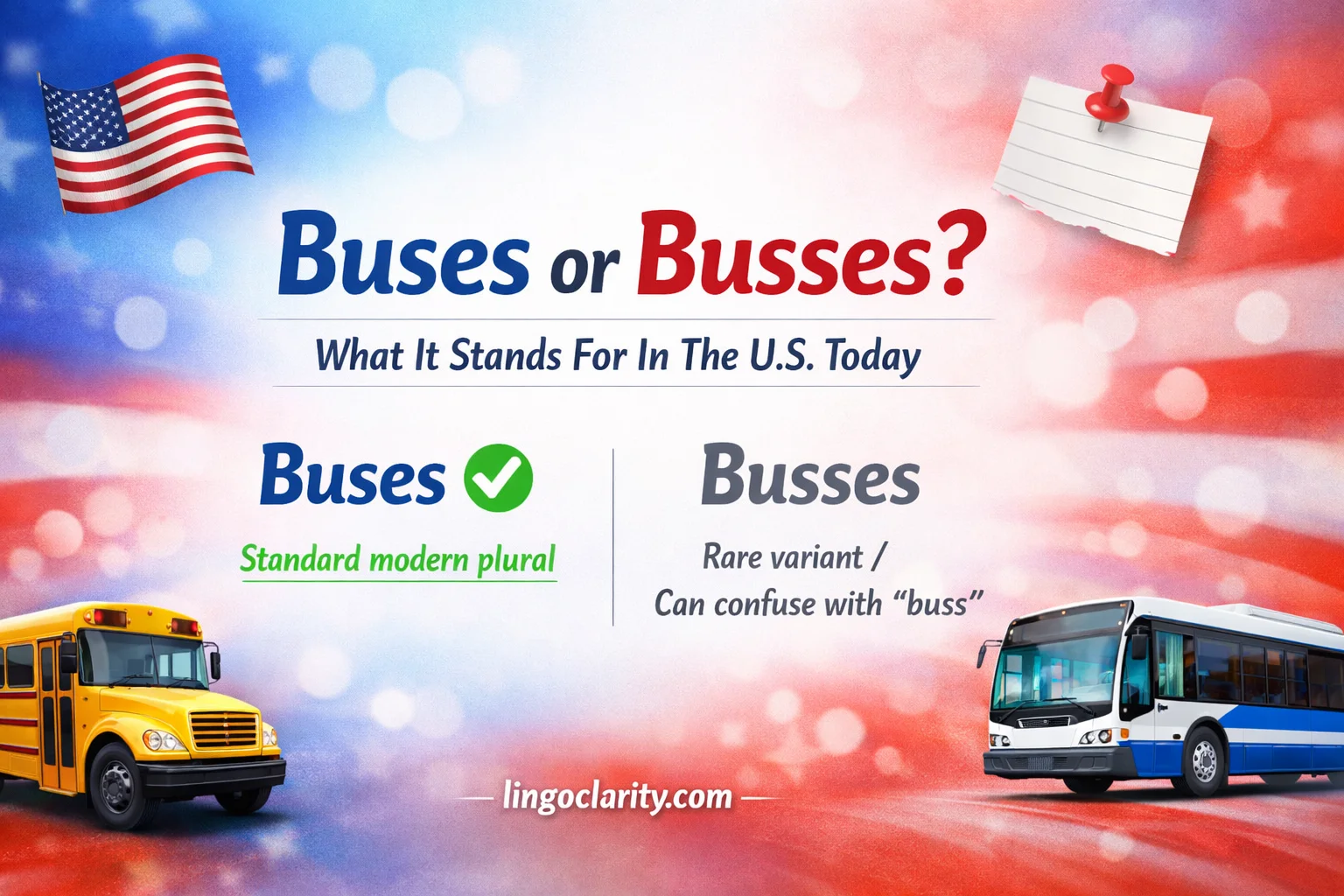
If you are writing about more than one bus, the spelling you should use in modern US English is buses. That is the form most readers expect. It is the form you will see most often in edited writing. And it is the form major reference sources treat as the standard everyday plural, even when they still record busses as a secondary or variant spelling.
The confusion is understandable. English often makes plurals by adding -es to words ending in -s, so buses is regular. But many people also feel that busses looks logical because it resembles words such as fusses and trusses. On top of that, busses can also be the plural of buss, an old word meaning “kiss,” which makes the double-s form look awkward in modern transportation writing.
So if you want the practical answer first, here it is: write buses almost every time. That choice is standard, clear, modern, and easy for readers to process.
Quick Answer
Use buses when you mean the plural of bus in US English.
Use busses only in narrow cases, such as:
• when you are discussing spelling history
• when you are following a source that still uses the variant
• when the word actually belongs to buss, meaning “kiss”
In polished modern writing, buses is the safest and strongest choice.
Simple Definition
Buses = the standard modern plural of bus.
Busses = a less common variant plural that some dictionaries still record, but one that many readers now treat as odd, old-fashioned, or mistaken in everyday writing. It can also be the plural of buss, which means “kiss.”
Buses Vs. Busses At A Glance
| Context | Best Choice | Why |
|---|---|---|
| Plural of the vehicle | buses | Standard modern spelling |
| School, work, news, blogs, signs | buses | Clear and expected |
| Dictionary-listed variant | busses | Still recorded by some references, but uncommon |
| Writing that could be confused with buss (“kiss”) | buses | Avoids confusion |
| Discussion of spelling history | buses or busses | Depends on the point you are making |
That is why sentences like school buses, city buses, and tour buses look natural, while school busses usually looks off to modern readers.
Why People Confuse These Spellings
One reason is sound. The word bus ends in an s sound, and many English words with a short vowel before s use a doubled s in related forms. So at a glance, busses can look more “phonetic” to some writers. Merriam-Webster even notes that the form may seem logical because it resembles words like fusses and trusses.
Another reason is dictionary wording. Some dictionaries still show busses as a variant or an additional US form. That can make people think the two spellings are equally normal in everyday writing. In practice, though, the major usage guidance points the same way: buses is the form to prefer in current edited English.
A third reason is overlap with another word. Buss is a real word meaning “kiss,” and its plural is busses. That means the double-s spelling can carry an extra meaning that buses does not. Even when readers know what you meant, the form can still slow them down.
Are Buses And Busses The Same Word?
Most of the time, yes. If someone writes buses or busses while talking about public transportation, school vehicles, or tour coaches, both forms point to the same underlying noun: bus.
But they do not feel equally current. Buses reads as standard modern English. Busses reads as a variant, and often as a distracting one. Merriam-Webster says the double-s plural has become so rare that it seems like an error to many people, and Grammarly makes the same practical point for modern readers.
So while the two spellings can refer to the same thing, they are not equal in tone, clarity, or reader expectation. For everyday US writing, buses wins easily.
Which Spelling Should You Use In US English?
Use buses in almost all modern US writing.
That includes:
• school assignments
• business writing
• blog posts
• product copy
• newsletters
• captions
• emails
• local news
• website content
• social posts that you want to look polished
This is the spelling that reads cleanly and professionally. It is also the form most readers will accept without hesitation.
Use busses only when you have a special reason. Maybe you are quoting an older source. Maybe you are discussing variant spellings in a language article. Maybe a dictionary entry you are citing includes it. Outside those situations, the double-s form adds friction without giving you any benefit.
Is There A US Vs. UK Difference?
This is not a clean split like color/colour.
Current references do not show a simple rule where one country strongly prefers buses and the other strongly prefers busses in everyday modern prose. Instead, they show buses as the main form, while some dictionaries still record busses as an additional or variant spelling. Cambridge says “plural buses or US also busses,” Oxford lists “plural buses, US English also busses,” and Britannica gives “plural buses also US busses.”
That means the best practical rule is simple: for a US audience, write buses. For general English readers outside the US, buses is still the safer choice. It is clearer, more familiar, and far less likely to be mistaken for an error.
When Busses Still Appears
You may still see busses in dictionaries because some references continue to record it as an accepted variant plural. Merriam-Webster lists “plural buses also busses,” and Collins records busses as an alternative plural in American English.
You may also see it in older texts, archived material, or discussions about spelling history. Merriam-Webster explains that busses was once the preferred plural in its dictionaries until 1961 and that buses overtook busses in frequency in the 1930s. That history explains why the older form has not disappeared completely from reference works.
Still, history is not the same as present-day style. A word can be recorded and technically possible without being the best choice for modern publication-ready writing. That is exactly the case here.
Real-Life Examples
Here are natural modern examples with the standard spelling:
• The city added eight new electric buses this year.
• Three yellow buses were waiting outside the school.
• We missed the last two buses home.
• Tour buses lined the street near the stadium.
• Shuttle buses run every fifteen minutes on weekends.
Now compare that with the less helpful variant:
• The school busses arrived late.
• Two tour busses were parked outside.
Those second examples may not always be impossible, but they look unusual enough that many readers will stop and question them. That pause is reason enough to avoid the spelling in normal US prose.
Synonyms
For the transportation meaning, useful alternatives depend on context:
• coaches
• shuttles
• transit vehicles
• motor coaches
• school vehicles
These are not perfect replacements in every sentence, but they can help you avoid repetition when you are writing about transit, school transportation, or travel services.
Example:
Instead of “The buses left early,” you might write, “The shuttles left early,” if the vehicles are short-route service vehicles.
Opposites
There is no true opposite of buses or busses because this is mainly a spelling-choice issue, not a meaning pair like hot/cold or early/late.
If you mean the vehicle, the opposite depends on context, not vocabulary. For example:
• private cars might contrast with buses in a transit article
• walking might contrast with taking the bus in a lifestyle article
• singular bus is not an opposite; it is simply the singular form
That is why it is better to say this topic has no natural antonym.
Sentence Usage
Here are strong, natural examples you can use as models:
Correct
• The district bought four new buses for rural routes.
• City buses are usually crowded during rush hour.
• Two buses were delayed because of roadwork.
• The museum provides free buses during the festival.
• We saw charter buses near the arena.
Less Natural In Modern US Writing
• The district bought four new busses for rural routes.
• School busses were parked behind the gym.
About The Verb
The noun question is the main issue here, but dictionaries also record verb forms such as bused/bussed and busing/bussing. Merriam-Webster lists both sets as variants for the verb bus. That does not change the main recommendation for the noun plural: buses remains the clearest choice when you are talking about vehicles.
Common Mistakes
Mistake 1: Assuming busses looks more correct because of pronunciation
That instinct makes sense, but modern usage still favors buses. Logic alone does not always decide English spelling. Reader expectation matters too, and current readers overwhelmingly expect buses.
Mistake 2: Treating this as a strict US-vs-UK spelling split
It is not that simple. Major references show buses as the main form and busses as a listed variant, not as a clean regional standard on the level of color/colour.
Mistake 3: Forgetting that busses can relate to buss
Because buss means “kiss,” busses carries an extra meaning that can make modern transportation sentences look awkward or unintentionally funny.
Mistake 4: Using a dictionary variant as if it were the best style choice
A dictionary may record a form without recommending it as the clearest modern option. In this case, several references still record busses, but practical usage advice still points writers toward buses.
Word History
The word bus comes from omnibus. Merriam-Webster notes that the transportation sense of bus developed as a shortened form and that busses once competed with buses as the plural. Over time, buses became the dominant spelling, overtaking busses in the 1930s. Merriam-Webster also notes that its own dictionaries preferred busses until 1961 before shifting to buses.
That history matters because it explains why older or secondary forms still show up in reference works today. But for modern readers, history is background information, not a reason to choose the weaker spelling in fresh copy.
Final Verdict
If you want one answer you can trust in modern US English, use buses.
It is the standard plural. It is the clearer spelling. It is the form most readers expect. And it avoids the extra confusion that comes with busses, which some dictionaries still list but which many readers now see as strange or mistaken in everyday writing.
So for school writing, business writing, articles, captions, web copy, and almost every other modern use, the right choice is simple: buses.
FAQs
Is busses ever correct?
Yes. Some dictionaries still list busses as a variant plural of bus. But it is much less common than buses, and many readers will read it as a mistake in normal modern writing.
Is buses the standard spelling in US English?
Yes. Buses is the standard modern plural in US English and the best choice for everyday edited writing.
Does busses mean kisses?
It can. Busses is also the plural of buss, an old word meaning “kiss.” That is one reason the spelling can feel distracting in transportation writing.
Do dictionaries allow both buses and busses?
Some do. Merriam-Webster, Cambridge, Oxford, Britannica, and Collins all record both in some way, but they do not treat them as equally common in present-day writing. Buses remains the better everyday choice.
Should I ever use busses in a blog post or article?
Usually no. Unless you are quoting older material or discussing spelling history, buses is the cleaner and more professional choice for a blog post, article, or website page.

1 thought on “Buses or Busses? Which Spelling Is Standard in US English”
Comments are closed.