
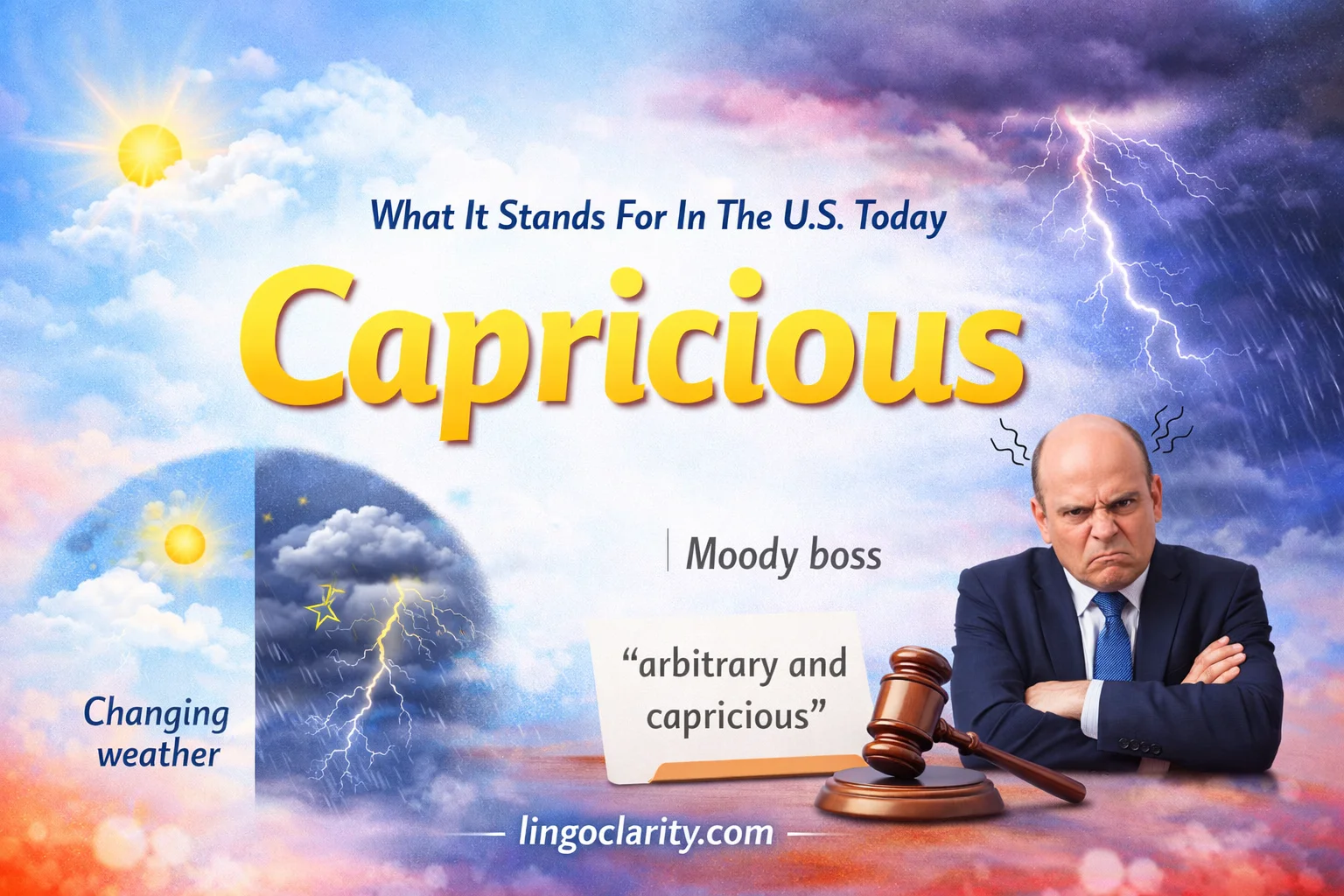
You may come across the word capricious in books, news articles, business discussions, legal writing, and everyday vocabulary. Although it is not one of the most common words in casual conversation, it is a precise word used to describe something that changes suddenly, unpredictably, or without a reasonable explanation.
The capricious meaning is closely connected to the ideas of whim, impulse, inconsistency, and sudden change. When someone describes a person, decision, mood, or situation as capricious, they usually mean it is difficult to predict because it seems controlled by personal feelings or random choices rather than logic.
For example, a manager who changes workplace rules every day without explanation may be called capricious. A weather pattern that changes quickly from sunshine to storms may also be described as capricious.
However, capricious does not simply mean “different” or “changeable.” The word usually carries a negative feeling because it suggests that the changes are unreasonable, impulsive, or frustrating.
Quick Answer
Capricious means changing suddenly and unpredictably because of a whim, impulse, or lack of steady judgment. It is an adjective commonly used for people, decisions, behavior, weather, policies, and situations that seem inconsistent or difficult to understand.
Key Takeaways
- Capricious is an adjective.
- It means unpredictable, impulsive, or controlled by sudden whims.
- The word usually has a negative or critical tone.
- It is often used in formal writing.
- Common examples include capricious behavior, capricious decisions, and capricious weather.
- In U.S. law, “arbitrary and capricious” is an important legal phrase.
What Does Capricious Mean in Simple Words?
In simple English, capricious means someone or something that changes suddenly without a clear reason.
Imagine a person who agrees to a plan in the morning, cancels it at noon, and changes their mind again in the evening. If those changes happen because of random moods or impulses, that person may be described as capricious.
The same idea applies to things:
- Capricious weather → weather that changes quickly and unexpectedly.
- Capricious behavior → actions that seem random or inconsistent.
- Capricious decisions → choices made without stable reasoning.
- Capricious rules → rules that change unpredictably.
The important difference is that capricious involves more than simple change. It suggests that the change happens because of a whim rather than a logical reason.
Capricious Pronunciation
The word capricious is pronounced:
kuh-PRISH-us
Phonetic spelling:
/kəˈprɪʃ.əs/
The stress falls on the second syllable:
kuh-PRISH-us
Breaking it apart:
- ca → kuh
- pri → prish (strongest sound)
- cious → us
Many English learners pronounce the first syllable too strongly, but the main emphasis should be on PRISH.
Part of Speech: Is Capricious a Noun or Adjective?
Capricious is an adjective.
It describes a person, thing, or situation.
Examples:
- a capricious leader
- a capricious decision
- a capricious climate
- a capricious market
Related word forms include:
| Word | Meaning |
|---|---|
| Caprice | A sudden desire or whim |
| Capriciously | In an unpredictable or impulsive way |
| Capriciousness | The quality of being capricious |
The adjective capricious is the most commonly used form in modern English.
Why Capricious Has a Negative Meaning
Although capricious describes change, it usually does not sound positive.
For example:
- Flexible suggests someone can adapt.
- Spontaneous suggests creativity or excitement.
- Capricious suggests unreliable or unreasonable changes.
Compare these sentences:
Positive:
She is spontaneous and enjoys trying new things.
Negative:
She is capricious and changes her plans without warning.
The second sentence suggests frustration because the person’s actions are difficult to trust or predict.
That is why writers should use capricious carefully. It is usually a criticism, not a compliment.
How To Use Capricious in Real Sentences
The easiest way to use capricious is to place it before a noun that describes a person, action, decision, or situation. Because the word suggests sudden and unreasonable change, it works best when something feels unstable or difficult to predict.
Common combinations include:
- capricious behavior
- capricious decision
- capricious nature
- capricious weather
- capricious leader
- capricious policy
- capricious market
Examples:
- The company suffered because of its capricious management decisions.
- The mountain climate is known for its capricious weather patterns.
- Employees became frustrated by their boss’s capricious behavior.
- Investors often struggle with the capricious nature of financial markets.
- The government was criticized for making capricious changes to the regulations.
In each example, the word does more than describe change. It suggests that the change happens without a dependable pattern or reasonable explanation.
A Simple Real-Life Example of Capricious
Imagine a teacher who announces a new classroom rule on Monday, removes it on Tuesday, brings it back on Wednesday, and punishes students for following the original rule on Thursday.
That teacher’s actions could be described as capricious because the decisions seem driven by changing moods rather than a consistent system.
Now consider weather. A summer morning may begin with clear skies, become stormy in the afternoon, and turn cold by evening. People often describe this type of sudden change as capricious weather.
The important idea is that capricious situations are not just unpredictable; they often feel random, inconsistent, or controlled by impulse.
Common Contexts Where You See Capricious
The word capricious appears in many areas of English, especially formal writing.
| Context | Why Capricious Fits |
|---|---|
| Workplace decisions | Describes leaders who change directions without clear reasons |
| Weather | Shows sudden and unexpected changes |
| Personal behavior | Describes inconsistent moods or actions |
| Government policies | Suggests unstable or poorly reasoned decisions |
| Legal writing | Refers to decisions lacking a reasonable basis |
Because of its formal tone, capricious appears more often in books, journalism, academic writing, and legal discussions than in casual conversations.
Capricious vs Similar Words
Many English learners confuse capricious with words such as fickle, mercurial, erratic, and unpredictable. Although these words overlap, each one highlights a different type of change.
Capricious vs Fickle
Capricious and fickle are close, but they focus on different ideas.
- Capricious = sudden changes caused by whims or impulses.
- Fickle = changing opinions, interests, or loyalties easily.
Examples:
- A capricious manager changes rules without warning.
- A fickle friend changes who they support depending on the situation.
Someone who changes favorite sports teams every month may be fickle. Someone who makes random decisions that affect others may be capricious.
Capricious vs Mercurial
Mercurial mainly describes rapid changes in mood or temperament.
Examples:
- Her mercurial personality made people unsure whether she would be happy or angry.
- His capricious decisions created confusion at work.
A person can be mercurial because their emotions change quickly. A person can be capricious because their choices seem controlled by sudden impulses.
Capricious vs Erratic
Erratic means irregular or inconsistent.
Examples:
- The machine’s erratic performance caused problems.
- The leader’s capricious decisions upset employees.
The difference is that erratic focuses on an unpredictable pattern, while capricious often suggests personal choice, whim, or poor judgment.
Capricious vs Unpredictable
Unpredictable is a neutral word. It simply means something cannot be easily predicted.
Capricious is stronger because it usually includes criticism.
Compare:
- The weather is unpredictable.
→ It is difficult to know what will happen. - The weather is capricious.
→ It changes suddenly and seems inconsistent.
Synonyms For Capricious
Depending on the situation, these words may work as alternatives:
- unpredictable
- impulsive
- erratic
- fickle
- mercurial
- unstable
- whimsical
- inconsistent
- changeable
- volatile
However, no synonym matches perfectly. The special meaning of capricious is that the change often appears to come from a whim rather than a logical reason.
Antonyms Of Capricious
Opposite words include:
- consistent
- stable
- steady
- predictable
- reliable
- constant
- reasonable
- dependable
For example:
- A capricious leader changes decisions randomly.
- A consistent leader follows clear principles.
Capricious In Legal English
The phrase “arbitrary and capricious” is one of the most important legal uses of the word in the United States.
In everyday English, capricious means impulsive or unpredictable. In legal language, it describes actions that lack a reasonable basis, ignore important facts, or are not supported by established rules.
For example:
The court found the agency’s decision arbitrary and capricious.
This does not simply mean the decision was unpopular. It means the decision-making process failed to meet legal standards of reasonableness and evidence.
The phrase appears frequently in administrative law, especially when courts review decisions made by government agencies.
Word Origin And History Of Capricious
The history of capricious connects the word to the noun caprice, meaning a sudden desire or whim.
The word entered English through French capricieux, from Italian capriccioso, which came from capriccio. The deeper origin of capriccio is debated, but its modern meaning developed around the idea of sudden changes, whims, and unpredictable impulses.
Merriam-Webster records the first known English use of capricious in 1588.
Today, the word remains active in formal English and is commonly used in discussions about behavior, decisions, weather, economics, and law.
Common Mistakes When Using Capricious
Mistake 1: Using Capricious as a Positive Word
Some people think capricious means creative or spontaneous. Usually, it does not.
Incorrect idea:
She is capricious because she is adventurous and fun.
Better:
She is spontaneous because she enjoys trying new experiences.
Capricious usually contains criticism.
Mistake 2: Using It for Normal Changes
Not every change is capricious.
Example:
A company updates its policy after careful research.
That is not capricious.
A company changes the policy every week without explanation.
That may be capricious.
Mistake 3: Confusing It With Fickle
Remember:
- Fickle → changing loyalty or preferences.
- Capricious → changing because of sudden impulses.
Mistake 4: Using It in Casual Situations
Although correct, capricious sounds formal. In everyday conversation, people often use:
- unpredictable
- random
- inconsistent
- all over the place
However, capricious is a stronger and more precise choice in formal writing.
More Sentence Examples
- The politician was criticized for making capricious decisions.
- The ocean can be capricious, changing from calm to dangerous within hours.
- Her capricious attitude made teamwork difficult.
- The company avoided capricious spending decisions by creating clear financial rules.
- The court rejected the agency’s arbitrary and capricious action.
Mini Quiz
1. What part of speech is capricious?
Answer: Adjective
2. Does capricious usually have a positive meaning?
Answer: No. It is usually critical.
3. Which word is closer to capricious: stable or unpredictable?
Answer: Unpredictable
4. What legal phrase uses capricious?
Answer: Arbitrary and capricious
5. What noun comes from capricious?
Answer: Caprice
Frequently Asked Questions About Capricious
What does capricious mean in simple English?
Capricious means changing suddenly and unexpectedly because of a whim, impulse, or unclear reason. It describes people, decisions, moods, or situations that seem difficult to predict because they do not follow a stable pattern.
For example:
- A capricious boss changes instructions without explanation.
- Capricious weather changes quickly from calm to stormy.
- A capricious decision seems based on personal feelings rather than logic.
The word usually suggests that the changes are frustrating, unreasonable, or unreliable.
Is capricious a positive or negative word?
Capricious is usually a negative or critical word.
It often suggests that someone or something is unreliable because of sudden impulses or unpredictable behavior. For example, calling a person capricious usually means you believe their actions are difficult to trust.
However, the word is not always extremely negative. When describing nature, weather, or complex situations, it can simply emphasize unpredictability.
Examples:
- Negative: The manager’s capricious decisions confused the employees.
- Neutral: The ocean has a capricious nature that sailors must respect.
What is the difference between capricious and unpredictable?
The main difference is the idea of reason and attitude.
Unpredictable simply means something cannot be easily predicted.
Capricious suggests that something changes because of sudden choices, impulses, or whims.
Compare:
- The weather is unpredictable.
- It is hard to know what will happen.
- The weather is capricious.
- It changes suddenly and seems inconsistent.
Every capricious thing is unpredictable, but not everything unpredictable is capricious.
What is the difference between capricious and fickle?
Both words describe change, but they focus on different areas.
Capricious:
- sudden changes caused by impulses or whims
- often used for decisions, behavior, rules, and situations
Fickle:
- changing loyalty, opinions, interests, or feelings
Examples:
- A politician who changes decisions every day may be capricious.
- A person who changes their favorite team every season may be fickle.
Merriam-Webster explains that fickle emphasizes unreliability, while capricious emphasizes sudden whim or fancy.
How do you pronounce capricious?
The standard pronunciation of capricious is:
kuh-PRISH-us
Phonetic spelling:
/kəˈprɪʃ.əs/
The strongest stress is on the second syllable:
PRISH
Example:
The manager’s capricious behavior surprised everyone.
What is the noun form of capricious?
The noun form is capriciousness.
Related words include:
| Word | Meaning |
|---|---|
| Caprice | A sudden desire or whim |
| Capricious | Changing suddenly because of impulse |
| Capriciously | In an unpredictable way |
| Capriciousness | The quality of being capricious |
Example:
The capriciousness of the weather made planning difficult.
What does “arbitrary and capricious” mean in law?
In U.S. legal writing, “arbitrary and capricious” is a specific legal phrase. It describes a decision that lacks a reasonable basis, does not properly consider evidence, or fails to follow established rules.
For example:
The court found the agency’s decision arbitrary and capricious.
In this context, capricious does not simply mean “changing often.” It means the decision-making process was unreasonable or unsupported.
Final Takeaway
The word capricious describes something that changes suddenly, unpredictably, and often because of a whim or impulse. It is stronger than simple words like changeable or unpredictable because it usually suggests inconsistency, poor judgment, or a lack of clear reasoning.
Use capricious when you want to describe unstable behavior, unpredictable decisions, shifting policies, or rapidly changing conditions. It works especially well in formal writing, literature, journalism, and legal discussions.
Remember:
- Flexible means able to adapt.
- Spontaneous means naturally unplanned.
- Unpredictable means hard to foresee.
- Capricious means changing in a sudden, impulsive, and unreliable way.
When the idea is “change without a dependable reason,” capricious is the precise word.
