
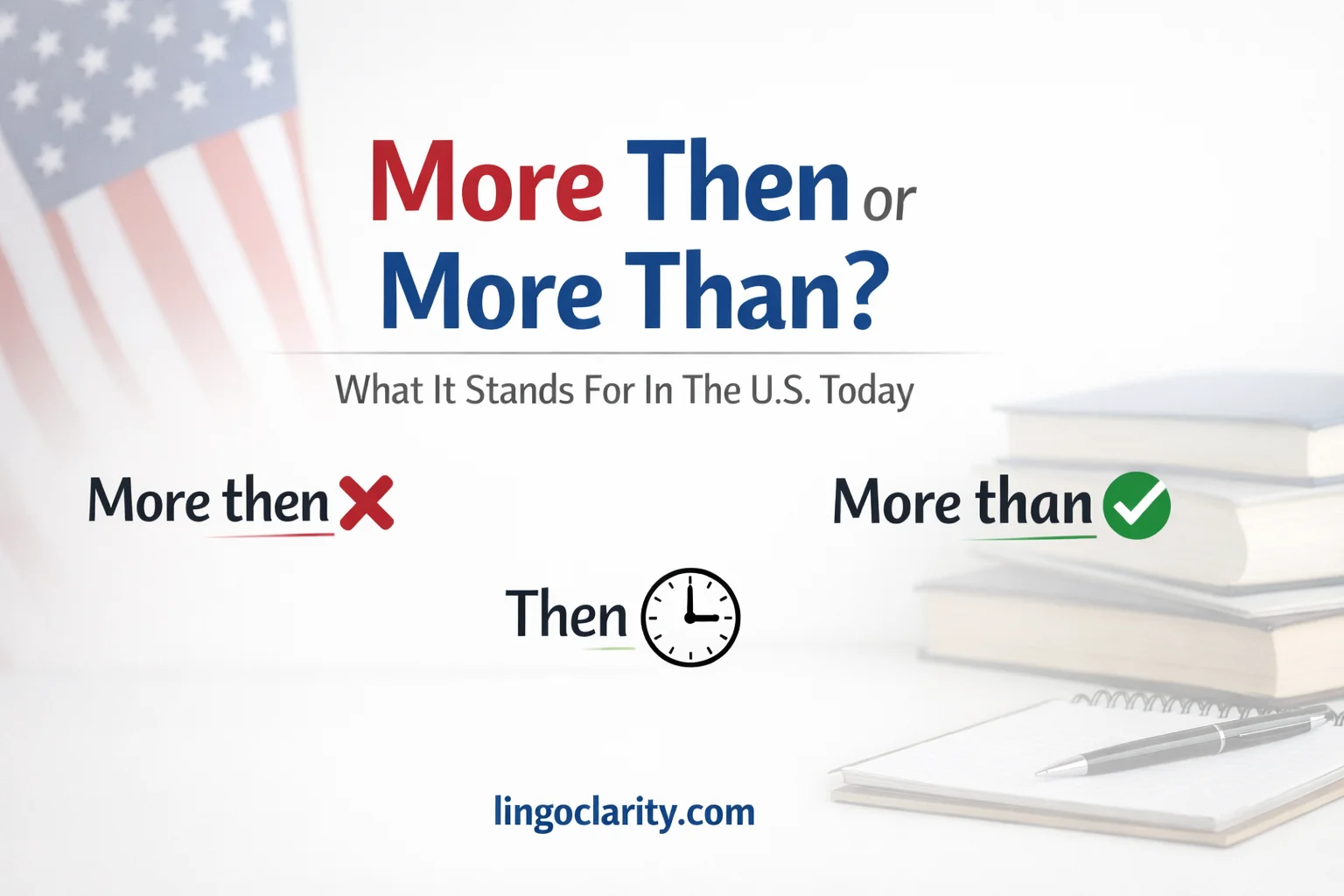
Many writers stop for a second when they reach more then or more than. The two words sound similar in fast speech, and that makes the mistake easy to type.
Still, the rule in standard American English is simple. When you are talking about a larger amount, a comparison, or something beyond a number, the correct phrase is more than. When you use then, you are usually talking about time, order, or result.
That means sentences like more then 10 people or more then I expected are not standard. In those cases, you need than, not then.
This guide explains the difference in plain English, shows where writers get stuck, and gives you easy examples you can use right away.
Quick Answer
Use more than for comparisons, amounts, and degree.
Use then for time, sequence, or result.
| Form | Best Use | Why |
|---|---|---|
| more than | comparisons, amounts, emphasis | than is the standard comparison word |
| more then | usually incorrect in this phrase | then does not mark comparison |
| then | time, order, result | means things like next, at that time, or in that case |
A quick shortcut helps:
• If you mean over, beyond, or compared with, use more than.
• If you mean next, at that time, or in that case, use then.
Simple Definition
More than means a greater amount, degree, or number than something else.
It often means:
• above a number
• greater in amount
• beyond what is expected
• in comparison with another person, thing, or idea
Examples:
• We sold more than 100 tickets.
• She studies more than her brother does.
• That was more than enough food.
By contrast, then does a different job. It usually refers to time, sequence, or result.
Examples:
• We finished lunch and then left.
• Back then, life was slower.
• If the file is missing, then call support.
What Is Correct In American English?
The correct phrase is more than.
Write:
• The class had more than 30 students.
• I spent more than I planned.
• She was more than ready to start.
Do not write:
• The class had more then 30 students.
• I spent more then I planned.
• She was more then ready to start.
This is not just a style preference. In edited American English, than is the right word for comparison, and then is the wrong word in that phrase. Standard reference sources explain the same split: than compares, while then points to time or consequence.
Why “More Than” Is Correct
The key idea is grammar.
The word than is used in comparisons. You see it after words like more, less, rather, other, and better. That is why English uses phrases such as more than, less than, and rather than.
The word then does not do that job. It usually means:
• at that time
• next
• in that case
• as a result
So in a sentence like The repair cost more than we expected, the sentence needs a comparison word. That word is than.
If you change it to then, the grammar breaks. The sentence no longer uses the right word for comparison.
When To Use “More Than”
Use more than in three very common situations.
For Comparisons
Use it when one thing is greater than another.
Examples:
• This laptop costs more than mine did.
• He talks more than his sister.
• The red route takes more than the blue route in travel time.
For Numbers And Amounts
Use it when something goes above a number, limit, or amount.
Examples:
• More than 500 people applied.
• The meeting lasted more than an hour.
• We need more than one copy.
For Degree Or Emphasis
Use it in phrases that mean “very,” “fully,” or “beyond enough.”
Examples:
• I was more than happy to help.
• She is more than capable of doing the job.
• We had more than enough chairs.
This last group matters because many writers think more than is only for math or numbers. It is not. It also appears in common expressions of degree and emphasis. Standard usage guides treat than as the comparison form, and that supports these patterns too.
When To Use “Then”
Use then when you are talking about time, order, or result.
For Time
• Back then, we mailed paper forms.
• I was in college then.
• Things were different then.
For Sequence
• Finish your homework, then watch TV.
• First save the file, then send it.
• We checked the budget and then called the client.
For Result Or Consequence
• If the door is locked, then use the side entrance.
• If that report is final, then we can publish it.
• If the data is wrong, then the conclusion is weak.
These are the normal jobs of then in everyday English. They are separate from the comparison role of than.
Real-Life Example
Imagine you are writing a work email:
Incorrect: We received more then 40 customer replies, and then we sent the update.
Correct: We received more than 40 customer replies, and then we sent the update.
This example is useful because it shows both words in one sentence.
• more than 40 = quantity above a number
• then we sent = next action in time
Here is another everyday example:
Incorrect: She spends more then I do on groceries.
Correct: She spends more than I do on groceries.
And one more:
Correct: Back then, gas cost less than it does now.
That sentence uses both words correctly. Then points to time. Than marks comparison.
Sentence Usage
Here are natural American English examples you can model in your own writing:
• The project took more than a week.
• We had more than enough food for everyone.
• He earns more than I expected.
• The team scored more than 90 points.
• This option may cost more than the basic plan.
• She was more than ready for the interview.
• Back then, we did everything on paper.
• First read the directions, then begin the test.
• If the printer jams again, then call the front desk.
A helpful pattern to remember is this: if more is followed by a comparison, number, or level, than is almost certainly the word you need.
Synonyms And Near Equivalents
Sometimes you can replace more than with another phrase, depending on the sentence.
Possible near equivalents include:
• over
• above
• in excess of
• greater than
• beyond
Examples:
• We served more than 200 guests.
• We served over 200 guests.
• The wait was more than two hours.
• The wait was in excess of two hours.
But these are not always equal in tone.
Over sounds natural and common.
In excess of sounds formal.
Greater than sounds technical or mathematical.
Beyond often changes the sentence slightly.
That is why more than is often the safest and most natural choice in everyday writing.
Opposites And Contrasts
The opposite depends on the context.
For general amount or degree, the clearest opposite is often:
• less than
Examples:
• The repair took less than an hour.
• We had less than enough time to prepare.
For countable nouns, writers may also use:
• fewer than
Example:
• Fewer than 20 students were absent.
Another useful contrast is:
• no more than
This means “only” or “not more than.”
Examples:
• The trip takes no more than 10 minutes.
• He spent no more than five dollars.
So while more than signals increase, words like less than, fewer than, and no more than move in the opposite direction.
Common Mistakes
Writers make this mistake for a few predictable reasons.
Confusing Sound With Spelling
In quick speech, than and then can sound close. That makes people type the wrong one from memory.
Example:
• Incorrect: We need more then one form.
• Correct: We need more than one form.
Forgetting That “Than” Is The Comparison Word
People often know the sentence is about “more,” but they forget which partner word goes with it.
Examples:
• better than
• less than
• other than
• rather than
• more than
That comparison pattern is consistent across standard English usage.
Using “Then” Because It Looks Familiar
Since then is a very common word, it often slips into sentences by habit.
Example:
• Incorrect: The new model costs more then the old one.
• Correct: The new model costs more than the old one.
Missing The Meaning Change
This is important. Replacing than with then is not a tiny spelling problem. It changes the function of the word.
• than = comparison
• then = time, order, result
A Quick Test You Can Use Every Time
Ask yourself one question:
Am I comparing, measuring, or going beyond a number?
If yes, use than.
If not, ask a second question:
Do I mean next, at that time, or in that case?
If yes, use then.
You can also try a word swap.
If over works, choose more than.
If next works, choose then.
Examples:
• We hired more than 10 people. → over 10 people works.
• We finished the draft and then sent it. → next sent it works.
Does “More Then” Ever Appear?
As the comparison phrase, more then is not standard.
That said, the two words can appear next to each other by accident when then belongs to a different part of the sentence.
For example:
• If we need more, then we will order it.
Here, more stands alone, and then starts the next part of the sentence. That is different from the phrase more than.
So the practical rule is easy:
• If you mean comparison or quantity, write more than.
• Do not write more then as a replacement.
Why This Mistake Matters In Professional Writing
This error is common, but it still stands out.
In school papers, business emails, blog posts, and formal messages, readers usually expect more than in comparison phrases. Using more then can make polished writing look rushed or unchecked.
The good news is that this is one of the easiest grammar mistakes to fix. Once you connect than with comparison, the pattern becomes automatic.
Conclusion
In American English, the correct phrase is more than when you are comparing things, showing an amount above a number, or expressing degree.
Use then only when you mean time, order, or result.
That means:
• more than 50 people
• more than I expected
• more than enough time
But:
• finish the form, then send it
• back then
• if that is true, then we should leave
Remember one simple split: than compares, then sequences. Once you learn that, this mistake becomes much easier to avoid.
Frequently Asked Questions
Is “more then” ever correct?
Not as the standard comparison phrase. If you mean a greater amount, a comparison, or something beyond a number, write more than. You may see more and then near each other only when then belongs to a separate part of the sentence.
Is “more than” only used with numbers?
No. It is also used for comparisons and degree. You can write more than I expected, more than my brother, or more than ready.
Why is “than” correct after “more”?
Because than is the standard comparison word in English. It appears after words such as more, less, and rather when one thing is being compared with another.
What does “then” mean?
Then usually means at that time, next, or in that case. It does not mark comparison.
Is “more than enough” correct?
Yes. It is a common and correct phrase. It means there is extra amount beyond what is needed.
How can I remember the difference fast?
Use this shortcut: than compares, then tells when or what happens next.

6 thoughts on “More Then or More Than? Which Is Correct in American English”
Comments are closed.