
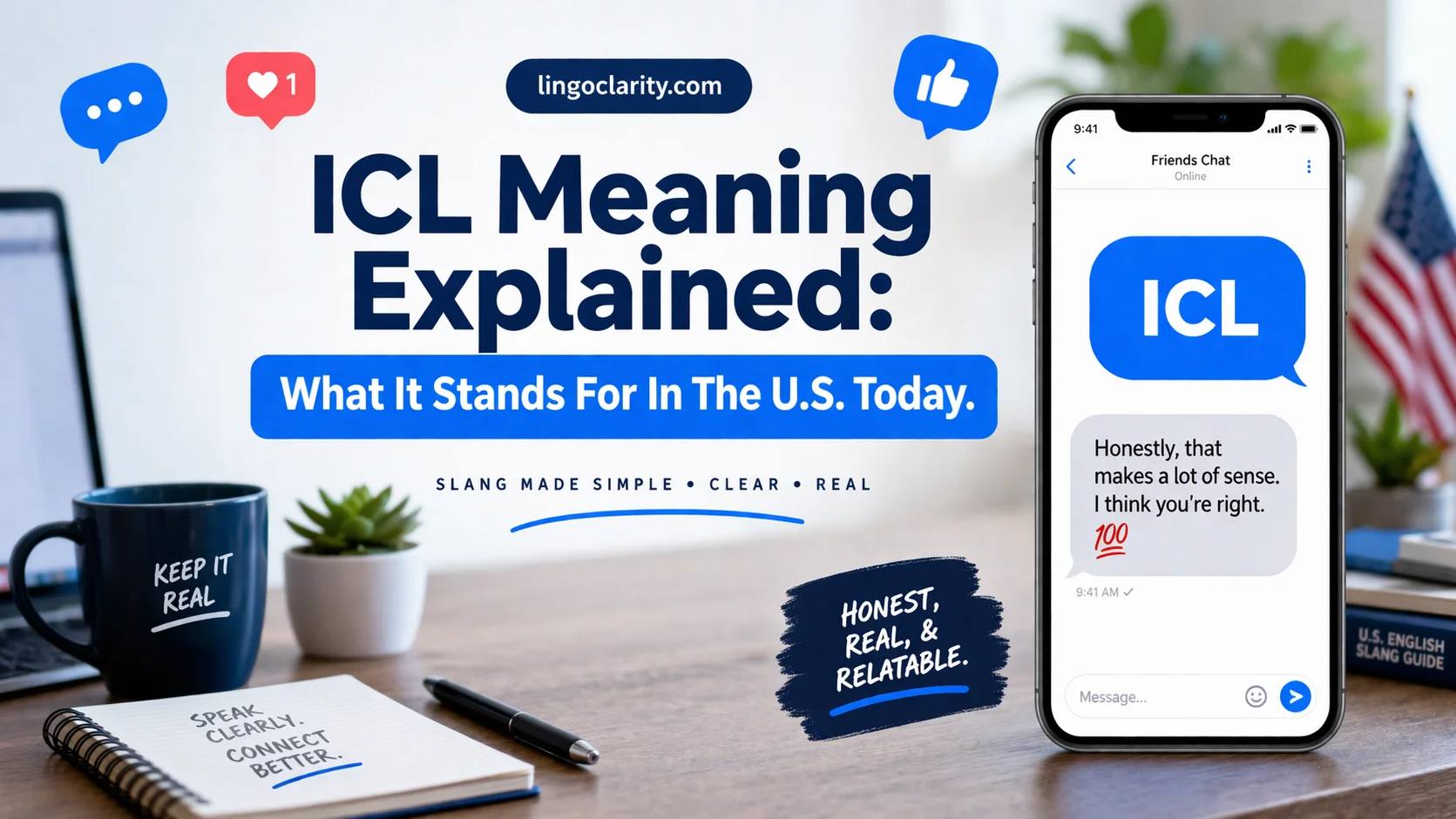
ICL meaning trips people up the first time it lands in a group chat. You see three lowercase letters — icl — sitting in front of a strong opinion, a small confession, or a blunt reaction, and the whole message suddenly feels heavier. In current slang, ICL means “I can’t lie,” and that is the sense most readers assume in texts, TikTok captions, Snapchat replies, and Instagram comments.
That tiny initialism does more work than it looks like it should. In online writing, short forms carry tone as much as meaning. A few letters can make a message sound more personal, more direct, or more emotionally real. This guide explains what ICL means, how people actually use it, the tone it adds, when it sounds natural, when it backfires, and how it compares with NGL, TBH, and no cap. You will also see what ICL means outside slang, because context changes the answer completely.
Quick Answer: What Does ICL Mean?
ICL means “I can’t lie.” People type it before an honest thought, a real feeling, or a direct opinion to flag that what follows is candid. It is casual internet slang — perfect for texting, social posts, and relaxed chat, and wrong for a resume, a work email, or a message to a professor.
TL;DR
- ICL usually means “I can’t lie.”
- It is casual and conversational, never formal.
- It introduces honesty, a confession, or a direct opinion.
- It can sound sincere, blunt, playful, or dramatic depending on what follows.
- It is close to NGL, but not identical in tone.
- Outside slang, ICL can mean something else entirely (eye surgery, for one).
Simple Definition of ICL
In plain English, ICL means “I’m being real right now.” More exactly, it is an initialism for I can’t lie. It warns the reader that an honest opinion, an admission, or an unfiltered reaction is coming next.
That is why it almost always sits at the front of a sentence that feels personal:
- ICL, that movie was better than I expected.
- ICL, I do not want to go out tonight.
- ICL, your new haircut looks great.
- ICL, I was wrong about that.
- ICL, this app confused me at first.
- ICL, I forgot we had plans.
- ICL, that was the best meal I’ve had all year.
What ICL Means in Texts and Social Posts
In casual digital conversation, ICL works as an honesty marker. It tells the reader, “This is my real view,” or “Here is the truth as I see it.” Slang references describe it the same way, and note that it sits beside NGL and no cap, which also signal truth or sincerity in online speech.
So ICL is less about information and more about attitude. The words after it can be positive, negative, funny, awkward, or emotional — the acronym itself simply frames the message as candid.
Compare these two:
- That burger was good.
- ICL, that burger was good.
The second version sounds more personal. It reads like a real reaction instead of a flat statement.
ICL Meaning on TikTok, Snapchat, and Instagram
The platform shifts the flavor slightly, but the core meaning of ICL holds.
| Where you see it | How it usually lands | Example |
|---|---|---|
| TikTok comments | An unfiltered hot take on the video | “icl the edit carried this” |
| Snapchat / DMs | A private admission between friends | “icl I’ve been avoiding my phone” |
| Instagram captions | Self-aware honesty about a photo | “icl I took 40 of these” |
| Group chats | A vote, a refusal, or a real opinion | “icl I’d rather stay in” |
| X / Twitter replies | A blunt disagreement, softened slightly | “icl that take is rough” |
Almost nobody capitalizes it. Lowercase icl is the default, and the lowercase styling is part of the casual tone.
The Tone ICL Adds
One acronym, four very different moods:
- Sincere — “ICL, I really appreciated that.” Warm and genuine.
- Blunt — “ICL, that plan won’t work.” Direct, sometimes uncomfortable.
- Playful — “ICL, I’d eat that whole pizza again.” Light and self-deprecating.
- Dramatic — “ICL, this week broke me.” Exaggerated for effect.
The rule of thumb: ICL raises the emotional volume of whatever follows it. If the sentence after it is kind, it sounds kinder. If it is critical, it sounds more critical.
Real-Life Examples of ICL in Conversation
Imagine a friend sends you a photo of a new apartment. A dry reply says:
Nice place.
A more human reply says:
ICL, that kitchen looks amazing.
The second response feels warmer and more natural because it sounds like a genuine reaction. The phrase makes the message feel spontaneous, almost like spoken conversation.
Another one:
Friend: “Do you think I should cut my hair shorter?”
Reply: “ICL, yes. It would suit you.”
That works because the speaker is giving an honest personal view, and ICL prepares the listener for directness.
And one where it does the heavy lifting:
Friend: “Were you okay with how I handled that?”
Reply: “icl, not really. But I get why you did it.”
Here ICL softens a hard answer by signalling that the honesty is coming from a good place, not from an attack.
ICL vs NGL vs TBH vs No Cap
They overlap, but they are not interchangeable.
| Term | Stands for | What it signals | Typical tone | Best used before |
|---|---|---|---|---|
| ICL | I can’t lie | I’m being real with you | Warm, confessional, sometimes blunt | A personal admission or honest reaction |
| NGL | Not gonna lie | Mild honesty, slight hedge | Casual, low stakes | A soft opinion or small confession |
| TBH | To be honest | Considered opinion | Neutral, evaluative | A judgment or rating |
| No cap | No lie / not lying | Emphasis on truth | Emphatic, hype-leaning | A claim someone might doubt |
| FR | For real | Agreement or confirmation | Quick, reactive | Backing someone else up |
The short version: NGL hedges, TBH evaluates, no cap insists, and ICL confesses.
Common Mistakes With ICL
- Using it in formal writing. ICL in a cover letter, a client email, or an assignment reads as careless.
- Stacking honesty markers. “ICL NGL TBH” cancels itself out and sounds like filler.
- Using it before something dishonest or sarcastic. The acronym promises candor; breaking that promise reads as mocking.
- Assuming everyone knows it. Older relatives and coworkers often will not, and the message will land as a typo.
- Capitalizing it mid-chat. “ICL” in all caps inside a casual text can read as shouting; lowercase is the norm.
- Putting it at the end. ICL is a lead-in. “That was great, icl” works, but the front position is what readers expect.
What ICL Means Outside Slang
Context decides the meaning, and the non-slang senses have nothing to do with honesty:
- Implantable Collamer Lens — a lens implanted in the eye to correct nearsightedness, often discussed as an alternative to LASIK. This is the dominant medical use of “ICL surgery.”
- International Computers Limited — a former British computer manufacturer, still common in tech history writing.
- Intercompany loan — finance and accounting shorthand in corporate documents.
If the surrounding words are about vision, surgery, hardware, or balance sheets, ICL is not slang.
How to Reply When Someone Says ICL
- Match the honesty: “icl same” or “fair, I get that.”
- Ask for the rest: “go on” or “say more.”
- Acknowledge a hard truth: “that’s fair, thanks for being real.”
- Keep it light if theirs was playful: “icl I knew you’d say that.”
The one reply to avoid is treating a sincere ICL as a joke. The acronym signals that the person has dropped the filter.
Frequently Asked Questions
What does ICL mean in text?
ICL in text means “I can’t lie.” It introduces an honest opinion, a confession, or a real reaction, and it tells the reader that the next few words are candid rather than polite.
Is ICL rude?
No. ICL is not rude by itself. It signals honesty, so it only sounds harsh when the sentence after it is critical. Softening the follow-up — “icl, not my favorite, but I see why you like it” — keeps it friendly.
What does ICL mean on TikTok?
On TikTok, ICL means the same thing: “I can’t lie.” It shows up in comments and captions before an unfiltered opinion about a video, a trend, or a creator.
Is ICL the same as NGL?
They are close but not identical. NGL (“not gonna lie”) hedges a mild opinion. ICL (“I can’t lie”) feels more confessional, as if the speaker could not hold the truth in.
Can I use ICL at work?
Avoid it. ICL belongs in texting and social media. In workplace chat, plain phrasing like “honestly” or “to be direct” carries the same meaning without sounding informal.
Does ICL always mean “I can’t lie”?
In slang, yes — that is the meaning readers assume. In medical, technical, or financial writing, ICL can mean implantable collamer lens, International Computers Limited, or intercompany loan.
Conclusion
ICL meaning comes down to one honest promise: I can’t lie. Three letters that ask the reader to take the next sentence at face value. It works because online writing strips out the voice, the face, and the pause before a hard truth — and ICL puts a little of that back. Use it in texts, captions, comments, and group chats where warmth and directness both belong. Skip it anywhere a hiring manager, a professor, or a client is reading. And when someone sends you an ICL, read it as a small act of trust, because that is usually exactly what it is.

1 thought on “ICL Meaning: What It Really Means in Texts and Social Posts”
Comments are closed.