
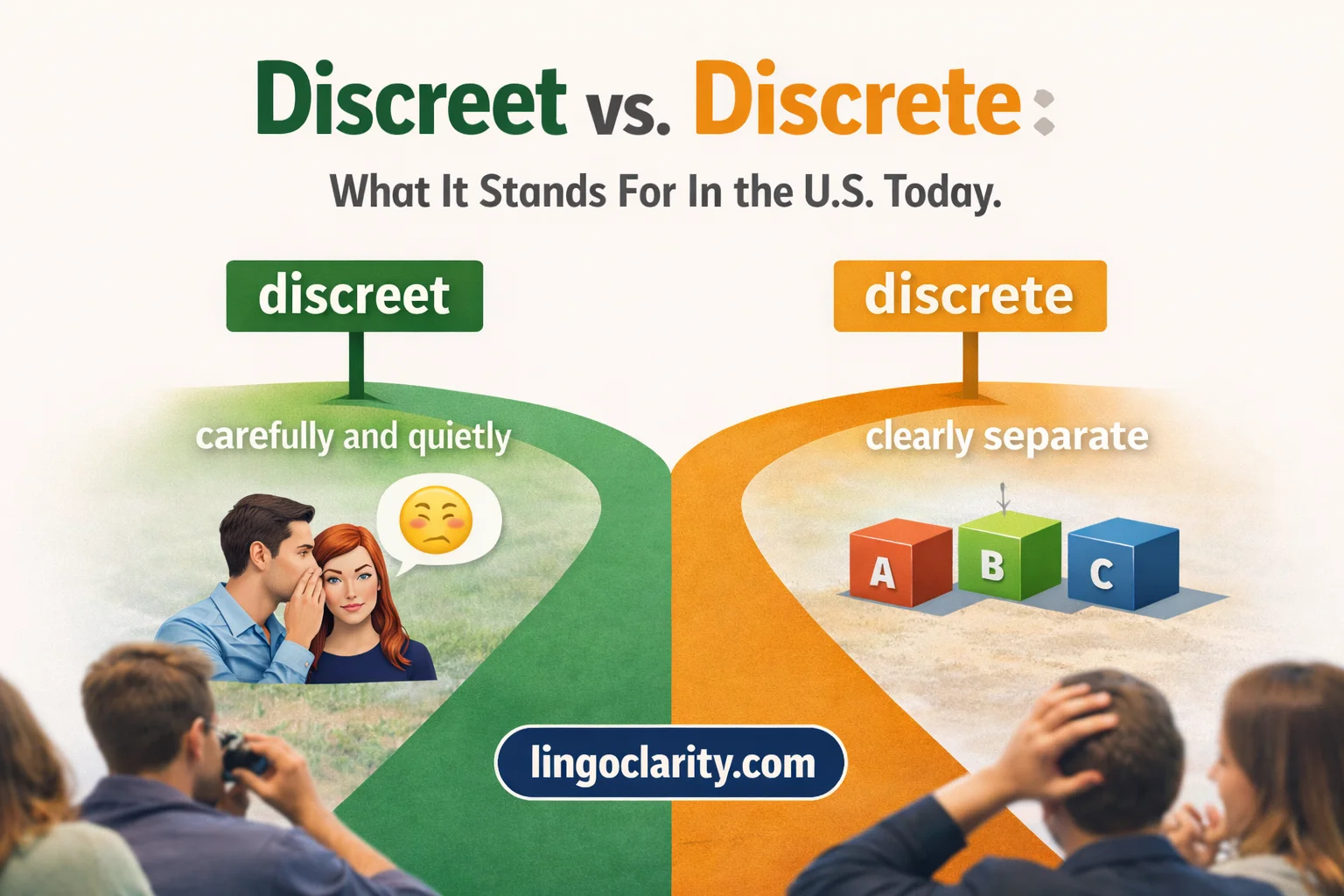
If you remember only one thing, remember this: discreet means careful, tactful, private, or not attracting attention, while discrete means separate, distinct, or individually different. Both words are correct, but they are used in completely different situations and cannot be exchanged without changing the meaning.
A simple way to remember the difference is:
- Discreet = keeps things private
- Discrete = keeps things separate
For example:
- Please be discreet about this information. (Keep it confidential.)
- The study divided participants into discrete groups. (Separate groups.)
Although these words look and sound similar, understanding their meanings will help you avoid one of the most common English usage mistakes.
Quick Answer
Use discreet when the meaning involves privacy, tact, caution, restraint, or avoiding attention. Use discrete when the meaning involves separation, distinction, or clearly individual parts. In everyday writing, discreet is commonly used for people, conversations, behavior, and services, while discrete is more common in technical, academic, and organizational contexts involving categories, data, systems, or separate units.
A simple way to remember the difference:
- Discreet = keeps things private
- Discrete = keeps things separate
Examples:
- Please be discreet about this confidential information. (Be careful and private.)
- The research divided the results into discrete categories. (Separate and distinct groups.)
Why People Confuse Them
These two words are a classic trap because they are homophones: they are pronounced the same in major dictionaries, even though they mean different things. Grammarly calls them homophones, and Cambridge gives both the pronunciation /dɪˈskriːt/. They also share a common origin, which helps explain why the spellings look so similar.
That combination makes them especially easy to mix up in writing. You cannot rely on sound here. You have to rely on meaning.
What Discreet Means
Discreet describes someone or something that is careful not to cause embarrassment, reveal something sensitive, or attract too much attention. Cambridge defines it as being careful not to cause embarrassment or attract too much attention, especially by keeping something secret. Dictionary.com adds that it can also mean unobtrusive.
In everyday US English, discreet is the right word when you mean:
- tactful
- private
- low-key
- restrained
- subtle
- intentionally unobtrusive
Examples:
- Please be discreet about the hiring discussion.
- The concierge arranged a discreet pickup for the guest.
- She prefers discreet jewelry over bold statement pieces.
- He made a discreet inquiry instead of asking in front of everyone.
In all of those examples, the meaning is about handling something carefully, not dividing it into parts.
What Discrete Means
Discrete means clearly separate, distinct, or independent from other things of the same type. Cambridge defines it as clearly separate or different in shape or form, and Oxford labels it formal or specialist, which matches how it often appears in technical, academic, and analytical writing.
In plain English, discrete is the word you want when something exists as its own unit instead of blending into a whole.
Examples:
- The report is divided into five discrete sections.
- The software tracks user behavior as discrete events.
- The survey results fell into three discrete groups.
- In statistics, a discrete variable has countable values.
That last example matters because discrete often contrasts with continuous in math and data-related writing. QuillBot and other usage pages highlight that distinction directly.
Key Difference At A Glance
The easiest way to choose is to ask one question:
Are you talking about privacy or about separation?
If the sentence is about privacy, tact, diplomacy, or subtle presentation, use discreet.
If the sentence is about separate parts, distinct categories, or individual units, use discrete.
Here is the difference in one line:
- Discreet = careful
- Discrete = separate
That rule is simple, accurate, and reliable.
A Memory Trick That Works
The best-known memory trick is still the most useful: in discrete, the t separates the two e’s. That matches the meaning of separate. Merriam-Webster and Grammar Monster both use this visual cue, and it is effective because it links spelling directly to meaning.
You can also remember it this way:
- discr ee t: the two e’s stay together, like a quiet, private whisper
- discr e t e: the e’s are split apart, like separate units
Use whichever version you can recall fastest under pressure.
When To Use Discreet
Use discreet when a person, action, message, or object is:
- tactful
- cautious
- confidential
- polite about sensitive matters
- unobtrusive or understated
This word is common in hospitality, customer service, health care, HR, fashion, personal communication, and any setting where privacy matters.
Examples:
- The clinic offers discreet check-in for patients.
- The attorney gave a discreet response.
- The hotel has a discreet entrance for guests who want privacy.
- He sent a discreet text instead of raising the issue at dinner.
That last example shows why the word is broader than “secret.” A discreet action may be private, but it may also just be socially intelligent.
When To Use Discrete
Use discrete when something is:
- separate
- distinct
- independent
- broken into parts
- countable as individual units
This word appears often in business writing, academic writing, product documentation, engineering, statistics, and systems design.
Examples:
- The rollout happened in three discrete phases.
- The platform stores actions as discrete events.
- The city is made up of several discrete neighborhoods.
- The experiment measured discrete variables instead of continuous ones.
Oxford’s “formal or specialist” note is useful here. Discrete is absolutely standard English, but it often sounds more natural in structured, analytical, or technical contexts than in casual everyday conversation.
How The Tone Differs
Even when both words are grammatically possible in a sentence, the tone usually makes one choice feel more natural than the other.
Discreet feels human, social, and practical. It often appears in sentences about people’s behavior, service, communication, and appearance.
Discrete feels more structural and analytical. It often appears in sentences about systems, categories, measurements, logic, and organization.
That tonal difference is one reason these words feel so different in real writing even though they sound the same.
Common Mistakes And Fast Fixes
A lot of incorrect usage becomes obvious once you know what to look for.
Wrong: Please be discrete about this complaint.
Right: Please be discreet about this complaint.
Why? The sentence is about tact and privacy.
Wrong: The app sorts documents into discreet folders.
Right: The app sorts documents into discrete folders.
Why? The folders are separate categories.
Wrong: The course is taught in five discreet modules.
Right: The course is taught in five discrete modules.
Why? Modules are distinct parts, not secretive or tactful actions.
Wrong: She chose a discrete necklace for the interview.
Right: She chose a discreet necklace for the interview.
Why? The necklace is understated, not separate.
Real-World Examples By Context
Business And Workplace
- A discreet manager does not discuss salary issues in public.
- The company split the product launch into discrete stages.
- HR handled the issue in a discreet way.
- Finance tracks spending across discrete cost centers.
Hospitality And Privacy
- The resort offers discreet transportation for high-profile guests.
- The building has discrete access zones for staff and visitors.
- The staff remained discreet during the celebrity’s stay.
Design And Style
- She likes discreet branding and simple packaging.
- The interface uses discrete cards for separate functions.
- The décor is discreet, but the floor plan is divided into discrete spaces.
That last example is useful because it shows both words can appear in the same paragraph without overlap in meaning.
Discreetly, Discretely, And Discretion
Many pages ranking for this topic stop at the adjectives, but readers often need the related forms too.
Discreetly means in a tactful, private, or unobtrusive way. Cambridge lists discreetly as the related adverb for discreet.
Examples:
- She discreetly asked whether the issue had been resolved.
- He discreetly moved the conversation away from the sensitive topic.
Discretely means in a separate or distinct way. Oxford and Cambridge both list discretely as the related adverb for discrete.
Examples:
- The system stores the records discretely by type.
- The signals were processed discretely rather than continuously.
Discretion belongs to the discreet family, not the discrete family. GrammarBook specifically notes that this connection makes the spelling confusion worse because people see discretion and then misspell discreet as discrete.
Examples:
- Thank you for your discretion.
- Use your discretion when discussing confidential matters.
That detail is important because many writers are not just confusing two adjectives. They are confusing entire word families.
Word History
These words share the same historical root. Merriam-Webster traces both back to the Latin discretus, and modern usage guides note that English eventually settled on a spelling split: discreet for tact or unobtrusiveness, discrete for separateness or distinction. QuillBot and YourDictionary both explain that the two forms overlapped earlier in English before the modern distinction became established.
You do not need the history to use the words correctly, but it explains why they look so similar while doing different jobs.
What Strong Writers Do Differently
Strong writers do not choose between discreet and discrete by ear. They choose by concept.
If the concept is human behavior, privacy, tact, style, or restraint, they choose discreet.
If the concept is structure, categories, separation, data, phases, or units, they choose discrete.
That habit matters because these words often show up in professional writing where the wrong choice stands out fast.
FAQ
Are discreet and discrete pronounced the same?
Yes. Major dictionaries treat them as pronounced the same, which is one reason they are so commonly confused in writing.
Is “discreet entrance” or “discrete entrance” correct?
Usually discreet entrance is correct because the point is privacy or low visibility. Discrete entrance would only make sense if you were specifically emphasizing that the entrance is physically separate from others.
Is discrete only used in math or science?
No. It is common in math, science, and data writing, but it also works in general formal English for separate categories, units, sections, stages, or entities. Oxford’s entry explicitly marks it as formal or specialist, which explains why it feels more analytical in tone.
What is the easiest way to remember the difference?
Remember that in discrete, the t separates the two e’s. That matches the meaning of separate parts. Then use discreet for tact, privacy, and subtlety.
What is the difference between discreetly and discretely?
Discreetly means privately or tactfully. Discretely means separately or distinctly. They follow the same meaning split as discreet and discrete.
Final Takeaway
Both words are correct. The mistake is using the right spelling for the wrong idea.
The difference between discreet vs. discrete becomes simple once you focus on the meaning behind each word. Use discreet when you are talking about privacy, careful behavior, tact, or avoiding attention. Use discrete when you are talking about separate, distinct, or clearly divided parts.
A quick memory trick can help:
Discreet = keeps things private
Discrete = keeps things separate
For example:
- A person can be discreet by handling sensitive information carefully.
- A system can contain discrete parts that work as separate units.
Although these words look and sound similar, they have different meanings and should not be used interchangeably. Choosing the correct word depends on whether your sentence is about how something is handled or how something is divided.
