
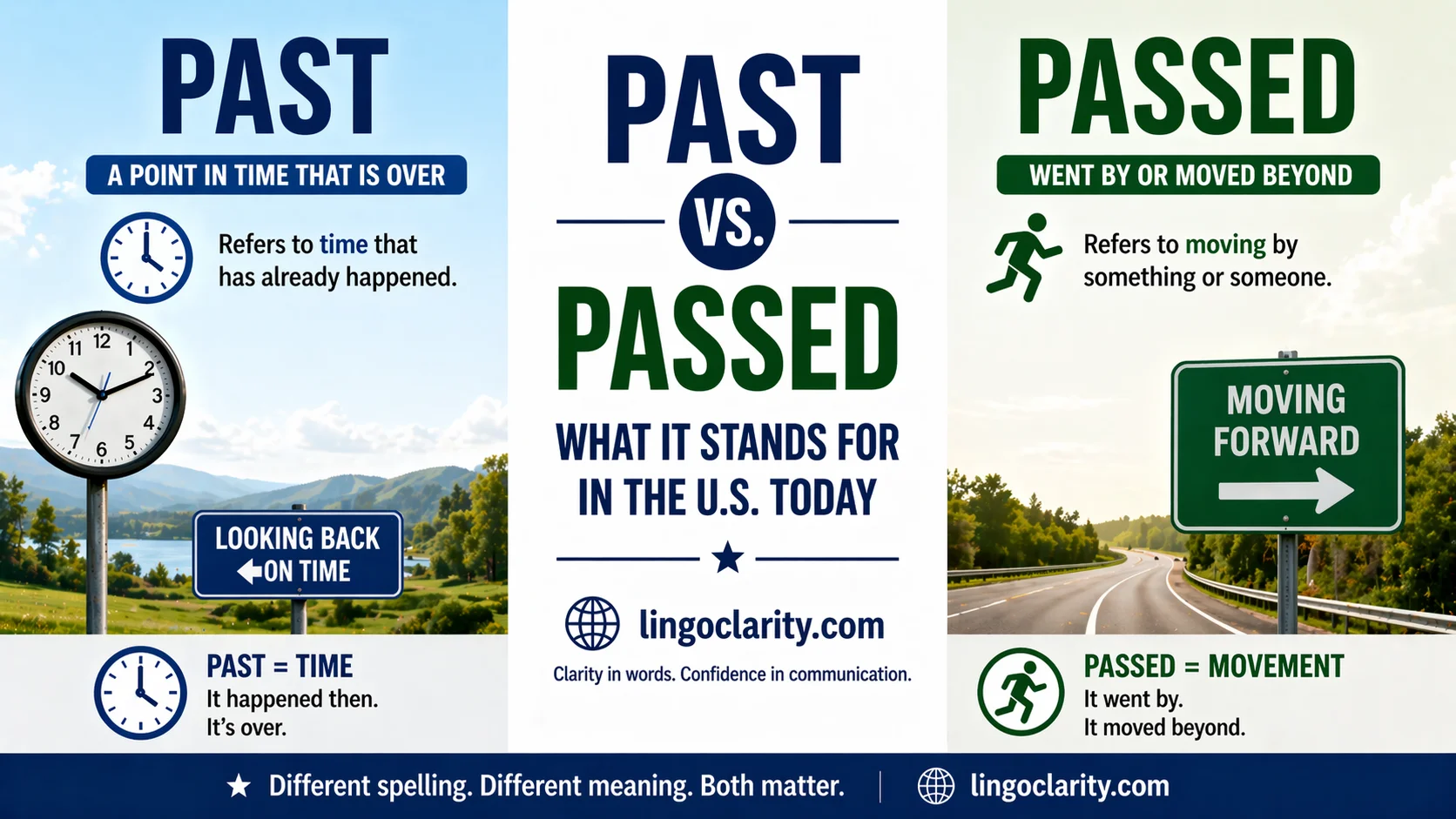
Both words are correct, but they do different jobs.
Use passed when you need the verb pass in the past tense or past participle: She passed the test. Use past for time, position, direction, or a point beyond something: That’s in the past. We walked past the bank. It’s half past six. In standard modern English, past is not used as a verb in this contrast, while passed is a verb form.
That one rule solves most mistakes: if you need a verb, use passed; if you do not, use past.
Why These Words Are Easy To Confuse
People mix up past and passed for a simple reason: they are homophones. In everyday speech, they sound the same or nearly the same, even though they have different spellings and different grammatical functions. That makes them especially easy to mistype when you are writing quickly.
They are also closely related in meaning. Both can show up in sentences about time or movement. That overlap is where most errors happen. Compare these two correct sentences: We passed the library and We walked past the library. The idea is similar, but the grammar is different.
What “Passed” Means
Passed is the past tense and past participle of the verb pass. It describes an action that already happened. Depending on context, it can mean moving beyond something, succeeding, approving, handing something over, letting time go by, or occurring and ending.
Here are some common ways passed is used:
- Movement: We passed the gas station.
- Success: She passed the exam.
- Approval: The bill passed.
- Transfer: He passed me the salt.
- Time/Event: Time passed slowly. The storm passed overnight.
Those are all verb uses, which is the key point. If the sentence needs an action word, passed is usually the right choice.
You also use passed in perfect and passive constructions because it is the past participle of pass: has passed, had passed, was passed, has been passed.
What “Past” Means
Past is much more flexible than passed. It can work as a noun, adjective, preposition, or adverb. That is one reason writers get tripped up: past has several jobs, while passed has just one.
Past As A Noun
As a noun, past means an earlier time or someone’s earlier life, history, or background.
Examples:
- Let the past stay in the past.
- She wrote a memoir about her past.
- In the past, people mailed far more letters than they do now.
Past As An Adjective
As an adjective, past describes something earlier, previous, or no longer current.
Examples:
- The past year has been hectic.
- He is a past president of the club.
- Her past mistakes made her more careful.
Past As A Preposition
As a preposition, past means beyond a point in place, time, or limit.
Examples:
- We drove past the stadium.
- It’s past midnight.
- She is past the age where she needs a babysitter.
- We are past the point of arguing about it.
Past As An Adverb
As an adverb, past describes movement beyond a point.
Examples:
- A cyclist sped past.
- I waved, but she walked right past.
- A truck rumbled past just before dawn.
The Difference In One Sentence Pair
The cleanest way to see the difference is to compare a verb sentence with a motion sentence.
- We passed the store.
- We walked past the store.
In the first sentence, passed is the verb. In the second, walked is already the verb, so past shows direction or position. This is one of the most common patterns in real writing, and it is also one of the most common mistakes.
The same contrast works again and again:
- She passed the truck.
- She drove past the truck.
- They passed the finish line.
- They ran past the finish line.
- He passed me in the hall.
- He walked past me in the hall.
If another verb already does the action, you usually want past, not passed.
The One-Test Rule That Solves Most Mistakes
When you are unsure which word to use, find the main verb first.
If passed is doing the action, it is correct:
- She passed the exam.
- The Senate passed the bill.
- The fever passed by morning.
If another verb is already doing the action, past is usually correct:
- She walked past the exam room.
- We drove past the courthouse.
- He looked past the typo and read the whole sentence anyway.
This is why walked passed, ran passed, and drove passed are usually wrong. They stack one verb on top of another when the sentence only needs one main verb.
Common Mistakes And How To Fix Them
Here are the errors people make most often:
- Wrong: She past the test.
Right: She passed the test. - Wrong: We drove passed the exit.
Right: We drove past the exit. - Wrong: It’s half passed three.
Right: It’s half past three. - Wrong: I’m sorry your grandfather past away.
Right: I’m sorry your grandfather passed away. - Wrong: The law was past last night.
Right: The law was passed last night. - Wrong: The deadline has past.
Right: The deadline has passed.
Or, depending on meaning: The deadline is past.
That last pair matters. The deadline has passed means the action of passing is complete. The deadline is past means the deadline is already over or beyond the current time. Both can be correct, but they are not interchangeable in every sentence.
High-Frequency Phrases You Should Know
Some phrases show up so often that it helps to memorize them.
Use past in these:
- in the past
- past midnight
- past due
- past the point of no return
- walk past
- look past
- half past six
Use passed in these:
- passed the test
- passed the ball
- passed a law
- time passed
- has passed
- passed away
Learning the fixed phrases helps because many real-life mistakes happen inside familiar expressions, not isolated grammar drills.
Past Vs. Passed In Real-World Contexts
In school and testing, you almost always need passed because you are describing the action of succeeding: She passed chemistry or He passed the bar exam.
For time expressions, you usually need past: It’s a quarter past two, The meeting ran past noon, The worst is in the past.
With location and movement phrases, the choice depends on whether the sentence already has a verb. We passed the museum is correct because passed is the verb. We walked past the museum is correct because walked is the verb and past tells you where.
In government and business writing, passed often appears in approval language: The board passed the measure or The policy was passed unanimously. Meanwhile, past often appears in timing and status language: past due, past deadline, past performance, past quarter, and past experience.
A Fast Memory Trick
Here is the best quick memory rule: passed belongs to pass; past does not. If you can swap in another verb form of pass—such as pass, passes, or passing—then passed is probably right. If not, you probably want past.
Try it:
- She passed the exam → She passes the exam.
It is still clearly a verb, so passed makes sense. - We walked past the bakery → We walked passes the bakery.
That fails, so past is the right word.
This is not just a memory trick. It is a fast editing method that works in real writing.
Quick Reference
Use passed for the action:
- passed the test
- passed the car
- passed the bill
- time passed
- passed away
Use past for time, position, or beyond:
- in the past
- past the bank
- past midnight
- half past five
- past the point of arguing
If you remember one line, make it this: passed is a verb form; past is everything else in this comparison.
Frequently Asked Questions
Is it “walked past” or “walked passed”?
It is walked past. The verb is already walked, so you need past to show direction or position, not another verb.
Is it “half past” or “half passed”?
It is half past. In clock-time expressions, past means a certain number of minutes after the hour.
Can past ever be a verb?
Not in standard modern English usage for this distinction. In ordinary writing, past is used as a noun, adjective, preposition, or adverb, while passed is the verb form you want.
Why is it “passed away”?
Because passed away is a verb phrase built from the verb pass. Even though it is an idiom, the grammar still requires passed, not past.
How do I remember the difference quickly?
Find the verb. If the sentence needs the action word pass, use passed. If the sentence is about time, direction, position, or something beyond a point, use past.
Final Takeaway
Here is the rule in its clearest form: use passed for the action of pass, and use past for time, place, direction, or anything beyond a point. That one distinction covers nearly every common mistake, from passed the test to walked past the store to half past six.
When you edit your sentence, do not ask which word sounds right. They sound the same. Ask which job the word needs to do. If it needs to act, choose passed. If it needs to point to time or beyond, choose past. That is the difference.
