
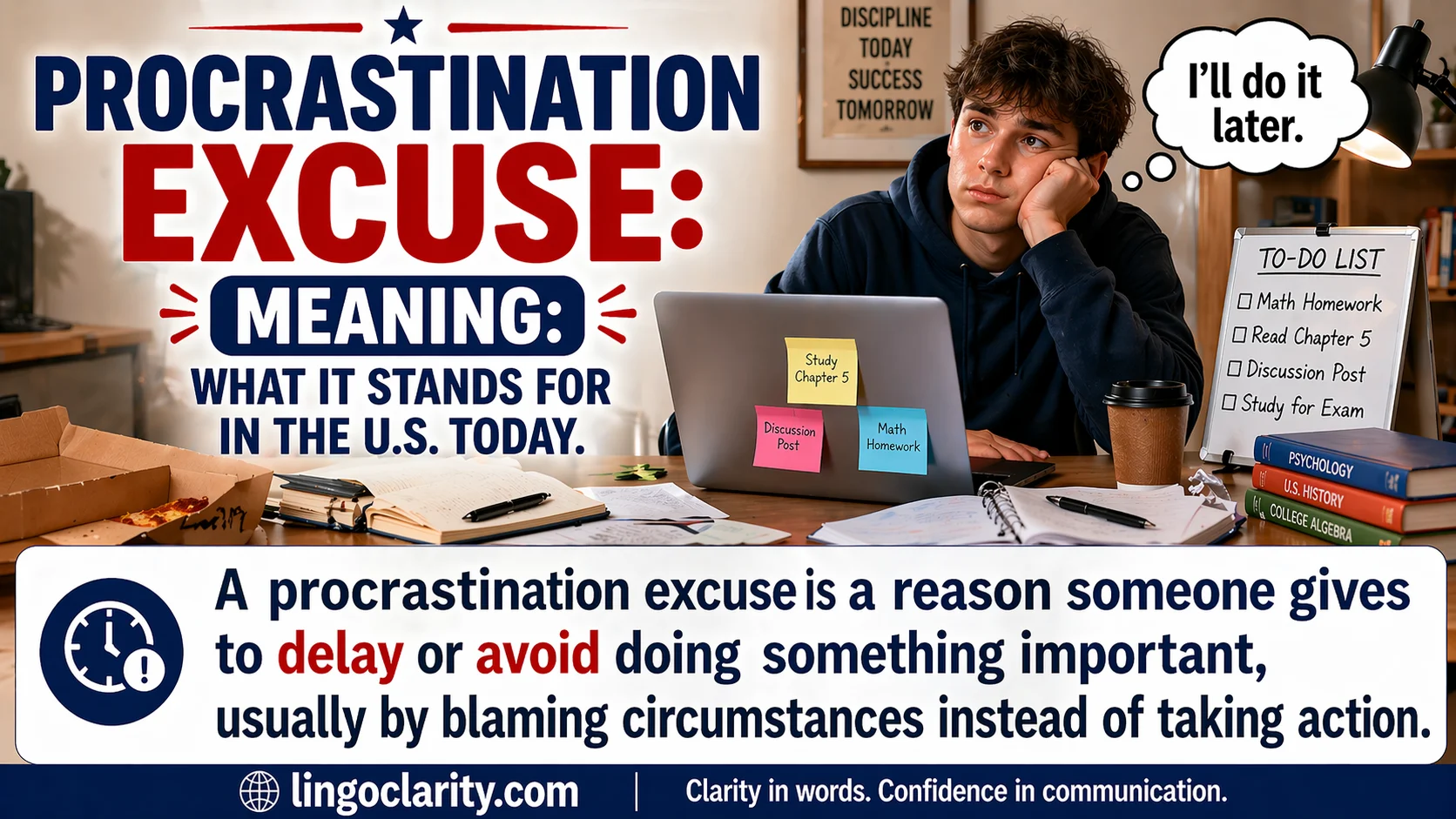
If you are trying to understand procrastination excuse, the plain meaning is simple: it is a reason someone gives, or tells themselves, to justify putting off something they should do. Usually, the reason has a little truth in it, but the point of the phrase is that the reason mainly protects delay rather than action. That basic idea matches how major dictionaries define procrastination and excuse, and it also matches how counseling and psychology sources talk about procrastination excuses in real life.
What Does “Procrastination Excuse” Mean?
A procrastination excuse is a justification for delaying a task, responsibility, or decision that should probably be handled now.
For example:
- “I need to be in the right mood first.”
- “I still have plenty of time.”
- “I should clean my desk before I start.”
- “I do my best work under pressure.”
Each of those statements may contain some truth. You really might be tired. You really might need a cleaner workspace. But when someone calls those statements procrastination excuses, they mean the statements are being used to avoid starting. Counseling materials often make this same point: these excuses tend to include a grain of truth while leading to an unhelpful conclusion that delay is the best option.
Is “Procrastination Excuse” A Real English Phrase?
Yes. It is a real, natural English phrase, but it is not a special idiom or an official grammar term.
It is a normal noun phrase built from two common words:
- procrastination = delaying something that should be done
- excuse = a reason given to justify or explain something
Put together, the phrase means an excuse connected to procrastination or an excuse used to justify procrastinating. Dictionaries define the component words clearly, even though they do not usually list the combined phrase as a separate entry. That is normal. English forms many everyday phrases this way.
How The Phrase Works In Grammar
In grammar, excuse is the head noun, and procrastination functions like a modifier telling you what kind of excuse it is.
That means you use the phrase like other ordinary noun phrases:
- a procrastination excuse
- another procrastination excuse
- my favorite procrastination excuse
- common procrastination excuses
You can also make it plural:
- “He always has new procrastination excuses.”
- “I’m tired of hearing the same procrastination excuses every week.”
This matters because learners sometimes treat the phrase like a set expression that cannot change. It can change normally. You can add articles, adjectives, and plurals the same way you would with other noun phrases.
How Native Speakers Usually Use It
Native speakers usually use procrastination excuse in one of three ways.
First, they use it for self-awareness:
- “My usual procrastination excuse is that I need more research.”
- “I realized that ‘I’m too tired’ was just my default procrastination excuse.”
Second, they use it to describe a pattern:
- “Waiting for the perfect time is a classic procrastination excuse.”
- “A lot of procrastination excuses sound practical at first.”
Third, they use it to challenge a weak justification:
- “That sounds less like a real obstacle and more like a procrastination excuse.”
- “Calling it planning doesn’t make it any less of a procrastination excuse.”
That last use is why tone matters. The phrase often carries mild criticism. It suggests the speaker thinks the reason is convenient, self-protective, or not fully honest. That tone lines up with how counseling and psychology sources describe excuses as a way of managing discomfort, fear, or avoidance rather than the task itself.
When The Phrase Sounds Natural
The phrase sounds natural when you are talking about:
- avoidance
- delay habits
- productivity
- study behavior
- self-reflection
- coaching, counseling, or self-help
Here are natural examples in context:
In School
- “Saying you needed a new notebook was a procrastination excuse.”
- “Her procrastination excuse was that she wanted to ‘review one more source’ before writing.”
On The Job
- “He turned every small distraction into a procrastination excuse.”
- “Needing the slides to be perfect became a procrastination excuse for not presenting anything at all.”
At Home
- “Cleaning the whole kitchen first was my procrastination excuse for not doing my taxes.”
- “I told myself I needed a fresh cup of coffee, but that was just a procrastination excuse.”
A smoother option without labels:
In self-reflection:
- “My biggest procrastination excuse is that I wait for motivation instead of starting.”
- “Once I noticed the excuse, it was easier to stop repeating it.”
These examples sound natural because they reflect how people actually talk about delay: not as a grammar problem, but as a behavior pattern.
When The Phrase Sounds Too Harsh
Do not use procrastination excuse for every reason someone gives for delay.
Sometimes the problem is real:
- illness
- grief
- disability-related barriers
- missing information
- a broken system
- a family emergency
- a mental health episode
In those situations, calling the reason a procrastination excuse can sound unfair or dismissive. University and psychology sources consistently note that procrastination is not just laziness, and related struggles can overlap with anxiety, overwhelm, depression, ADHD, perfectionism, and fear of failure.
A better rule is this: use the phrase when the “reason” mainly helps defend delay. Do not use it when the barrier genuinely blocks action.
Compare these:
- “I have the flu and can barely sit up.” → real reason
- “I need ideal weather before I start.” → likely a procrastination excuse
- “The company server is down for everyone.” → real obstacle
- “I’ll start once my desk looks perfect.” → likely a procrastination excuse
A Useful Real-World Distinction
A procrastination excuse often has this structure:
something true + an exaggerated conclusion
For example:
- “I’m tired” + “so I should not start at all”
- “I don’t have everything I need” + “so I should wait completely”
- “I have time” + “so there is no reason to begin now”
That pattern appears again and again in counseling materials about procrastination. The truth is not always false. The problem is the leap from truth to delay.
Common Sentence Patterns
If you want to use the phrase naturally, these are the most common sentence patterns.
1. My/His/Her + procrastination excuse + is/was + clause
- “My procrastination excuse is that I need more time to think.”
- “Her procrastination excuse was that she worked better at night.”
2. That/It + sounds like + a procrastination excuse
- “That sounds like a procrastination excuse, not a plan.”
- “It sounded like a procrastination excuse disguised as caution.”
3. Make + procrastination excuses
- “He keeps making procrastination excuses instead of starting.”
- “I used to make procrastination excuses every time a task felt uncomfortable.”
4. Turn something into a procrastination excuse
- “She turned uncertainty into a procrastination excuse.”
- “I turned perfectionism into a procrastination excuse.”
5. Classic/Common/Usual + procrastination excuse
- “Waiting for inspiration is a classic procrastination excuse.”
- “Being ‘too busy’ is a common procrastination excuse.”
These patterns are more natural than awkward versions like “I procrastination excuse a lot,” which is not correct English.
“Procrastination Excuse” Vs. “Excuse For Procrastination”
These two phrases are close, but they are not always identical.
A procrastination excuse usually means the excuse itself, especially the one someone says out loud or repeats mentally.
An excuse for procrastination often points more toward the underlying reason or cause behind the procrastination.
Compare:
- “My procrastination excuse was that I needed the perfect mood.”
- “My excuse for procrastination was fear of doing the job badly.”
The first sentence focuses on the wording of the excuse itself.
The second focuses more on the deeper reason behind the delay.
In everyday writing, though, people often blur that distinction.
Still, this distinction is useful if you want to sound precise.
Is It The Same As Laziness?
No. Not necessarily.
That is one of the biggest mistakes people make when they talk about procrastination. Modern psychology sources often describe procrastination as a form of emotional avoidance or emotion regulation, not simple laziness. A person can care deeply about a task and still delay it because the task brings up anxiety, boredom, fear, shame, or overwhelm.
That matters for this phrase too. Calling something a procrastination excuse does not automatically mean the person is lazy. It usually means the person is using a reason, consciously or not, to make delay feel more acceptable.
Does The Phrase Sound Formal Or Informal?
It is plain modern English. It is not slang, and it is not especially academic.
You can use it in:
- conversation
- workplace discussion
- self-help writing
- counseling contexts
- educational content
In very formal academic writing, though, you might choose a more technical word depending on the point you are making, such as:
- rationalization
- avoidance
- self-justification
- fear-based avoidance
- self-handicapping
Those terms may be more precise in scholarly discussion. But in ordinary English, procrastination excuse is direct, clear, and easy to understand.
Pronunciation
In American English, procrastination is pronounced roughly like proh-krass-tuh-NAY-shun, and excuse as a noun is pronounced roughly like ik-SKYOOS. Major learner dictionaries give the same core stress pattern: the strongest stress in procrastination falls on -NAY-, and the noun excuse ends with an s sound.
Common Mistakes To Avoid
One common mistake is using the phrase too aggressively.
Saying “That’s just a procrastination excuse” may be accurate, but it can also sound blunt. In sensitive situations, softer wording may work better:
- “That may be part of the delay pattern.”
- “That sounds more like avoidance than a real barrier.”
- “I think you may be using that as a reason to postpone.”
Another common mistake is using the phrase where a simpler word is better.
Incorrect:
- “My procrastination excuse is due tomorrow.”
Better:
- “My assignment is due tomorrow.”
A third mistake is confusing the phrase with a verb.
Incorrect:
- “I procrastination excuse a lot.”
Better:
- “I make a lot of procrastination excuses.”
- “I procrastinate a lot.”
A fourth mistake is assuming every delay is an excuse. Sometimes the delay is the result of a real limitation, not avoidance.
A Quick Test For Whether The Phrase Fits
Ask these questions:
- Is the person actually unable to act, or just reluctant to start?
- Does the reason solve the problem, or only postpone it?
- Does the reason contain some truth but lead to an exaggerated conclusion?
- Would a small first step still be possible?
If the answer to the last question is yes, you may be looking at a procrastination excuse rather than a real barrier. That logic closely matches the challenge questions used in counseling materials on procrastination.
FAQ
What is a procrastination excuse?
A procrastination excuse is a reason used to justify delaying something that should be done. The reason may be partly true, but it mainly helps defend postponement.
Is “procrastination excuse” a common phrase in English?
Yes. It is a natural, understandable phrase in modern English, especially in advice, productivity, counseling, and everyday discussion. It is not a formal dictionary entry as a fixed phrase, but it is built in a normal English way from two common words.
Is it rude to call something a procrastination excuse?
It can be. The phrase often carries mild criticism because it suggests the speaker thinks the reason is weaker than it sounds. It is safest in self-reflection or supportive discussion, and riskier when aimed at someone going through a real difficulty.
What are common procrastination excuses?
Common ones include:
- “I’m too tired.”
- “I still have time.”
- “I need the right mood.”
- “I don’t have everything I need yet.”
- “I work better under pressure.”
These show up repeatedly in university and counseling materials on procrastination.
Is procrastination the same as laziness?
No. Many psychology sources describe procrastination as an emotion-management problem or avoidance pattern rather than simple laziness.
Can I use “procrastination excuse” in formal writing?
You can, but in highly formal or academic writing, a more precise term may fit better, such as rationalization, avoidance, or self-justification.
Final Thoughts
Procrastination excuse means a reason used to justify delay, especially when that reason sounds more helpful than it really is. It is a normal English noun phrase, not slang, and native speakers often use it to describe avoidance, self-justification, or a familiar habit of putting things off. The phrase works best when the “reason” mainly protects delay, not when a person faces a real obstacle.
Once you understand that difference, the phrase becomes much easier to use well. You stop hearing it as just another productivity buzzword and start hearing the nuance: not every delay is an excuse, but some excuses are really just procrastination in nicer clothes.
