
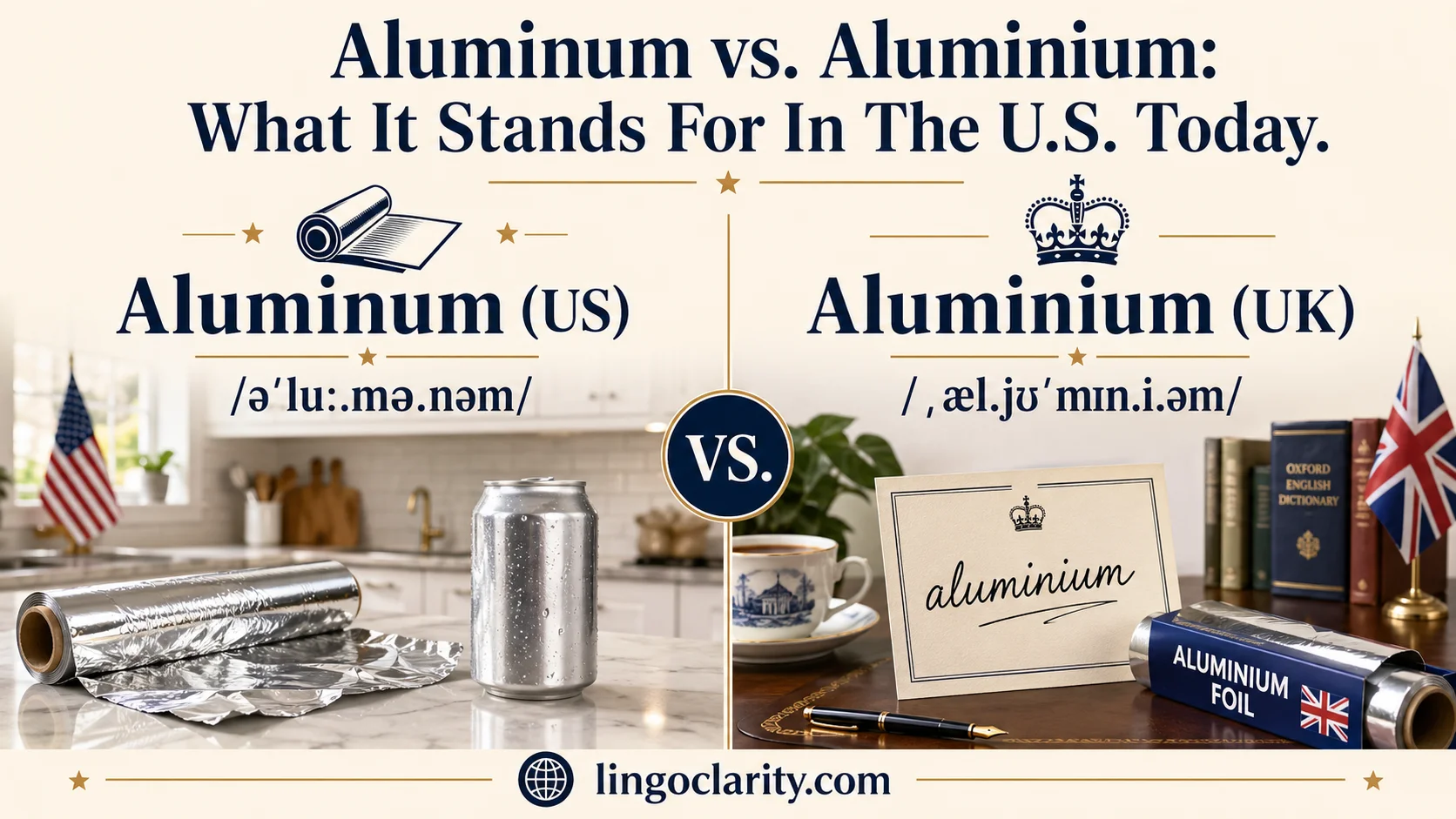
Aluminum vs. aluminium is a spelling difference, not a meaning difference. Both words refer to the same chemical element: Al, atomic number 13. The metal is used in foil, cans, cookware, window frames, aircraft parts, bicycles, laptops, and many industrial alloys. However, the spelling you choose should match your audience.
For a US audience, aluminum is the correct and expected spelling. For a UK audience, aluminium is the standard spelling. Therefore, the best choice depends on where your readers are, which style guide you follow, and whether you are writing original text or quoting another source.
Although the two spellings can look like separate words, they do not describe different metals. In other words, a US product label that says aluminum foil and a UK product label that says aluminium foil are describing the same material. The difference is regional usage, pronunciation, and editorial style.
Quick Answer
Use aluminum in American English. Use aluminium in British English and in many countries that follow British spelling conventions.
Both spellings are correct. However, aluminum is the safer choice for US schoolwork, journalism, product copy, business writing, technical manuals, labels, and everyday communication.
For example, a US writer should usually write:
- aluminum foil
- aluminum cans
- aluminum siding
- aluminum frame
- aluminum alloy
By contrast, a UK writer would usually write:
- aluminium foil
- aluminium cans
- aluminium siding
- aluminium frame
- aluminium alloy
So, if your readers are American, choose aluminum. If your readers are British, choose aluminium. Most importantly, do not mix both spellings in the same piece unless you are directly comparing them, quoting a source, or preserving an official title.
Aluminum And Aluminium Mean The Same Thing
Aluminum and aluminium are regional spellings of the same word. They both name the light, silvery metal with the chemical symbol Al. Therefore, the spelling does not change the substance, the chemical symbol, the atomic number, or the normal meaning.
For instance, if a US manual says aluminum frame and a UK manual says aluminium frame, both are referring to a frame made from the same type of metal. Likewise, aluminum oxide and aluminium oxide refer to the same compound, although the preferred spelling changes by region.
This distinction matters because many readers assume the extra i in aluminium must signal a technical difference. However, it does not. The words do not separate grades, purity levels, alloy types, or manufacturing methods. Instead, they reflect two accepted spelling traditions.
Which Spelling Should US Writers Use?
US writers should use aluminum in almost all original writing. It is the standard American English form and the spelling that American readers expect to see.
Use aluminum when writing for:
- US students
- US teachers
- US consumers
- US contractors
- US product buyers
- US news readers
- US business clients
- US technical audiences
For example:
Correct For US English:
The contractor installed aluminum gutters.
Less Natural For US English:
The contractor installed aluminium gutters.
Although American readers will usually understand aluminium, it may look foreign, overly British, or like a spelling mistake in US copy. Therefore, unless your context specifically requires British English, aluminum is the better choice for American audiences.
Which Spelling Should UK Writers Use?
UK writers should use aluminium. It is the standard spelling in British English and is also common in Australia, New Zealand, Ireland, South Africa, and many other English-speaking regions that follow British spelling conventions.
For example:
Correct For UK English:
The builder ordered aluminium panels for the shopfront.
Less Natural For UK English:
The builder ordered aluminum panels for the shopfront.
In British English, aluminum can look noticeably American. Therefore, if your publication uses British spellings such as colour, centre, favour, and travelling, it should normally use aluminium as well.
US, UK, Canadian, And International Usage
The spelling choice becomes easier when you match it to the target audience. However, international writing can require extra care because readers may come from several English-speaking regions.
| Audience Or Context | Best Choice | Why |
|---|---|---|
| United States | Aluminum | Standard American English spelling. |
| Canada | Aluminum | Common North American spelling, although house style may vary. |
| United Kingdom | Aluminium | Standard British English spelling. |
| Australia | Aluminium | Usually follows British spelling. |
| New Zealand | Aluminium | Usually follows British spelling. |
| International Website | Depends On Market | Use localized pages when possible. |
| Scientific Journal | Follow Journal Style | Some journals require specific spelling rules. |
| Direct Quotation | Keep Original | Do not silently change quoted text. |
| Product Name Or Title | Keep Official Spelling | Official names should remain unchanged. |
As a result, a US brand selling to American buyers should usually write aluminum. However, the same brand may use aluminium on a UK landing page. This approach improves clarity and helps the page feel natural to local readers.
Why The Two Spellings Cause Confusion
The confusion comes from three main factors: spelling, pronunciation, and exposure to international content.
First, aluminium has an extra i, so it looks unusual to many American readers. Second, the two forms are usually pronounced differently. Third, both spellings appear online in product listings, science articles, dictionaries, news reports, and international documents. Consequently, readers often wonder whether one form is wrong.
In reality, neither spelling is wrong by itself. The problem only appears when the spelling does not match the audience. For example, aluminum foil is natural in a US grocery listing, while aluminium foil is natural in a UK grocery listing.
Therefore, the key is not to ask which spelling is universally correct. Instead, ask which spelling is correct for your readers.
How To Pronounce Aluminum And Aluminium
The spelling difference usually affects pronunciation.
In American English, aluminum is commonly pronounced:
uh-LOO-muh-num
In British English, aluminium is commonly pronounced:
al-yuh-MIN-ee-um or al-uh-MIN-ee-um
Because aluminium has one more syllable, it often sounds more different than it looks. This is another reason the two forms can feel like separate words. Nevertheless, they still refer to the same element.
For US writing, pronunciation supports the spelling choice. American readers say and expect aluminum. British readers say and expect aluminium. Therefore, matching the spelling to the audience also matches the usual spoken form.
A Short History Of Aluminum And Aluminium
The history of the word explains why both forms survived.
The name is connected to alumina, a compound associated with aluminum oxide. In the early 1800s, different forms of the word appeared as chemists discussed the element. One early form was alumium. Later, aluminum appeared. After that, aluminium became common because it matched the -ium ending used in many element names, such as sodium, potassium, calcium, and magnesium.
Over time, aluminum became the dominant spelling in North America. Meanwhile, aluminium became the preferred spelling in British English and many international contexts.
This history is why both spellings can appear in serious writing. More importantly, it shows that the difference is not a modern typo or a casual mistake. Instead, it is a long-standing regional split.
Is Aluminium More Scientific Than Aluminum?
No. Aluminium is not more scientific than aluminum, and aluminum is not less formal than aluminium. Both spellings are used in serious contexts.
The idea that aluminium is more scientific usually comes from its -ium ending. Since many element names end in -ium, the British spelling may look more consistent to some readers. However, in US English, aluminum is the accepted formal spelling.
For example, a US engineering report can correctly refer to aluminum alloy 6061. A British engineering report can correctly refer to aluminium alloy 6061. The alloy does not change. Only the spelling changes.
Therefore, choose the form required by your audience, editor, organization, or style guide.
When To Use Aluminum
Use aluminum when the text is written for American readers or follows American English.
Use Aluminum In US Schoolwork
Students in the United States should normally write aluminum.
Example:
Aluminum is widely used because it is lightweight, durable, and resistant to corrosion.
Use Aluminum In US Business Writing
American companies should use aluminum in proposals, emails, invoices, reports, and marketing copy.
Example:
We recommend aluminum panels because they are lightweight and easy to maintain.
Use Aluminum In US Product Copy
For US ecommerce pages, labels, and packaging, aluminum is usually the right choice.
Example:
Heavy-duty aluminum foil is ideal for grilling, baking, and food storage.
Use Aluminum In US Technical Manuals
US manuals should use aluminum unless the project style guide says otherwise.
Example:
Attach the aluminum bracket using the supplied stainless steel screws.
When To Use Aluminium
Use aluminium when the text is written for British readers or follows British English.
Use Aluminium In UK Copy
UK publications, product pages, and manuals should usually use aluminium.
Example:
The aluminium frame provides strength without adding unnecessary weight.
Use Aluminium For British-Style International Content
If a publication uses British spelling throughout, aluminium should match the rest of the text.
Example:
The company specialises in aluminium windows, doors, and curtain walling.
Use Aluminium When Required By House Style
Some organizations, journals, or international publishers may require aluminium. Therefore, always follow the assigned style guide when one exists.
When To Keep The Original Spelling
Although US writers usually use aluminum, they should not automatically change every instance of aluminium. In some cases, the original spelling should remain.
Keep the original spelling in:
- direct quotations
- article titles
- book titles
- organization names
- company names
- product names
- legal documents
- citations
- historical references
For example:
The British report titled “Recycling Aluminium In Construction” discusses aluminum recovery methods used in several countries.
In that sentence, the title keeps Aluminium because it is part of the original title. However, the writer’s own sentence uses aluminum because the surrounding article is in US English.
This method keeps the text accurate while maintaining a consistent editorial style.
Common Mistakes And Quick Fixes
Mistake 1: Saying They Are Different Metals
Incorrect:
Aluminium is different from aluminum.
Correct:
Aluminum and aluminium are different spellings of the same metal.
The spelling does not affect the element, symbol, or material properties.
Mistake 2: Mixing Both Spellings In One Article
Incorrect:
The aluminum frame is made with aluminium alloy parts.
Correct For US English:
The aluminum frame is made with aluminum alloy parts.
Correct For UK English:
The aluminium frame is made with aluminium alloy parts.
Consistency makes the writing look professional.
Mistake 3: Changing The Chemical Symbol
Incorrect:
The chemical symbol for aluminium is Am.
Correct:
The chemical symbol for both aluminum and aluminium is Al.
No matter which spelling you use, the symbol stays the same.
Mistake 4: Assuming Aluminium Is Always More Formal
Incorrect:
Use aluminium in formal US writing because it sounds more scientific.
Correct:
Use aluminum in formal US writing and aluminium in formal UK writing.
Formality depends on the correct regional style, not on which spelling looks longer.
Mistake 5: Changing A Quotation Without Notice
Incorrect:
A UK source says “aluminum foil” when the original quotation used “aluminium foil.”
Correct:
Keep the spelling used in the original quotation.
If you must adapt a quotation for style, make the change transparently and only when editorial rules allow it.
Everyday Examples
US English Examples
- I wrapped the leftovers in aluminum foil.
- The recycling bin is full of aluminum cans.
- The contractor installed aluminum siding.
- Her laptop has a brushed aluminum case.
- The bike frame is made from aluminum alloy.
- The company produces aluminum parts for aircraft.
- The storm damaged several aluminum window frames.
UK English Examples
- I wrapped the leftovers in aluminium foil.
- The recycling bin is full of aluminium cans.
- The contractor installed aluminium cladding.
- Her laptop has a brushed aluminium case.
- The bike frame is made from aluminium alloy.
- The company produces aluminium parts for aircraft.
- The storm damaged several aluminium window frames.
These examples show the main rule in action. The sentences mean the same thing, but the spelling changes for the audience.
Phrases With Aluminum And Aluminium
Common US Phrases
- aluminum foil
- aluminum can
- aluminum siding
- aluminum frame
- aluminum window
- aluminum oxide
- aluminum sulfate
- aluminum alloy
- aluminum extrusion
- recycled aluminum
- powder-coated aluminum
- brushed aluminum finish
Common UK Phrases
- aluminium foil
- aluminium can
- aluminium cladding
- aluminium frame
- aluminium window
- aluminium oxide
- aluminium sulphate
- aluminium alloy
- aluminium extrusion
- recycled aluminium
- powder-coated aluminium
- brushed aluminium finish
Notice that other spellings may also change by region. For example, American English usually uses sulfate, while British English often uses sulphate. Therefore, a fully localized document should check more than just aluminum and aluminium.
Best Choice For SEO And Online Content
For SEO, choose the spelling your target audience searches for. A US page should primarily use aluminum, while a UK page should primarily use aluminium.
If your website serves multiple countries, the best solution is usually localization:
- US page: Aluminum Windows
- UK page: Aluminium Windows
- US product: Aluminum Foil
- UK product: Aluminium Foil
This approach helps search engines and readers understand the market you are targeting. Additionally, it avoids awkward keyword stuffing. You can mention the alternate spelling naturally once or twice, especially in an FAQ or comparison section, but the main page should use the local spelling consistently.
For example, a US page can say:
In British English, aluminum is usually spelled aluminium.
That sentence captures the alternate term without making the page sound forced.
Best Editorial Rule To Remember
The easiest rule is this:
Use aluminum for American English. Use aluminium for British English. Keep the original spelling in quotations, titles, names, and official source material.
This rule works for most school, business, publishing, product, and technical writing situations. Additionally, it keeps your writing consistent and prevents unnecessary reader distraction.
FAQ
Is aluminum or aluminium correct?
Both spellings are correct. Aluminum is the standard spelling in American English, while aluminium is the standard spelling in British English. Both words refer to the same chemical element.
Which spelling should I use in the United States?
Use aluminum in the United States. It is the expected spelling in US schoolwork, journalism, business writing, product labels, technical manuals, and everyday communication.
Are aluminum and aluminium the same metal?
Yes. Aluminum and aluminium are the same metal. Both refer to element Al, atomic number 13. The spelling does not change the substance, alloy, grade, or meaning.
Why do British people spell it aluminium?
British English uses aluminium because that spelling became established with the -ium ending found in many element names. Over time, aluminium became standard in British English, while aluminum became standard in American English.
Does Canada use aluminum or aluminium?
Canada usually uses aluminum, following North American spelling. However, some Canadian organizations may follow their own house style, so it is still worth checking style requirements for formal publications.
Is aluminium more formal than aluminum?
No. Aluminium is not more formal for US readers. In American English, aluminum is the correct formal spelling. In British English, aluminium is the correct formal spelling.
Should I use aluminum or aluminium in academic writing?
Use the spelling required by your school, journal, publisher, or style guide. If no style guide is provided, use aluminum for American English and aluminium for British English.
Should I change aluminium to aluminum in a quote?
No. Do not change spelling inside a direct quotation unless your editorial rules specifically allow it. In most cases, preserve the original spelling in quotes, titles, names, and citations.
How do you pronounce aluminum?
In American English, aluminum is usually pronounced uh-LOO-muh-num.
How do you pronounce aluminium?
In British English, aluminium is usually pronounced al-yuh-MIN-ee-um or al-uh-MIN-ee-um.
Conclusion
For a US audience, choose aluminum. For a UK audience, choose aluminium. Both spellings are correct, and both refer to the same chemical element: Al, atomic number 13.
The difference is not chemical. Instead, it is regional. Therefore, the best spelling depends on your readers, your style guide, and your publishing context. Use one spelling consistently in your own writing, preserve the original spelling in quotations and titles, and match the form your audience expects.
