
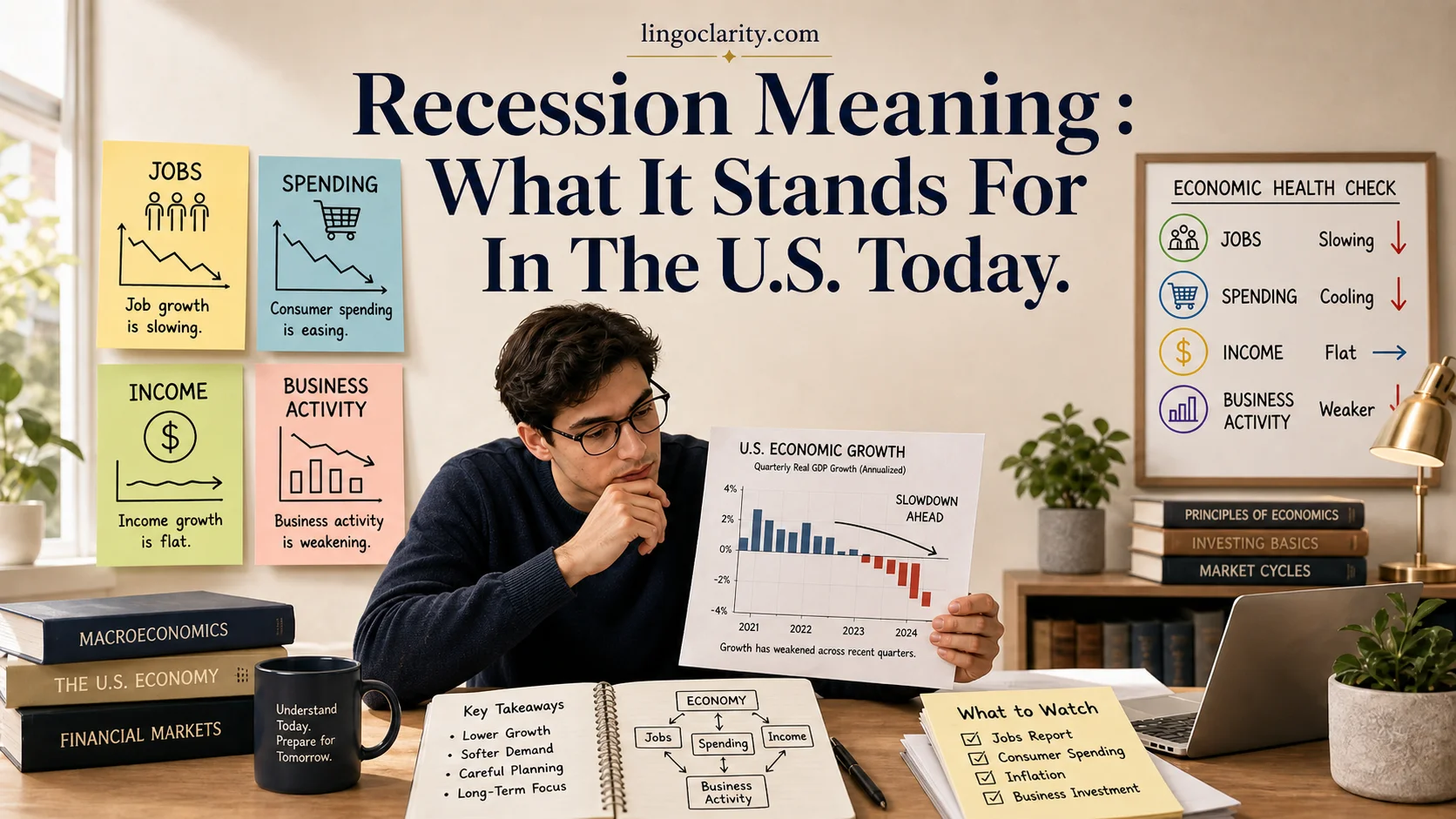
Recession meaning is simple: a recession is a serious, broad slowdown in economic activity that lasts more than a short time. In plain English, it means the economy is doing worse. Businesses may sell less, companies may hire less, workers may lose jobs or hours, and people may spend more carefully.
In the United States, a recession is not officially defined by one simple number. The National Bureau of Economic Research describes a recession as a significant decline in economic activity that spreads across the economy and lasts more than a few months. It weighs depth, diffusion, and duration when dating recessions.
Simple meaning: A recession is a major economic slowdown that affects many people, businesses, and industries.
Quick Facts About Recession
| Question | Answer |
|---|---|
| Part of speech | Noun |
| Pronunciation | ri-SESH-uhn |
| Main meaning | A serious slowdown in the economy |
| Formal or slang? | Formal word, sometimes used casually online |
| Common field | Economics, business, news, school, personal finance |
| Opposite | Expansion, boom, recovery, growth |
| Stronger related word | Depression |
What Recession Means In Plain English
A recession happens when an economy loses momentum in a serious way. People buy fewer goods and services. Businesses earn less money. As a result, companies may cut costs, pause hiring, reduce hours, or lay off workers.
The effect can spread. If workers lose income, they may spend less. If customers spend less, businesses may sell less. Then companies may cut more expenses. That cycle is one reason recessions can feel stressful and hard to stop.
A recession does not mean every person loses a job or every company fails. It also does not mean prices automatically fall or the stock market always crashes. Instead, it means the overall economy is weaker across several important areas, such as production, employment, income, and spending.
Britannica describes a recession as a downward business-cycle trend marked by lower production and employment, which can cause household income and spending to decline.
How To Pronounce Recession
Recession is pronounced ri-SESH-uhn.
The stress is on the second syllable: SESH.
Examples:
- The country entered a recession.
- Many people spent less during the recession.
- Economists studied recession risks.
- The company prepared for recessionary conditions.
The adjective form is recessionary, which means related to a recession.
Example:
- Higher borrowing costs can create recessionary pressure.
How The U.S. Defines A Recession
In everyday conversation, people often say a recession means “two quarters of negative GDP.” GDP, or gross domestic product, measures the value of goods and services a country produces.
That shortcut is common, but it is not the official U.S. definition. The U.S. Bureau of Economic Analysis says two straight quarters of negative GDP growth are not an official recession designation. In the United States, recession dating belongs to the National Bureau of Economic Research, which considers monthly indicators such as employment, personal income, industrial production, and GDP.
A helpful way to remember the U.S. approach is:
- Depth: Is the decline serious?
- Diffusion: Has it spread across the economy?
- Duration: Has it lasted more than a short moment?
So, a recession is not just one weak report, one bad week, or one struggling company. It is a broader decline across the economy.
Is A Recession Always Two Quarters Of Negative GDP?
No. Two quarters of falling real GDP is a useful shortcut, but it is too narrow to be the full definition.
The IMF notes that many analysts use two consecutive quarters of falling inflation-adjusted GDP as a practical definition, but it also says GDP alone is narrow and that a wider set of economic measures can give a better picture.
This matters because an economy can have weak GDP while jobs or income remain stronger. It can also have signs of recession before GDP data fully confirms the downturn. For that reason, recessions are often identified after enough data is available.
What Happens During A Recession?
During a recession, the economy usually weakens in several connected ways.
Businesses may see fewer sales. Consumers may delay large purchases, such as cars, appliances, vacations, or homes. Companies may reduce hiring, cut hours, or lay off workers. Banks and lenders may become more cautious. Investors may worry about future profits. Governments may collect less tax revenue because incomes and business earnings fall.
A recession can affect people unevenly. One industry may suffer badly while another remains stable. For example, travel, retail, construction, and manufacturing may feel a downturn sooner than essential services. Some regions may also struggle more than others.
Common recession effects include:
- Higher unemployment or slower job growth
- Lower consumer spending
- Weaker business sales
- Falling or slower production
- Lower household income
- More financial caution
- Delayed investment by businesses
- Greater uncertainty about the future
What Causes A Recession?
A recession can have more than one cause. Often, several problems build at the same time.
Common causes include:
- Weak demand: People and businesses spend less, so companies produce less.
- High interest rates: Borrowing becomes more expensive, which can slow buying and investment.
- Financial stress: Banks, lenders, or markets become unstable.
- Major shocks: A pandemic, war, oil-price spike, supply disruption, or natural disaster can hurt economic activity.
- Loss of confidence: Consumers and businesses become worried and pull back.
- Asset bubbles bursting: A sharp fall in housing, stocks, or another major market can reduce wealth and spending.
A recession is rarely caused by one simple event. More often, a trigger exposes weaknesses that were already building.
Recession Examples In Sentences
Use recession when you mean a broad economic downturn, not just one personal or business problem.
Correct examples:
- The economy entered a recession after several months of falling activity.
- Many families cut back on spending during the recession.
- The company delayed expansion because it feared a recession.
- Economists disagreed about whether the slowdown would become a recession.
- The government introduced policies to help the country recover from recession.
- Students studied the Great Recession in economics class.
- A recession can affect jobs, income, business sales, and consumer confidence.
Less accurate:
- My favorite restaurant closed, so the city is in recession.
Better:
- My favorite restaurant closed during a weak local economy.
One business closing does not prove a recession. A recession describes a wider economic pattern.
Common Phrases With Recession
| Phrase | Meaning | Example |
|---|---|---|
| In recession | Experiencing a recession | The economy was in recession for several months. |
| Enter a recession | Begin a recession | Analysts warned the country could enter a recession. |
| Fall into recession | Move into recession | The economy fell into recession after a sharp drop in demand. |
| Avoid a recession | Prevent a recession | Policymakers tried to avoid a recession. |
| Deep recession | A severe recession | The country faced a deep recession after the financial crisis. |
| Mild recession | A less severe recession | Some economists expected only a mild recession. |
| Recessionary conditions | Conditions linked to recession | Businesses prepared for recessionary conditions. |
| Recession risk | Chance of a recession | The report increased recession risk. |
| Recover from recession | Improve after recession | Employment slowly recovered from recession. |
Recession Vs Similar Words
| Word | Meaning | How It Differs |
|---|---|---|
| Slowdown | Growth becomes weaker | Can happen without the economy shrinking |
| Downturn | Conditions get worse | Broader and less technical than recession |
| Contraction | Economic activity shrinks | More formal and often tied to GDP or output |
| Recession | Serious, broad economic decline | More specific than slowdown or downturn |
| Depression | Extremely severe, long downturn | Much worse than a recession |
| Recovery | Economy improves after decline | Opposite phase after a recession |
| Expansion | Economy grows | Opposite of recession |
| Boom | Fast, strong growth | Stronger than normal expansion |
A slowdown may mean the economy is still growing, just more slowly. A recession means the decline is serious enough to affect the broader economy. A depression is much more severe and long-lasting.
Merriam-Webster explains that a recession can reduce production, employment, household income, and spending, while a depression is more severe and marked by widespread unemployment and major pauses in economic activity.
What A Recession Is Not
A recession is often confused with other economic problems. These problems can happen during a recession, but they do not prove one by themselves.
A recession is not automatically:
- One bad stock-market day
- One company closing
- One person losing a job
- One month of weak sales
- High prices alone
- Inflation alone
- A bad housing market alone
- A viral online “recession indicator”
For example, inflation means prices are rising. A recession means economic activity is broadly declining. The two can happen near the same time, but they are not the same thing.
Other Meanings Of Recession
In everyday news and school writing, recession usually means an economic downturn.
However, the word can also mean a movement backward or withdrawal. Dictionaries include non-economic uses such as the recession of floodwater, gum recession, or a formal procession leaving a place.
Examples:
- The recession of the floodwater revealed damage to the road.
- Gum recession can expose part of a tooth root.
These meanings are real, but the economic meaning is the one most people mean when they say “a recession.”
Common Mistakes To Avoid
Do not use recession for one person’s finances.
Incorrect:
- I am in a recession because I lost my job.
Better:
- I am struggling financially after losing my job.
Do not use recession for one company’s problem.
Incorrect:
- The store had a recession.
Better:
- The store had a sales slump.
Do not treat the two-quarter GDP rule as the full U.S. definition.
Incorrect:
- A recession is always exactly two quarters of negative GDP.
Better:
- Two quarters of negative GDP is a common shortcut, but the U.S. uses a broader definition.
Do not confuse recession with rescission.
- Recession means an economic downturn or movement backward.
- Rescission means cancellation, often of a contract.
Mini Quiz: Recession Meaning
Test your understanding:
- Is recession a noun or a verb?
- Does one bad sales week prove a recession?
- Which is stronger: recession or depression?
- Is recession mainly a slang word?
- What is the opposite of recession?
- What common shortcut uses two quarters of falling GDP?
Answers:
- Noun.
- No.
- Depression.
- No.
- Expansion, growth, boom, or recovery.
- The two-quarter GDP rule.
FAQs
What does recession mean in simple terms?
A recession means the economy slows down in a serious and widespread way. Businesses may sell less, companies may hire less, workers may lose income, and people may spend more carefully.
Who decides if the U.S. is in a recession?
In the United States, the National Bureau of Economic Research’s Business Cycle Dating Committee identifies recessions. It looks at several measures of economic activity rather than relying only on GDP.
Is a recession two quarters of negative GDP?
Two quarters of negative GDP is a common shortcut, but it is not the official U.S. test. The U.S. approach looks at a broader decline across indicators such as employment, income, production, sales, and GDP.
What happens during a recession?
During a recession, economic activity weakens. People may spend less, businesses may earn less, hiring may slow, unemployment may rise, and companies may delay investment.
What causes a recession?
A recession can be caused by weak demand, high borrowing costs, financial shocks, falling confidence, major supply disruptions, or a sudden crisis. Often, several causes work together.
Is recession the same as depression?
No. A depression is more severe and usually lasts longer. A recession is serious, but a depression involves deeper and more damaging economic decline.
Can prices rise during a recession?
Yes. Prices can still rise during a recession, especially if inflation is caused by supply problems or higher costs. Recession and inflation are different concepts.
How do you use recession in a sentence?
You can say, “The company prepared for a recession,” or “Many families spent less during the recession.” Use the word for broad economic trouble, not one small setback.
Conclusion
A recession is a serious, broad decline in economic activity that lasts more than a short time. It can affect jobs, income, business sales, production, and consumer spending.
The easiest way to remember it is this: a recession is not just bad news or one weak month. It is a wider economic slowdown that spreads across many parts of the economy.
