
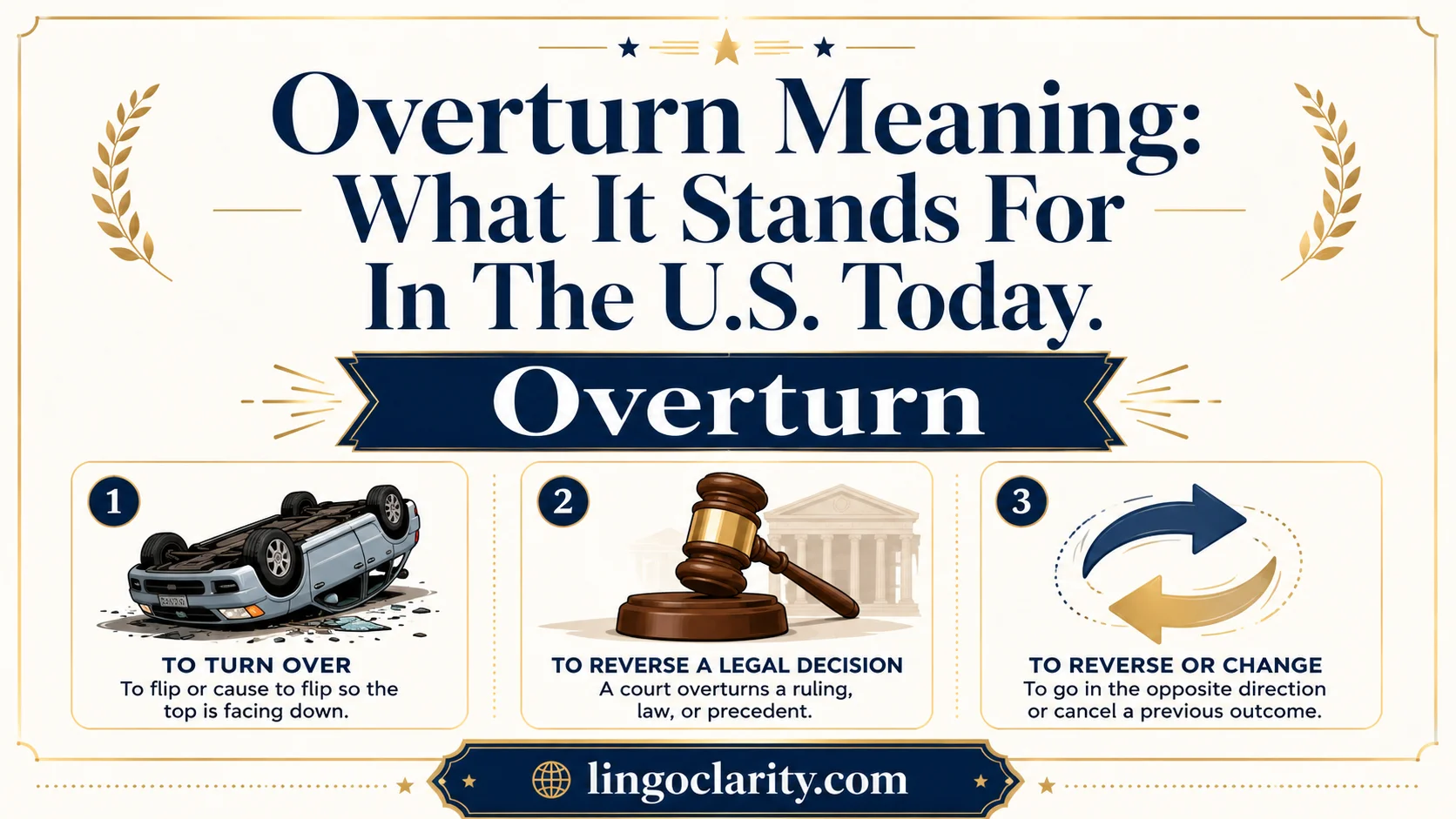
Overturn meaning is simple: to overturn something means to turn it over, knock it onto its side, or reverse a decision that was already made. Therefore, the word can describe both a physical action and an official change.
For example, a truck can overturn on a highway after an accident. Likewise, a court can overturn a ruling after an appeal. In both cases, something changes from its earlier position or status.
Although the word is easy to understand, it can be confusing because it appears in different contexts. You may see it in news reports, legal articles, sports coverage, accident descriptions, and everyday conversation. Therefore, the best way to understand overturn is to look at how it works in real sentences.
This version is correct because exact keyphrase “Overturn meaning” appears right at the start, and the sentence still sounds natural.
Quick Answer
Overturn means to flip over, knock over, or officially reverse something.
Use overturn when:
| Context | Meaning | Example |
|---|---|---|
| Physical action | Something turns onto its side or upside down | “The storm overturned the patio table.” |
| Vehicle accident | A vehicle rolls over or flips | “The truck overturned on the icy road.” |
| Court or law | A legal decision is reversed | “The appeals court overturned the ruling.” |
| Sports review | An original call is changed | “Replay review overturned the call.” |
| Official decision | A rule, ban, policy, or fine is reversed | “The board voted to overturn the ban.” |
In simple terms, overturn means turn over in physical situations and reverse in decision-based situations.
What Does Overturn Mean?
Overturn has two main meanings.
First, it can mean to turn something over physically. For example, strong wind may overturn a trash can, a chair, a boat, or a table. Similarly, a car may overturn during a crash.
Second, it can mean to reverse an official decision. For instance, a court may overturn a conviction, a judge may overturn an order, or sports officials may overturn a call after video review.
Although these meanings look different, they share one basic idea. Something moves away from its earlier position. In the physical meaning, the change is literal. However, in the legal or official meaning, the change is about authority, status, or outcome.
Overturn Definition In Plain English
To overturn something means to flip it over, knock it over, or reverse a decision so it no longer stands as it did before.
Here are the two clearest meanings:
| Meaning | Plain-English Explanation |
|---|---|
| Physical meaning | Something turns over, falls over, or flips onto its side. |
| Decision meaning | An earlier decision, ruling, rule, or result is reversed. |
For example:
“The boat overturned in the river.”
This means the boat turned over in the water.
“The court overturned the conviction.”
This means the court reversed the earlier conviction.
Therefore, the object after overturn helps you understand the meaning. If the object is a car, boat, table, or chair, the meaning is physical. However, if the object is a ruling, conviction, decision, verdict, ban, or call, the meaning is official or legal.
Pronunciation And Part Of Speech
Overturn is usually a verb.
Pronunciation:
oh-ver-TURN
The strongest stress usually falls on the final syllable: TURN.
Verb forms:
| Verb Form | Example |
|---|---|
| Base form | “They may overturn the decision.” |
| Present tense | “The court overturns the ruling.” |
| Past tense | “The court overturned the ruling.” |
| Present participle | “The court is overturning the ruling.” |
In addition, overturn can sometimes be used as a noun. However, the noun form is less common in everyday English.
Less common:
“The overturn of the ruling surprised the public.”
More natural:
“The court’s decision to overturn the ruling surprised the public.”
How To Use Overturn In A Sentence
Use overturn when something flips, falls over, or gets officially reversed. However, choose the sentence structure carefully because the word can be transitive or intransitive.
A transitive verb takes an object:
“The court overturned the ruling.”
Here, the ruling is the object.
An intransitive verb does not take an object:
“The truck overturned.”
Here, the truck itself turned over.
Therefore, both sentence patterns are correct.
Physical Meaning Of Overturn
When overturn describes a physical action, it means something turns onto its side, turns upside down, or gets knocked from its normal position.
Examples:
“The car overturned after the driver lost control.”
“A strong gust overturned the umbrella.”
“The child overturned the basket of toys.”
“The boat overturned near the dock.”
“She bumped the cart, and it overturned in the aisle.”
In these examples, overturn describes visible movement. As a result, this meaning often appears in accident reports, weather stories, and everyday descriptions.
Legal Meaning Of Overturn
In law, overturn means to reverse, cancel, set aside, or invalidate an earlier legal decision. Therefore, when a court overturns a ruling, the earlier ruling no longer stands in the same way.
Examples:
“The appeals court overturned the lower court’s decision.”
“New evidence helped overturn the conviction.”
“The judge refused to overturn the order.”
“The verdict was overturned after a successful appeal.”
“The court overturned part of the law.”
However, an overturned decision does not always mean the entire case is finished. Sometimes, the court reverses only part of a decision. In other cases, the court sends the case back to a lower court for more action.
Therefore, in legal writing, overturn is stronger than review, question, or challenge. A decision has not been overturned just because someone disagrees with it. Instead, the proper authority must reverse it.
Overturn In Sports
In sports, overturn means that an original call changes after review. Therefore, the word is common in sports that use replay systems.
Examples:
“The touchdown call was overturned after replay.”
“The referee overturned the goal after checking the video.”
“The umpire’s call was overturned on review.”
“The officials reviewed the play and overturned the original decision.”
In this context, overturn means the first call did not stand. Instead, the final decision replaced it.
Overturn In Rules, Policies, And Decisions
Overturn can also describe a reversed rule, policy, ban, fine, or official decision. Therefore, it often appears in business, education, government, and workplace settings.
Examples:
“The board voted to overturn the policy.”
“The committee refused to overturn the suspension.”
“The city council may overturn the parking ban.”
“The agency overturned its earlier decision.”
“The company asked regulators to overturn the fine.”
In these examples, overturn sounds more formal than change. It also suggests that a previous decision is being reversed, not simply updated.
Common Phrases With Overturn
| Phrase | Meaning | Example |
|---|---|---|
| Overturn a decision | Reverse an earlier decision | “The board may overturn the decision.” |
| Overturn a ruling | Reverse a court ruling | “The court overturned the ruling.” |
| Overturn a conviction | Reverse a criminal conviction | “New DNA evidence helped overturn the conviction.” |
| Overturn a verdict | Reverse a trial result | “The verdict was overturned on appeal.” |
| Overturn a law | Invalidate or strike down a law | “The court could overturn the law.” |
| Overturn a ban | Cancel or reverse a ban | “Officials voted to overturn the ban.” |
| Overturn a call | Change a sports call | “Replay review overturned the call.” |
| Vehicle overturned | A vehicle flipped or rolled over | “An overturned truck blocked traffic.” |
These phrases are common because overturn often appears with nouns related to authority, accidents, and official outcomes.
Overturn Synonyms
The best synonym for overturn depends on the meaning.
| Synonym | Best Use | Example |
|---|---|---|
| Turn over | Simple physical movement | “The box turned over.” |
| Tip over | Something falls from an upright position | “The lamp tipped over.” |
| Flip over | Something turns completely over | “The car flipped over.” |
| Knock over | Someone or something causes an object to fall | “He knocked over the glass.” |
| Upend | Something is turned over or disrupted | “The storm upended the boat.” |
| Capsize | A boat or vessel turns over | “The canoe capsized.” |
| Reverse | A decision or direction changes | “The court reversed the ruling.” |
| Overrule | An authority rejects a decision or objection | “The judge overruled the objection.” |
| Invalidate | Something is made legally ineffective | “The court invalidated the rule.” |
| Set aside | A legal decision is canceled or rejected | “The verdict was set aside.” |
| Strike down | A law or rule is declared invalid | “The court struck down the law.” |
However, these words are not always exact replacements. For example, capsize usually applies to boats, while overrule often applies to objections or authority-based decisions.
Overturn Antonyms
The opposite of overturn depends on the context.
| Antonym | Best Use | Example |
|---|---|---|
| Uphold | Legal decisions and rulings | “The court upheld the ruling.” |
| Affirm | Appeals and judgments | “The appeals court affirmed the decision.” |
| Confirm | Decisions or results | “The board confirmed the earlier decision.” |
| Maintain | Rules, policies, or positions | “The company maintained the policy.” |
| Preserve | Keeping something in place | “The ruling preserved the old rule.” |
| Support | Approving or backing a decision | “The committee supported the decision.” |
| Set upright | Physical objects | “She set the chair upright.” |
| Right | Boats, vehicles, or objects | “The crew worked to right the boat.” |
For legal decisions, the most useful opposite is often uphold. If a court overturns a ruling, it reverses it. However, if a court upholds a ruling, it allows the ruling to remain in effect.
Overturn Vs. Reverse
Overturn and reverse are closely related. In many legal contexts, they can mean almost the same thing.
Examples:
“The court overturned the ruling.”
“The court reversed the ruling.”
Both sentences mean the earlier ruling no longer stands as it did before.
However, reverse is broader. You can reverse a car, reverse a direction, reverse a trend, or reverse a decision. By contrast, overturn often suggests a stronger change to an official decision or a physical object’s position.
Therefore, use reverse when the main idea is changing direction or outcome. Use overturn when the main idea is canceling a prior decision or flipping something over.
Overturn Vs. Overrule
Overturn and overrule are related, especially in legal contexts. However, they are not always interchangeable.
Overrule usually means that a person in authority rejects an argument, objection, or earlier decision.
Example:
“The judge overruled the objection.”
Overturn usually means that an earlier ruling, conviction, verdict, or decision is reversed.
Example:
“The appeals court overturned the conviction.”
Therefore, a judge may overrule an objection during a trial. Later, a higher court may overturn the verdict or overturn the ruling.
Overturn Vs. Overthrow
Do not confuse overturn with overthrow.
Overturn means to reverse a decision or flip something over.
Example:
“The court overturned the law.”
Overthrow usually means to remove a ruler, leader, government, or system from power.
Example:
“The rebels tried to overthrow the government.”
Therefore, use overthrow for governments, rulers, regimes, and power structures. Use overturn for decisions, rulings, convictions, verdicts, calls, bans, policies, and physical objects.
Overturn Vs. Capsize
Capsize is more specific than overturn.
Use capsize mainly for boats, ships, canoes, kayaks, and other vessels.
Example:
“The canoe capsized in the river.”
Use overturn for vehicles, furniture, containers, court decisions, sports calls, and official decisions.
Examples:
“The truck overturned on the highway.”
“The court overturned the ruling.”
A boat can overturn or capsize. However, a car does not usually “capsize,” and a court decision never “capsizes.”
Common Mistakes With Overturn
Do not use overturn for every small change.
Incorrect: “The editor overturned a comma.”
Correct: “The editor changed a comma.”
Instead, use edit, revise, adjust, or update for small changes.
Do not say a person was “overturned” unless the person was literally flipped or knocked over.
Awkward: “The player was overturned by the defender.”
Better: “The player was knocked down by the defender.”
Also, do not use overthrow when you mean a decision was reversed.
Incorrect: “The court overthrew the conviction.”
Correct: “The court overturned the conviction.”
Finally, do not use capsize for cars, court decisions, tables, or policies.
Incorrect: “The court capsized the ruling.”
Correct: “The court overturned the ruling.”
Clear Example Sentences With Overturn
“The SUV overturned after sliding off the icy road.”
“The wind overturned several trash cans before sunrise.”
“She accidentally overturned a chair while carrying the box.”
“The canoe overturned near the dock.”
“The child overturned the toy basket onto the floor.”
“The appeals court overturned the lower court’s decision.”
“The judge refused to overturn the earlier order.”
“New evidence helped overturn the conviction.”
“The replay review overturned the touchdown call.”
“The committee voted not to overturn the policy.”
“The city council may overturn the parking ban.”
“The court overturned part of the law but left the rest in place.”
“The company asked regulators to overturn the fine.”
“The earlier verdict was overturned on appeal.”
“The ruling was not overturned, so the original decision still stands.”
Frequently Asked Questions
What does overturn mean in simple words?
Overturn means to flip something over or reverse a decision. For example, a car can overturn in an accident, and a court can overturn a ruling.
What does overturn mean in law?
In law, overturn means to reverse, cancel, or set aside an earlier legal decision. Therefore, if an appeals court overturns a conviction, the conviction no longer stands in the same way.
Does overturn mean cancel?
Sometimes, yes. In official or legal contexts, overturn can mean to cancel the effect of a decision, rule, ban, conviction, or ruling. However, reverse or set aside may be more precise in some legal situations.
What is the opposite of overturn?
The opposite depends on the context. For decisions, common opposites include uphold, affirm, confirm, and maintain. For physical objects, opposites include right, raise, and set upright.
Can a car overturn?
Yes. If a car overturns, it turns onto its side or roof. For example, you could say, “The car overturned after the driver lost control.”
Can a court overturn a decision?
Yes. A court can overturn a decision when it has the authority to reverse it. For example, an appeals court may overturn a lower court’s ruling.
Is overturn a formal word?
Overturn is standard English, not slang. However, it sounds more formal in legal, political, and official contexts. In casual speech, people may use simpler phrases such as flip over, tip over, or change the decision.
What is the difference between overturn and uphold?
Overturn means to reverse a decision. By contrast, uphold means to keep a decision in place. For example, if a court overturns a ruling, it reverses it. However, if a court upholds a ruling, the ruling still stands.
Final Takeaway
Overturn means to turn something over or reverse an earlier decision. Use it for physical events, such as overturned cars, boats, tables, chairs, and trash cans. Also, use it for official decisions, such as overturned rulings, convictions, verdicts, bans, policies, and sports calls.
Therefore, the easiest way to remember the word is this: if something changes from upright to flipped, it has overturned. Likewise, if a decision changes from standing to reversed, it has been overturned.
