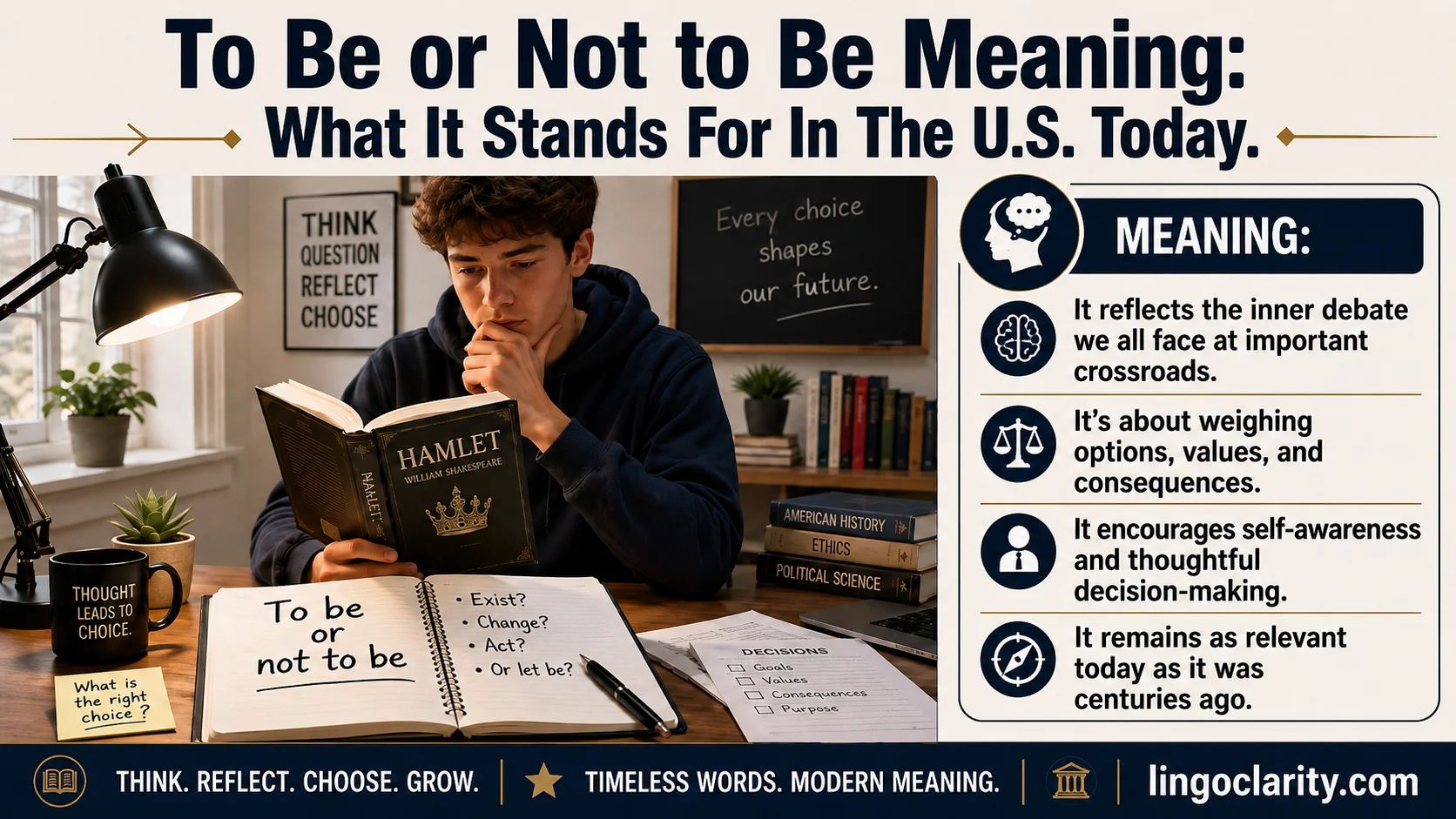
The to be or not to be meaning is simple on the surface but deeply serious in Shakespeare’s Hamlet: it asks whether it is better to live and endure suffering or to stop existing. The phrase comes from Hamlet’s famous speech in Act 3, Scene 1, where he thinks about life, death, fear, pain, conscience, and the difficulty of taking action.
Today, people still quote “to be or not to be” in literature classes, speeches, essays, movies, jokes, and everyday conversations. Sometimes it keeps its original serious meaning. Other times, people use it playfully to describe a difficult choice, such as “to move or not to move” or “to text or not to text.”
Quick Answer
“To be or not to be” means “to live or not to live” in Shakespeare’s Hamlet. More broadly, it describes a serious moment of doubt: should someone continue, act, endure, stop, or give up?
The full line is “To be, or not to be, that is the question.” Hamlet says it in Act 3, Scene 1 while thinking about suffering, death, fear, conscience, and the uncertainty of what comes after life.
What Does To Be or Not to Be Mean?
“To be or not to be” means “to exist or not to exist.” In the play, “to be” means to live, continue, and endure life. “Not to be” means to die or stop existing.
However, the phrase is not only about the dictionary meaning of “be.” It carries emotional and philosophical weight. Hamlet is asking whether it is nobler to suffer through life’s pain or to escape it through death.
In modern English, people often use the phrase in a softer way. It can mean:
- Should I do this or not?
- Should I continue or stop?
- Should I act or stay passive?
- Is this decision worth the risk?
For example, someone might joke, “To text or not to text, that is the question.” That playful version borrows Shakespeare’s structure, but it does not carry the full seriousness of Hamlet’s original thought.
The Plain-English Meaning
In plain English, “To be or not to be” means:
Should I keep going, or should I stop existing?
That is the direct meaning in Hamlet. Still, the phrase also points to a larger human question: why do people keep living through pain, injustice, fear, and uncertainty?
Hamlet does not ask the question lightly. He is grieving, angry, disgusted by corruption, and trapped between thought and action. As the speech develops, he suggests that people often endure known suffering because they fear what might come after death.
Where The Phrase Comes From
The phrase comes from William Shakespeare’s tragedy Hamlet. Hamlet says it in Act 3, Scene 1. The Shakespeare Birthplace Trust lists the quote as “Hamlet, Act 3 Scene 1, lines 56–83.”
The full famous opening is:
“To be, or not to be, that is the question.”
Shakespeare likely wrote Hamlet around 1599 to 1601. The play follows Prince Hamlet of Denmark after the ghost of his father tells him that his uncle Claudius murdered him. Hamlet then struggles with grief, revenge, moral doubt, and uncertainty.
By the time Hamlet speaks this line, he is not simply asking whether revenge is difficult. He is weighing life itself.
What The Line Means In Hamlet
In Hamlet, the line begins a speech about suffering and fear. Hamlet wonders whether it is better to endure life’s pain or to resist it, even if resistance may mean death.
The Royal Shakespeare Company explains the scene as Hamlet thinking about whether he should face life’s hardships directly or end them by dying.
The speech moves through several ideas:
First, Hamlet asks whether it is nobler to suffer or fight against suffering.
Next, he compares death to sleep. At first, that sounds peaceful.
Then he becomes uncertain. If death is like sleep, what dreams might come after death?
Finally, he concludes that fear of the unknown makes people hesitate. That hesitation turns strong decisions into inaction.
So the line is not just a dramatic way to say “I am sad.” It is a compressed philosophical question about existence, fear, and the human tendency to overthink action.
Is It A Soliloquy Or A Monologue?
The speech is commonly called a soliloquy, and that label is widely accepted in classrooms and study guides. A soliloquy is a speech in which a character speaks inner thoughts aloud, usually while alone.
However, there is a technical complication. Ophelia is onstage, and Claudius and Polonius are secretly watching. Britannica notes that the speech does not strictly meet the definition of a soliloquy because Ophelia is present, even though Hamlet does not speak to her until the end.
Therefore, both descriptions can be useful:
- Call it a soliloquy in ordinary literary discussion.
- Call it a monologue if you want to be technically precise.
- Mention the complication if you are writing a detailed essay.
Why The Phrase Is So Famous
“To be or not to be” is famous because it is short, simple, memorable, and profound. The words are plain, but the question behind them is enormous.
The phrase also works because of its balance. “To be” and “not to be” mirror each other. The rhythm makes the line easy to remember, while the meaning invites endless interpretation.
Britannica calls it one of Shakespeare’s most famous phrases and one of the most famous phrases in English literature.
It remains popular because it can fit many situations:
- literature classes
- stage performances
- film references
- speeches
- jokes
- memes
- captions
- discussions about decision-making
Still, the original meaning is serious. The line belongs to a speech about despair, fear, and mortality.
A Short Breakdown Of The Speech
Hamlet’s speech starts with a choice: to live or not live. Then it expands into a debate.
When he speaks about suffering “the slings and arrows of outrageous fortune,” he imagines life as an attack. When he speaks of taking “arms against a sea of troubles,” he imagines fighting back against overwhelming pain.
Then Hamlet shifts to death. He calls death a kind of sleep, which makes it sound like rest. However, he immediately worries about what dreams may come in that sleep. This fear changes the argument.
The problem is not only life’s pain. The problem is uncertainty. People know the troubles they already have, but they do not know what comes after death. Because of that fear, Hamlet says, conscience and thought can make people hesitate.
That is why the speech matters so much to the play. Hamlet is a character who thinks deeply, but his thinking often delays his action.
How People Use To Be or Not to Be Today
Today, people use “to be or not to be” in two main ways.
The first is serious. A writer, teacher, student, or speaker may use the phrase when discussing Hamlet, existence, mortality, indecision, or a major life choice.
The second is playful. People often copy the structure and replace “be” with another verb or noun.
Examples:
- To move or not to move, that is the question.
- To call or not to call, that is the question.
- Coffee or no coffee, that is the question.
- To apply or not to apply, that is the question.
These playful versions work because the original line is so recognizable. However, they should be used carefully. In a serious conversation about grief, depression, or self-harm, the phrase may sound insensitive or theatrical.
Examples In Sentences
Here are natural examples of the phrase in modern English:
- The essay explains what “to be or not to be” means in Hamlet.
- Hamlet’s “to be or not to be” speech explores life, death, fear, and inaction.
- For the character, this is not a simple decision; it is a “to be or not to be” moment.
- She stared at the job application and joked, “To apply or not to apply, that is the question.”
- The phrase is often quoted humorously, but its original meaning is deeply serious.
- In the speech, “be” means to exist, live, and continue.
Part Of Speech And Grammar
“To be or not to be” is a phrase built around infinitive verb forms. “To be” is the infinitive form of the verb “be.”
In this context, “be” means to exist or live. Merriam-Webster includes “to have objective existence” and “live” among the meanings of “be.”
The phrase works as a quoted expression rather than as ordinary everyday grammar. In a sentence, it can function like a noun phrase:
- “To be or not to be” is the opening line of Hamlet’s speech.
- The speaker framed the decision as a “to be or not to be” question.
When people imitate the structure, they often use it as a template:
- To stay or not to stay
- To buy or not to buy
- To forgive or not to forgive
This pattern is recognizable because it keeps Shakespeare’s balanced form.
Pronunciation
Pronounce it like this:
too bee or not too bee
The word “be” sounds like “bee.”
A natural rhythm is:
To be / or not to be / that is the question.
The pause after the first “be” helps listeners hear the contrast between the two choices.
Related Phrases From The Same Speech
Several famous expressions come from the same speech or are closely tied to it.
Slings and arrows means attacks, troubles, or painful events.
Sea of troubles means an overwhelming amount of difficulty.
To sleep, perchance to dream compares death to sleep, then introduces fear about what may come after death.
There’s the rub means “that is the problem” or “that is the difficulty.”
Mortal coil means the troubles, confusion, and physical burden of human life.
Conscience does make cowards of us all means thought, moral awareness, or fear can make people hesitate instead of act.
These phrases deepen the meaning of “to be or not to be.” The first line asks the question, but the rest of the speech shows why the answer is so difficult.
Common Mistakes
One common mistake is saying the line happens in the skull scene. It does not. The skull scene with Yorick happens later, in Act 5, Scene 1. “To be or not to be” appears in Act 3, Scene 1.
Another mistake is treating the phrase as casual slang. It is not standard slang. It is a famous literary quotation.
A third mistake is using it too dramatically. Not every decision is a “to be or not to be” moment. For ordinary choices, the phrase works best as humor.
A fourth mistake is ignoring the darker context. The original speech deals with death and despair, so it should not be used lightly around someone who is suffering.
FAQ
What does “to be or not to be” mean?
It means “to live or not to live” or “to exist or not exist.” In modern use, it can also describe a serious choice about whether to continue, act, or stop.
Who says “to be or not to be”?
Hamlet says it. He is the prince of Denmark in Shakespeare’s tragedy Hamlet.
What play is “to be or not to be” from?
The phrase is from William Shakespeare’s Hamlet. It appears in Act 3, Scene 1.
Is “to be or not to be” a soliloquy?
It is commonly called a soliloquy, but it is technically complicated because Ophelia is present onstage and Claudius and Polonius are secretly observing. For general use, “soliloquy” is acceptable; for precise analysis, “monologue” may be more accurate.
Is “to be or not to be” a metaphor?
The opening phrase itself is fairly direct. “To be” means to exist or live. However, the rest of the speech uses metaphor, including images such as “slings and arrows” and a “sea of troubles.”
Does “to be or not to be” mean action or inaction?
Partly, yes. The phrase begins with life and death, but the speech also explores action and inaction. Hamlet wonders whether to endure suffering or oppose it, and then he shows how fear and thought can prevent action.
Is “to be or not to be” slang?
No. It is a famous literary quote. Playful versions like “to text or not to text” are jokes or references, not standard slang.
How do you use “to be or not to be” in a sentence?
You can write, “The phrase ‘to be or not to be’ comes from Shakespeare’s Hamlet.” For a playful echo, you might say, “To order dessert or not to order dessert, that is the question.”
Conclusion
“To be or not to be” means “to live or not to live,” but its power comes from everything behind that question. In Hamlet, Shakespeare uses the line to open a speech about pain, fear, death, conscience, and hesitation.
Today, the phrase can describe a serious dilemma or a playful everyday choice. Use it with care, though. In its original context, it is not a casual slogan. It is one of literature’s most memorable expressions of human doubt.
