
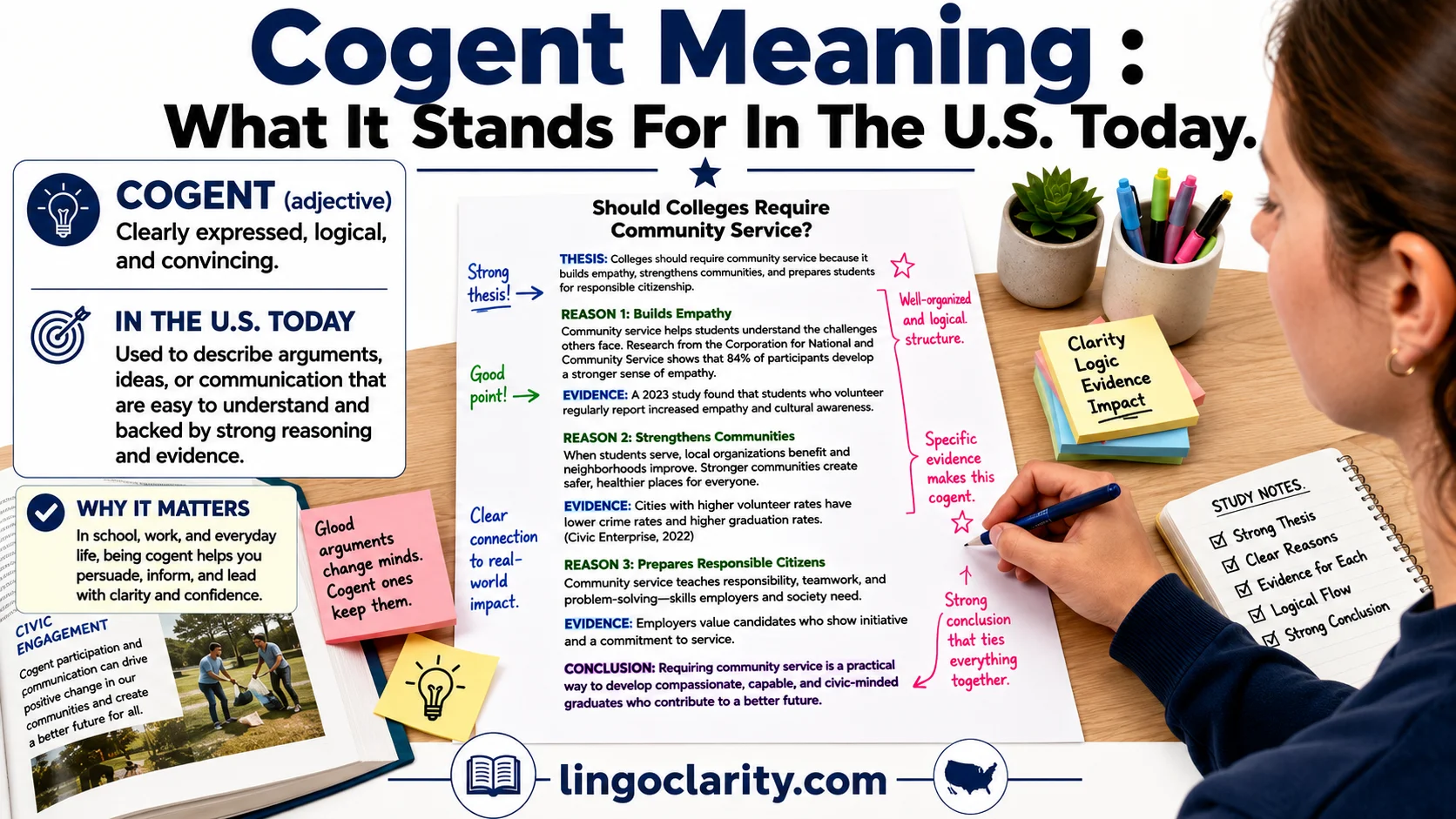
Cogent meaning is simple: clear, logical, and convincing. Therefore, when someone gives a cogent argument, reason, explanation, or case, their point is easy to understand and strong enough to persuade.
You may see cogent in essays, debates, legal writing, reviews, reports, and serious news articles. However, it is not usually a casual word. Instead, it works best when people are discussing reasoning, evidence, analysis, or persuasion.
For example, a student can write a cogent essay if the ideas are organized and supported with evidence. Likewise, a lawyer can make a cogent case if the argument is clear, logical, and persuasive. In short, cogent describes thinking that makes sense and carries force.
Quick Answer
Cogent meaning: clear, logical, and convincing.
A cogent reason is a strong reason that makes sense. Similarly, a cogent argument is an argument that is easy to follow and persuasive enough to make people take it seriously.
TL;DR
- Cogent is an adjective.
- It means clear, logical, and convincing.
- It often describes an argument, reason, case, explanation, analysis, or evidence.
- It is usually formal, not slang.
- It is pronounced KOH-jent.
- Most importantly, it should describe strong reasoning, not appearance, taste, or emotion.
What Cogent Means In Plain English
Cogent means that an idea is clear and persuasive because it is based on good reasoning. In other words, a cogent point does not merely sound confident; it actually makes sense.
For instance, imagine someone says, “We should extend library hours because student attendance is highest after 5 p.m., and many students work during the day.” That is a cogent reason because it connects the claim to practical evidence.
By contrast, “We should extend library hours because I like libraries” is not very cogent. Although the sentence is understandable, it does not offer a strong reason.
So, a simple meaning of cogent is: strong because it makes sense.
Pronunciation Of Cogent
Cogent is pronounced KOH-jent.
The first syllable sounds like co in coat. Meanwhile, the second syllable sounds like jent. The stress comes at the beginning: KOH-jent.
Part Of Speech And Word Forms
Cogent is an adjective. Therefore, it describes a noun.
Common phrases include:
- a cogent argument
- a cogent reason
- a cogent explanation
- a cogent case
- a cogent analysis
- cogent evidence
- a cogent response
- a cogent critique
The related adverb is cogently. It means “in a clear and convincing way.”
Example:
She argued cogently during the meeting.
The related noun is cogency. It means the quality of being clear, logical, and persuasive.
Example:
The panel questioned the cogency of his argument.
How To Use Cogent In A Sentence
Use cogent when you want to describe reasoning that is clear, organized, and persuasive. Usually, the word appears before nouns connected to thinking, proof, or explanation.
Examples:
- The lawyer presented a cogent case to the jury.
- Her essay made a cogent argument for later school start times.
- The report gave cogent reasons for reducing waste.
- His explanation was brief, calm, and cogent.
- The editor asked for a more cogent conclusion.
- The committee rejected the proposal because it lacked cogent evidence.
In each sentence, cogent describes reasoning. Therefore, it does not simply mean “good,” “impressive,” or “strong.” Instead, it means strong because the idea is clear and convincing.
Common Sentence Patterns With Cogent
Cogent often appears before nouns:
- a cogent argument
- a cogent reason
- a cogent explanation
- a cogent objection
- a cogent defense
- a cogent critique
- a cogent analysis
- a cogent summary
It can also appear after a linking verb:
- Her argument was cogent.
- His explanation seems cogent.
- The presentation became more cogent after she added data.
However, avoid using cogent with things that do not involve reasoning.
Incorrect:
The new shoes look cogent.
Correct:
The new shoes look stylish.
Incorrect:
That pizza was cogent.
Correct:
That pizza was delicious.
Examples Of Cogent In Different Contexts
Academic Writing
- The student wrote a cogent essay on climate policy.
- The thesis was clear; however, the supporting paragraphs needed more cogent evidence.
- A cogent conclusion should connect the evidence back to the main claim.
Business And Workplace Writing
- The manager gave a cogent explanation for the budget change.
- The proposal was cogent, practical, and easy to follow.
- Before we change the policy, we need cogent reasons.
Law And Debate
- The attorney built a cogent case from witness statements and records.
- Her rebuttal was cogent because it answered the strongest objection directly.
- The debate judge praised his cogent reasoning.
Journalism And Reviews
- The review made a cogent point about the film’s uneven pacing.
- The editorial offered a cogent critique of the mayor’s plan.
- The article was persuasive because it turned complex facts into a cogent analysis.
Everyday Use
You can use cogent in everyday speech. However, it may sound formal. Therefore, in casual conversation, people usually say clear, strong, convincing, or good point.
Formal:
She gave a cogent reason for leaving early.
Casual:
She gave a good reason for leaving early.
Cogent Argument Meaning
A cogent argument is an argument that is clear, well reasoned, and persuasive. In everyday English, this means the argument makes sense and gives the reader or listener a strong reason to agree.
For example, this argument can be cogent:
Students should have access to later library hours because many work during the day, study after classes, and need a quiet place in the evening.
This argument is stronger because it gives practical reasons. Moreover, it connects those reasons directly to the main claim.
However, this argument is weaker:
Students should have later library hours because libraries are nice.
Although the sentence is clear, it is not very persuasive. As a result, it is not a strong example of cogent reasoning.
In logic and critical thinking, cogent argument can have a more specific meaning. Generally, it refers to an argument with strong reasoning and true supporting claims. Still, in ordinary English, the simpler meaning is enough: a cogent argument is clear, reasonable, and persuasive.
Cogent Vs. Coherent
Cogent and coherent are related, but they are not identical.
A coherent idea is clear and organized. A cogent idea is clear, organized, and convincing.
| Word | Main Meaning | Example |
|---|---|---|
| Coherent | Clear and logically organized | Her paragraph was coherent, so I could follow it. |
| Cogent | Clear and persuasive | Her paragraph was cogent, so I accepted her conclusion. |
A paragraph can be coherent without being cogent. For example, it may be easy to follow, yet still fail to prove its point.
Example:
“The cafeteria should serve only soup because soup is warm, soup is popular, and soup comes in bowls.”
This sentence is coherent because the ideas are connected. However, it is not very cogent because the reasons are weak.
Cogent Vs. Convincing, Persuasive, Compelling, Logical, Valid, And Sound
Several words are close to cogent. However, each one has a slightly different use.
| Word | Best Use | Example |
|---|---|---|
| Cogent | Clear and convincing reasoning | She made a cogent case for reform. |
| Convincing | Strong enough to make someone believe something | His evidence was convincing. |
| Persuasive | Good at changing someone’s mind | The speech was persuasive. |
| Compelling | So strong or interesting that it demands attention | The documentary made a compelling case. |
| Logical | Based on clear reasoning | Her solution was logical. |
| Valid | Supported by rules, facts, or acceptable reasoning | That is a valid concern. |
| Sound | Based on reliable reasoning or judgment | The plan is financially sound. |
Use cogent when clarity and persuasion work together. Use logical when the reasoning structure matters most. Meanwhile, use convincing when the result matters most: someone believes the point.
Synonyms For Cogent
Good synonyms for cogent include:
- convincing
- persuasive
- compelling
- logical
- sound
- valid
- reasonable
- forceful
- clear
- well reasoned
- powerful
- effective
However, these words are not always interchangeable. For example, compelling can describe something emotionally powerful, while cogent usually focuses on reasoning. Similarly, logical means the idea follows reason, but it may not always persuade the reader.
Antonyms For Cogent
Useful antonyms include:
- weak
- unconvincing
- illogical
- unsound
- flimsy
- unclear
- irrelevant
- incoherent
- unsupported
- questionable
- unpersuasive
Example:
The argument was unconvincing because it relied on guesses instead of evidence.
Although uncogent exists, it is uncommon. Therefore, weak, unconvincing, or illogical will usually sound more natural.
Common Mistakes With Cogent
Using Cogent To Mean Loud Or Confident
A confident opinion is not always cogent. After all, confidence is not the same as evidence.
Weak:
He shouted a cogent opinion.
Better:
He gave a cogent reason for his opinion.
Using Cogent For Things That Do Not Involve Reasoning
Incorrect:
The garden looked cogent.
Correct:
The garden looked beautiful.
Incorrect:
The song was cogent.
Better:
The song was powerful.
However, you could say a song has cogent lyrics if the lyrics make a clear and persuasive point.
Confusing Cogent With Coherent
A coherent idea is understandable. However, a cogent idea is both understandable and persuasive.
For example, a report can be coherent because it is organized. Nevertheless, it may not be cogent if it lacks strong evidence.
Using Cogent In Very Casual Writing
Cogent is a formal word. Therefore, it can sound stiff in casual messages.
Formal:
Your explanation was cogent.
Casual:
Your explanation made sense.
Word Origin Of Cogent
The history of cogent connects to ideas of force, pressure, and bringing things together. This origin fits the modern meaning because a cogent argument has intellectual force.
Today, however, cogent does not usually mean physical force. Instead, it means mental force through clear reasoning. In other words, a cogent point persuades because the ideas fit together well.
Mini Quiz: Test Your Understanding
Choose the best answer.
What does cogent mean?
A. Funny
B. Clear and convincing
C. Expensive
Answer: B
Which phrase sounds natural?
A. cogent reason
B. cogent sandwich
C. cogent rain
Answer: A
Is cogent usually slang?
A. Yes
B. No
Answer: B
Which word is closest to cogent?
A. persuasive
B. random
C. decorative
Answer: A
Which sentence uses cogent correctly?
A. The soup tasted cogent.
B. The lawyer gave a cogent argument.
C. The shoes looked cogent.
Answer: B
FAQs About Cogent
What does cogent mean?
Cogent means clear, logical, and convincing. It usually describes an argument, reason, case, explanation, analysis, or evidence.
How do you pronounce cogent?
Pronounce cogent as KOH-jent. The stress is on the first syllable.
Is cogent a formal word?
Yes. Cogent is usually formal. Therefore, it fits academic writing, legal writing, reports, essays, reviews, debates, and professional communication.
What is a cogent argument?
A cogent argument is clear, well reasoned, and persuasive. In simple terms, it gives people a strong reason to accept a point.
What is a cogent reason?
A cogent reason is a strong reason that makes sense and can help persuade someone.
Example:
The school gave a cogent reason for changing the exam schedule.
What is another word for cogent?
Good alternatives include convincing, persuasive, compelling, logical, sound, valid, and reasonable. However, the best choice depends on the sentence.
What is the opposite of cogent?
Common opposites include weak, unconvincing, illogical, unsound, flimsy, and unpersuasive.
What is the difference between cogent and coherent?
Coherent means clear and organized. Cogent means clear, organized, and convincing. Therefore, a coherent argument makes sense, while a cogent argument also persuades.
Can a person be cogent?
Yes, but the word usually refers to the person’s speech, writing, or thinking.
Natural:
She was cogent during the interview.
Even clearer:
Her answers were cogent during the interview.
Is cogent positive or negative?
Cogent is usually positive. It praises the strength, clarity, and persuasiveness of someone’s reasoning.
Conclusion
Cogent means clear, logical, and convincing. Use it when an argument, reason, explanation, case, or analysis is easy to follow and strong enough to persuade.
The simplest rule is this: if a point is clear but weak, it is not cogent. However, if it is clear, well supported, and persuasive, cogent is the right word.
