
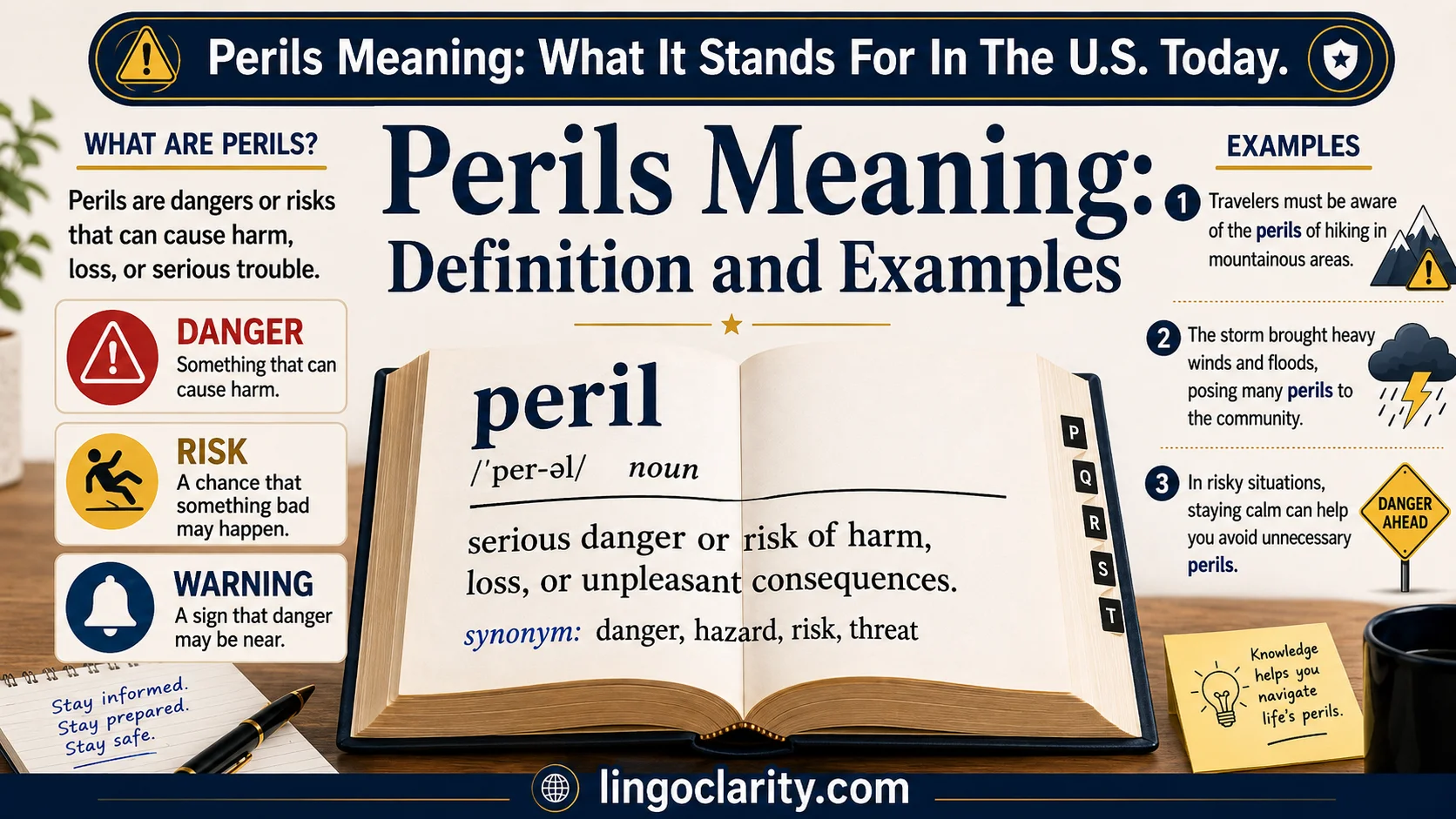
Perils meaning is simple: perils means serious dangers, risks, or harmful situations that could cause injury, loss, damage, or major trouble.
Perils is the plural form of peril. One peril is one serious danger. Several perils are several dangers. The word often appears in serious writing, warnings, stories, history, news, and insurance language.
In everyday conversation, many Americans would simply say dangers or risks. However, perils is still useful when you want the danger to sound stronger, more serious, or more formal.
Quick Answer
The hikers understood the perils of climbing during a storm.
Perils means serious dangers or risks.
This means the hikers understood the serious dangers of climbing in bad weather.
Perils Meaning In Plain English
Perils means dangerous things or risky situations that may cause harm.
The word can describe physical danger, financial danger, emotional danger, social danger, or professional danger. It does not always mean death or disaster, but it usually points to something more serious than a small problem.
For example:
The perils of winter driving include icy roads, poor visibility, and sudden accidents.
In that sentence, perils means the serious dangers connected with winter driving.
Another example:
New business owners often underestimate the perils of poor budgeting.
Here, perils does not mean physical danger. It means serious financial or practical risks that could hurt the business.
Perils Vs. Peril
Peril is singular. Perils is plural.
Use peril when you mean one serious danger or a general state of danger.
Use perils when you mean more than one danger or the dangers connected with a situation.
| Word | Meaning | Example |
|---|---|---|
| Peril | One serious danger, or a state of danger | The ship was in peril during the storm. |
| Perils | More than one danger or risk | The sailors knew the perils of the sea. |
You may also see peril used as an uncountable noun in phrases such as in peril.
Example:
The rescue team knew the child was in peril.
That means the child was in serious danger.
How To Pronounce Perils
Perils is pronounced PAIR-uhlz in standard US English.
The singular form peril is pronounced PAIR-uhl.
The word has two syllables:
per-ils
It rhymes loosely with barrels in many American accents, though the first vowel sound is closer to pair.
Is Perils Formal Or Casual?
Perils sounds more formal, serious, or literary than dangers or risks.
In casual speech, someone is more likely to say:
There are risks.
In a serious article, speech, warning, or story, someone might say:
There are real perils.
The word also has a slightly dramatic feel in some phrases, such as mortal peril or the perils of the journey. These phrases often appear in books, movies, speeches, and serious warnings.
However, in insurance, perils is not dramatic. It is a normal technical word for events that may cause damage or loss.
Common Patterns With Perils
The most common pattern is:
the perils of + noun or activity
Examples:
Common phrases include the perils of war, fame, online scams, distracted driving, and ignoring safety rules.
You can also use the phrase with many activities or situations, especially when you want to show serious danger or risk.
This pattern means “the dangers connected with something.”
For example:
The article explained the perils of sharing personal information online.
This means the article explained the dangers connected with sharing personal information online.
Perils In Everyday Sentences
Here are natural examples of perils in modern US English:
Parents often warn teens about the perils of distracted driving.
The documentary showed the perils of living through a long drought.
New business owners quickly learn the perils of poor planning.
The article explained the perils of sharing personal information online.
The rescue team understood the perils of entering the flooded area at night.
The book follows a family through the perils of war.
She ignored the perils of overworking until her health began to suffer.
The guide warned visitors about the perils of hiking without enough water.
Perils In Insurance
In insurance, perils means events or causes that may lead to loss or damage.
For example, a homeowners insurance policy may discuss covered perils. These are damaging events the policy may cover, depending on the exact terms.
Common insurance perils may include:
fire
theft
wind
hail
lightning
vandalism
falling objects
water damage from certain sudden events
A policy may also use phrases such as named perils or open perils.
A named perils policy covers only the specific perils listed in the policy.
An open perils policy generally covers many causes of loss unless the policy specifically excludes them.
Because insurance language can be technical, always read the actual policy or ask a licensed insurance professional when coverage matters.
Perils Vs. Dangers, Risks, Hazards, Threats, And Pitfalls
These words are related, but they do not always mean exactly the same thing.
| Word | Best Meaning | Example |
| Perils | Serious dangers or harmful risks | The perils of war changed the family forever. |
| Dangers | Plain, everyday word for things that can harm you | The dangers of icy roads are real. |
| Risks | Possibilities of harm, loss, or failure | Starting a business comes with risks. |
| Hazards | Unsafe conditions or sources of danger | Wet floors are a workplace hazard. |
| Threats | Things that may actively cause harm | Cyberattacks are a threat to small businesses. |
| Pitfalls | Hidden problems or mistakes | The guide explains the pitfalls of buying a used car. |
Choose dangers when you want the clearest everyday word.
Risks work best when the outcome is uncertain and something bad may happen.
A hazard is usually an unsafe condition, especially in work, travel, weather, or insurance.
Threats suggest something that may actively cause harm.
Pitfalls are hidden problems, mistakes, or traps that people may not notice at first.
Perils sounds stronger than all of these. It fits best when the danger feels serious, important, formal, or dramatic.
Use This, Not That
Choose perils when you mean serious dangers.
For a simple everyday word, dangers is usually better.
When the result is uncertain and may or may not be severe, risks sounds more natural.
For unsafe conditions, especially in work, travel, weather, or insurance, hazards is the better choice.
When you mean hidden problems or common mistakes, choose pitfalls.
Avoid perils for tiny inconveniences because it can sound too dramatic.
Avoid using perils for tiny inconveniences.
Weak: The perils of forgetting my pen were terrible.
Better: The problem of forgetting my pen was annoying.
Strong: The perils of driving through a blizzard were obvious.
Related Words And Phrases
Peril
Peril means serious danger.
Example:
The missing hikers were in peril as temperatures dropped.
Perilous
Perilous is an adjective. It means very dangerous.
Example:
The climbers began a perilous journey across the icy ridge.
Imperil
Imperil is a verb. It means to put someone or something in danger.
Example:
Poor safety planning can imperil the entire project.
At Your Peril
At your peril means that if you do something, you may suffer bad results.
Example:
Ignore the evacuation warning at your peril.
This phrase uses the singular word peril, not perils.
Mortal Peril
Mortal peril means danger that could cause death.
Example:
The hero was in mortal peril at the edge of the cliff.
This phrase sounds dramatic and is common in stories, movies, and serious descriptions.
Perils Of The Sea
Perils of the sea means dangers connected with sea travel, storms, waves, shipwrecks, or other maritime risks.
Example:
Old sailors knew the perils of the sea well.
Common Mistakes With Perils
Using Perils For Small Problems
Do not use perils for every minor issue. It sounds too strong.
Weak: The perils of a slow internet connection ruined my morning.
Better: The frustration of a slow internet connection ruined my morning.
Forgetting That Perils Is Plural
Perils is plural. If you mean one danger, use peril.
Weak: A major perils of hiking is dehydration.
Better: A major peril of hiking is dehydration.
Also correct:
The perils of hiking include dehydration, injury, and sudden weather changes.
Using Perils When Risks Sounds More Natural
If the situation is not especially serious, risks may sound more natural.
Natural: There are risks when you invest money.
Stronger: The article explored the perils of careless investing.
Confusing Peril With Perilous
Peril is a noun. Perilous is an adjective.
Correct: The road was perilous.
Correct: The road was full of perils.
Incorrect: The road was peril.
More Natural Examples By Context
Everyday Warnings
Drivers should understand the perils of texting behind the wheel.
The signs warn visitors about the perils of swimming near strong currents.
The coach explained the perils of training without proper rest.
Formal Or Serious Writing
The report examines the perils of ignoring early climate warnings.
The speech focused on the perils of political violence.
The book describes the perils faced by families during wartime.
Business And Money
Small companies often face the perils of weak cash flow.
The advisor explained the perils of investing without research.
The startup survived the perils of rapid growth.
Insurance
The policy lists which perils are covered.
Fire and theft may be covered perils, depending on the policy.
The agent explained the difference between named perils and open perils.
Storytelling
The travelers faced many perils on their journey through the mountains.
The novel follows a young sailor through storms, hunger, and the perils of the sea.
Each chapter adds a new peril for the hero to overcome.
Simple Definition For Students
Perils means serious dangers or risks.
If something has perils, it has things that could hurt someone, damage something, or cause serious trouble.
Example:
The perils of exploring a cave include falling rocks, darkness, and getting lost.
FAQ
What does perils mean in simple words?
Perils means serious dangers or risks. It describes things that could cause harm, loss, damage, or major trouble.
Is perils singular or plural?
Perils is plural. The singular form is peril. One danger is a peril. Several dangers are perils.
Does perils always mean life-threatening danger?
No. Perils can describe life-threatening danger, but it can also describe serious financial, social, emotional, or practical risks.
Is perils a formal word?
Yes, perils usually sounds more formal, serious, or literary than dangers or risks. However, it is a normal technical word in insurance.
What is the difference between perils and risks?
Risks are possibilities of harm or loss. Perils are usually more serious dangers or harmful situations. In insurance, a peril is often a cause of loss, such as fire or theft.
What does covered perils mean?
Covered perils are events or causes of damage that an insurance policy may cover. Examples may include fire, theft, wind, or hail, depending on the policy.
What is a good synonym for perils?
Good synonyms include dangers, risks, hazards, threats, and pitfalls. The best choice depends on the sentence.
Can I use perils in everyday conversation?
Yes, but it may sound serious or formal. In casual conversation, dangers or risks often sounds more natural.
Final Thought
Perils means serious dangers, risks, or harmful situations. It is the plural form of peril and often appears in phrases like the perils of war, the perils of driving in bad weather, or covered perils in insurance.
Use perils when the danger feels important, serious, formal, or dramatic. Use dangers or risks when you want simpler everyday language.
A good sentence to remember is:
The hikers understood the perils of climbing during a storm.
That means they understood the serious dangers involved.

3 thoughts on “Perils Meaning: Definition, Usage, and Everyday Examples”
Comments are closed.