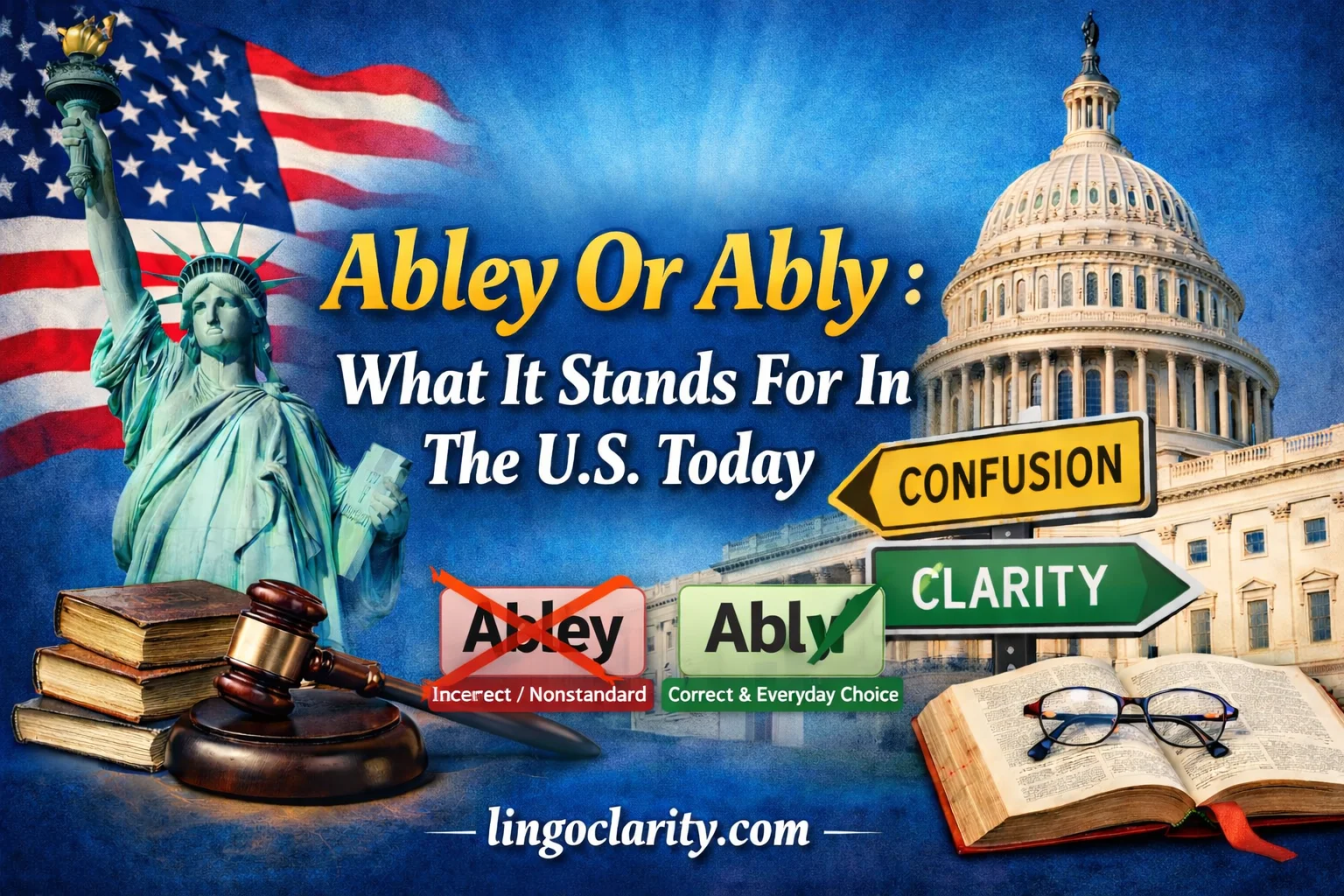
If you are choosing between abley and ably, the correct standard word for modern US English is ably. Major dictionaries define ably as an adverb meaning with skill, competently, or in an able manner. Cambridge also pairs able as the adjective with ably as the adverb, which makes the grammar pattern clear.
By contrast, I did not find abley listed as a standard lowercase everyday word in the dictionary sources checked. What does appear in public records is Abley as a surname or name, which helps explain why people sometimes think it might be a regular English word. In other words, this is usually not a true word-choice split. It is mostly a matter of choosing the standard adverb ably instead of a likely misspelling, unless you are writing a proper name such as Abley.
Quick Answer
Use ably when you mean skillfully, capably, competently, or well. That is the standard adverb recognized by major dictionaries. Use Abley only when it is part of a name, such as a surname, company name, or title.
Simple Definition
Ably means in a skillful, capable, or competent way. Merriam-Webster defines it as “in an able and skillful manner,” while Dictionary.com defines it as “with skill or ability; competently.” Cambridge gives the short meaning “skilfully.”
Abley is usually not the word you want in ordinary sentence writing. In the sources checked, it appears as a name rather than as the standard adverb that matches able.
Key Differences At A Glance
This is the simplest way to remember it. The table below reflects how standard dictionaries treat ably and how separate public references show Abley in name use.
| Context | Best Choice | Why |
|---|---|---|
| You mean “competently” or “skillfully” | ably | It is the standard adverb |
| You are writing normal edited prose | ably | It is recognized in major dictionaries |
| You are describing how something was done | ably | It functions as an adverb |
| You are writing a surname or proper name | Abley | Here it is a name, not the adverb |
| You typed the word from able and added -y | ably | The standard form is ably, not abley |
Why People Confuse Them
The confusion is easy to understand. People start with able, then assume the adverb must keep the full spelling and become abley. That feels logical at first glance, especially if you are typing quickly or relying on sound instead of memory. But standard English does not use abley as the usual adverb here. Dictionaries point to ably as the established form.
There is another reason the mistake survives: Abley can genuinely appear in names. Public name records list it as a surname, and there are also public references to people and organizations using Abley as a name. So a writer may have seen Abley before and assumed it works as a normal vocabulary word too. In most sentence-level writing, though, that assumption leads to an error.
Why Ably Is The Correct Standard Form
If your sentence needs an adverb that means with ability or in a competent way, ably is the form supported by major dictionaries. Merriam-Webster, Cambridge, Oxford Learner’s Dictionaries, Collins, and Britannica all treat ably as the accepted adverb. This is not a US-versus-UK split where one region prefers one spelling and another region prefers the other. Ably is the standard form generally, including in US English.
In real usage, ably often appears in polished phrases such as ably assisted, ably led, ably handled, or ably written. That does not make it wrong or overly stiff. It simply means the word is common in formal, professional, editorial, and evaluative writing. You can still use it in everyday prose when it fits the sentence.
When Abley May Still Be Correct
There is one important exception. Abley can be correct when it is a proper noun. For example, it may be someone’s surname, part of a company name, or part of a title. Public surname records and public references to named people and businesses support that limited use.
That means these two sentences behave very differently:
- She ably handled the client meeting.
- Ms. Abley handled the client meeting.
The first uses the adverb ably to describe how she handled the meeting. The second uses Abley as a name. Once you separate adverb use from name use, the confusion becomes much easier to fix. The grammar rule stays simple: if the word describes an action, use ably. If it identifies a person, place, or organization named Abley, keep the capitalized name.
Real-Life Example
Imagine you are editing a workplace email:
“Jordan abley explained the rollout plan and answered every question.”
That sentence looks off because the writer is trying to describe how Jordan explained the plan. The correct revision is:
“Jordan ably explained the rollout plan and answered every question.”
Now the sentence reads naturally because ably does the job of an adverb. It means Jordan explained the plan capably and with skill. That matches the standard dictionary meaning exactly.
Here is another real-life contrast:
“Dr. Abley will speak at noon.”
That version can be correct if Abley is the speaker’s surname. In that case, it is not competing with ably at all. It is simply a name.
Synonyms And Opposites
If you want alternatives to ably, dictionaries and thesaurus sources point to words such as capably, competently, skillfully, expertly, deftly, and sometimes well, depending on the sentence. These are useful when ably feels a bit formal or when you want a slightly different shade of meaning. Capably and competently are especially close matches.
Useful opposites include poorly, ineptly, inexpertly, and incompetently. Those opposites are especially helpful when you are rewriting performance reviews, commentary, or analysis and want a clearer contrast.
A quick style guide:
- Use ably when you want a neat, polished tone.
- Use competently when you want a plain and direct business tone.
- Use skillfully when you want to emphasize technique.
- Use well when you want the most natural everyday choice.
Sentence Usage
Here are clear sentence patterns that show how ably works in real English:
- She ably led the discussion through a tense final round.
- The team was ably supported by two senior analysts.
- He ably handled the customer complaint without escalating it.
- The report was ably written and easy to follow.
- They were ably assisted by local volunteers.
Here are examples with Abley as a name:
- Ms. Abley signed the contract this morning.
- We spoke with Mark Abley after the event.
- Abley published its transport update this week.
A strong editing test is this: if you can replace the word with competently or skillfully, you almost certainly want ably. That test works because dictionaries define ably in those same terms.
Common Mistakes
The most common mistake is writing abley when you really mean ably. This usually happens because the writer starts with the adjective able and assumes the adverb keeps the same visible base. Standard dictionary treatment does not support that lowercase form as the normal adverb.
Another common mistake is thinking ably sounds “too formal” and must therefore be wrong. It is true that ably often appears in polished writing, but that is not the same as being incorrect or unnatural. Dictionary examples and common collocations show it is a standard, useful word.
A third mistake is seeing Abley as a surname and then treating it like an interchangeable adverb. That does not work. Name use and vocabulary use are separate. A surname does not turn a nonstandard lowercase form into an accepted everyday adverb.
Which Word Should You Use In Your Writing?
For almost every normal sentence, choose ably. It is the right choice in essays, business writing, articles, reviews, biographies, reports, and polished everyday prose. If you mean with skill, with competence, or in an able way, ably is the form that fits.
Keep Abley only when you are preserving a name exactly as it belongs to a person, family, business, or title. If you are not dealing with a name, the safest edit is almost always ably.
Final Verdict
Ably is the correct standard word in modern US English. It means something was done skillfully, competently, or capably, and major dictionaries consistently treat it as the accepted adverb form. Abley is usually a misspelling in ordinary writing, though it can be correct as a proper name.
So when you are editing a sentence, ask one simple question: Am I describing how something was done? If the answer is yes, the word you want is ably.
Frequently Asked Questions
Is abley ever correct?
Yes, but only in a limited way. Abley can be correct when it is part of a proper name, such as a surname or organization name. It is not the standard lowercase adverb used to mean skillfully or competently.
Is ably a real word?
Yes. Major dictionaries list ably as a standard adverb meaning in an able and skillful manner, competently, or skilfully.
Is this a US vs UK spelling difference?
No. The evidence checked does not show a US-versus-UK split between abley and ably. Standard dictionary sources across English treat ably as the accepted form.
What is the easiest way to remember the difference?
Use this shortcut: if the word means competently or skillfully, choose ably. If it is someone’s last name, Abley may be correct.
Can I replace ably with a simpler word?
Yes. Depending on tone, you can often replace ably with well, capably, competently, or skillfully. That is useful when you want the sentence to sound more conversational.
