
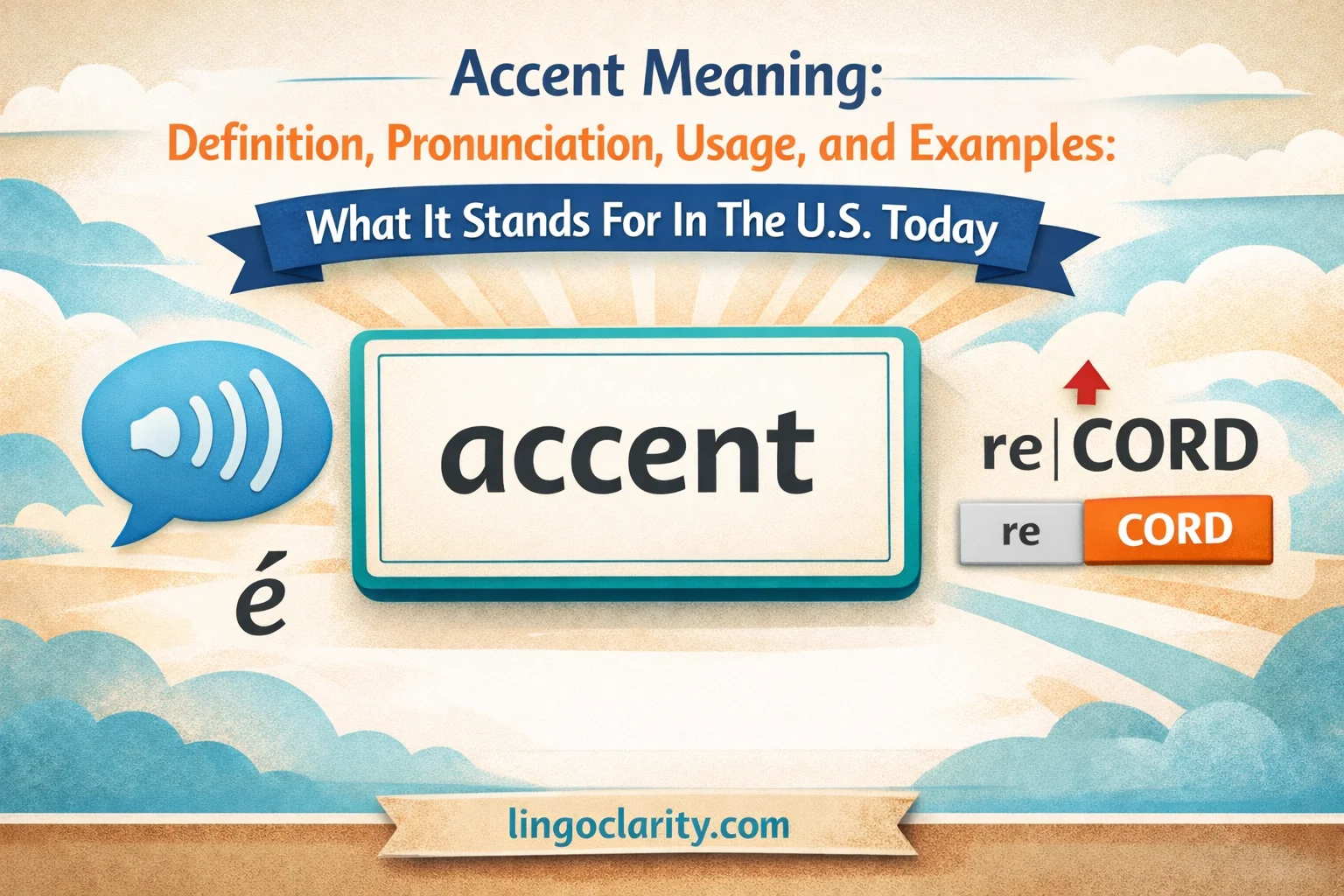
The word accent is common, but it can mean different things in different situations. Most people first hear it in conversations about speech. Someone may say a person has a New York accent, a British accent, or a Spanish accent when speaking English. That is the most common everyday meaning. But the word does not stop there. It can also refer to stress on a syllable, a mark above a letter, or the act of making something stand out. Merriam-Webster lists these meanings, and Cambridge also notes the written-mark sense.
That is why the word can confuse learners. One small word covers speech, writing, and emphasis. The good news is that the context usually makes the meaning clear. Once you know the main uses, accent becomes much easier to understand and use correctly.
Quick Answer
Accent usually means a way of pronouncing words. It can also mean stress on a syllable, a written mark such as the one in café, or extra emphasis on a detail or idea. As a verb, accent means to stress, highlight, or make something more noticeable.
TL;DR
• Accent often means a way of speaking.
• It can also mean stress on a syllable.
• It may refer to a written mark above a letter.
• As a verb, it means to emphasize or highlight.
• Everyone speaks with some accent, even if one local variety sounds “normal” to nearby listeners.
Simple Definition
In simple English, an accent is something that stands out in sound, speech, or writing. A person’s pronunciation can stand out. One syllable in a word can stand out more than the others. A small mark above a letter can stand out on the page. A design detail can also stand out because it draws your attention. That basic idea connects the word’s main meanings.
What Does Accent Mean?
The most common meaning of accent is a pattern of pronunciation. If someone says, “She has a Southern accent,” they mean she pronounces words in a way linked to a place, group, or language background. Merriam-Webster defines this sense as a way of speaking typical of a particular group, especially people from a region.
Another meaning is stress on a syllable. In this use, accent is not about a person’s voice overall. It is about which part of a word receives extra force or attention. Britannica explains accent in phonetics as the property of a syllable that makes it stand out from nearby syllables.
A third meaning is a written mark above or near a letter. Merriam-Webster defines this as a mark used in writing or printing to show sound value, stress, pitch, or another distinction. That is why learners often hear the phrase accent mark in school.
The fourth common meaning appears when accent is used as a verb. In that case, it means to give something extra attention or prominence, or to pronounce part of a word with greater stress.
Pronunciation And Part Of Speech
Accent works as both a noun and a verb. Merriam-Webster gives the noun pronunciation as ˈak-ˌsent. For the verb, Merriam-Webster lists both ˈak-ˌsent and ak-ˈsent. That means you may hear either pattern, especially when the verb means “to emphasize.”
Here is the easiest way to think about it:
• Noun: a speech pattern, a stressed syllable, or a written mark
• Verb: to stress, highlight, or make something more noticeable
Examples:
• “He speaks with a clear Midwestern accent.”
• “The accent falls on the second syllable.”
• “The bright pillows accent the gray sofa.”
These examples match the dictionary senses of the word.
Accent In Speech
This is the meaning most readers need first. In everyday English, accent usually means the way someone pronounces words. A person may sound different because of region, community, or first-language influence. This does not mean the person is using the wrong English. It simply means their pronunciation has recognizable features. Merriam-Webster and Cambridge both connect accent with how speech sounds.
It is also important to say this clearly: everyone has an accent. Cambridge notes that most people speak standard English with an accent connected to the place they come from or live in. In other words, people often notice other accents more than their own, but no one is truly accent-free.
That idea matters because learners sometimes think “accent” is a negative word. It is not. In normal English, it is a neutral word. It describes pronunciation, not intelligence, character, or ability.
Accent In Word Stress
In phonetics and everyday classroom English, accent can mean the stress placed on one syllable in a word. If a teacher says, “Put the accent on the second syllable,” the teacher is talking about word stress, not regional pronunciation. Merriam-Webster includes this sense directly, and Britannica describes accent as what makes a syllable stand out in an utterance.
For example:
• In ho-TEL, the second syllable is accented.
• In TA-ble, the first syllable is accented.
• In be-FORE, the second syllable is accented.
This sense is especially useful for English learners because stress can change how natural a word sounds. Even if every sound is correct, wrong stress can still make speech harder to follow.
Accent As A Written Mark
In writing, an accent can be a mark placed over or near a letter. Merriam-Webster defines it as a mark used to show sound value, stress, pitch, or other distinctions. Merriam-Webster’s usage guide on diacritics explains that such marks can appear over, under, or through letters to signal pronunciation features.
Common examples in English writing include:
• café
• résumé
• déjà vu
• naïve
A broader technical term for these signs is diacritics or diacritical marks. In everyday school use, though, accent mark is still a clear and natural phrase. It is easy to understand, and many teachers prefer it in basic lessons.
Accent As A Verb
As a verb, accent means to make something more noticeable. Merriam-Webster defines the verb as giving something special attention or prominence, making it more emphatic, or pronouncing part of a word with greater stress.
You can use the verb in language, design, and everyday writing:
• “Please accent the first syllable.”
• “The gold trim accents the dark blue wall.”
• “Her final sentence accented the main point.”
This use feels slightly more formal than highlight in some situations, but it is still natural and correct.
Real-Life Example
Imagine a student in an English class. The teacher says, “Your Spanish accent is easy to hear, but your pronunciation is clear.” Later, the same teacher says, “In this word, the accent is on the second syllable.” Then the student writes café on the board and asks about the mark over the e. In just one short class, the word accent appears in three different ways: pronunciation, word stress, and a written mark.
Now imagine a home-design show. The host says, “These yellow pillows accent the room.” That is the verb use. The meaning has shifted again, but the core idea is the same: something stands out.
This is why context matters so much. The sentence usually tells you which meaning fits.
Accent Vs Dialect
Many people confuse accent and dialect, but they are not the same. A dialect is broader. Merriam-Webster defines a dialect as a regional variety of language distinguished by vocabulary, grammar, and pronunciation. Accent, by contrast, usually refers only to pronunciation. Britannica also notes that phonological features are commonly treated as aspects of accent within dialect study.
Here is the practical difference:
| Context | Best Choice | Why |
|---|---|---|
| You are talking about how someone sounds | accent | It refers to pronunciation |
| You are talking about grammar, vocabulary, and pronunciation together | dialect | It is broader |
| You are talking about a mark above a letter | accent mark | It refers to writing |
| You are talking about making something stand out | accent | It works as a verb |
A person can share a dialect with others in a region and still have slightly different accent features. So when the issue is only sound, accent is usually the better word.
Synonyms And Opposites
The best near-synonym depends on the meaning.
For the speech meaning, near-synonyms include:
• pronunciation
• way of speaking
• speech pattern
For the stress or emphasis meaning, near-synonyms include:
• stress
• emphasis
• highlight
• prominence
For the written mark meaning, related terms include:
• accent mark
• diacritic
• diacritical mark
There is no single clean opposite for the speech sense in normal English, because language experts do not treat some speakers as having “no accent.” For the emphasis sense, useful opposites include downplay, soften, or de-emphasize.
Sentence Usage And Examples
Here are natural sentence patterns you can use right away:
• “She speaks English with a light French accent.”
• “His accent became stronger when he spoke to his family.”
• “The accent is on the first syllable of the word.”
• “The menu keeps the accent in café.”
• “The red scarf accents her black coat.”
• “The article places special accent on student safety.”
If you want the clearest wording, match the sentence to the meaning:
• Use accent for pronunciation.
• Use accent for syllable stress.
• Use accent mark when talking about writing.
• Use accent as a verb for emphasis or design.
Common Mistakes
One common mistake is thinking accent only refers to regional speech. That is the most familiar meaning, but dictionaries also recognize stress, written marks, and emphasis.
Another mistake is saying that some people have no accent. In casual conversation, people say this when a person sounds familiar or “standard” to them. But from a language point of view, everyone speaks with some accent.
A third mistake is using accent when you really mean dialect. If you are discussing grammar choices, vocabulary, and pronunciation together, dialect is the stronger and more accurate word.
A fourth mistake is assuming every mark above a letter in English must be removed. In many borrowed words, the mark may still appear, especially in careful writing, names, menus, language classes, and formal text. Usage can vary by style, but the mark itself is not wrong.
Mini Quiz
- In “She has a Boston accent,” what does accent mean?
- In “The accent is on the second syllable,” what does accent mean?
- In “The silver frame accents the mirror,” is accent a noun or a verb?
- Which word is broader in language study: accent or dialect?
Answer Key
- A way of pronouncing words
- Stress on a syllable
- Verb
- Dialect
FAQs
What does accent mean in English?
In English, accent most often means the way someone pronounces words. It can also mean stress on a syllable, a written mark above a letter, or special emphasis on something.
Is accent a noun or a verb?
It is both. As a noun, it can mean a speech pattern, word stress, or a written mark. As a verb, it means to stress, emphasize, or make something stand out.
What is the difference between accent and dialect?
Accent usually refers to pronunciation. Dialect is broader and includes pronunciation, grammar, and vocabulary.
Does everyone have an accent?
Yes. Cambridge notes that most people speak with an accent connected to where they come from or live. People often notice unfamiliar accents more easily than their own.
What is an accent mark?
An accent mark is a written sign used to show pronunciation, stress, pitch, or another sound feature. A broader technical term is diacritic.
How do you use accent in a sentence?
You can use it in several ways: “She speaks with a British accent,” “The accent is on the first syllable,” and “The gold trim accents the doorway.” These match the main noun and verb meanings listed in major dictionaries.
Conclusion
Accent is a flexible English word with several clear meanings. Most often, it refers to the way someone pronounces words. It can also refer to word stress, a mark above a letter, or the act of giving something extra emphasis. Major dictionary and reference sources support all of these uses.
The easiest way to understand accent meaning is to check the context. If the topic is speech, it usually means pronunciation. If the topic is a word part, it probably means stress. If the topic is spelling, it may mean an accent mark. If the topic is style or emphasis, it may be the verb. Once you know those patterns, the word becomes simple and useful.
