
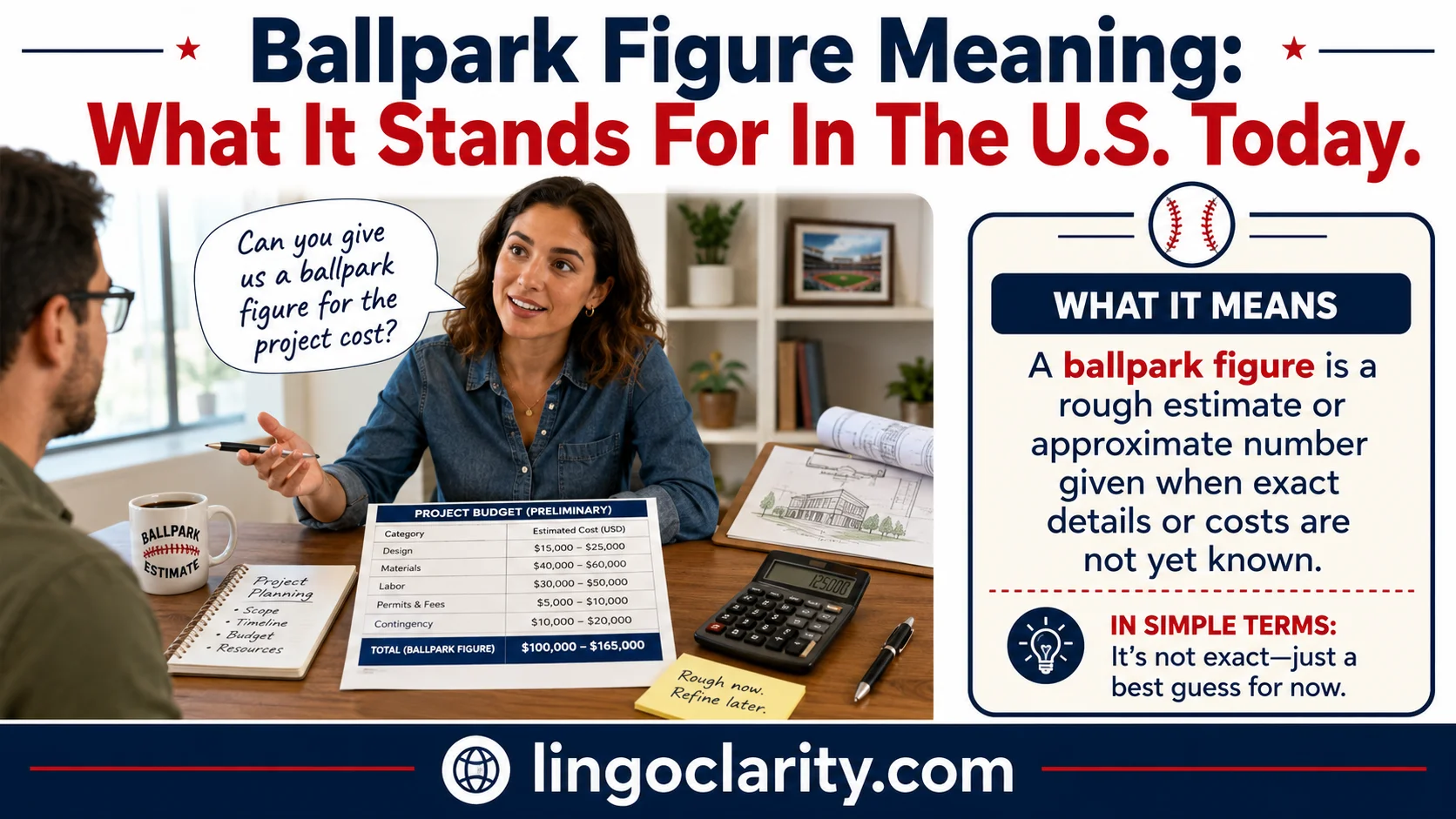
Quick answer: A ballpark figure is a rough estimate — a number close enough to the real one to be useful, but not exact. It’s an informal American English idiom borrowed from baseball, used most often in business, pricing, and planning talk when someone wants an approximate number now rather than a precise one later.
If your contractor says the job will run “nine or ten thousand,” he isn’t quoting you. He’s giving you a number to think with. That gap — between a helpful approximation and a promise — is the whole point of the phrase, and it’s the part most explanations skip.
What Does “Ballpark Figure” Mean?
Part of speech: noun phrase. Ballpark works here as an attributive adjective meaning “approximate,” modifying the noun figure. Merriam-Webster lists that adjective sense directly, defining ballpark as “approximately correct” and citing a ballpark price as an example [link to Merriam-Webster “ballpark” entry].
Pronunciation: BAWL-park FIG-yer — /ˈbɔl ˌpɑrk ˈfɪɡ jər/. Americans say FIG-yer; British speakers usually say FIG-uh.
The phrase carries two ideas at once:
- An approximation. The number is estimated, not measured or calculated.
- A limit on liability. The speaker is signaling that nobody should hold them to it.
That second part does real work. The phrase is a safe way to answer a question you can’t answer precisely yet, which is why it turns up constantly in sales calls, budget meetings, and renovation quotes.
How Rough Is Too Rough?
There’s no fixed tolerance, and any source quoting you a percentage is inventing it. The number should land in the right order of magnitude and be close enough to guide a decision. Answer $40,000 when the final bill is $250,000 and you didn’t give a rough estimate — you gave a wrong one.
The related idiom “in the ballpark” works the same way: it means within a reasonable range. “Your guess is in the ballpark” is mild praise. “That’s not even in the same ballpark” means the two things aren’t remotely comparable.
Ballpark also works as a verb in casual American speech: Can you ballpark it for me? Merriam-Webster dates both the adjective and verb uses to the 1950s.
Where Did This Baseball Phrase Come From?
The image is baseball. A ballpark is a big, enclosed space, so being inside one means you’re in the right place without standing on any exact spot: correct territory, imprecise location. The trail from the stadium to the estimate runs roughly like this:
- 1871 — ballpark is recorded as a noun for a baseball ground, per Merriam-Webster’s first-known-use date.
- 1940s — American newspapers show the comparative form “in the same ball park,” used for two things being roughly equivalent.
- 1954 — the Online Etymology Dictionary cites Ralph E. Lapp in the Bulletin of the Atomic Scientists writing, “Assuming this estimate is ‘in the ball park’…” The quotation marks tell you the sense was still new [link to Etymonline “ballpark” entry].
- Late 1950s and 1960s — ballpark settles in as an adjective, and ballpark figure and ballpark estimate become standard business vocabulary.
One popular claim is that the estimating sense grew out of Cold War missile jargon, where “the ballpark” meant the broad area a rocket was expected to come down in. Etymonline notes that connection, though it’s better treated as a likely influence than a settled fact. Either way, both images point the same direction: a large space you can be inside without being precise.
How Do You Use “Ballpark Figure” in a Sentence?
The phrase is flexible — object of a verb, subject, singular or plural. Five examples across different registers:
- Text message: “No pressure, but can you send me a ballpark figure before Friday? Just need something to show my wife.”
- Client email: “Based on similar projects, a ballpark figure for the full build is $70,000–$85,000. I’ll send a firm quote once we’ve confirmed the scope.”
- Meeting dialogue: “How many licenses will we need?” — “Ballpark? Around 400. I’d want a week to check that against the headcount.”
- News or analyst writing: “The company declined to give exact costs, but executives offered a ballpark figure of roughly $2 billion over five years.”
- Verb form, spoken: “Don’t overthink it — just ballpark it and we’ll refine the numbers next week.”
Notice that the honest versions all pair the estimate with a qualifier: around, roughly, a range, I’d want to check. That pairing is what keeps an estimate from turning into an accidental commitment.
Is “Ballpark Figure” Formal or Informal?
It’s informal, but respectably so — at home in an American business email, out of place in a contract. Register by context:
| Context | Use it? | Why |
|---|---|---|
| Texts, chats, casual speech | Yes | Natural and clear |
| Business email, sales calls, meetings | Yes | Standard American workplace English |
| Client proposal or estimate document | Careful | Say preliminary estimate or estimated range instead |
| Contracts, invoices, legal writing | No | Nothing in a binding document should be approximate by design |
| Academic papers and formal reports | No | Use approximation, estimate, or the actual margin of error |
| Writing for non-American readers | Careful | Understood in most English-speaking countries, but the baseball image doesn’t land everywhere |
The phrase isn’t rude, dated, or generational — it’s neutral American office vocabulary, in steady use since the 1960s. The only real risk is precision: using it where someone expects a firm number reads as evasive.
What Mistakes Do People Make With This Phrase?
Most errors here are spelling and logic, not grammar.
| Common mistake | Correct version | What’s going on |
|---|---|---|
| ball park figure | ballpark figure | Ballpark is one word in American English. Ball-park is an older British styling and looks dated in US writing. |
| “That estimate is out of the ballpark.” | “That estimate isn’t in the ballpark.” | Out of the park is praise, not a range judgment — see below. |
| “a ballpark figure of exactly $52,340” | “about $50,000” | An exact number can’t be approximate. The point is the rounding. |
| “roughly a ballpark figure of around 200” | “a ballpark figure of around 200” | Ballpark already means roughly. One hedge is enough. |
| “He ballparked figures at the meeting.” | “He gave ballpark figures at the meeting.” | The verb takes the thing estimated, not the word figure: ballpark the cost, not ballpark the figure. |
“In the Ballpark” vs. “Out of the Park”
These two get swapped constantly, and they aren’t opposites.
- In the ballpark = within an acceptable range. Approximately right.
- Out of the park (as in hit it out of the park) = a big success. A home run.
So “your numbers are out of the park” praises performance; it says nothing about accuracy. If you mean an estimate is wildly wrong, say way off or not in the same ballpark.
What Can You Say Instead of “Ballpark Figure”?
Each of these shifts the shade of meaning, so they aren’t interchangeable:
| Alternative | How it differs |
|---|---|
| Rough estimate | The plainest swap. Slightly more formal, no baseball image, works with any audience. |
| Guesstimate | More casual and more openly uncertain — admits guesswork is doing most of the work. |
| Approximation | Formal and technical. Fits academic and engineering writing, where the idiom would not. |
| Back-of-the-envelope calculation | Implies you actually did quick math, not just recalled a number. |
| Order of magnitude | Much looser. Only claims you have the right number of zeros. |
| Rule of thumb | A method, not a number — a shortcut you apply to reach an estimate. |
| Quote or quotation | The opposite end of the scale: a firm, often binding price. Never use it for an approximation. |
| Preliminary estimate | The client-facing version of the same idea, appropriate in proposals and reports. |
If you want the middle ground for a client-facing document, estimated range does the job: it’s precise about its own imprecision, which is exactly what the idiom is trying to be.
Frequently Asked Questions
Is “ballpark” one word or two?
Ballpark is one word, and the phrase itself is two words total. Older British sources sometimes hyphenate it as ball-park, but American dictionaries including Merriam-Webster list the closed spelling, and that’s the form to use in US writing.
Is it rude to ask for a ballpark figure?
No. Asking for one is generally considered polite, because it explicitly releases the other person from having to be exact. It’s often a softer request than “how much will this cost?”
Can you use “ballpark figure” in formal writing?
In business writing, yes. In contracts, academic papers, or technical reports, use estimate, approximation, or estimated range instead. The idiom’s informality is a feature in conversation and a liability in documents people rely on.
What does “not in the same ballpark” mean?
It means two things are too far apart to compare — in price, quality, size, or skill. “Their offer and ours weren’t in the same ballpark” means the gap was large enough that negotiation wasn’t realistic.
Is a ballpark figure legally binding?
Generally no, and that’s why people use it: the phrase signals an estimate rather than an offer. This isn’t legal advice, though, and some US states have consumer rules about how far a final bill may drift from a quoted estimate — get anything you’re relying on in writing.
Is “ballpark figure” American or British English?
It started as American English and still feels American because of the baseball reference, but it’s understood across the UK, Ireland, Canada, and Australia. British writers just reach for rough estimate more often.
The Short Version
Reach for a ballpark figure when someone needs a number to think with, and pair it with a qualifier so it stays an estimate rather than a promise. When the number has to hold up — in a proposal, a contract, anything with a signature line — swap in estimated range and give the real one the moment you have it.

1 thought on “Ballpark Figure Meaning: What It Is and How to Use It”
Comments are closed.