
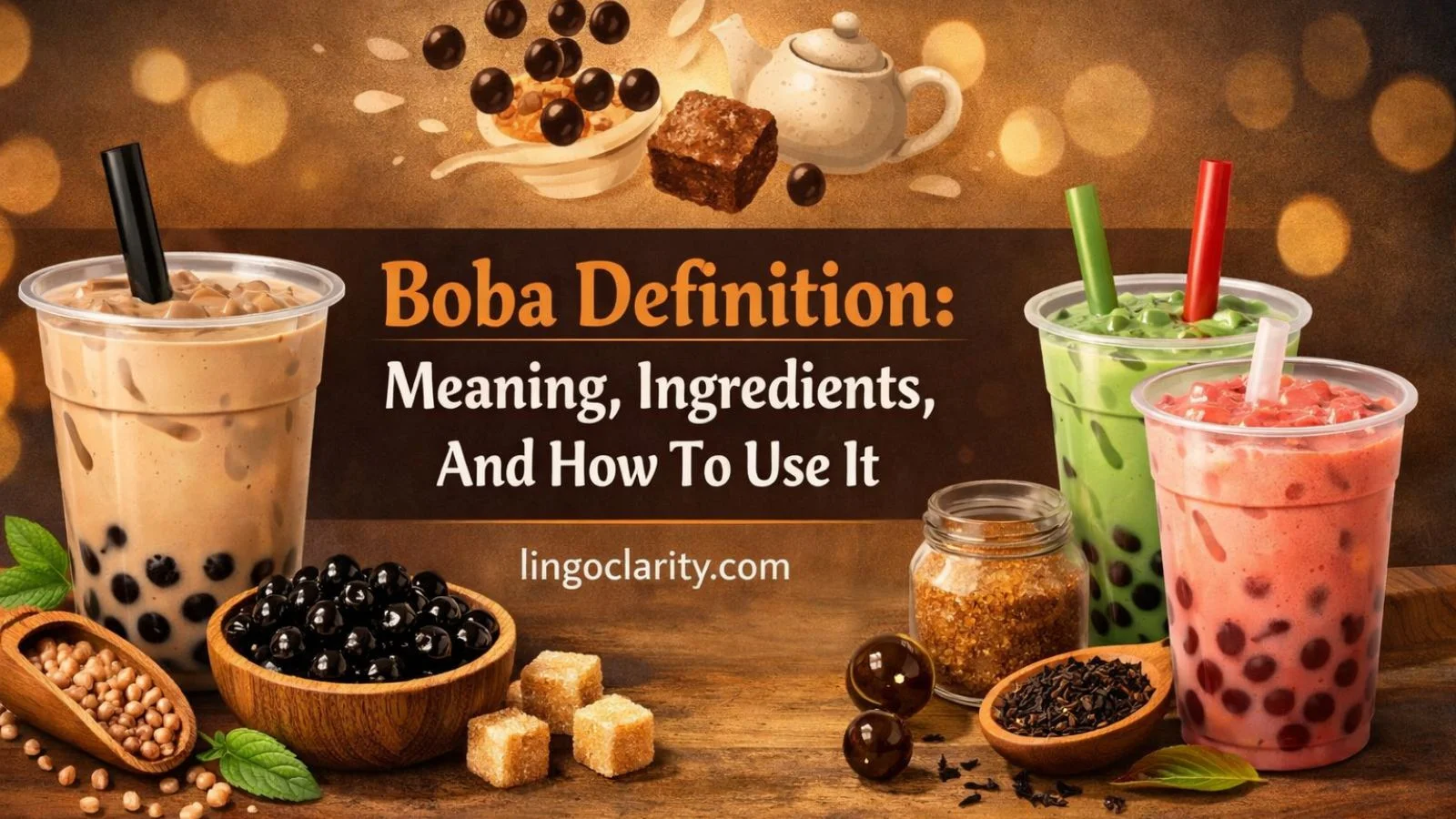
You’ll see boba on café menus, delivery apps, and drink labels—and you’ll hear it in everyday US talk: “Let’s get boba.” The tricky part is that boba can mean two things depending on who’s speaking and where you are:
- the chewy pearls at the bottom, or
- the whole drink (often called bubble tea)
Once you know the difference, ordering gets easier and your writing becomes clearer—especially when you’re explaining boba to someone new.
Meta Description: Learn the boba definition, what the pearls are made of, how bubble tea is ordered, common mix-ups, and easy alternatives you can use in the U.S. today.
Quick Answer
In US English, boba commonly refers to bubble tea (the drink) and it can also refer to the tapioca balls/pearls used in the drink.
Tl;Dr
- “Boba” Can Mean Pearls Or The Whole Drink.
- Classic Pearls Are Usually Made From Tapioca Starch (from cassava).
- Bubble Tea Is A Customizable Drink Category (tea base + sweetness + ice + toppings).
- Popping Boba Is Different From Tapioca Pearls (juice-filled “pop” vs chewy “sip”).
- For Formal Writing, “Bubble Tea” Or “Tapioca Pearls” Is Clearer than “boba.”
Boba Definition In Plain English
Boba is a tea-based drink you sip through a wide straw, often with chewy pearls at the bottom. Many menus use boba to mean the drink itself (same as bubble tea), while other people use boba to mean the pearls.
Real-Life Examples
- “Can I add boba (pearls) to my drink?”
- “Let’s grab boba after class.”
- “This shop has great brown sugar boba.”
- “I want the drink, but no boba (no pearls).”
Common Mistake And Fix
🛑 “Boba is the bubbles on top.”
🟢In bubble tea, the “bubbles” usually refer to the pearls/toppings (or foam from shaking), not carbonation.
Boba Vs Bubble Tea Vs Tapioca Pearls
These terms overlap, but they don’t always mean the same thing:
- Bubble Tea: the drink category.
- Boba: often the drink or the pearls (context decides).
- Tapioca Pearls: the pearls only (most precise).
- Popping Boba: juice-filled pearls that pop (different texture).
| Term | What It Usually Means On US Menus | What It Points To |
|---|---|---|
| Boba | Bubble tea or pearls | Drink or topping |
| Bubble Tea | The drink category | Tea + sweetener + toppings |
| Tapioca Pearls | Chewy balls | Pearls only |
| Popping Boba | Juice-filled pearls | “Pop,” not chewy |
Practical Examples
- “Bubble tea with tapioca pearls, 50% sweet.”
- “No boba, add aloe.”
- “I like boba (pearls), but I don’t like milk tea.”
- “Popping boba tastes fruity and bursts—tapioca pearls are chewy.”
What Boba Pearls Are Made Of
Classic boba pearls are typically made from tapioca starch, which comes from the cassava root. After cooking, pearls are often soaked or coated in a sweetener (like brown sugar syrup) for flavor and shine.
What You Might See On Ingredient Labels
- tapioca starch
- water
- sugar or brown sugar syrup
- flavorings (sometimes)
Common Mistake And Fix
- Mistake: “Boba is gelatin.”
- Fix: Traditional pearls are tapioca-based, not gelatin-based.
Types Of Boba And Popular Add-Ins
Not every topping called “boba” feels the same. Texture is the biggest difference.
Common Options
- Classic Tapioca Pearls: chewy and dense
- Mini Pearls: smaller chew, easier to sip
- Popping Boba: thin skin, juice inside
- Jellies: soft strips or cubes (lychee, coconut, etc.)
- Aloe / Grass Jelly: smoother, mild flavor (varies by shop)
Common Mistake And Fix
- Mistake: “Popping boba is tapioca.”
- Fix: Popping boba is typically a different type of pearl than tapioca.
How Bubble Tea Is Built
Think of bubble tea as a simple “build”:
- Tea base: black, green, oolong, jasmine (or fruit tea)
- Milk or non-dairy: optional
- Sweetness level: often adjustable
- Ice level: often adjustable
- Toppings: pearls, popping boba, jelly, pudding, etc.
Example Builds
- “Black milk tea, 30% sweet, less ice, pearls.”
- “Jasmine green tea, no milk, mango popping boba.”
- “Oolong milk tea, half ice, no toppings.”
How To Order Boba In The Us
A simple ordering script helps—especially at busy shops.
Ordering Script
- Pick the drink
- Pick sweetness
- Pick ice
- Pick topping(s)
Copy-Paste Sample Orders
- “Brown sugar milk tea, 50% sweet, less ice, tapioca pearls.”
- “Strawberry fruit tea, regular sweet, no ice, popping boba.”
- “Thai tea, 25% sweet, light ice, pearls.”
- “Jasmine milk tea, half sweet, no topping.”
Common Mistake And Fix
- Mistake: “I’ll take a boba.”
- Fix: Add the base drink + topping: “Milk tea with pearls,” or “Fruit tea with popping boba.”
How To Use The Word “Boba” In Everyday English
Pronunciation: commonly BOH-buh.
Plural is often boba (and sometimes bobas).
Everyday Examples
- “I’m craving boba tonight.”
- “That place has the chewiest boba.”
- “Do you want boba or coffee?”
Tone Note
- “Let’s get boba” sounds casual and social.
- “Bubble tea” is often clearer for first-timers.
When Not To Use “Boba”
Sometimes “boba” is too vague—especially when clarity matters.
Avoid “Boba” When You Need Precision
- school writing or definitions
- recipes with exact ingredients
- ordering for someone new
- allergy/diet discussions
Better Choices
- Bubble tea (the drink category)
- Tapioca pearls (chewy pearls only)
- Popping boba (juice-filled pearls)
Common Confusions And Quick Fixes
Fast Fixes
- Drink vs pearls: ask “Do you mean the drink or the pearls?”
- “Bubbles” confusion: bubble tea isn’t carbonated; “bubbles” often means pearls/toppings.
- Popping vs tapioca: popping = burst; tapioca = chew.
- Pop culture: Boba Fett is unrelated (same spelling, different meaning).
| Context | Best Choice | Why |
|---|---|---|
| Ordering for a first-timer | Bubble tea | Most recognizable |
| Talking about chewy balls | Tapioca pearls | Most precise |
| Talking about juice-filled pearls | Popping boba | Prevents wrong texture |
| Casual hangout plan | Boba | Natural in US speech |
| School writing | Bubble tea with tapioca pearls | Clear + complete |
Alternatives And Related Terms
Use these when “boba” feels unclear:
- Bubble tea (drink category)
- Milk tea (may or may not include pearls)
- Pearl milk tea (milk tea with pearls)
- Tapioca pearls / pearls (chewy topping)
- Fruit tea (often no milk)
- Jasmine / oolong / black tea (common bases)
- Toppings (umbrella term)
Mini Quiz With Answer Key
Questions
- Which term is clearest for the topping: boba or tapioca pearls?
- Popping boba is best described as: chewy or juice-filled?
- For a school paper, which is clearest: “boba” or “bubble tea with tapioca pearls”?
- Saying “Let’s get boba” usually means: the pearls only, or going out for the drink?
Answer Key
- Tapioca pearls
- Juice-filled
- Bubble tea with tapioca pearls
- Going out for the drink (or the whole boba outing)
Faqs
What is boba?
Boba commonly refers to bubble tea and/or the pearls inside it. On many menus, “boba” can mean the drink itself, while some people use it specifically for the tapioca balls.
Is boba the same as bubble tea?
In the US, many people use the terms interchangeably. If you want to be precise, bubble tea is the drink category, and boba can mean either the drink or the pearls depending on context.
What are boba pearls made of?
Classic pearls are typically made from tapioca starch (from cassava), cooked, then often sweetened.
What is popping boba?
Popping boba are thin-skinned, juice-filled pearls that burst when you bite them—different from chewy tapioca pearls.
Why is it called boba?
“Boba” is widely used in US English for the drink and/or the pearls. The exact naming story varies by source and region, but in modern usage you don’t need the backstory to order—if you want the clearest wording, say bubble tea for the drink and tapioca pearls for the topping.
Is boba healthy?
It depends on the drink size, sugar level, and toppings. Many shops let you adjust sweetness and ice, which can help you match your preferences.
Does boba have caffeine?
The pearls typically don’t add caffeine, but the tea base often does (black/green/oolong). If you want less caffeine, ask for a caffeine-free option if the shop offers one.
Conclusion
In US English, boba can mean the pearls, the drink, or both. If clarity matters, use bubble tea for the drink and tapioca pearls for the chewy topping. That one small wording change prevents most mix-ups and helps you order exactly what you want.
