
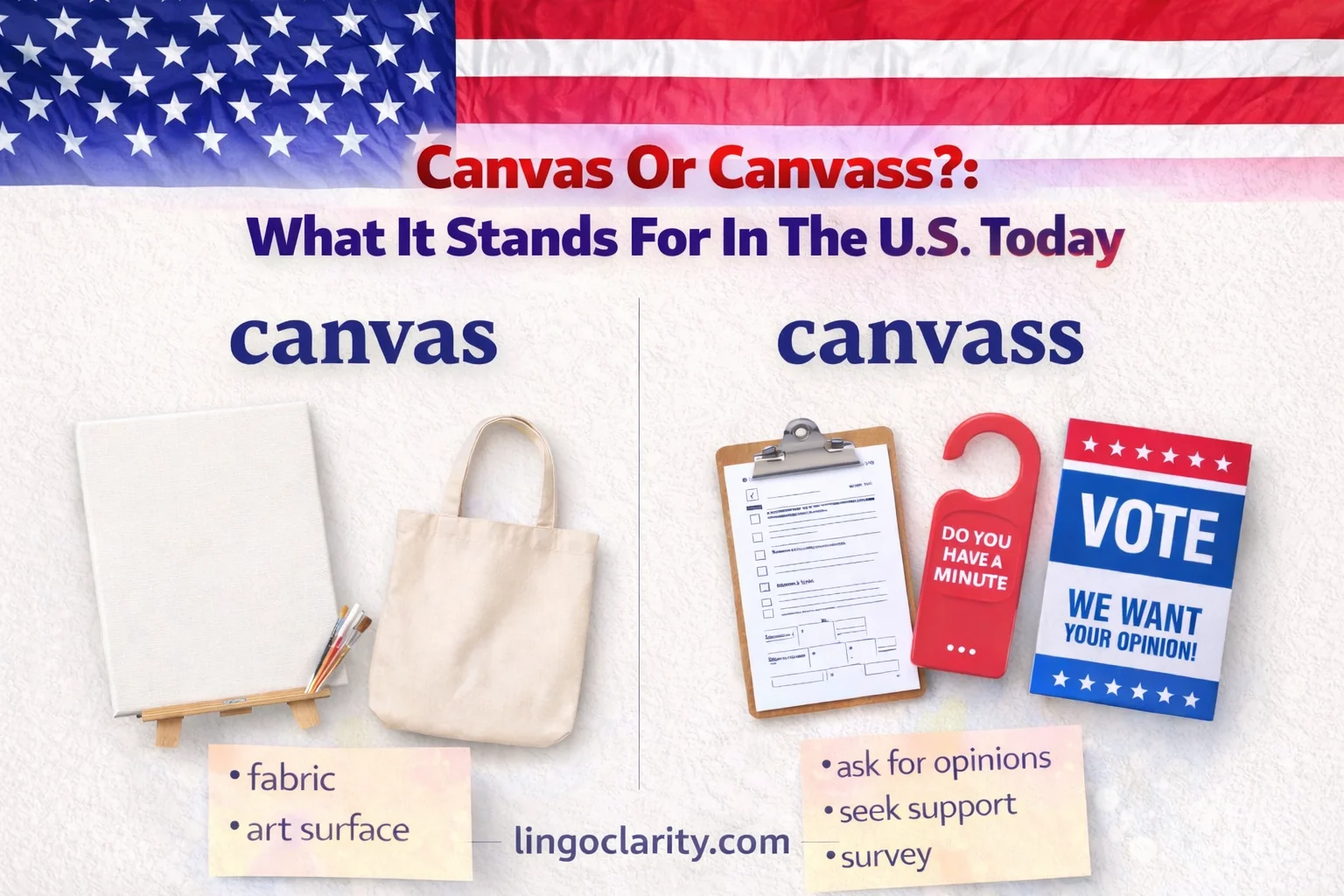
Canvas and canvass sound the same, but they do not do the same job.
In modern English, canvas usually refers to strong cloth, an artist’s painting surface, or sometimes the painting itself. Canvass usually means to ask people for opinions or support, to seek votes, to discuss an issue carefully, or to carry out an official review of votes. Major current dictionaries still draw that core distinction, and the U.S. Election Assistance Commission uses canvass for the official post-election review process.
That is the rule most US readers expect. So if you want the safest everyday choice, think canvas for cloth or art and canvass for asking, surveying, reviewing, or seeking support.
Quick Answer
Use canvas when you mean fabric, a painting surface, or a painting.
Use canvass when you mean asking people for opinions, going door to door, seeking votes or support, discussing something carefully, or officially reviewing election results.
Simple Definition
Here is the simplest way to remember it:
• canvas = cloth or art surface
• canvass = ask around, seek support, survey, or review
That short rule matches current dictionary definitions and official election terminology.
Why People Confuse These Words
People confuse canvas and canvass for three clear reasons.
First, they are pronounced the same way. Cambridge shows both with the same pronunciation pattern. Second, the spellings are almost identical. Third, dictionary entries still record some limited historical overlap in variant forms, which can make the pair look less tidy than it feels in normal modern writing. Even so, the clean meaning split remains the safest choice for US readers.
So the confusion is understandable. But the practical fix is easy: do not focus on sound. Focus on meaning.
Key Differences At A Glance
| Context | Best Choice | Why |
|---|---|---|
| A painter stretched fresh cloth on a frame | canvas | It names the cloth or art surface |
| She bought sturdy summer shoes | canvas | It describes the material |
| Volunteers went door to door before the election | canvass | It means seeking support or votes |
| The school asked parents what they thought | canvass | It means gathering opinions |
| Officials reviewed ballot totals after the election | canvass | It is the standard election term |
| Workers covered the boat with heavy cloth | canvas | It can work as a verb meaning cover with canvas |
That pattern matches current dictionary definitions for both words and the EAC’s election guidance.
What Canvas Means
Canvas is most often a noun. It refers to a firm, strong cloth used for things like bags, tents, sails, and shoes. It also refers to the cloth artists paint on, and by extension, it can refer to the painting itself. Cambridge and Merriam-Webster both reflect those core meanings.
That is why these phrases sound natural:
• canvas bag
• canvas shoes
• canvas tent
• blank canvas
• oil on canvas
• large canvas
In each example, the word points to material, art, or a physical surface.
What Canvass Means
Canvass is most often a verb. It means to go through an area or approach people to ask for opinions, gather information, seek support, or request votes. It can also mean to examine a subject carefully or make it the subject of discussion. In election settings, canvass is the standard term for the official process of reviewing and confirming valid ballots before certification.
That is why these phrases sound natural:
• canvass voters
• canvass the neighborhood
• canvass public opinion
• canvass several options
• official canvass of the vote
• post-election canvass
In each example, the idea is inquiry, outreach, review, or support-seeking.
Real-Life Example
Imagine this short scene:
An artist walks into a supply store and buys a canvas for a new painting. Later that evening, a local campaign volunteer goes door to door to canvass voters about an upcoming school board race.
That one example shows the whole difference. The first word names a thing. The second word names an action. More importantly, the meanings live in completely different worlds: art and fabric on one side, outreach and review on the other. That is why swapping them usually looks wrong right away.
Parts Of Speech And Grammar
The easiest grammar shortcut is this:
• canvas is usually a noun
• canvass is usually a verb
That shortcut works most of the time, but it is not the full story. Merriam-Webster also lists canvas as a verb meaning to cover, line, or furnish something with canvas. And canvass can also be a noun, especially in phrases like a neighborhood canvass or the official canvass of election results.
So the best rule is not only noun versus verb. The better rule is meaning:
• canvas belongs to cloth, coverings, art surfaces, and paintings
• canvass belongs to asking, surveying, discussing, seeking support, and reviewing votes
That meaning-based rule is more reliable than grammar alone.
Which One Should You Use In US English?
For normal US writing, use canvas when the sentence is about material or art. Use canvass when the sentence is about people, opinions, support, debate, or election review.
That is the spelling split most careful readers expect today. Even though dictionaries note some variant overlap, modern plain-English writing is clearer when you keep the meanings separate.
So these choices are the safest:
• The museum displayed three large canvases.
• I need a canvas tote for groceries.
• Volunteers will canvass the district this weekend.
• Officials completed the county canvass on Friday.
Sentence Usage And Examples
Here are clear example sentences you can model:
• The artist leaned a blank canvas against the studio wall.
• She packed her books in a sturdy canvas bag.
• We bought canvas chairs for the patio.
• The exhibit includes two early canvases from the painter’s college years.
• Workers canvased the trailer before the storm.
• Volunteers plan to canvass voters after work.
• The group will canvass residents about the traffic proposal.
• The committee canvassed several ideas before making a final decision.
• The county’s official canvass confirmed the final totals.
• Reporters waited while election staff finished the canvass.
These examples follow current dictionary meanings and official election usage.
Synonyms
Because these words have different meanings, they also take different kinds of synonyms.
For Canvas
Depending on the sentence, near synonyms can include:
• cloth
• fabric
• artist’s surface
• painting surface
• painting
No single synonym fits every use. For example, fabric works for a canvas bag, but not as neatly for a finished painting. Merriam-Webster and Cambridge both show that canvas covers both material and art meanings.
For Canvass
Depending on the sentence, near synonyms can include:
• survey
• poll
• ask around
• solicit support
• seek votes
• discuss
• review
• examine
Those choices line up with dictionary definitions that describe canvass as asking for opinions or support, discussing something thoroughly, or examining it in detail.
Opposites
Exact opposites are harder here, because both words have multiple senses. Still, these contextual opposites help.
For Canvas
If canvas means strong cloth or an art surface, there is no single true opposite. In context, the opposite may be:
• bare frame
• uncovered surface
• non-fabric material
For Canvass
If canvass means to ask around or seek support, useful opposites in context can include:
• ignore
• overlook
• avoid asking
• stop short of surveying
• dismiss without review
These are practical opposites, not perfect dictionary mirror terms. They help writers understand the contrast in real sentences.
Common Mistakes
This pair causes a few predictable mistakes.
Mistake 1: Using Canvas For Political Outreach
Wrong: The campaign will canvas the neighborhood tonight.
Better: The campaign will canvass the neighborhood tonight.
Why it is wrong: the sentence is about asking people for support, not cloth or art. Current dictionaries assign that meaning to canvass.
Mistake 2: Using Canvass For Art Supplies
Wrong: She bought a large canvass for the studio.
Better: She bought a large canvas for the studio.
Why it is wrong: the sentence is about an artist’s surface, which belongs to canvas.
Mistake 3: Forgetting That Canvass Can Be A Noun
Some writers think canvass only works as a verb. But official and political writing also uses it as a noun, as in the official canvass or a door-to-door canvass. Cambridge and election guidance both support that use.
Mistake 4: Relying Only On Noun Vs Verb
That shortcut helps, but it can mislead you. Canvas can be a verb meaning cover with canvas, and canvass can be a noun. Meaning is the better guide.
A Simple Memory Trick
Use this quick memory aid:
Canvas has art and fabric meanings.
Canvass has the extra s for speaking, support, and survey.
It is not a historical rule. It is just a practical reminder. But it works well in everyday writing.
When One Choice Sounds Wrong
Some sentences sound wrong the moment you read them.
• The artist painted on a canvass.
• The candidate will canvas voters tomorrow.
• The county completed the ballot canvas.
Why do these fail? Because readers expect canvas in art and material contexts, and canvass in outreach and election-review contexts. That expectation is backed by current dictionary entries and official election terminology.
If you are unsure, ask one question:
Am I talking about cloth or art, or am I talking about asking and reviewing?
If it is cloth or art, choose canvas.
If it is asking, surveying, support-seeking, discussing, or reviewing, choose canvass.
FAQs
Is canvas ever a verb?
Yes. Merriam-Webster lists canvas as a verb meaning to cover, line, or furnish something with canvas. That use is real, but it is much less common than the noun.
Can canvass be a noun?
Yes. Canvass can be a noun for an organized support-seeking effort or an official review, especially in election contexts.
Which word is used for election review?
Use canvass. The U.S. Election Assistance Commission uses canvass for the post-election process of confirming and including all valid ballots before certification.
Can I write “canvas voters”?
That is not the safest choice in modern US writing. For asking voters for support or opinions, use canvass voters. Current dictionary definitions support canvass for that meaning.
What does blank canvas mean?
A blank canvas is an unused painting surface. By extension, it can also suggest a fresh start or open possibility. The literal art meaning comes directly from the dictionary sense of canvas as an artist’s surface.
Do both words sound the same?
Yes. Current dictionary pronunciation guides show both words with the same spoken pattern, which is one reason writers confuse them so often.
Final Takeaway
If you write for a US audience, keep the rule simple.
Choose canvas for fabric, coverings, painting surfaces, and paintings. Choose canvass for asking people, gathering opinions, seeking support, discussing something carefully, or officially reviewing votes. That is the clearest modern split, and it is the one most readers will expect.
Your safest final check is this:
• canvas = thing made of cloth or used for art
• canvass = action of asking, surveying, or reviewing
That one distinction will fix almost every mistake.
