
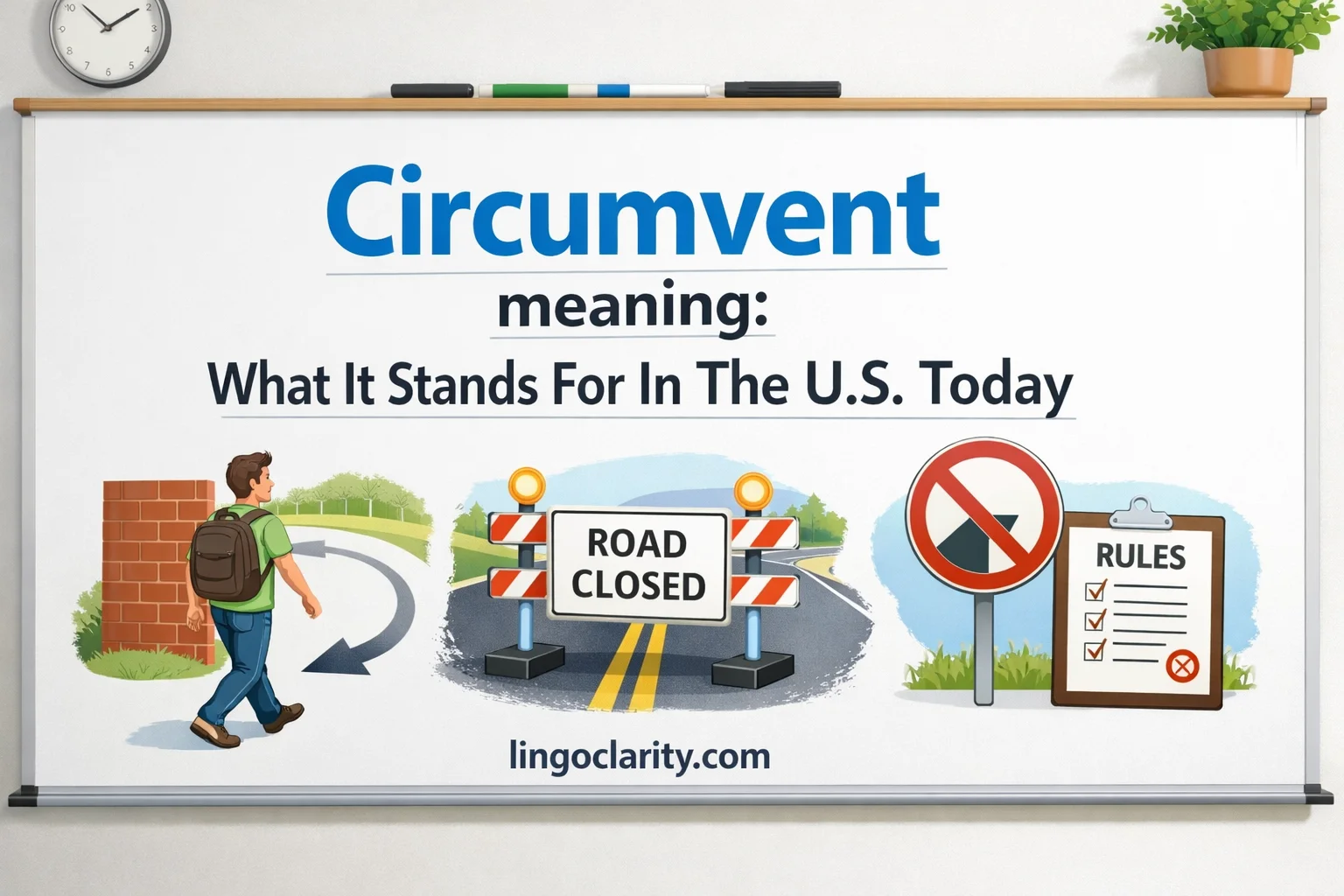
If you searched for circument meaning, you were most likely trying to find the word circumvent. That is the correct spelling, and it is a real English word that appears often in formal writing. Although it may sound advanced at first, the meaning is actually quite simple once you see it in context.
In general, people use circumvent when someone finds a way around a problem, rule, barrier, or restriction. Instead of dealing with the obstacle directly, the person uses another route, method, or strategy. Because of that, the word often suggests cleverness, planning, or indirect action.
At the same time, the tone can change depending on the situation. In some cases, circumvent sounds smart and practical. In other cases, however, it can sound sneaky or even improper. For that reason, it is important to understand not only the meaning of the word, but also how it feels in real sentences.
In this guide, you will learn what circumvent means, how to pronounce it, how to use it naturally, how it compares with avoid and bypass, and which common mistakes to avoid. In addition, you will see real-life examples, synonyms, opposites, sentence patterns, and a quick quiz to help you remember the word with confidence.
Quick Answer
Circumvent means to get around something in a clever, indirect, or strategic way. Most often, people use it for rules, restrictions, barriers, systems, delays, and obstacles.
TL;DR
• Circumvent means to get around something rather than face it directly.
• Usually, it is a formal verb.
• In many cases, it suggests a workaround.
• Depending on context, it can sound neutral, clever, or sneaky.
• Common objects include rules, laws, restrictions, barriers, delays, and systems.
• The related noun is circumvention.
What Does Circumvent Mean?
In plain English, circumvent means to find a way around something without dealing with it directly. In other words, you do not confront the obstacle head-on. Instead, you go around it.
That obstacle can be physical, practical, legal, social, or technical. For example, a person may circumvent a roadblock, a company may circumvent a rule, or a team may circumvent a delay by using a different plan. In each case, the main idea stays the same: there is a barrier, and someone finds another way past it.
Because of that, circumvent is stronger than simply saying avoid. The word does not just suggest staying away from something. Rather, it suggests active problem-solving, deliberate action, or a workaround.
For example:
• We avoided traffic by leaving early.
• We circumvented the road closure by using a side street.
The first sentence is broad and simple. The second sentence, by contrast, shows a more specific and strategic action. Therefore, circumvent often feels more precise.
Simple Definition
A very simple definition is this:
Circumvent = to get around something indirectly
You can also think of it this way:
To circumvent something is to find another path when the direct path is blocked.
That “something” might be:
• a rule
• a law
• a restriction
• a barrier
• a system
• a delay
• a problem
So, while the word may sound formal, the core idea is easy to understand.
How To Pronounce Circumvent
A simple pronunciation guide is:
• SUR-kum-VENT
• /ˌsɝːkəmˈvent/
Most importantly, the stress falls on the last part: vent.
Some learners flatten the word too much. However, natural pronunciation gives a little more emphasis to the final syllable. As a result, the word sounds clearer and more confident.
Try it slowly first:
SUR + kum + VENT
Then say it normally:
circumvent
Part Of Speech And Word Forms
Circumvent is mainly used as a verb. More specifically, it is usually a transitive verb, which means it normally takes an object. So, in most sentences, you circumvent something.
Examples:
• They circumvented the restriction.
• She tried to circumvent the policy.
• We circumvented the delay with a backup plan.
Here are the main word forms:
| Word Form | Use | Example |
|---|---|---|
| circumvent | base verb | We may circumvent the issue with a better process. |
| circumvents | present tense | He circumvents the filter by using another account. |
| circumvented | past tense | They circumvented the roadblock last night. |
| circumventing | -ing form | She is circumventing the usual process. |
| circumvention | noun | The rule was created to prevent circumvention. |
The noun circumvention means the act of getting around something indirectly. Although it is less common in casual speech, it appears often in legal, technical, and business writing.
Why This Word Sounds Formal
Many learners notice that circumvent sounds more formal than other options. That is true. In everyday conversation, native speakers often choose simpler phrases like:
• get around
• work around
• find a way around
Even so, circumvent is still common in serious everyday English. For instance, you may see it in:
• news reports
• legal writing
• business emails
• policy documents
• academic articles
• technical discussions
Because of that, the word sounds polished and precise. Still, it is not old-fashioned. Instead, it simply belongs more to formal or semi-formal English than casual chat.
How To Use Circumvent Naturally
Use circumvent when you want to show that someone got around an obstacle through an indirect method. Usually, the sentence works best when there is a clear barrier or limit involved.
Common patterns include:
• circumvent a rule
• circumvent a law
• circumvent a restriction
• circumvent a barrier
• circumvent a problem
• circumvent an obstacle
• circumvent a delay
• circumvent a system
These combinations sound natural because each one includes something that blocks direct action. As a result, the word feels logical and exact.
Also, circumvent often works best when the action seems:
• strategic
• deliberate
• indirect
• clever
• procedural
So if the action is very simple or casual, another word may sound better.
Real-Life Example
Imagine that your usual road to work is closed because of repairs. You check a map, take a side street, and still arrive on time.
You could say:
We circumvented the road closure by taking a neighborhood route.
Now consider a different example. A company has a rule that all large purchases need approval. Instead of requesting approval, an employee divides one big purchase into several smaller ones.
You could say:
The employee tried to circumvent the approval rule.
These two examples help show an important point. In both cases, someone gets around a barrier. However, the first sounds practical, while the second sounds questionable. Therefore, context matters a lot.
Common Contexts Where People Use Circumvent
Rules And Laws
This is one of the most common uses of the word.
• The company was accused of trying to circumvent labor laws.
• He looked for a way to circumvent the school policy.
• New safeguards were added to stop people from circumventing the ban.
In these sentences, the tone usually feels negative. After all, getting around a law or official rule often sounds dishonest or improper.
Problems And Obstacles
On the other hand, the word can sound neutral or even positive when the obstacle is practical.
• We circumvented the delay by switching suppliers.
• She circumvented the scheduling conflict by moving the meeting online.
• The team circumvented the outage with a backup server.
Here, the word highlights problem-solving. In other words, it shows that someone found an efficient workaround.
Technology And Systems
This is another very common area.
• Some users try to circumvent content filters.
• The update prevents people from circumventing the login check.
• The software was designed to stop easy circumvention.
In technology writing, circumvent often refers to getting around controls, restrictions, or security systems.
Business And Workplace Writing
In professional settings, the word appears often because it sounds precise.
• Employees must not circumvent the approval process.
• We need a lawful solution, not a plan to circumvent the requirement.
• The vendor found a way to circumvent the shipping delay.
For that reason, it is a useful word in reports, policies, and formal updates.
Circumvent Vs Avoid
These words overlap, but they are not identical.
Avoid is broader and simpler. Usually, it means staying away from something or not dealing with it at all.
Examples:
• I avoid sugar late at night.
• She avoided the topic during dinner.
• We avoided traffic by leaving early.
Circumvent, by contrast, suggests a workaround. So instead of simply staying away, you find another path past the problem.
Examples:
• We circumvented the road closure by using a side street.
• They circumvented the restriction with a different process.
Therefore, the easiest way to remember the difference is this:
Avoid = stay away
Circumvent = get around
Circumvent Vs Bypass
Bypass is often closer to circumvent than avoid is. Even so, there is still a difference in tone and use.
Bypass often sounds physical, practical, or procedural.
Circumvent often sounds strategic, indirect, or formal.
Examples with bypass:
• We bypassed downtown traffic.
• The technician bypassed the damaged circuit.
• The surgeon bypassed the blocked artery.
Examples with circumvent:
• They circumvented the policy through a loophole.
• Users tried to circumvent the security setting.
So while both words can mean “go around,” bypass often fits roads, systems, or steps, whereas circumvent often fits restrictions, rules, and barriers.
Circumvent Vs Get Around
In casual conversation, get around is often the most natural alternative.
Compare these two sentences:
• We got around the delay by ordering locally.
• We circumvented the delay by ordering locally.
Both are correct. However, the first sounds conversational, while the second sounds more formal. As a result, native speakers often prefer get around in speech and circumvent in more formal writing.
Synonyms Of Circumvent
No synonym is perfect in every sentence, but these are the closest common choices.
Bypass
This word often works for routes, steps, and systems.
• We bypassed the blocked intersection.
Evade
This usually sounds more negative. In many cases, it suggests avoiding responsibility or consequences.
• He tried to evade the question.
Sidestep
This is slightly lighter and less formal. It often works when someone avoids direct engagement.
• She sidestepped the issue in the interview.
Get Around
This is natural, common, and conversational.
• They found a way to get around the problem.
Work Around
This is especially common in offices and problem-solving situations.
• We worked around the delay by changing the schedule.
Outwit
This emphasizes cleverness against a person or opponent.
• The character outwitted his rivals.
Opposites Of Circumvent
There is no single perfect opposite for every sentence. Even so, these words often work well depending on the context.
Obey
Best for rules, laws, and instructions.
• They obeyed the policy instead of trying to circumvent it.
Follow
A broad and useful opposite for procedures and directions.
• She followed the normal process.
Observe
A more formal choice, especially for laws or standards.
• The company observed the regulation.
Face
Useful when the meaning is “deal with directly.”
• Instead of circumventing the problem, we faced it.
Confront
A stronger version of direct action.
• He confronted the issue rather than trying to get around it.
Sentence Usage
Here are clear examples that show how circumvent works in real sentences.
At School
• Some students try to circumvent the dress code with small loopholes.
• She circumvented the deadline problem by submitting the project early.
• The teacher warned the class not to circumvent the plagiarism rules.
At Work
• The manager refused to circumvent the hiring process.
• Our team circumvented the delay by switching vendors.
• Employees should not circumvent security steps just to save time.
In Technology
• Some users attempt to circumvent content filters.
• The latest patch makes it harder to circumvent the system.
• The company added safeguards to prevent circumvention of account limits.
In Everyday Life
• We circumvented the traffic jam by leaving before rush hour.
• He tried to circumvent the long line by using another entrance.
• They circumvented the roadblock by taking a back road.
In Formal Writing
• The policy was introduced to prevent circumvention.
• The report described several attempts to circumvent compliance rules.
• Lawyers argued that the company did not circumvent the regulation.
Common Mistakes
1. Using Circumvent For Simple Avoidance
Not every case of staying away from something is circumvention.
Less natural:
• I circumvent coffee after 6 p.m.
Better:
• I avoid coffee after 6 p.m.
Here, there is no barrier, rule, or obstacle. So avoid is the better choice.
2. Forgetting The Object
Because circumvent is usually transitive, the sentence often needs a direct object.
Less natural:
• They circumvented.
Better:
• They circumvented the restriction.
Without the object, the sentence can feel incomplete.
3. Using It In Very Casual Conversation
The word is correct, but sometimes it sounds too heavy in relaxed speech.
Formal:
• We circumvented the problem.
More natural in casual speech:
• We worked around the problem.
• We got around the problem.
So although circumvent is accurate, simpler alternatives may sound more natural in conversation.
4. Assuming It Is Always Illegal
This is a very common mistake.
• We circumvented the delivery delay by using a local supplier.
That sentence does not suggest cheating. Instead, it describes a smart workaround. Therefore, the word is not always negative.
5. Confusing It With Bypass In Every Situation
These words overlap, but they are not always interchangeable.
Bypass often suits routes, systems, and steps.
Circumvent often suits rules, restrictions, and barriers.
Because of that, choosing the right word depends on the context.
How To Remember Circumvent Easily
A simple pattern can help:
Avoid = stay away
Bypass = go around directly
Circumvent = find a strategic way around
That last idea matters most. When a sentence involves a workaround, a loophole, or an indirect solution, circumvent may be the best choice.
Mini Quiz
1. What Does Circumvent Usually Mean?
A. To explain something
B. To get around something indirectly
C. To copy something exactly
2. Which Sentence Uses Circumvent Most Naturally?
A. I circumvent milk in my tea.
B. We circumvented the road closure by taking a side street.
C. She circumvented cheerful music on the drive home.
3. Which Is The Noun Form Of Circumvent?
A. circumventive
B. circumvention
C. circumvently
4. Which Choice Is More Casual Than Circumvent?
A. get around
B. observe
C. confront
Answer Key
- B
- B
- B
- A
FAQs
What does circumvent mean?
It means to get around a rule, barrier, problem, or restriction in an indirect way. Usually, the word suggests a workaround rather than direct action.
Is circumvent a formal word?
Yes, it usually sounds more formal than phrases like get around or work around. Because of that, it appears often in business, legal, academic, and technical writing.
Is circumvent always negative?
No, not always. Sometimes it sounds negative when someone dodges a rule or law. In other cases, though, it sounds neutral or even positive when someone finds a smart solution to a practical problem.
How do you use circumvent in a sentence?
Usually, you use it with an object. For example: They circumvented the delay by changing suppliers. In most cases, the sentence should say what was circumvented.
What part of speech is circumvent?
It is mainly a verb. In addition, the related noun is circumvention.
What is the difference between circumvent and avoid?
Avoid is broader and simpler. It usually means staying away from something. Circumvent, however, means finding an indirect way around a barrier, problem, or rule.
What is the difference between circumvent and bypass?
Bypass often refers to going around a route, step, or system. Circumvent, by contrast, usually emphasizes strategy, indirect action, or a workaround, especially with rules and restrictions.
Can circumvent be used in a positive way?
Yes. For example, if a team circumvents a delay by finding a better supplier, the word describes practical problem-solving rather than dishonest behavior.
Conclusion
Circumvent means to get around something in a clever, indirect, or strategic way. Although it is a formal word, the idea behind it is simple. Whenever someone finds another path around a barrier, rule, delay, or obstacle, circumvent may be the right word.
Still, context matters. Sometimes the word sounds practical and smart. In other situations, however, it can sound sneaky or improper. That is why it is helpful to notice what is being circumvented and why.
So if you searched for circument meaning, the correct word is circumvent. Now you know what it means, how to pronounce it, how to use it, and how to choose it naturally in real US English.
