Many writers recognize both colour and color, but in American English only one is standard for everyday use. The forms mean the same thing. The real question is not meaning or pronunciation. It is which spelling matches your audience and style guide.
Quick Answer
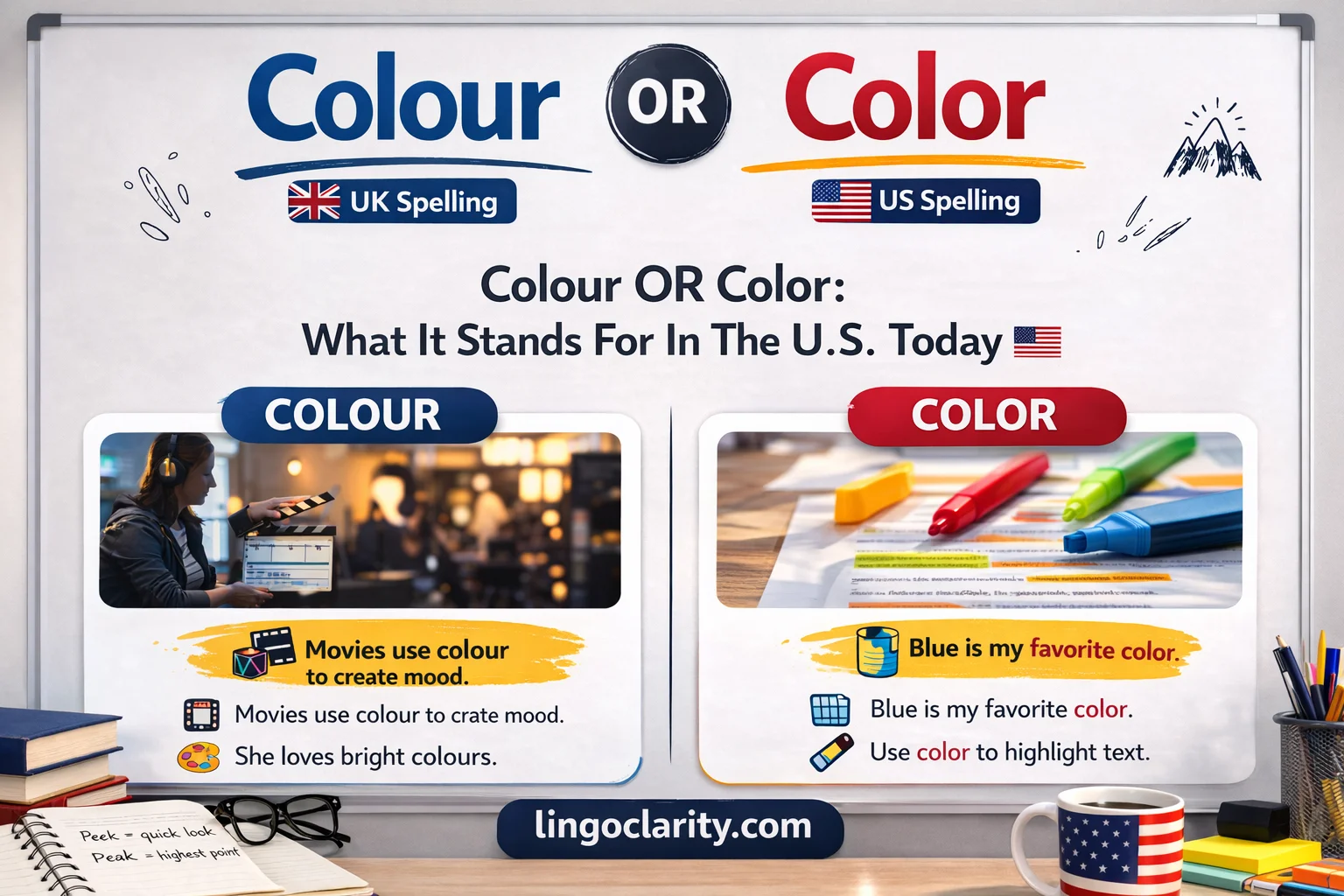
In US English, the standard spelling is color. Colour is the standard spelling in British English and in many varieties of English that follow British conventions. Major dictionary sources reflect that split directly: Merriam-Webster lists colour as the chiefly British spelling of color, while Cambridge labels color as the US spelling of colour.
Are Colour And Color The Same Word?
Yes. They are spelling variants of the same word, not different words with different meanings. Both can function as a noun, as in “Blue is my favorite color,” and as a verb, as in “Please color the chart before class.” Merriam-Webster defines color and notes colour as the chiefly British spelling, which confirms that the difference is regional spelling rather than meaning.
Which Spelling Is Standard In American English?
For an American audience, use color.
That includes:
- school writing in the United States
- US-based websites and blogs
- American business writing
- marketing aimed at US readers
- most writing that follows American style guides
If your article, email, or brand voice is written in US English, color is the correct and expected choice. Oxford’s British/American spelling guidance lists colour/color among the standard -our/-or differences between British and American English.
Why People Confuse These Spellings
The confusion is easy to understand. Both spellings are correct in English as a whole, and they are typically pronounced the same in everyday speech. Because readers see color in American writing and colour in British or international writing, they sometimes assume there must be a difference in meaning. There is not. In most cases, it is simply a regional spelling difference. Cambridge provides entries for both forms and treats them as equivalent apart from spelling convention.
Colour Vs. Color At A Glance
For writing aimed at the United States, choose color. For writing aimed at the United Kingdom, choose colour. When quoting British material, keep colour in the original quotation. When editing a US document, change colour to color unless the original wording needs to stay intact.
A slightly more polished version for the article:
Use color for US writing and colour for UK writing. If you are quoting British material, keep colour in the quotation. If you are editing a US document, change colour to color unless the original wording must be preserved.
The safest rule is simple: match the spelling to the variety of English you are using, then stay consistent throughout the piece.
US And UK Preference In Related Words
The same pattern usually appears in related forms:
- colorful / colourful
- colored / coloured
- coloring / colouring
- color palette / colour palette
This is a spelling-system difference, not a grammar difference. If you choose American English, the related forms should usually follow American spelling too. Oxford’s spelling-difference reference shows this broader -our/-or pattern across many words, not just colour/color.
When One Spelling Looks Wrong
A word can be correct in English overall and still look wrong in a particular document.
In US writing, colour often looks out of place because American readers expect color. In British writing, color can look equally off for the same reason. That does not make either form fake or meaningless. It only means the spelling does not match the language variety of that piece.
This is why mixed spelling in one document can make otherwise strong writing feel careless.
Common Mistakes And Quick Fixes
One common mistake is assuming that one spelling is always wrong everywhere.
Fix: Treat them as regional variants.
Another mistake is mixing systems, such as writing color in one sentence and colourful in the next.
Fix: Follow one spelling style from start to finish.
A third mistake is thinking the extra u changes the pronunciation.
Fix: In normal use, it usually does not. Cambridge provides pronunciation entries for both forms and they represent the same word with regional spelling variation.
Examples In Natural US English
Here are clear American-style examples:
My favorite color is green.
The room needs more color.
She used markers to color the poster.
The leaves add bright color to the street in fall.
The company updated its color palette last spring.
Here are the same ideas in British-style spelling:
My favourite colour is green.
The room needs more colour.
She used markers to colour the poster.
For US readers, the American set is the right fit.
Word Details
As A Noun
Color is the standard US spelling for the noun referring to hue, shade, pigment, or visual appearance.
Colour is the same noun written in British spelling.
As A Verb
Color is also the standard US spelling of the verb meaning to add color to something, change its shade, or affect the way something is perceived.
Colour is the same verb in British-style spelling.
Related Alternatives
Depending on the sentence, close alternatives can include hue, shade, tone, tint, or pigment. Merriam-Webster’s thesaurus lists several of these among related words for color.
A Brief Note On History
The modern American preference for color fits a broader pattern in US spelling, where many words use -or instead of the British -our ending, such as honor/honour and color/colour. Merriam-Webster notes that Noah Webster helped shape what became standard American spelling, although actual adoption ultimately depended on public use.
Fixed Expressions And Set Phrases
In American English, you will usually see:
- true colors
- with flying colors
- color scheme
- color palette
In British English, the same phrases often appear with colour where applicable, such as true colours and colour scheme.
The meaning stays the same. The spelling changes with the language variety.
Conclusion
If you are writing in US English, choose color.
If you are writing in British English, choose colour.
They are the same word, they carry the same meanings, and the difference is mainly a matter of regional spelling convention. For American writing, color is the clear standard choice. Merriam-Webster and Cambridge both support that distinction directly.
FAQs
Is colour ever correct in the US?
Yes, but usually only in special cases, such as a direct quotation, a brand name, a publication that follows British style, or writing intentionally preserved in non-US spelling. In standard American writing, color is the expected form.
Is color wrong in British English?
It is not meaningless or unknown, but it is not the normal standard British spelling. In British English, colour is the expected form.
Do colour and color mean different things?
No. They are spelling variants of the same word. The difference is regional spelling, not meaning.
Do they sound different when spoken?
Usually no. The usual pronunciation is effectively the same, which is one reason many writers mix them up.
Which spelling should I use on a US website?
Use color. For an American audience, that is the standard and safest choice.
