
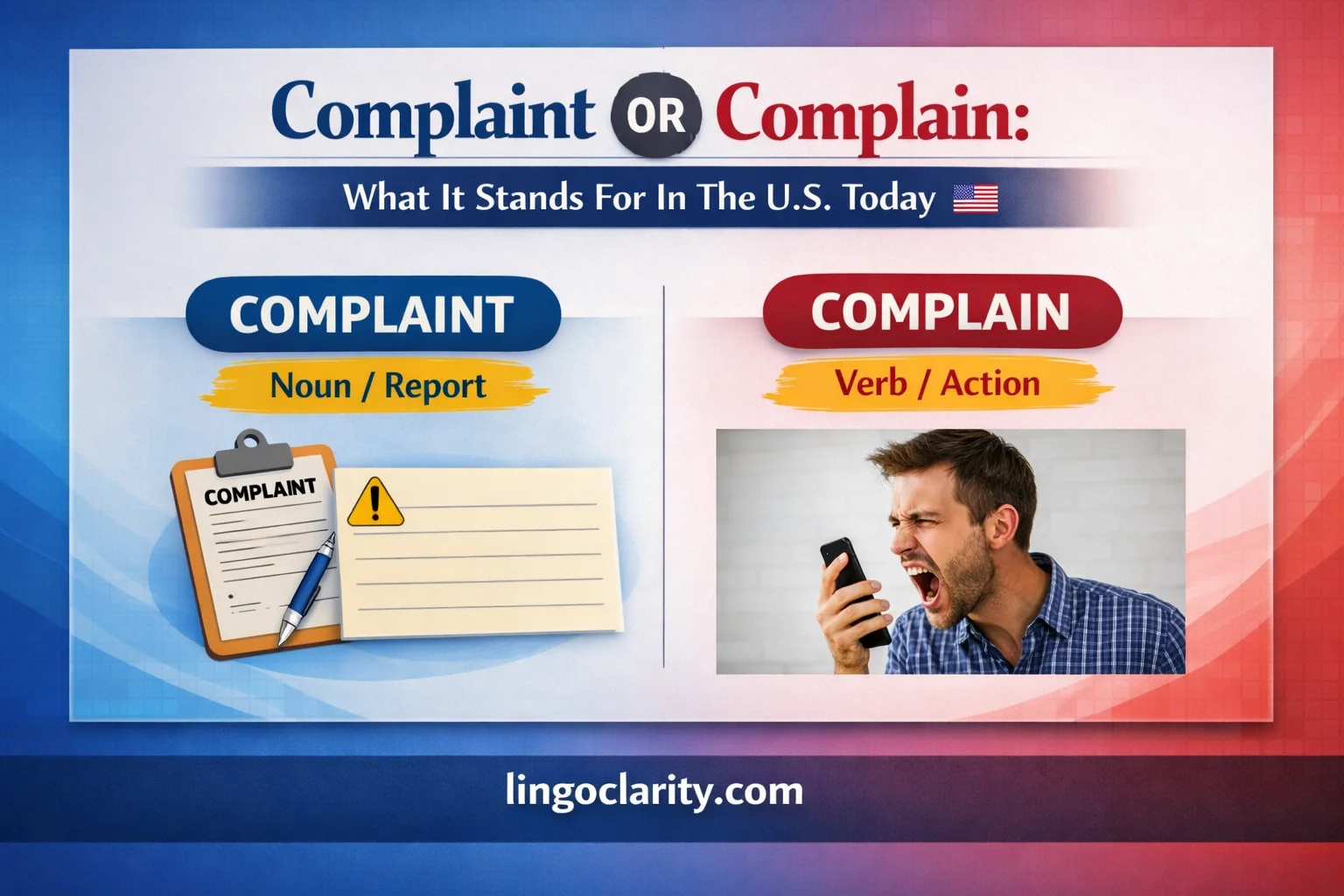
When writers mix up complaint and complain, the problem is usually grammatical, not semantic. The two words are closely related, but they do different jobs in a sentence. In standard US English, complaint is a noun, while complain is a verb. Dictionaries consistently define complaint as an expression of dissatisfaction, a grievance, or, in some contexts, a medical or legal term; they define complain as the act of expressing dissatisfaction or making a formal accusation.
Quick Answer
Use complaint when you are naming the problem, report, or grievance. Use complain when you are describing the action of speaking or writing about that problem. In other words, you can make, file, hear, receive, or resolve a complaint, but you complain about something.
What Is The Difference Between Complaint And Complain?
The difference is simple: complaint is the thing, and complain is the action. If the sentence needs a noun, choose complaint. If it needs a verb, choose complain. That rule covers nearly every everyday use in US English.
Compare these:
- I have a complaint about the charge.
- I want to complain about the charge.
Both sentences are correct, but the grammar changes. In the first sentence, the word names the issue. In the second, it describes the act of raising it.
Why People Confuse These Words
These two words are easy to mix up because they look alike, sound similar, and come from the same word family. They also share the same core idea of dissatisfaction. But related meaning does not make them interchangeable. English often has noun-verb pairs with similar forms, and this is one of them. That is why I have a complaint is correct, but I have a complain is not.
Complaint Meaning And Usage
Complaint is a noun. In general writing, it means an expression of dissatisfaction or the reason someone is unhappy. In medical use, it can refer to an ailment or symptom. In legal use, it can refer to the document that starts a civil action. These meanings are standard and well established in major dictionaries.
Common patterns include:
- file a complaint
- make a complaint
- customer complaint
- noise complaint
- chief complaint
- legal complaint
Examples:
- Her main complaint was the long wait time.
- The company received three customer complaints this week.
- The doctor recorded the patient’s chief complaint.
- They filed a formal complaint with HR.
Complain Meaning And Usage
Complain is a verb. It means to express dissatisfaction, pain, or resentment. It can also mean to make a formal accusation. In actual usage, it commonly appears in patterns such as complain about, complain to, complain that, and, in medical contexts, complain of.
Common patterns include:
- complain about the service
- complain to the manager
- complain that the bill is wrong
- complain of pain
Examples:
- I called to complain about the late delivery.
- Customers often complain when the app crashes.
- She complained to the landlord about the noise.
- The patient began to complain of chest pressure.
A Fast Choice Rule
Use this quick test:
- If the word names the issue, choose complaint.
- If the word shows the action, choose complain.
A second test also helps. If the word comes after a, the, my, your, this, or that, you usually need complaint. If it comes after to, will, can, did, want to, or a subject like I, they, or she, you usually need complain or another verb form such as complained or complains.
When Complaint Sounds Better
Complaint often fits better in formal or institutional settings because it sounds like a named report or documented issue. That is why it appears so often in customer service, legal writing, HR documents, complaint procedures, and healthcare records.
Examples:
- Please submit your complaint in writing.
- The agency investigates consumer complaints.
- Her attorney drafted the complaint yesterday.
When Complain Sounds Better
Complain works best when you are talking about what someone does rather than what exists on paper. It is common in speech, emails, narratives, and everyday reporting because it describes the action directly.
Examples:
- Guests rarely complain when staff solve the problem quickly.
- He called to complain about an unexpected fee.
- They complained that the instructions were unclear.
Common Mistakes And How To Fix Them
These are some of the most common errors:
- Wrong: I made a complain.
Right: I made a complaint. - Wrong: She wants to complaint about the bill.
Right: She wants to complain about the bill. - Wrong: We received several complain last week.
Right: We received several complaints last week. - Wrong: The patient complaints of pain.
Right: The patient complains of pain.
The reason these mistakes happen is straightforward: writers choose the right meaning but the wrong part of speech. The fastest fix is to ask whether the sentence needs a thing or an action.
Complaint Vs Complain In Everyday Sentences
Here are clear side-by-side examples:
- I have a complaint about my order.
- I want to complain about my order.
- His only complaint was the noise.
- He complained about the noise all night.
- The website logged my complaint automatically.
- I complained through the website this morning.
- The nurse noted the patient’s chief complaint.
- The patient complained of stomach pain.
Grammar Tip To Remember
Think of it this way:
- complaint = noun = report, grievance, issue
- complain = verb = express dissatisfaction
That one distinction will keep you right almost every time.
Related Forms You May See
The same word family includes forms such as complained, complaining, complains, and complaints. These do not change the core distinction. The verb stays a verb, and the noun stays a noun.
Examples:
- She complained yesterday.
- They are complaining again.
- The store has received many complaints.
Which One Should You Use In US English?
If you are writing in US English, the correct choice depends on grammar, not regional preference. Choose complaint when you need a noun. Choose complain when you need a verb. That is the standard distinction in edited American English.
FAQs
Is complaint a noun or a verb?
In standard US English, complaint is a noun. It names a grievance, expression of dissatisfaction, medical issue, or legal filing, depending on context.
Is complain a noun or a verb?
Complain is a verb. It means to express dissatisfaction, pain, or resentment, and it can also mean to make a formal accusation.
Which is correct: “I have a complaint” or “I have a complain”?
I have a complaint is correct because the sentence needs a noun after a. I have a complain is incorrect in standard US English.
Which is correct: “I want to complain” or “I want to complaint”?
I want to complain is correct because want to is followed by a base-form verb. I want to complaint is not standard English.
Can complaint be used in legal or medical writing?
Yes. In legal contexts, complaint can refer to the document that begins a civil case. In medical contexts, it can refer to an ailment, symptom, or the patient’s reported issue.
What is the easiest way to remember the difference?
Remember this: complaint is the issue, and complain is the action. If the word names the problem, use complaint. If it shows someone expressing dissatisfaction, use complain.
Conclusion
The difference between complaint and complain is clear once you focus on grammar. Complaint is the noun. Complain is the verb. You file a complaint, but you complain about something. Once you remember that one rule, choosing the correct word becomes much easier.
If you want, I can also turn this into a more aggressive SEO version with featured-snippet formatting and a stronger FAQ schema layout.
