
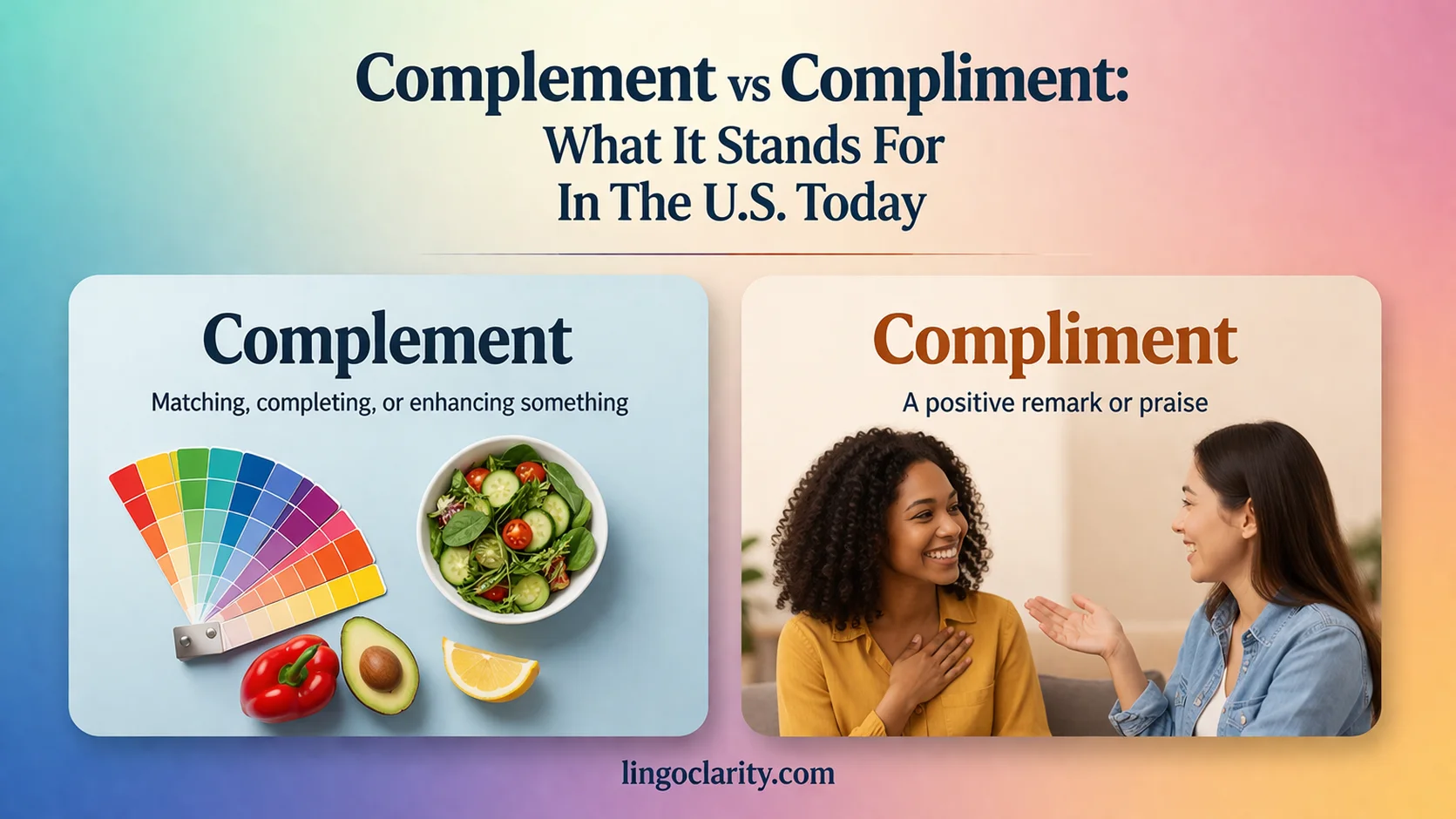
Complement and compliment are one of the most common word pairs people mix up in English. They sound the same, they look almost the same, and they both often appear in positive situations. That is exactly why the mistake keeps happening in emails, essays, captions, product descriptions, and everyday conversation.
Still, the meanings are not the same. Complement is about something that completes, improves, or goes well with something else. Compliment is about praise, admiration, or a kind remark. Major dictionaries make that split clear, and standard usage in US English follows it consistently.
Once you understand that one word is about a good match and the other is about praise, the choice becomes much easier. This guide will show you the simple definitions, real-life examples, sentence patterns, synonyms, opposites, common mistakes, and memory tricks that help you get complement vs compliment right every time.
Quick Answer
Use compliment when you mean praise.
Use complement when you mean complete, improve, balance, or match well with.
That is the main rule. It works in almost every everyday sentence. Dictionaries define compliment as an expression of admiration or respect, while complement refers to something that completes something else or makes it better.
Here is the fastest way to remember it:
- Complement = complete, enhance, go well together
- Compliment = praise, admire, say something nice
If someone says, “I love your presentation,” that is a compliment.
If your calm style balances your partner’s energy, your styles complement each other.
Simple Definitions
A simple definition makes this pair much easier to learn.
Complement means something that completes, improves, or makes something else look or work better. It can be a noun or a verb. Dictionaries also note another noun meaning: the full number or amount needed in a group or set.
Compliment means a polite expression of praise, admiration, or respect. It can also be a noun or a verb. As a verb, it means to praise someone. Dictionaries also record plural uses such as compliments, meaning regards or polite good wishes.
So in plain English:
- A complement makes something better.
- A compliment says something nice.
Why Complement Vs Compliment Is So Confusing
People confuse these words for three main reasons.
First, they are pronounced the same way in standard dictionary pronunciation. That means sound does not help you separate them.
Second, the spelling difference is tiny. Only one letter changes: e in complement and i in compliment.
Third, both words can be used as nouns and verbs. You can give a compliment or compliment someone. You can describe a perfect complement or say one thing complements another. That shared sentence flexibility makes the mix-up even more common.
There is also a meaning link in their history. Both words trace back to the Latin idea of filling up or completing, but modern English separated them. Today, complement stayed with the idea of completion, while compliment moved toward courtesy, admiration, and praise.
Key Differences At A Glance
| Situation | Correct Word | Why |
|---|---|---|
| A kind remark to a coworker | compliment | It means praise |
| Praising someone’s work | compliment | The verb means to praise |
| Two colors that look good together | complement | One improves the other |
| A sauce that makes a meal better | complement | It completes or enhances |
| A balanced team with different strengths | complement | The skills work well together |
| The full number of employees needed | complement | It can mean the full set or amount |
This distinction matches standard dictionary usage for both noun and verb forms.
Complement Meaning And Usage
In everyday US English, complement usually means that one thing goes well with another or makes it better.
As a verb, it means to complete, improve, or enhance by adding something that fits well. Merriam-Webster defines the verb this way, and Cambridge also describes it as making something seem better or more attractive when combined with something else.
As a noun, it often means a matching addition or something that completes another thing. It can also mean the full amount needed, as in a full complement of staff or a ship’s complement of crew.
Real-Life Examples Of Complement
- The soft lighting complements the painting.
- Her patience complements his fast decision-making.
- Lemon is a perfect complement to grilled fish.
- The rug is a beautiful complement to the room.
- After weeks of hiring, the office finally has its full complement of staff.
In all of these, the idea is the same: one thing helps complete or improve another.
Compliment Meaning And Usage
Compliment is the word you want when the sentence is about praise.
As a noun, it means an expression of admiration, respect, or approval. As a verb, it means to praise someone or express admiration directly. Dictionaries also note common set expressions such as my compliments, our compliments, and compliments to the chef.
Real-Life Examples Of Compliment
- She gave me a compliment on my presentation.
- He complimented the chef on the soup.
- That was a thoughtful compliment.
- I took her comment as a genuine compliment.
- Please give my compliments to your parents.
Each sentence is about kind words, approval, or polite praise.
How To Choose The Right Word In A Sentence
When you are stuck between complement vs compliment, ask one quick question:
Am I talking about praise, or am I talking about a good match?
If the answer is praise, choose compliment.
If the answer is a good match, choose complement.
This test works well in normal writing:
- She complimented me on my jacket.
You can replace it with praised. - The jacket complements your shoes.
You can replace it with goes well with. - Their skills complement each other.
You can replace it with balance each other well. - I took his comment as a compliment.
You can replace it with praise.
That quick replacement trick is one of the easiest ways to avoid the error.
Tone, Context, And Formality
Neither word is especially formal or especially casual. The choice is mainly about meaning, not tone level.
Compliment appears often in speech, personal writing, workplace feedback, and polite conversation. It feels natural in daily life because people often praise clothing, food, effort, ideas, and performance.
Complement also appears in everyday English, but it is especially common in writing about style, design, teamwork, branding, food, and comparison. It often shows up when writers want to explain why two things work well together. That matches dictionary usage, which centers on completing, enhancing, or making something better.
Here are natural patterns to remember:
- compliment someone on something
- pay someone a compliment
- complement something
- be a complement to something
- complement each other
Complement Vs Compliment In Real Life
This is where many learners finally lock in the difference.
In Style And Design
Use complement.
- These curtains complement the wall color.
- Gold jewelry complements dark green beautifully.
- The simple logo complements the brand design.
The point is visual harmony, not spoken praise.
In Food And Cooking
Use complement when flavors work well together, and compliment when someone praises the cook.
- Fresh herbs complement the soup.
- Citrus complements rich seafood dishes.
- The guests complimented the host on dinner.
Same dinner table, two different words.
In Work And Team Settings
Use complement when people’s skills balance each other. Use compliment when someone gives positive feedback.
- Her planning skills complement his creativity.
- The manager complimented the team on its calm response.
- Their personalities complement each other well.
In Daily Conversation
Use compliment for praise.
- Thanks for the compliment.
- He complimented me on my writing.
- That is one of the nicest compliments I have received in a while.
Synonyms Of Complement
The best synonym for complement depends on the sentence.
Possible choices include:
- complete
- enhance
- improve
- balance
- match
- go well with
- finish
- add to
Examples:
- The candles enhance the room.
- Her clear structure improves the report.
- His humor balances her seriousness.
No single synonym works in every sentence, but complete, enhance, and go well with are often the closest plain-English replacements. Merriam-Webster’s synonym list for the verb includes words such as enhance, complete, and improve.
Opposites Of Complement
The opposite of complement also depends on context. Good options can include:
- clash with
- conflict with
- detract from
- spoil
- weaken
- compete with
Examples:
- That bright frame clashes with the artwork.
- The heavy sauce detracts from the fish.
- His style sometimes conflicts with the brand message.
There is not one perfect opposite for every use, because complement can refer to style, teamwork, quantity, grammar, and other fields.
Synonyms Of Compliment
Useful synonyms for compliment include:
- praise
- kind remark
- admiring comment
- commendation
- tribute
- approval
Examples:
- She offered warm praise.
- He made a kind remark about her effort.
- The review read like a public commendation.
These are helpful when you want variety without changing the meaning.
Opposites Of Compliment
Clear opposites of compliment include:
- insult
- criticism
- put-down
- slight
- disrespect
Examples:
- That was not a compliment. It was an insult.
- He expected praise but got criticism instead.
- Her comment sounded more like a put-down than support.
These opposites are usually much easier to spot because praise and insult are so different in tone.
Sentence Usage Examples
Here are clear model sentences for both words.
Using Complement Correctly
- The blue tie complements his gray suit.
- Her practical mindset complements his big ideas.
- This side dish is a perfect complement to the main course.
- The company now has a full complement of trained staff.
- Soft music can complement a relaxed dinner setting.
Using Compliment Correctly
- She complimented him on his calm leadership.
- That was a generous compliment.
- I smiled and thanked her for the compliment.
- He loves to compliment people on their work.
- Please accept this note with my compliments.
These examples reflect the standard noun and verb uses recorded by major dictionaries.
Common Mistakes And Quick Fixes
Writers usually make the same few mistakes with complement vs compliment.
Mistake 1: Using Compliment For Matching Things
Wrong: The curtains really compliment the sofa.
Right: The curtains really complement the sofa.
Why? Curtains are not praising the sofa. They are matching it well.
Mistake 2: Using Complement For Praise
Wrong: She complemented me on my speech.
Right: She complimented me on my speech.
Why? She praised you. She did not complete you.
Mistake 3: Mixing Up Fixed Expressions
Wrong: Please give my complements to the chef.
Right: Please give my compliments to the chef.
Wrong: The lime is a great compliment to the dish.
Right: The lime is a great complement to the dish.
Mistake 4: Confusing The Adjectives Too
Wrong: We got complementary tickets.
Right: We got complimentary tickets.
Wrong: Blue and orange are complimentary colors.
Right: Blue and orange are complementary colors.
Dictionaries define complementary as completing, mutually supplying what is lacking, or relating to a color pair that balances into a neutral whole. They define complimentary as expressing praise or being given free as a courtesy.
Complementary Vs Complimentary
This related pair deserves its own section because it causes a lot of confusion.
Use complementary when two things complete each other or work well together.
- Their skills are complementary.
- The colors are complementary.
- The software and service offer complementary strengths.
Use complimentary when something expresses praise or is free as a courtesy.
- She made a complimentary remark.
- The hotel offered complimentary breakfast.
- We received complimentary tickets.
That distinction follows standard dictionary definitions and is worth learning alongside complement vs compliment.
Memory Tricks That Actually Help
A good memory trick should be simple and usable under pressure.
Remember The Letter E In Complement
Complement has e, like complete.
That fits the core meaning: something completes, improves, or enhances something else. Merriam-Webster even points to the link between complement and the idea of completion as a helpful guide.
Remember The Letter I In Compliment
Compliment has i, like I admire you.
That points you toward praise, approval, and kind words.
Use A Fast Meaning Check
- Praise? → compliment
- Match well? → complement
This is often faster than trying to remember a rule from school.
Word History In Simple Terms
These two words are related, which helps explain why they look and sound so similar.
Both words go back to the Latin root complēre, meaning “to complete.” Over time, English separated their everyday meanings. Complement stayed close to the idea of completion. Compliment developed along a courtesy-and-praise path. That historical split is reflected in modern dictionary usage.
The history is interesting, but the modern rule is still the one that matters most:
- complement = complete or enhance
- compliment = praise
Conclusion
The difference between complement vs compliment is simple once you reduce it to one question.
If the sentence is about praise, choose compliment.
If the sentence is about completing, improving, or matching well, choose complement.
That rule covers clothing, design, teamwork, meals, writing, and everyday conversation. It also helps you avoid the most common mistakes with related forms like complementary and complimentary.
So the next time you pause over the spelling, do a quick test:
- Can you replace it with praise? Use compliment.
- Can you replace it with go well with or complete? Use complement.
That is the cleanest, most reliable way to get it right.
FAQs
Is complement or compliment used for praise?
Use compliment for praise. A compliment is a kind remark, an expression of admiration, or polite approval. That is the standard dictionary meaning.
Can complement be a verb?
Yes. Complement can be a verb, and it means to complete, enhance, or improve by fitting well with something else. For example: “The sauce complements the fish.”
What does full complement mean?
Full complement means the complete number or amount needed. For example, a company with a full complement of workers has all the staff it is supposed to have.
Is it compliments to the chef or complements to the chef?
The correct phrase is compliments to the chef because the meaning is praise. Dictionaries list this kind of plural use under compliment.
What is the difference between complementary and complimentary?
Complementary means completing, matching, or working well together. Complimentary means praising or free as a courtesy. So complementary colors is correct, but complimentary tickets is also correct.
Why do complement and compliment sound the same?
They are pronounced the same in standard dictionary pronunciation, which is one reason people confuse them so often in writing.
Is this sentence correct: “Your shoes complement your jacket”?
Yes. That sentence is correct because the shoes and jacket go well together. The word is complement, not compliment.
Is this sentence correct: “She complimented me on my report”?
Yes. That sentence is correct because she praised your report. The word is complimented.
