
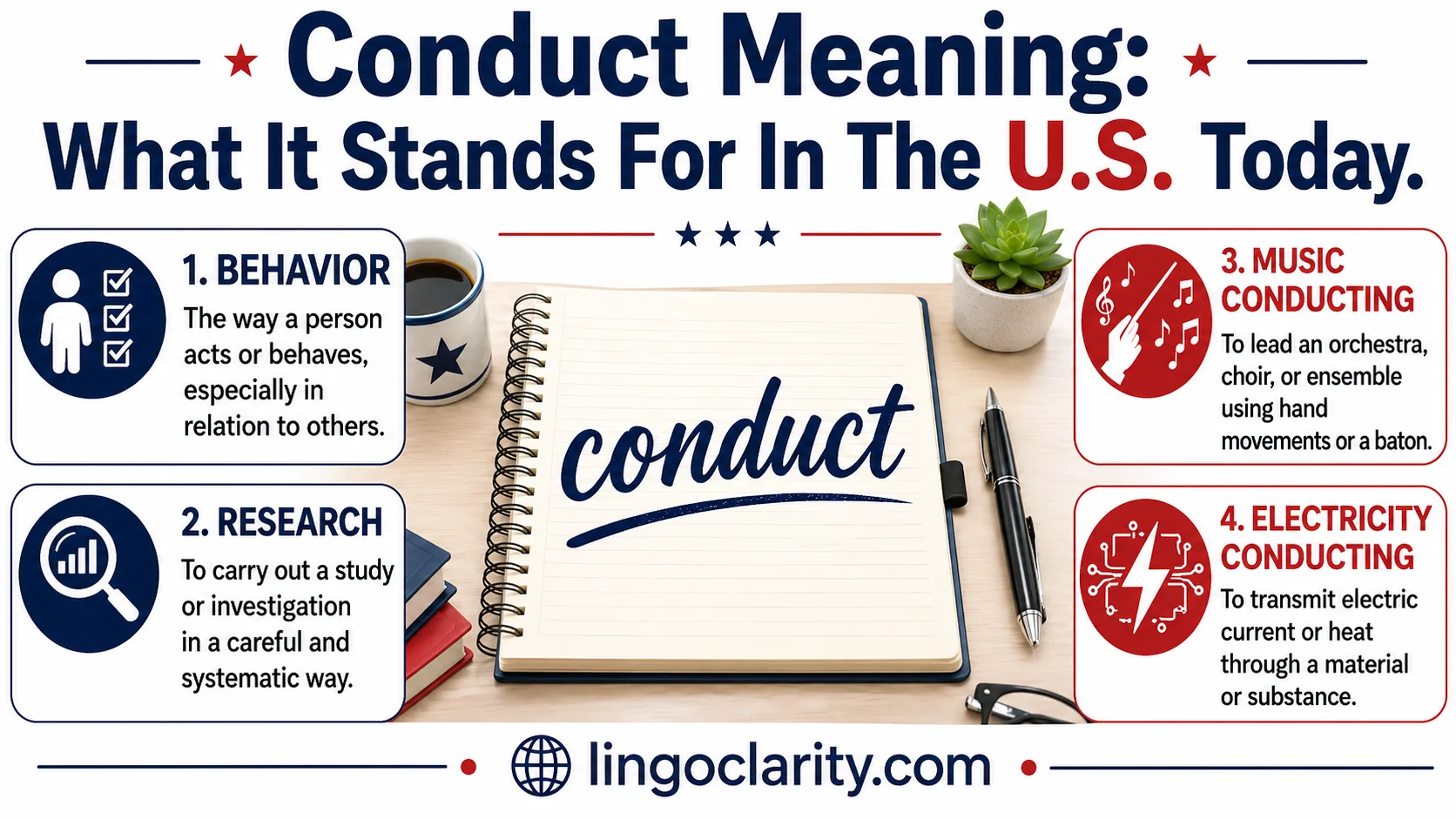
“Conduct” means behavior when it is used as a noun. However, when it is used as a verb, it means to organize, carry out, lead, direct, guide, or transmit something.
For example, “good conduct” means good behavior. Meanwhile, “conduct an interview” means to lead or carry out an interview.
The word is common in schools, workplaces, research, law, music, and science. Because it often sounds formal, “conduct” usually fits best in professional, academic, official, or serious contexts.
In short, the noun is about how someone behaves. By contrast, the verb is about doing, leading, directing, or carrying something through.
What Does Conduct Mean?
“Conduct” has two main meanings in English. First, as a noun, it refers to the way someone behaves. Second, as a verb, it refers to organizing, leading, carrying out, directing, guiding, or transmitting something.
For instance, a school may discuss student conduct when talking about behavior. Similarly, a workplace may describe professional conduct when explaining how employees should act.
The verb form works differently. A company can conduct a survey, a scientist can conduct research, and a manager can conduct a meeting. Therefore, the easiest way to understand “conduct” is to check its role in the sentence.
Conduct As A Noun
As a noun, “conduct” means a person’s behavior, especially in a formal, public, professional, or rule-based situation.
For example, a teacher may praise a student’s conduct after a field trip. In the same way, a manager may review an employee’s conduct after a workplace complaint.
Common examples include:
- Her conduct during the meeting was calm and respectful.
- The school praised the students for good conduct.
- The company expects ethical conduct from all employees.
In these examples, “conduct” means how someone acted. Therefore, it is close in meaning to “behavior,” “actions,” “manners,” or “demeanor.”
However, “conduct” usually sounds more formal than “behavior.” A parent might say, “Your behavior was rude,” while a school report might say, “The student’s conduct was inappropriate.”
Conduct As A Verb
As a verb, “conduct” means to organize, carry out, lead, manage, direct, guide, or transmit something.
For example, a company can conduct interviews. Likewise, researchers can conduct a study, and police can conduct an investigation.
Common examples include:
- The company will conduct interviews next week.
- Researchers conducted a study on sleep habits.
- Copper conducts electricity.
In these sentences, “conduct” does not mean behavior. Instead, it describes an action that is organized, directed, or carried through.
Because of this, “conduct” is common in professional and academic writing. For instance, “conduct research” sounds more polished than “do research,” and “conduct an investigation” sounds more official than “look into something.”
Although “conduct” can sound formal, it is not outdated. Rather, it is useful when the action involves planning, responsibility, leadership, or a clear process.
How To Pronounce Conduct
“Conduct” changes pronunciation depending on whether it is a noun or a verb.
As a noun, the stress is on the first syllable: CON-duct. For example, “His CON-duct was professional.”
As a verb, the stress is on the second syllable: con-DUCT. For example, “They will con-DUCT the interview tomorrow.”
This stress change is important because it helps listeners understand the meaning. Therefore, when “conduct” means behavior, stress the first syllable. However, when it means to carry out, lead, direct, or transmit something, stress the second syllable.
| Use | Pronunciation | Stress | Example |
|---|---|---|---|
| Noun | CON-duct | First syllable | Her conduct was respectful. |
| Verb | con-DUCT | Second syllable | They will conduct the study. |
Conduct In Everyday English
Although “conduct” is common, it is not always the most natural choice in casual conversation. In many everyday situations, simpler words like “do,” “run,” “lead,” or “behave” sound more natural.
For example, “We conducted a survey” sounds formal, while “We did a survey” sounds casual. Similarly, “She conducted the meeting” sounds more polished than “She ran the meeting.”
Therefore, use “conduct” when the situation is formal, organized, professional, or official. By contrast, use simpler words when the situation is casual or personal.
Common Uses Of Conduct
| Context | Common Phrase | Meaning |
|---|---|---|
| School | student conduct | student behavior |
| Workplace | professional conduct | workplace behavior |
| Law | disorderly conduct | disruptive public behavior |
| Research | conduct a study | carry out a study |
| Music | conduct an orchestra | direct musicians |
| Science | conduct electricity | allow electricity to pass through |
These phrases show the range of the word. In addition, they help you choose the right meaning based on context.
Conduct Yourself
The phrase “conduct yourself” means to behave in a particular way. It is often used in formal or serious situations.
For example:
- Please conduct yourself professionally during the interview.
- She conducted herself with confidence.
- The players conducted themselves respectfully after the game.
- He knows how to conduct himself in public.
In this phrase, “conduct” usually needs a reflexive pronoun, such as myself, yourself, himself, herself, ourselves, or themselves.
For example, say “She conducted herself well,” not “She conducted well.” As a result, the sentence sounds complete and grammatically correct.
Conduct In School, Work, Research, Music, And Science
In schools and workplaces, “conduct” often refers to behavior, rule-following, and professional standards. For instance, a student may receive a conduct report, while an employee handbook may describe acceptable conduct or workplace misconduct.
In research and business, “conduct” means to carry out an organized activity. For example, a team can conduct market research, a university can conduct a study, and a committee can conduct a review.
In music, “conduct” means to direct musicians during a performance. Therefore, a conductor leads the timing, rhythm, expression, and coordination of an orchestra, choir, or ensemble.
In science, “conduct” can mean to allow electricity, heat, sound, or another form of energy to pass through. For example, copper conducts electricity, and a wire can conduct a signal through a device.
Important Phrases With Conduct
A code of conduct is a set of rules for expected behavior in a school, workplace, event, or profession. Therefore, it often explains standards for respect, honesty, safety, privacy, and communication.
Disorderly conduct is a legal phrase for disruptive or unsafe public behavior. However, the exact meaning can vary by location, so it should be understood according to local law.
Professional conduct means behavior that meets workplace or industry standards. As a result, this phrase often appears in employee handbooks, licensing rules, policies, and performance reviews.
Synonyms For Conduct
The best synonym for “conduct” depends on the meaning and context.
When “conduct” means behavior, strong alternatives include:
- behavior
- actions
- manners
- demeanor
- comportment
When “conduct” means to organize or carry out something, useful alternatives include:
- carry out
- run
- lead
- manage
- direct
- perform
- organize
- oversee
In science contexts, especially when talking about energy or signals, better alternatives include:
- transmit
- carry
- channel
For example, “conduct a survey” can mean “carry out a survey.” Meanwhile, “professional conduct” can mean “professional behavior.”
However, not every synonym works in every sentence. You can say “conduct electricity,” but you would not usually say “manage electricity” with the same meaning.
Antonyms For Conduct
There is no single antonym that works for every meaning of “conduct.” Instead, the opposite depends on the sentence.
For the noun meaning, the most useful opposite idea is misconduct. Misconduct means improper, unacceptable, or unethical behavior.
For the verb meaning, the opposite may be cancel, stop, neglect, avoid, or fail to carry out.
For example:
- conduct a meeting → cancel a meeting
- conduct research → abandon research
- conduct an investigation → ignore a complaint
- conduct electricity → resist or block electricity
Therefore, choose the antonym based on the exact meaning in the sentence.
Conduct Vs. Misconduct
“Conduct” is neutral. It can describe good, bad, professional, careless, respectful, or inappropriate behavior.
By contrast, “misconduct” is negative. It means bad or improper behavior.
For example, speaking sharply in a meeting may be poor conduct. However, harassment, cheating, fraud, or serious rule-breaking may be called misconduct.
As a result, “poor conduct” and “misconduct” are related, but they are not always identical. “Misconduct” usually suggests a more serious violation of rules, ethics, or expectations.
Conduct Vs. Behavior
“Conduct” and “behavior” can often mean the same thing. However, they differ in tone.
“Behavior” is more common in everyday speech. By comparison, “conduct” is more formal and often appears in schools, workplaces, legal writing, policies, and official reports.
For example, “His behavior was rude” sounds everyday. Meanwhile, “His conduct was inappropriate” sounds more formal.
Therefore, choose “behavior” for ordinary conversation and “conduct” for more formal writing.
Conduct Vs. Do, Run, Lead, And Manage
When “conduct” is a verb, it can sometimes be replaced by “do,” “run,” “lead,” or “manage.” However, each word has a slightly different tone.
Choose conduct for organized or formal activities: conduct research, conduct an interview, conduct an investigation, conduct a survey, or conduct an experiment.
Use do for casual or general tasks: do homework, do research, or do a test.
Run fits practical leadership: run a meeting, run a workshop, or run a company.
Lead works when people are being guided: lead a team, lead a conversation, or lead a project.
Manage fits responsibility and control: manage an event, manage a department, or manage a system.
For example, “conduct a formal review” sounds natural. However, “conduct dinner” does not. Instead, say “have dinner” or “eat dinner.”
Common Mistakes With Conduct
Using The Wrong Pronunciation
Incorrect: His con-DUCT was respectful.
Correct: His CON-duct was respectful.
Incorrect: They will CON-duct the interview.
Correct: They will con-DUCT the interview.
Because the pronunciation changes by part of speech, always check whether “conduct” is being used as a noun or a verb.
Using Conduct For Casual Activities
Awkward: I conducted my breakfast at 8 a.m.
Natural: I ate breakfast at 8 a.m.
Awkward: She conducted a walk in the park.
Natural: She took a walk in the park.
Although “conduct” is useful, it should not replace every action verb. Instead, use it when the action is organized, formal, or professional.
Forgetting The Reflexive Pronoun
Incorrect: He conducted professionally during the event.
Correct: He conducted himself professionally during the event.
Incorrect: They conducted respectfully in court.
Correct: They conducted themselves respectfully in court.
When “conduct” means “behave,” it often needs a reflexive pronoun.
Example Sentences With Conduct
Conduct Meaning Behavior
- During the emergency, her conduct was calm and responsible.
- By the end of the semester, the student’s conduct had improved.
- Good conduct is expected during the ceremony.
Conduct Meaning Carry Out
- The team conducted a detailed review of the policy.
- Over six months, researchers conducted a long-term study.
- To understand customer needs, the company conducted a survey.
Conduct Meaning Behave
- She conducted herself with confidence.
- During the hearing, he conducted himself with dignity.
- At formal events, please conduct yourself appropriately.
Conduct Meaning Direct Or Transmit
- The musician conducted the orchestra.
- Copper conducts electricity.
- Inside the device, the wire conducts the signal.
Word Forms Related To Conduct
Related words include misconduct for improper behavior, conductor for a person or material that conducts, conductive for something able to conduct energy, conductivity for the ability to conduct, and conduction for the process of conducting heat, electricity, or sound.
Frequently Asked Questions
What does conduct mean?
“Conduct” means behavior when it is a noun. However, when it is a verb, it means to carry out, organize, lead, direct, guide, or transmit something.
How do you pronounce conduct?
As a noun, pronounce it CON-duct, with stress on the first syllable. As a verb, pronounce it con-DUCT, with stress on the second syllable.
Is conduct a noun or a verb?
“Conduct” can be both a noun and a verb. For example, it is a noun in “good conduct” and a verb in “conduct an interview.”
What does conduct yourself mean?
“Conduct yourself” means to behave in a certain way. For example, “She conducted herself professionally” means she behaved professionally.
What is a code of conduct?
A code of conduct is a set of rules for expected behavior. For instance, a workplace code of conduct may explain how employees should treat clients, coworkers, and company property.
Can conduct mean electricity?
Yes. In science, “conduct” can mean to allow electricity, heat, sound, or another form of energy to pass through. For example, copper conducts electricity.
Conclusion
“Conduct” is useful because it has several important meanings. As a noun, it usually means behavior. As a verb, it can mean to carry out, organize, lead, direct, guide, or transmit something.
However, the key is context. In “good conduct,” the word means behavior. In “conduct a study,” it means carry out a study. When someone says “conduct an orchestra,” it means direct musicians. Finally, in “conduct electricity,” it means allow electricity to pass through.
The easiest way to remember the word is through pronunciation. CON-duct is usually the noun, while con-DUCT is usually the verb. Therefore, once you know the stress pattern and the context, the meaning becomes much easier to understand.
