
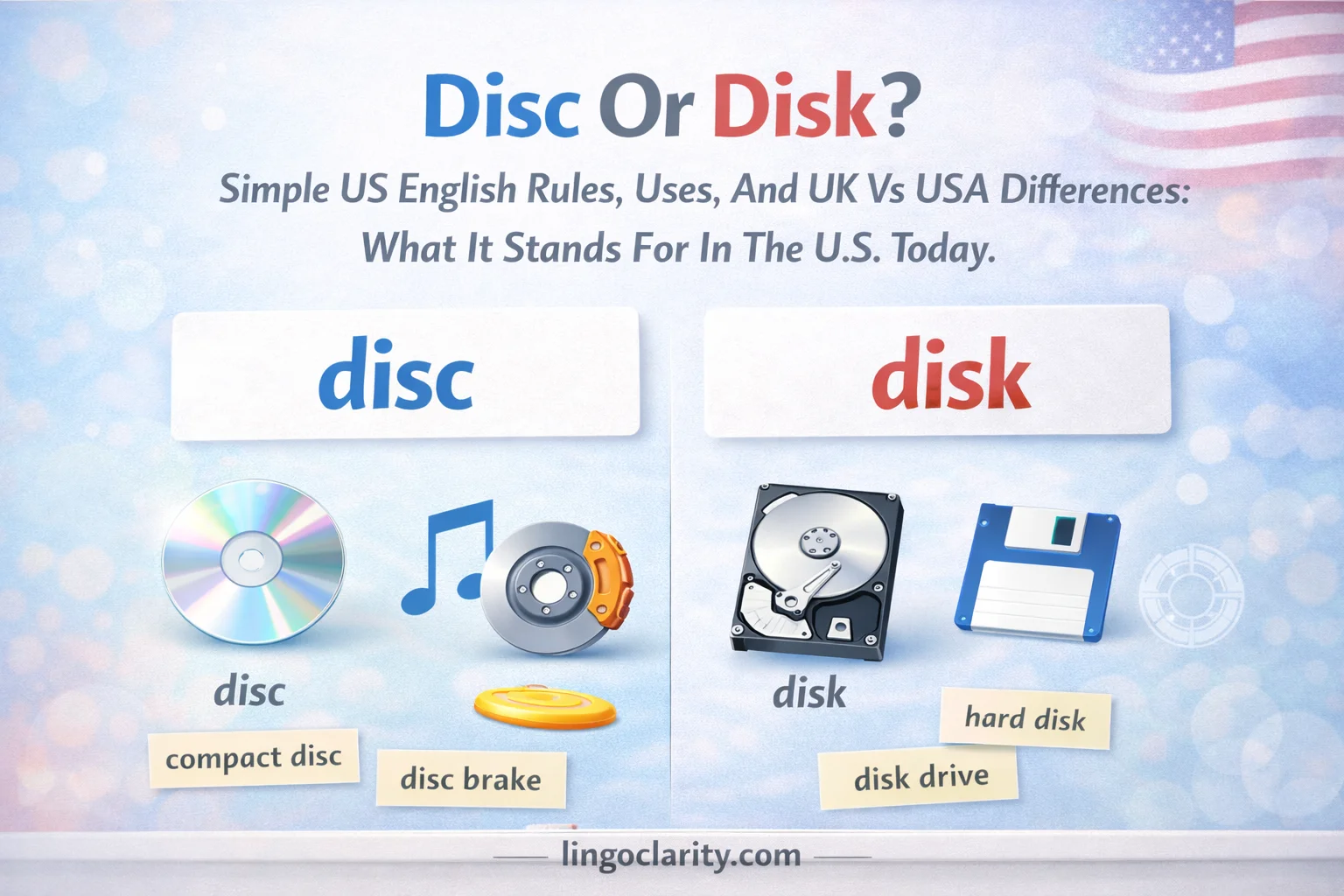
Many writers stop at disc and disk because both spellings are real, both are pronounced the same way, and both can appear in correct English. That is exactly why this pair causes so much hesitation. The question is not whether one form exists and the other does not. The real question is which form looks natural in a specific context. Oxford notes that disc is the usual spelling in British English and disk is the usual spelling in North American English, while Cambridge also marks disc as mainly UK and disk as the usual US form in the basic “round flat object” sense.
For a US audience, the safest starting point is simple: disk is the general American default, especially in computing. But that does not mean disc is wrong in American English. In fact, several common set phrases still strongly prefer disc, including compact disc, disc brake, disc jockey, and disc golf. That is why a good editor should not force one spelling into every sentence. The best choice depends on the phrase, the field, and the convention readers expect.
Quick Answer
If you are writing for a general US audience, use disk as your default spelling. That is the normal American form for general references and the standard form in computer language, as seen in Microsoft’s Disk Management, hard disk drive, and disk space terminology.
Use disc when the phrase is already established that way, especially in music, optical media, sports, and brake terms. In medicine, do not guess. Some US sources use intervertebral disc or slipped disc, while others use herniated disk, so the safest move is to follow the exact term used by the source, clinic, publisher, or workplace.
Simple Definition
At the most basic level, disc and disk are two spellings of the same word. Merriam-Webster treats them as variants, and Cambridge’s American dictionary entry for disc directly glosses it as a disk. In plain English, both spellings point to the same core idea: something round and flat.
They are also pronounced the same way: disk. So this is not a pronunciation problem, and it is not a grammar problem either. It is mainly a matter of spelling convention, field-specific usage, and reader expectation.
Are Disc And Disk Different Words?
No. In modern English, they are best understood as spelling variants rather than two separate everyday words with two separate meanings. Merriam-Webster’s usage note explains that English speakers historically used both forms for round, flat shapes, and that later usage patterns helped create the split we recognize now.
That said, the fact that they are variants does not mean they are always interchangeable in polished writing. A reader may understand compact disk, but it still looks unusual because the standard name is compact disc. In the same way, a US tech reader will understand hard disc, but it looks off because computing settled heavily on disk. So the spellings share meaning, but they do not always share the same natural fit.
US Vs. UK Preference
The broad rule is straightforward. In British English, the usual general spelling is disc. In North American English, the usual general spelling is disk. Oxford states this directly and also adds one important exception: for computer-related senses, the spelling is usually disk even in British English.
That exception matters because many people simplify the issue too much. They say, “disc is British, disk is American,” and stop there. That summary is partly true, but it misses the real usage pattern. British English may prefer disc in general, yet still use disk in computing. American English may prefer disk in general, yet still keep disc in many fixed names and phrases. A careful article needs to show both sides of that reality.
When To Use Disk In US English
In US English, disk is the safer choice when you are writing generally about storage, computing, or technical device language. Microsoft uses Disk Management, hard disk drive, and disk space across its official Windows documentation and support pages. That makes disk the clear standard for American computer writing.
Use disk in sentences like these:
• My computer is running low on disk space.
• The old machine still uses a hard disk drive.
• Open Disk Management and check the partitions.
Outside computing, disk is also the regular American spelling for many plain references to a round, flat object. If you are not dealing with a fixed phrase that clearly prefers disc, disk is usually the safer US fallback.
When To Use Disc
Use disc when you are working with a phrase that English has already settled in that form. The clearest examples are in music, optical media, braking systems, and certain sports terms. Merriam-Webster lists compact disc, disc brake, disc jockey, and disc golf in that spelling, even while acknowledging that some variant forms exist.
This is why the following phrases look natural:
• compact disc
• disc brake
• disc jockey
• disc golf
Cambridge also links disc with musical records, CDs, and DVDs, which supports the strong connection between disc and optical or recorded media. So even in American English, disc remains normal in those established settings.
Medical Terms Need Extra Care
Medical usage is the messiest part of this topic. Some standard references lean toward disc for anatomical structures. Merriam-Webster’s disk entry says anatomical structures are usually disc, especially intervertebral disc, and Cambridge lists disc for the cartilage between the bones in your back, while noting disk as a US alternative.
At the same time, major US health sources often use disk in patient-facing material. MedlinePlus uses herniated disk, while the UK’s NHS uses slipped disc and herniated disc. So medical English is not cleanly split into one universal rule. In this field, the best editorial choice is to follow the exact term used by the trusted source you are citing or the house style you are following.
That means all three of these can be correct in the right context:
• intervertebral disc in anatomy-focused language
• herniated disk in many US health references
• slipped disc in UK health writing
Real-Life Example
Imagine you are editing a US article about a cyclist who fell, damaged a bike rotor, bought music on an old CD, and then backed up photos from a laptop. A strong editor would not force one spelling across the whole article. You would write that the bike has a disc brake, the album came on a compact disc, and the laptop’s hard disk is almost full. That mix is not inconsistency. It is accurate usage.
This is the practical lesson most writers need. Good style here does not come from memorizing one “correct” spelling and applying it everywhere. It comes from recognizing the default American choice and respecting standard fixed phrases when they pull the spelling the other way.
Synonyms
There is no single perfect synonym that works in every case because disc and disk are used across several different subjects. In general writing, possible substitutes include round flat object, circular plate, or round piece. In music or media contexts, a substitute may be CD, record, or optical medium, depending on what you mean. In computing, the better replacement is often not a synonym for the word itself, but the exact device name, such as hard drive, storage drive, or HDD.
So if you are trying to improve clarity, do not ask, “What is the universal synonym for disc or disk?” Ask, “What object am I actually talking about?” The right substitute depends on whether the subject is music, a brake part, a spinal structure, astronomy, or computer storage.
Opposites
Strictly speaking, disc and disk do not have true opposites because they are naming forms, not opposite ideas. They are spelling variants, not antonyms. So it would be misleading to pretend that one has a neat opposite in the way that hot has cold.
If you need contrast words in a classroom exercise, use descriptive opposites tied to shape or form, such as square object, sphere, or irregular shape. But those are opposites of the underlying shape idea, not real opposites of the spellings disc and disk.
Sentence Usage
Here are clean, natural examples for US readers:
• I had to free up disk space before the update would install.
• The museum gift shop still sells the soundtrack on compact disc.
• The mechanic said the front disc brakes needed attention.
• She started as a radio disc jockey in college.
• We spent the afternoon playing disc golf in the park.
• The scan showed a herniated disk in his lower back.
These examples show the real rule in action. The choice changes with the phrase, not with your mood. Once you know the common patterns, the decision gets much easier.
Common Mistakes
One common mistake is thinking this is a grammar issue. It is not. The problem is spelling convention and usage tradition, not sentence structure.
Another common mistake is assuming disc is always British and disk is always American. That is too simple. British English still uses disk in computer contexts, and American English still uses disc in fixed phrases such as compact disc and disc brake.
A third mistake is forcing one spelling through an entire article for the sake of consistency. That can make standard terms look strange. A better rule is this: keep your overall style consistent, but do not rewrite established names into forms that look unnatural to readers.
A fourth mistake is guessing in medical writing. Because trusted sources really do vary between disc and disk in that field, the safest editorial move is to use the exact spelling attached to the recognized medical term you are referencing.
A Simple Rule You Can Actually Use
Here is the easiest working rule for American English:
Use disk as your default. Then switch to disc only when the phrase clearly prefers it.
That one rule will solve most cases. It fits computer language, ordinary US usage, and the major exceptions readers already expect. It also keeps you from making awkward changes like compact disk or hard disc, which many readers would notice immediately.
Conclusion
So, which spelling is correct: disc or disk? In US English, both are correct, but they are not equally natural in every context. Disk is the general American default and the standard spelling in computing. Disc stays strong in several fixed phrases, especially in music, optical media, sports, and brakes. Medical writing can use either form depending on the exact term and source.
The best editor’s answer is not “pick one and use it forever.” The better answer is: use the spelling that fits the phrase. And when you are writing for a US audience and no fixed phrase is involved, disk is usually your safest choice.
FAQs
Is disc or disk more common in American English?
In general American English, disk is more common as the everyday default, and it is the standard spelling in computer language. But American English still keeps disc in several established phrases, including compact disc and disc brake.
Is compact disc correct in US English?
Yes. Compact disc is the standard form recognized in major dictionaries, and it remains the normal spelling in that fixed name.
Why does computer writing usually use disk?
Computer language settled strongly on disk, and official Microsoft documentation consistently uses forms such as Disk Management, hard disk drive, and disk space. That is why disk looks natural in tech writing even outside the United States.
Is disc used in British English more often than in American English?
Yes. Oxford says disc is the usual spelling in British English, while disk is the usual spelling in North American English. However, British English still normally uses disk for computer-related senses.
Which spelling is better in medical writing?
Neither spelling wins in every medical case. Some references prefer terms like intervertebral disc or slipped disc, while major US health sources also use herniated disk. Follow the exact medical term used by your source, organization, or style guide.
Can I use one spelling throughout my whole article for consistency?
Not always. That approach can make fixed expressions look unnatural. A better editing choice is to keep your overall style steady while preserving established phrases such as compact disc, disc brake, and hard disk in their usual forms.
