
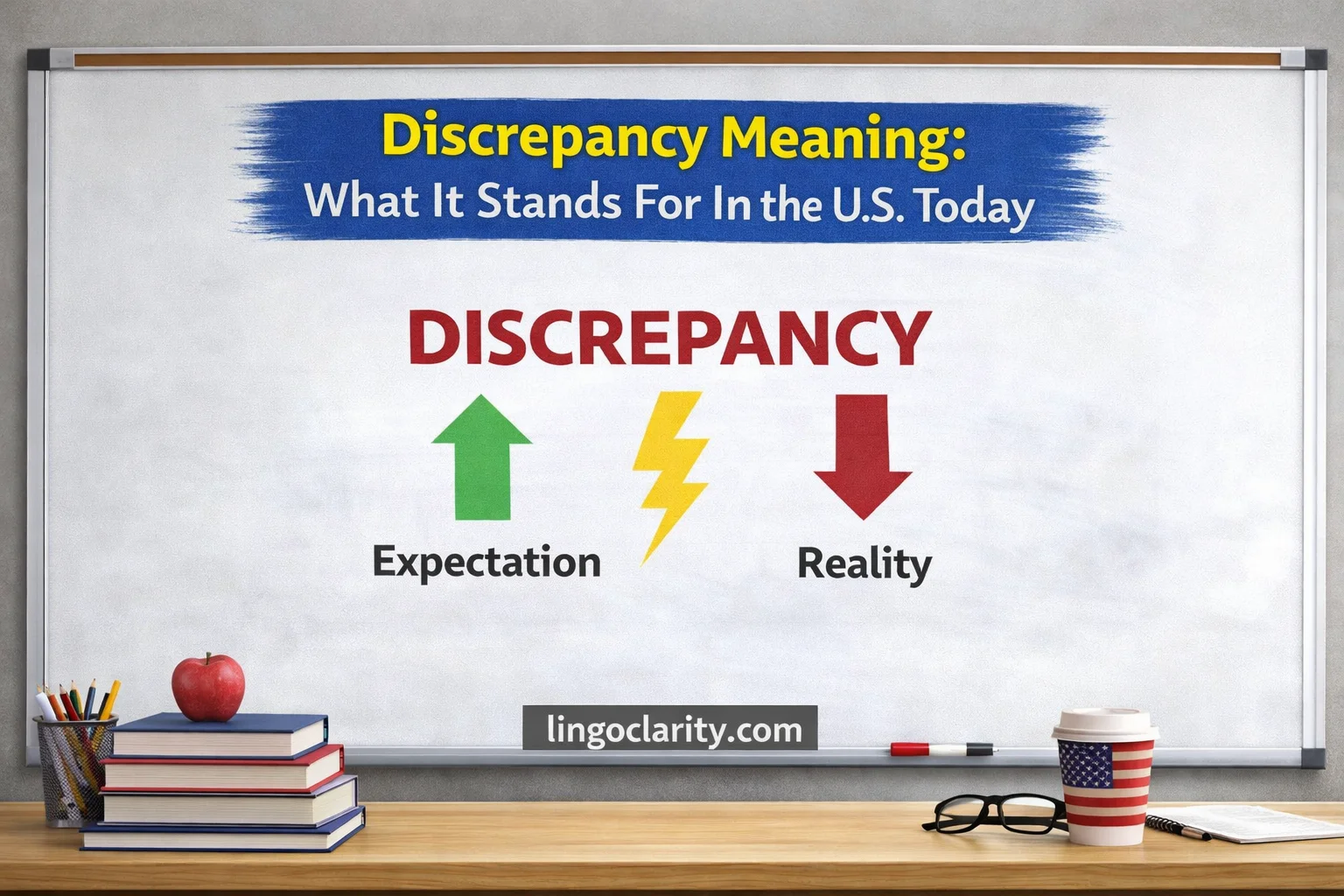
You may see the word discrepancy in bank alerts, office emails, school records, audit reports, legal documents, medical notes, and research papers. It usually describes a situation in which two details do not agree or match as expected. That is why the word often appears in writing about numbers, facts, totals, statements, dates, and records.
Many learners understand its basic meaning but still hesitate to use it. This happens because discrepancy sounds more formal than everyday words such as difference or mismatch. It is also sometimes confused with disparity, although the two words have different uses.
This guide explains the discrepancy meaning in plain English. You will learn its definition, pronunciation, part of speech, different meanings, word forms, sentence patterns, synonyms, opposites, and common mistakes. You will also see how the word is used in professional situations and everyday communication.
Quick Answer
Discrepancy means a difference, inconsistency, or lack of agreement between facts, figures, statements, or results. It often occurs when two things are expected to match, but it can also describe a noticeable variation that needs examination or explanation.
What Discrepancy Means in Plain English
In plain English, discrepancy means that two or more details do not agree when they are expected to agree. One document may show one amount while another document shows something different. A report may contain information that does not match the original records. One person’s statement may also conflict with another person’s account of the same event.
For example, imagine that your receipt shows a payment of $80, but your bank statement lists $95. The difference between these two records is a discrepancy that may need to be checked.
The word often suggests more than an ordinary difference. It can indicate that something is unclear, inconsistent, incomplete, or in need of explanation. However, a discrepancy does not automatically prove that someone has made a mistake. Sometimes small differences occur because of rounding, measurement methods, or normal variations.
Simple Definition
A simple definition is:
Discrepancy means a difference or inconsistency between things that are expected to agree or match.
This definition is useful for understanding the word in most everyday and professional situations.
For example:
- There is a discrepancy between the two reports.
- The manager noticed a discrepancy in the payment records.
- Researchers found a discrepancy in the test results.
In each example, the word describes information that does not fully agree.
Different Meanings of Discrepancy
The word discrepancy can describe several kinds of differences. Its exact meaning depends on the situation in which it appears.
| Meaning | Explanation | Example |
|---|---|---|
| Lack of agreement | When facts, statements, or records do not agree | There was a discrepancy between the two witness statements. |
| Difference from an expected result | When an actual result does not match an expected one | Researchers noticed a discrepancy in the test results. |
| Noticeable variation | When two things show a slight or considerable difference | There was a wide discrepancy between the two estimates. |
| Inconsistency | When information does not remain consistent across different sources | The investigation revealed a discrepancy in the employee’s records. |
In most contexts, discrepancy refers to an inconsistency that deserves attention. It is particularly useful when accuracy and agreement matter.
Pronunciation, Part of Speech, and Forms
The usual pronunciation of discrepancy is shown below.
Pronunciation
discrepancy
dih-SKREP-uhn-see
Discrepancy is a noun. It can be countable or uncountable depending on the sentence.
Its plural form is discrepancies.
Here is how the forms work:
Singular:
– There is a discrepancy in the report.
Plural:
– The auditor found several discrepancies.
Uncountable use:
– There is some discrepancy in the information provided.
These examples show that discrepancy can refer to one specific inconsistency, several inconsistencies, or a general lack of agreement.
Discrepancy Word Family
Discrepancy has a related adjective form that can help expand your vocabulary.
| Word | Part of Speech | Meaning | Example |
|---|---|---|---|
| Discrepancy | Noun | A difference or inconsistency | We found a discrepancy in the records. |
| Discrepant | Adjective | Inconsistent or not agreeing | The two reports contained discrepant figures. |
The noun discrepancy is much more common in everyday professional writing. The adjective discrepant is less common but can appear in formal, technical, and academic contexts.
Why Discrepancy Sounds Formal
Discrepancy is not slang or casual chat language. It is a standard English word that appears frequently in reports, research papers, legal documents, accounting, administrative records, and professional emails.
In casual conversation, people often choose simpler words such as difference, mix-up, or mismatch. In formal communication, discrepancy can sound more precise.
For example:
- Formal: There is a discrepancy in the employee records.
- Casual: The employee records do not match.
Both sentences communicate a similar idea. The first sounds more professional and is especially suitable when discussing records that need investigation.
How to Use Discrepancy Correctly
Use discrepancy when you want to describe a difference or inconsistency that matters because two details are expected to agree.
The most common sentence patterns include:
- A discrepancy between two things
- A discrepancy in a report, record, figure, or result
- Explain a discrepancy
- Resolve a discrepancy
- Notice a discrepancy
- Report a discrepancy
- Identify a discrepancy
- Find a discrepancy
Here are some clear sentence examples:
- There was a discrepancy between the invoice and the payment.
- The team found a discrepancy in the survey totals.
- We need to explain the discrepancy before the meeting.
- A small discrepancy in the data delayed the report.
- The company resolved the discrepancy in its records.
These patterns are useful in situations involving facts, records, amounts, and results that should agree.
Discrepancy of Something
The expression discrepancy of can describe the amount or size of a difference.
Examples:
- There was a discrepancy of $25 between the two payment records.
- The measurements showed a discrepancy of two centimeters.
- The report identified a discrepancy of approximately 5% in the final figures.
Use of to identify the amount of the difference, while between identifies the two things being compared.
For example, in the sentence “There was a discrepancy of $25 between the two invoices,” the amount is $25, and the two invoices are the items being compared.
Real-Life Example
Imagine that you order ten books for your office. The invoice says that ten books were purchased, but the delivery box contains only eight.
When you compare the invoice with the actual delivery, you discover a discrepancy. The two records do not agree, and the difference needs an explanation.
Consider another situation involving a student. The online grade portal shows a score of 91, but the printed report card shows 87. This is also a discrepancy because both records are supposed to display the same result.
In a workplace setting, a payroll sheet may show that an employee worked 40 hours, while the time-tracking system records only 37 hours. This difference is another example of a discrepancy.
Common Contexts Where You See Discrepancy
The word discrepancy appears in several areas where accuracy and consistency are important.
Money and Accounting
This is one of the most common contexts for discrepancy. It may appear in invoices, bank statements, balance sheets, payment records, tax documents, inventory counts, and payroll reports.
For example:
- The accountant found a discrepancy in the monthly balance.
- There was a discrepancy between the invoice and the bank statement.
Data and Research
Researchers use discrepancy when actual findings do not agree with expected results or other measurements.
For example:
- The study revealed a discrepancy between the two data sets.
- Researchers investigated a discrepancy in the experimental results.
Statements and Reports
In legal writing, journalism, and investigations, discrepancy can describe differences between witness statements, official records, or reports.
For example:
- The investigation revealed a discrepancy between the two accounts.
- The journalist noticed a discrepancy in the published figures.
School and Office Work
Teachers, managers, and administrative staff may use discrepancy when dates, names, deadlines, grades, or other records do not agree.
For example:
- The school identified a discrepancy in the student’s attendance record.
- The manager noticed a discrepancy in the weekly schedule.
Acceptable Discrepancy
Not every discrepancy is serious or unacceptable. In some situations, small differences are expected because of measurement limits, rounding, calculation methods, or permitted variations.
An acceptable discrepancy is a difference that falls within an approved or reasonable limit.
For example:
- A small discrepancy between two measuring instruments may fall within the accepted tolerance.
- A minor rounding discrepancy may appear in financial calculations.
- Manufacturing standards may allow a slight discrepancy in product dimensions.
The important point is to determine whether the difference falls within acceptable limits or requires further investigation.
In technical and professional settings, the acceptable amount of variation often depends on established standards, policies, or measurement tolerances.
Slight and Wide Discrepancy
A discrepancy can be small or considerable. Words such as slight, minor, wide, and significant help explain its size or importance.
| Expression | Meaning | Example |
|---|---|---|
| Slight discrepancy | A very small difference | There is a slight discrepancy between the two measurements. |
| Minor discrepancy | A difference with little importance | The auditor found a minor discrepancy in the figures. |
| Wide discrepancy | A considerable difference | There is a wide discrepancy between the estimated and actual costs. |
| Significant discrepancy | A difference important enough to require attention | The report revealed a significant discrepancy in the results. |
The size of a discrepancy depends on the context. Even a small difference can matter when financial records, scientific measurements, or official documents must be accurate.
Discrepancy vs. Difference vs. Disparity
These three words are related, but they are not interchangeable. Each one describes a different kind of situation.
| Word | Best Use | Main Idea |
|---|---|---|
| Discrepancy | When information or details do not agree as expected | Inconsistency or mismatch |
| Difference | When describing any kind of contrast | General variation |
| Disparity | When describing inequality or an uneven gap | Unequal levels or conditions |
A difference is the broadest word. It can describe almost any contrast. Two colors can be different, two opinions can be different, and two people can have different interests.
A discrepancy is more specific. It usually describes an inconsistency between facts, figures, statements, or records that are expected to agree.
A disparity generally describes inequality or an uneven gap between measurable things or conditions, such as wages, opportunities, income, or treatment.
For example:
- Difference: There is a difference between tea and coffee.
- Discrepancy: There is a discrepancy between the two payment records.
- Disparity: There is a disparity in income levels across the region.
Remember this simple distinction: difference describes a general contrast, discrepancy describes an inconsistency, and disparity describes inequality.
Synonyms of Discrepancy
Several English words have meanings similar to discrepancy. However, the best synonym depends on the context.
Common synonyms include:
- Mismatch
- Inconsistency
- Difference
- Variance
- Disagreement
- Divergence
- Deviation
- Disparity
Here is how these words differ in practical use.
| Synonym | Best Used For | Example |
|---|---|---|
| Mismatch | Things that should match but do not | There was a mismatch between the invoice and receipt. |
| Inconsistency | Conflicting facts or information | The report contained an inconsistency. |
| Difference | A general contrast | There is a difference between the two methods. |
| Variance | Numerical or statistical differences | The figures showed a variance of 3%. |
| Disagreement | Conflicting opinions or statements | There was a disagreement between the witnesses. |
| Divergence | Things moving or developing in different directions | The study showed a divergence in the results. |
| Deviation | A departure from a standard or expected value | The measurement showed a deviation from the target. |
| Disparity | Inequality between levels or conditions | The report highlighted a disparity in wages. |
Which synonym should you choose?
- Use mismatch for a simple difference between things that should match.
- Use inconsistency when facts or statements conflict.
- Use variance for numerical or statistical differences.
- Use deviation when something moves away from a standard.
- Use disparity when describing inequality.
- Use difference when you want a broad, everyday word.
For example, both discrepancy and mismatch can describe different amounts on an invoice and payment record. However, discrepancy sounds more formal.
Opposites of Discrepancy
There is no single perfect opposite of discrepancy in every situation. However, several words express the opposite idea of agreement or consistency.
Common opposites include:
- Agreement
- Consistency
- Correspondence
- Accord
- Match
- Harmony
For example:
- Discrepancy: There is a discrepancy between the two reports.
- Opposite: There is strong agreement between the two reports.
Another example:
- Discrepancy: We found a discrepancy in the totals.
- Opposite: The totals are consistent.
These words work as opposites because they express the idea of information or details matching correctly.
Sentence Usage You Can Copy
Here are additional natural sentences showing how discrepancy works in everyday and professional English.
- There is a discrepancy between the two totals.
- We found a discrepancy in the customer file.
- The report shows a discrepancy in last month’s figures.
- Please review the record and explain the discrepancy.
- A discrepancy between the two versions delayed approval.
- The laboratory is checking a discrepancy in the results.
- Even a small discrepancy can create confusion later.
- The audit uncovered several discrepancies in the accounts.
- The manager asked the team to investigate the discrepancy.
- There was a noticeable discrepancy between the expected and actual results.
These examples are suitable for essays, reports, emails, academic writing, and professional communication.
Common Mistakes and Easy Fixes
Understanding common mistakes can help you use discrepancy more accurately in speaking and writing.
Using It for Every Kind of Difference
Do not use discrepancy for every type of difference. The word is most appropriate when two details are expected to agree or match.
| Incorrect or Less Suitable | Better Sentence | Reason |
|---|---|---|
| There is a discrepancy between tea and coffee. | There is a difference between tea and coffee. | Tea and coffee are naturally different. |
| There is a discrepancy between two different colors. | There is a difference between the two colors. | No agreement is expected. |
Mixing It Up With Disparity
Discrepancy and disparity have related meanings, but they describe different situations.
| Less Suitable | Better | Explanation |
|---|---|---|
| There is a discrepancy in income levels across the region. | There is a disparity in income levels across the region. | Disparity is more suitable for inequality in income. |
| There is a disparity between the invoice and payment amount. | There is a discrepancy between the invoice and payment amount. | Discrepancy describes inconsistent records. |
Using the Wrong Sentence Pattern
The most common patterns are:
- A discrepancy between A and B
- A discrepancy in something
- A discrepancy of a particular amount
Examples:
- There is a discrepancy between the two reports.
- The auditor found a discrepancy in the records.
- There was a discrepancy of $15 in the final payment.
Choosing the correct preposition makes your sentence clearer and more natural.
Making Your Tone Too Formal
Discrepancy is useful in professional writing, but it may sound unnecessarily formal in casual conversation.
| Formal | Casual |
|---|---|
| There is a discrepancy in the list. | The list does not match. |
| We noticed a discrepancy in the figures. | We noticed that the numbers are different. |
Choose the expression that fits your audience and situation.
Being Too Vague
Avoid using discrepancy without explaining what does not match when the reader needs specific information.
- Weak: There is a discrepancy.
- Better: There is a discrepancy between the website total and the printed invoice.
The second sentence identifies the two sources and makes the problem easier to understand.
Etymology and Word History
Discrepancy comes from the Latin word discrepantia, which is connected to discrepare, meaning to disagree or sound differently.
The historical meaning reflects the modern use of the word because discrepancy still describes a lack of agreement or consistency.
The word entered English through Latin and has developed into a common term in formal writing, accounting, research, and professional communication.
You do not need to memorize its origin to use discrepancy correctly. Understanding its connection with disagreement can, however, make the meaning easier to remember.
Discrepancy – 10 Multiple-Choice Questions
Test your understanding of discrepancy. Choose the best answer for each question and check your score.
1. What does the word “discrepancy” mean?
2. Which sentence uses “discrepancy” correctly?
3. Which word is closest in meaning to “discrepancy”?
4. Which word is generally more suitable for a difference in income levels between groups?
5. Which expression correctly describes a difference in an amount?
6. Does every discrepancy mean that someone has made a mistake?
7. What is the part of speech of “discrepancy”?
8. Which phrase is grammatically correct?
9. Which situation is an example of a discrepancy?
10. What is the correct adjective form related to “discrepancy”?
Select one answer for each question before checking your final score.
FAQs About Discrepancy
1. What does discrepancy mean in simple English?
In simple English, discrepancy means a difference or mismatch between things that are expected to agree. It usually describes information, numbers, statements, or records that do not match.
2. Is discrepancy a formal word?
Yes. Discrepancy is a formal English noun commonly used in reports, research, office communication, accounting, legal writing, and technical documents. In casual conversation, people often use simpler words such as difference or mismatch.
3. How do you use discrepancy in a sentence?
The most common sentence patterns are discrepancy between and discrepancy in. For example, “There was a discrepancy between the two reports” and “We found a discrepancy in the figures.”
4. What is the difference between discrepancy and disparity?
Discrepancy describes an inconsistency between details that are expected to agree. Disparity generally describes inequality or an uneven gap between things such as wages, opportunities, or living conditions.
5. Is discrepancy countable or uncountable?
Discrepancy can be both countable and uncountable, depending on the sentence. You can say “a discrepancy,” “several discrepancies,” or “some discrepancy.”
6. What does discrepancy mean in accounting?
In accounting, discrepancy refers to a difference between financial figures or records that are expected to match. For example, an invoice may show a different amount from the payment received.
7. Does discrepancy always mean something is wrong?
No. A discrepancy does not always indicate an error or wrongdoing. It may result from rounding, measurement methods, reporting differences, or normal variations. However, it may need investigation when accuracy is important.
8. What is the plural form of discrepancy?
The plural form is discrepancies. For example: “The auditor discovered several discrepancies in the financial statements.”
9. What are the common synonyms of discrepancy?
Common synonyms include mismatch, inconsistency, variance, difference, disagreement, divergence, and deviation. The best choice depends on the context and the type of difference being described.
10. What is an acceptable discrepancy?
An acceptable discrepancy is a difference that falls within an approved or reasonable limit. It may occur in measurements, financial calculations, manufacturing, or other technical processes where small variations are allowed.
