
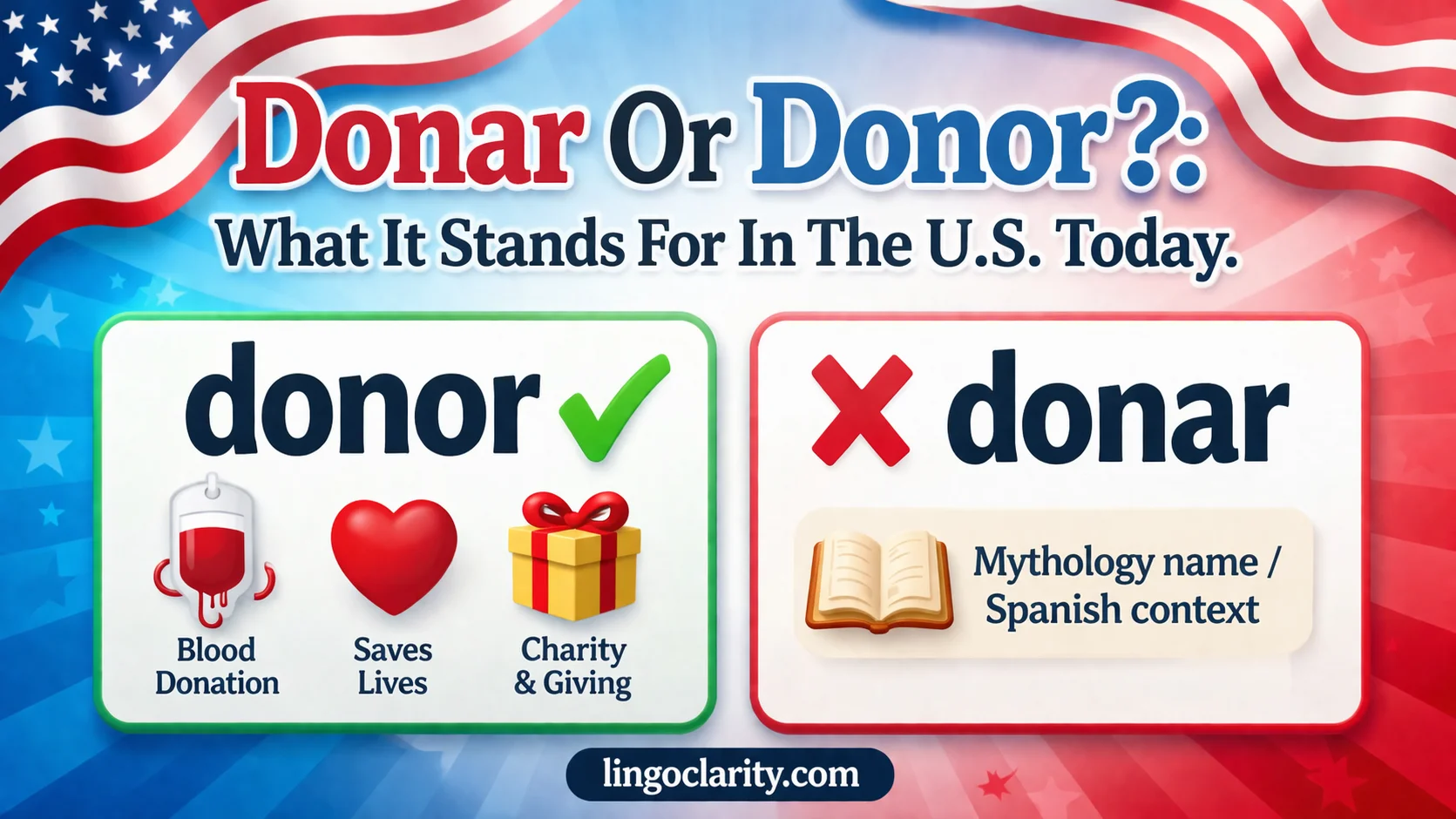
Some word pairs look like simple spelling variants, but this one is different. In standard US English, donor is the correct everyday word for a person who gives money, blood, an organ, tissue, or another kind of support. Major English dictionaries define donor that way in both general and medical use.
By contrast, donar is not the standard English noun you want in normal American writing. What makes this pair tricky is that donar does exist in other contexts. In Spanish, donar is a verb meaning “to donate.” In English reference works, Donar with a capital D appears as a mythology name linked to Thor, the Germanic god of thunder.
That means the real question is not “Which spelling sounds better?” The real question is, “Are you writing ordinary English, Spanish, or mythology?” In almost all everyday US writing, the answer is simple: use donor.
Quick Answer
If you mean a person who gives money, blood, an organ, tissue, or other support in English, use donor. English dictionaries define donor as the noun for someone who gives, while donate is the related verb. Donar is a separate mythology name, and donar is a Spanish verb, not the standard English noun for this idea.
Simple Definition
Here is the cleanest way to remember it:
• donor = the standard English noun for a giver
• donate = the English verb
• donar = Spanish verb meaning “to donate”
• Donar = mythology proper name connected with Thor
So if your sentence is about a hospital, a charity, a fundraiser, a blood drive, or an organ registry, donor is the correct word.
Why People Mix Them Up
This confusion happens for a few understandable reasons. First, donor and donar look close on the page. Second, people often expect the noun to match the verb more directly, so they see donate and assume donar might work by pattern. Third, bilingual readers may already know the Spanish verb donar, so the form feels familiar. Finally, Donar does appear in dictionary entries as a mythology name, which can make it look like a regular English alternative when it is not.
That is why the mistake shows up in charity writing, health content, school work, and casual posts. The word feels close enough to be plausible. But in edited US English, donor is still the expected choice.
What Donor Means In Standard English
English dictionaries give donor a broad but clear meaning. Merriam-Webster defines it as “one that gives, donates, or presents something,” and also lists the important medical sense for a source of blood or an organ. American Heritage similarly defines donor as someone who contributes to a cause or fund and, in medicine, as a person from whom blood, tissue, or an organ is taken for transfusion or transplant. Cambridge also gives the everyday meaning of a person who gives money or goods to help an organization.
That is why donor works across many common US contexts:
• a blood donor
• an organ donor
• a tissue donor
• a donor card
• a donor list for a nonprofit
• a major donor to a museum or school
The word is normal in formal and informal English. It belongs in hospital forms, charity appeals, scholarship pages, legal writing, nonprofit newsletters, classroom materials, and everyday speech.
What Donar Means In Spanish And Mythology
This is where the “twist” comes in. In Spanish, donar is a verb. The Royal Spanish Academy defines donar as giving something freely and also specifically as voluntarily giving blood or an organ to people who need it. SpanishDict likewise translates donar as “to donate.”
In English reference works, Donar with a capital letter is not a common everyday noun at all. It is a mythology name. Collins defines Donar as the Germanic god of thunder corresponding to Thor, and Britannica lists Donar among the spellings linked to Thor.
So donar is not “another acceptable English spelling of donor.” It points to a different language or to a proper name.
Donar Vs Donor: Key Differences At A Glance
| Context | Best Choice | Why |
|---|---|---|
| Charity fundraiser in English | donor | Standard English noun for a person who gives |
| Blood bank form | donor | Standard medical English |
| Organ transplant article | donor | Standard English and medical usage |
| Nonprofit website | donor | Clear and expected US wording |
| Spanish sentence | donar | Spanish verb meaning “to donate” |
| Mythology reference | Donar | Proper noun linked to Thor |
That split matches the major dictionary evidence: English dictionaries define donor as the giving noun, dictionary sources treat Donar as a mythology name, and Spanish authorities define donar as a verb.
Which Word Should You Use In Real US Writing?
Use donor almost every time you write in English.
Choose donor when you are talking about a person who gives money, blood, organs, tissue, sperm, eggs, supplies, or other forms of support. This is the form American readers expect. It is also the form used in dictionaries, medical writing, and nonprofit language.
Use Donar only if you are discussing mythology. Use donar only when you are writing Spanish or directly quoting Spanish. Outside those cases, donar will usually look like a spelling error in English.
A good editing shortcut is this: if you can replace the word with “giver,” you probably need donor.
Real-Life Example
Imagine a hospital webpage that says:
“Every donar helps save lives.”
A US reader will likely pause, because the sentence is written in English but uses the wrong form. The natural version is:
“Every donor helps save lives.”
Now imagine a Spanish learning example:
“Muchas personas quieren donar sangre.”
There, donar is correct because the sentence is in Spanish and the word is functioning as a Spanish verb. Or imagine a mythology article:
“Some sources identify Donar with the thunder god Thor.”
That sentence is also correct, because Donar is being used as a proper name.
This is why context matters so much. The spelling only looks confusing when the surrounding language is unclear.
Pronunciation And Form
In English, donor is commonly pronounced with a first syllable that sounds like “doh,” followed by “ner.” Merriam-Webster and Cambridge both record the standard pronunciation for donor. Dictionary sources for Donar show a different ending sound closer to “nar,” which reinforces that it is a separate word and not the everyday English noun.
Form matters too:
• donor is a noun
• donate is a verb
• donar is a Spanish verb
• Donar is a proper noun in mythology
If your sentence needs an English verb, write donate, not donor or donar.
Synonyms And Near-Synonyms
For donor, the closest context-based alternatives include:
• giver
• contributor
• benefactor
• patron
• supporter
• donator in some contexts, though donor is usually the more natural everyday choice
These are not perfect replacements in every sentence. For example, benefactor often sounds more generous or formal, while contributor can be broader and less personal. Patron may fit arts, institutions, or sponsorship better than medical contexts. Still, they are useful near-synonyms when you want variety.
For donar, there is no matching everyday-English synonym list for the “person who gives” meaning, because that is not the standard English use. In Spanish, however, donar can mean “to donate,” and Spanish thesaurus sources connect it with verbs such as regalar, ceder, and dar, depending on context.
Opposites And Counterparts
The most useful opposite or counterpart for donor depends on your sentence.
• recipient is the clearest opposite in medical and giving contexts
• beneficiary can work in charity or legal settings
• donee appears in legal language for the person who receives a gift, but it is much less common in everyday writing
Examples:
• “The donor was matched with the recipient.”
• “The donor funded the program, and the beneficiaries received the help.”
• “In legal language, the donor and the donee have different roles.”
That is more helpful than trying to force a single opposite that fits every use.
Sentence Usage
Here are natural, correct English examples with donor:
• The school thanked each donor in its annual report.
• She became a blood donor in college.
• He registered as an organ donor when he renewed his license.
• An anonymous donor paid for the library computers.
• The charity sent updates to every major donor.
Here are correct examples for the other forms:
• In Spanish, donar means “to donate.”
• In mythology, Donar is a name associated with Thor.
And here are examples that should be corrected in standard US English:
• Incorrect: “The donar gave blood yesterday.”
• Correct: “The donor gave blood yesterday.”
• Incorrect: “Our top donar funded the project.”
• Correct: “Our top donor funded the project.”
Common Mistakes And Quick Fixes
One common mistake is choosing donar because it feels close to donate. That pattern makes sense at a glance, but English dictionaries do not treat donar as the standard noun for someone who gives. The noun is donor, and the verb is donate.
Another mistake is copying Donar from a mythology page and assuming it is a normal English spelling variant. It is not. In reference works, Donar is treated as a mythology proper noun, not as the everyday word for a giver.
A third mistake appears in bilingual writing. Someone may see Spanish donar and move it into an English sentence without changing the form. The quick fix is easy: if the sentence is English, switch to donor for the noun or donate for the verb. If the sentence is Spanish, donar may be correct.
Word History And Usage Notes
If you enjoy word history, donor has been in English for a long time. Merriam-Webster traces it to Middle English through Anglo-French and Latin roots connected with giving, and it records the word’s first known use in the 15th century.
That long history helps explain why donor feels settled and standard in modern English. It is not a trendy form or a recent invention. It is the established noun. Meanwhile, Donar comes from a different historical path tied to old Germanic forms and the thunder-god tradition, which is another reason the two words should not be blended in ordinary writing.
Final Verdict
For normal US English, the right word is donor.
Use donor for a person who gives money, blood, an organ, tissue, or practical support. Use donate when you need the English verb. Keep donar for Spanish-language use, and keep Donar for mythology. That is the clean, accurate distinction that will make your writing look polished and correct.
FAQs
Is donor the correct spelling in US English?
Yes. In standard US English, donor is the correct noun for a person who gives money, blood, organs, tissue, or other support. Major English dictionaries record that meaning clearly.
Can I ever use donar in English?
Only in special cases. You may use donar when you are writing Spanish or quoting Spanish, because in Spanish it is a verb meaning “to donate.” In English prose, however, it is not the standard noun for a giver.
Is Donar just another spelling of donor?
No. Donar with a capital D is treated in dictionary sources as a mythology name connected with Thor, not as the normal English word for someone who gives.
What is the verb form of donor?
The English verb is donate. Donor is the noun.
Does donor work for money, blood, and organs?
Yes. English dictionaries use donor for general giving and also for medical uses such as blood and organs.
Is donar ever correct on a hospital or charity website in English?
Not if the site is written in English and means a person who gives. In that setting, donor is the clear and standard form. Donar would only fit if the text changed into Spanish or into a mythology discussion, which those pages usually do not.
Which sounds more natural: donor or donator?
Both exist, but donor is usually the more natural and common everyday choice in modern English. Thesaurus and dictionary sources list donator as related, but donor is the stronger default for clear US usage.
How can I remember the right choice fast?
Use this shortcut: if you mean a giver in English, write donor. If you need the action word, write donate. If you see donar, stop and ask whether the sentence is actually Spanish or mythology. That quick check usually solves the problem.
