
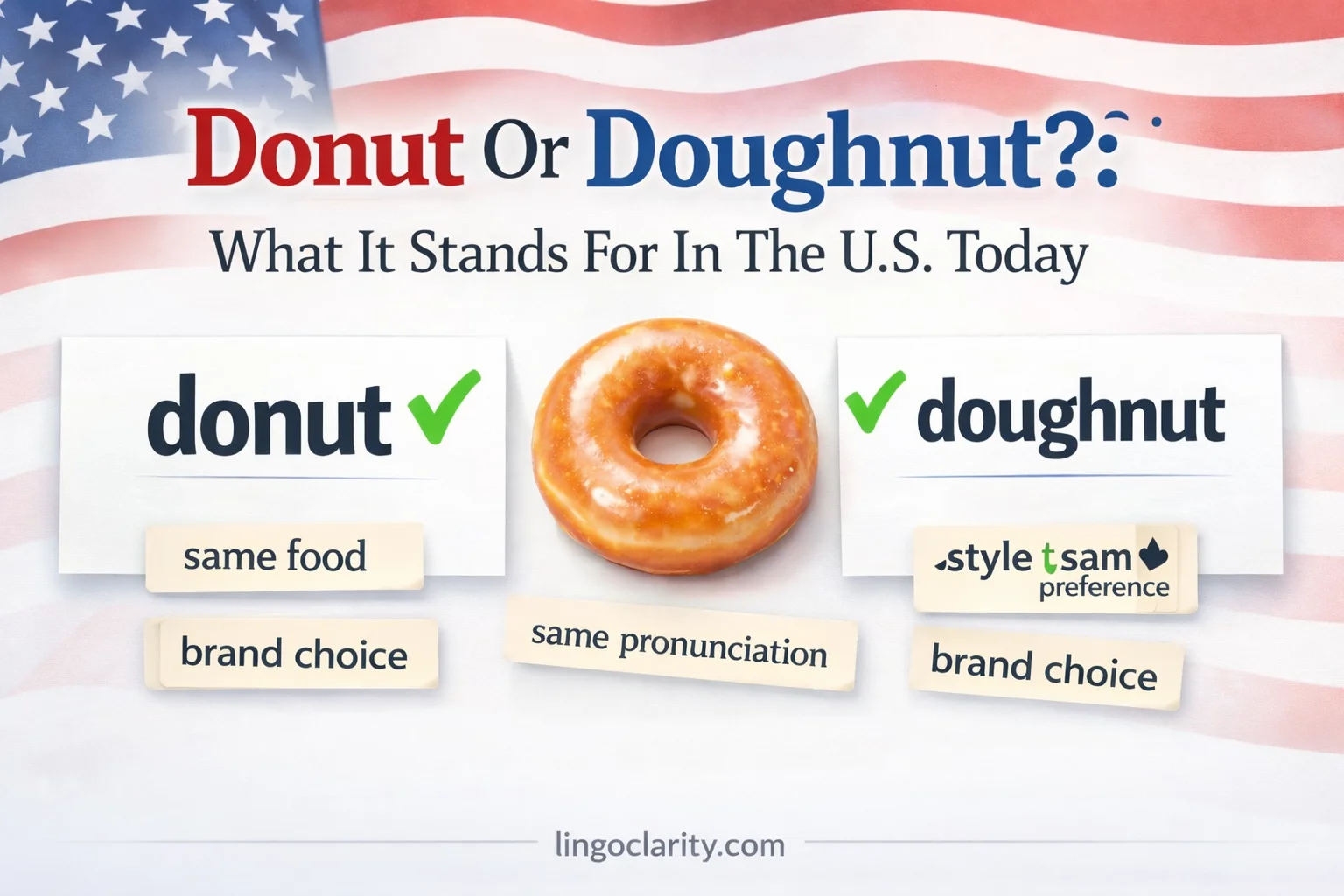
If you write for an American audience, both donut and doughnut are correct. They name the same food, they are pronounced the same way, and dictionaries treat them as variant spellings of the same noun. The real choice is not about meaning. It is about tone, style, and context.
In modern U.S. writing, donut often feels shorter, friendlier, and more casual. Doughnut feels more traditional and a little more formal. That does not mean one is right and the other is wrong. It means each spelling creates a slightly different impression on the page. That is why writers, students, editors, and business owners keep asking which one they should use.
This guide gives you a clear answer, practical rules, real examples, and an easy way to choose the best spelling every time.
Quick Answer
Use doughnut when you want the more traditional, dictionary-led spelling. Use donut when you want a more modern, casual, U.S.-friendly look. Both are accepted in American English, but many major references still present doughnut as the main entry and donut as the variant. That is why doughnut often feels safer in formal writing, while donut feels more natural in everyday U.S. copy and branding. This is an editorial inference from how current dictionaries label the two spellings.
Simple Definition
A donut or doughnut is a sweet fried pastry, often ring-shaped or filled. The word can also describe something shaped like a ring. In plain English, the spelling changes, but the meaning does not.
Are Donut And Doughnut The Same Word?
Yes. They are the same word.
That point matters because many articles overcomplicate it. There is usually no meaning difference between donut and doughnut in normal food writing. Merriam-Webster lists donut as a less common spelling of doughnut. American Heritage calls donut a variant of doughnut. Oxford shows donut as especially North American English, while Britannica marks it as chiefly U.S. spelling. Collins also treats donut as a variant spelling, especially in U.S. use.
That means a sentence like “I bought a glazed donut” and a sentence like “I bought a glazed doughnut” are both standard. A reader will understand both instantly.
Why People Get Confused
The confusion happens for a simple reason: readers see both spellings in real life.
They see donut on signs, packaging, social media, and brand pages. They see doughnut in dictionaries, edited prose, and traditional references. Because both forms are visible, many people assume they must carry different meanings. Usually, they do not.
Another reason is that English spelling is full of pairs like this. One version looks older and fuller. The other looks shorter and more modern. That makes people wonder whether one form is formal and the other is wrong. Here, the truth is simpler. Both are accepted. The choice depends on voice and consistency.
Donut Vs Doughnut At A Glance
The cleanest way to think about the pair is this:
| Context | Better Choice | Why |
|---|---|---|
| Formal essay or edited article | doughnut | More traditional and often the safer editorial default |
| Casual U.S. blog post or ad copy | donut | Shorter, friendlier, and familiar in American reading |
| Brand name | Follow the brand | Official spelling always comes first |
| Mixed or international audience | doughnut | More traditional and broadly recognizable |
| House style already chosen | Stay consistent | Consistency matters more than preference |
Which Spelling Looks Better In US English?
For many U.S. readers, donut looks more modern.
It is shorter. It feels lighter on the page. It fits cleanly into casual American marketing, menu writing, and conversational copy. That is one reason the spelling has become so visible in the United States.
But doughnut still carries authority. Because major dictionaries still anchor the word under doughnut or treat it as the traditional form, that spelling often feels more polished in formal copy. Again, that is not a rule from grammar. It is a practical editorial judgment based on current dictionary treatment and reader expectation.
So if you are writing a school paper, a polished article, a style-sensitive page, or professional copy that leans conservative, doughnut is often the safer choice.
If you are writing quick, lively, modern U.S. content, donut can feel more natural.
Formal, Casual, And Brand Use
This is where the real decision happens.
In formal writing, many editors still prefer doughnut because it looks more traditional and lines up with the main entry in major dictionaries. If your goal is to sound careful and neutral, doughnut is a strong default.
In casual writing, donut works very well. It feels relaxed and familiar. On a menu board, in a social caption, in a friendly email, or in playful website copy, it does not look strange at all.
In brand writing, the only correct answer is this: copy the brand’s official spelling. Dunkin’ uses donuts on its official U.S. site and menu pages. Krispy Kreme uses doughnut and doughnuts on its official site and product pages. So if you mention either company, use the company’s own spelling exactly as it appears.
That gives you a simple rule:
• general writing: choose your style
• formal writing: lean doughnut
• casual U.S. writing: donut is fine
• brand names: follow the brand
US Vs UK Preference
Many writers say this too strongly, so it helps to be precise.
It is fair to say that donut has a stronger North American and especially U.S. feel. Oxford labels donut as especially North American English, and Britannica marks it as chiefly U.S. spelling. But that does not mean Americans only use donut, or that doughnut is somehow non-American. American dictionaries still recognize doughnut perfectly well, and many U.S. writers still use it.
So the honest summary is this:
• doughnut = traditional spelling, still standard in U.S. English
• donut = accepted U.S.-leaning variant, especially common in casual American use
• not a strict U.S.-versus-U.K. rule
• more of a style and preference pattern than a hard boundary
That softer wording is more accurate than claiming one spelling belongs only to one country.
Real-Life Example
Imagine three real writing situations.
A newspaper food feature says: “The bakery’s apple cider doughnuts sell out by noon.”
A cheerful bakery sign says: “Fresh hot donuts every morning.”
A business article says: “Dunkin’ remains one of the largest coffee and donuts brands in the United States.”
All three can look correct because the context changes. The first sentence benefits from a more traditional editorial tone. The second sounds bright and modern. The third follows the company’s own spelling. That is the real lesson: spelling choice is often a style choice.
Sentence Usage
Here are natural U.S. examples with both spellings.
With donut
• I grabbed a glazed donut before work.
• Their maple bacon donuts are always sold out.
• The shop across the street makes great cake donuts.
• We brought a dozen donuts to the office.
With doughnut
• She ordered a jelly doughnut and black coffee.
• The bakery is known for its fresh cinnamon doughnuts.
• He wrote a short article about the history of the doughnut.
• We stopped for warm doughnuts on the drive home.
Notice that the meaning never changes. Only the spelling and tone shift a little.
Synonyms And Related Terms
There is no perfect everyday synonym for donut or doughnut, but these nearby terms may help in certain contexts:
• fried pastry
• ring pastry
• sweet fried dough
• filled pastry
• doughnut hole or donut hole, for the small round version
Still, in most cases, donut or doughnut is the clearest and most natural word. Replacing it with a broader phrase usually sounds less direct.
Opposites
Strictly speaking, donut and doughnut do not have true opposites. They are names for a pastry, not an idea with a natural opposite.
If you need a contrast in writing, the contrast usually comes from category, not from antonym. For example:
• sweet pastry vs savory pastry
• fried pastry vs baked good
• ring-shaped pastry vs filled pastry
But those are contrasts, not real opposites. So the best editorial choice is usually to say that there is no direct antonym.
Common Mistakes
Writers make the same mistakes again and again with this pair.
Mistake 1: Thinking Donut Is Wrong
It is not wrong. It is an accepted spelling in American English. Multiple major references recognize it.
Mistake 2: Saying The Words Have Different Food Meanings
They usually do not. In normal food use, they refer to the same thing.
Mistake 3: Mixing Both Spellings In One Article For No Reason
This is one of the most common quality problems. If you choose donut, keep using donut. If you choose doughnut, keep using doughnut. Only switch when quoting a source, citing a brand, or discussing the spelling difference itself.
Mistake 4: Changing A Brand’s Official Spelling
Do not write “Krispy Kreme donuts” in brand copy if the company uses doughnuts. Do not change Dunkin’ to doughnuts if the company uses donuts. Brand spelling outranks personal preference.
Mistake 5: Turning A Style Preference Into A Hard Grammar Rule
This is not a grammar issue like subject-verb agreement. It is a spelling-choice and style issue. The better question is not “Which one is legal English?” The better question is “Which one best fits this piece of writing?”
Word History In Plain English
The short version is simple.
Doughnut is the older, traditional spelling. Donut is the shorter simplified spelling that became widely accepted later. Merriam-Webster notes that most dictionaries still enter donut as a variant of doughnut and explains that the shorter spelling gained acceptance through use, including visibility from brands.
You do not need the full history to make the right choice today. What matters is this:
• doughnut has tradition behind it
• donut has modern U.S. momentum behind it
• both are standard enough to use with confidence
Best House-Style Rule
If you run a website, publication, bakery blog, or content team, set one house rule and stick to it.
A smart house-style system looks like this:
• Use doughnut in formal guides, educational articles, and polished reference content.
• Use donut in casual posts, ads, headlines, and playful U.S. copy.
• Always preserve official brand spelling.
• Never switch spellings randomly inside one piece.
That approach keeps your writing clean, credible, and easy to read.
Conclusion
For U.S. English, both donut and doughnut are correct. The better choice depends on how you want the writing to feel.
Choose doughnut if you want the more traditional, conservative, and dictionary-led spelling. Choose donut if you want a more casual, modern American look. Neither spelling changes the meaning. Both refer to the same pastry. The real key is consistency.
If you are writing for a broad audience and want the safest default, doughnut is still a strong editorial choice. If you are writing casual U.S. copy or following modern brand language, donut works well. And if you are naming a company, always follow the company’s official spelling.
Frequently Asked Questions
Is donut wrong in US English?
No. Donut is an accepted American spelling. Major dictionaries recognize it as a variant of doughnut.
Is doughnut more formal than donut?
Usually, yes. In practice, doughnut often feels more traditional and safer in formal edited writing because many major dictionaries still lead with that form. That is an editorial preference, not a rule that makes donut incorrect.
Do donut and doughnut mean different things?
No. In ordinary usage, they mean the same pastry. The difference is spelling and tone, not meaning.
Which spelling is more common in the United States?
Donut has a stronger American feel in casual writing and branding, but doughnut is still standard in American English. So the practical answer is that both appear in U.S. usage, with donut feeling more informal and modern.
Should I copy a brand’s spelling?
Yes. Always follow the brand’s official spelling. Dunkin’ uses donuts, while Krispy Kreme uses doughnuts.
What is the best default spelling for a website article?
If your tone is polished, neutral, or educational, doughnut is often the safer default. If your tone is casual, playful, and strongly U.S.-focused, donut may fit better. The most important thing is to choose one style and stay consistent.
