
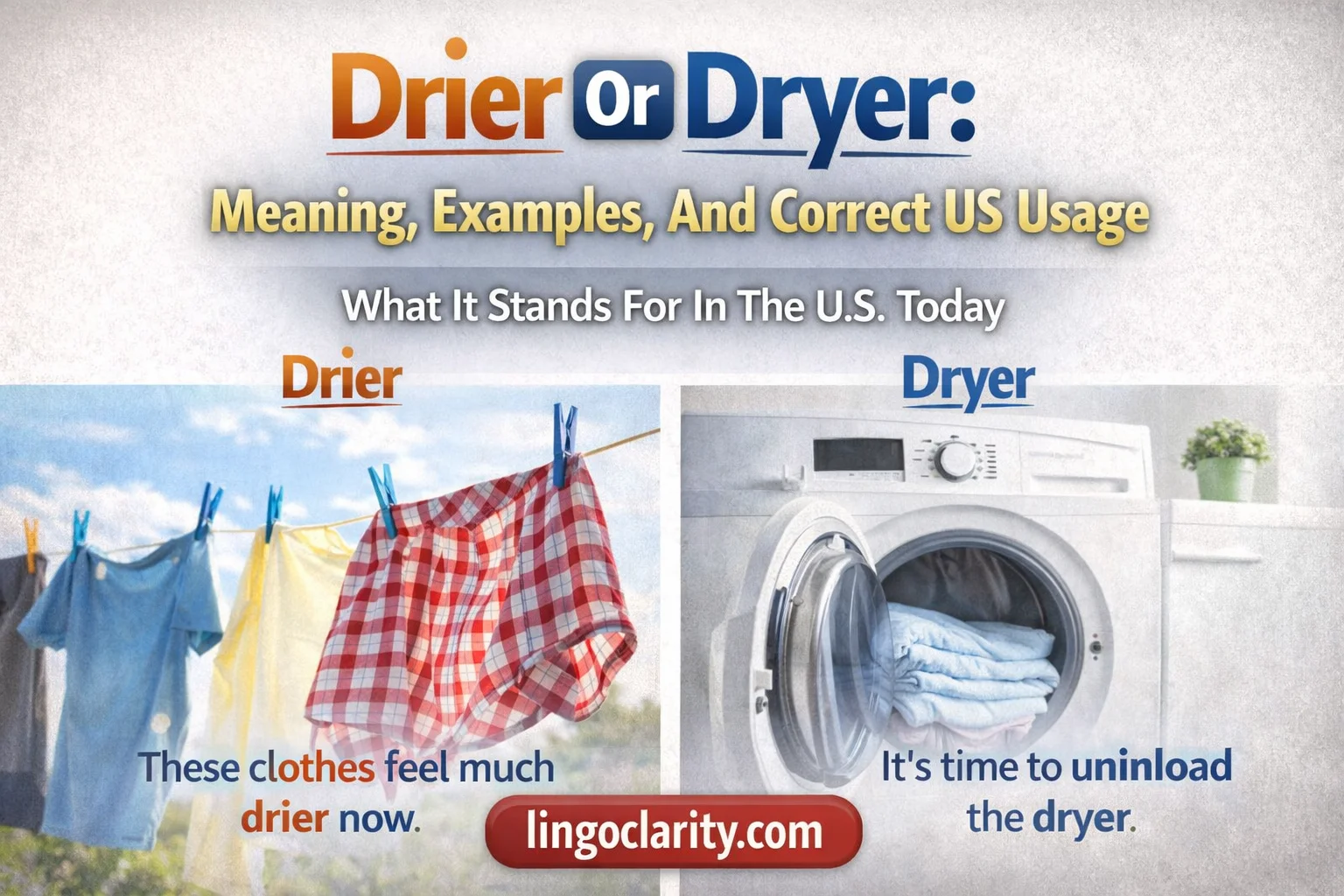
Drier and dryer sound exactly the same in everyday American speech, so it is easy to see why many writers mix them up. The confusion gets even stronger because both words come from dry, and major dictionaries record a small amount of overlap in noun use. Still, ordinary modern usage is much simpler than it first appears.
In standard US English, the safest everyday rule is clear: use drier when you mean more dry, and use dryer when you mean a machine or device that dries something. That covers weather, skin, soil, towels, laundry rooms, hair tools, and most real-life sentences you will ever write.
So if the air has less moisture, it is drier. If you put wet jeans into a machine after washing them, that machine is a dryer. Some dictionaries do allow overlap in limited noun senses, but current reference works still point readers toward drier as the comparative form and dryer as the usual appliance word.
Quick Answer
Use drier when you are comparing moisture levels. Use dryer when you are naming a machine, appliance, or drying device.
• Drier = more dry
• Dryer = a machine or device that dries
• Drier weather is correct
• Clothes dryer and hair dryer are correct
That is the rule most US readers expect in normal writing. While dictionary entries do show some overlap, the everyday split remains easy and natural.
Simple Definition
Let’s make it even easier.
Drier is usually an adjective. It describes something that has less moisture than something else.
Example:
This towel is drier than that one.
Dryer is usually a noun. It names a thing that dries something.
Example:
The dryer stopped working last night.
That means one word usually describes a condition, while the other usually names an object. This is the core difference that matters in real writing.
Drier Vs Dryer: The Main Difference
The easiest way to choose is to ask one question:
Am I describing something, or am I naming a thing?
If you are describing something as less wet, use drier. If you are naming a machine or tool, use dryer.
| Context | Correct Choice | Example |
|---|---|---|
| Comparing moisture | drier | This part of Texas is drier than the coast. |
| Weather or climate | drier | The air gets drier in late winter. |
| Skin, soil, food texture | drier | My hands feel drier after using that soap. |
| Laundry appliance | dryer | The dryer is still running. |
| Hair tool | dryer | She packed a travel hair dryer. |
| Hand or grain machine | dryer | The restroom has a hand dryer. |
Reference works support this split. Merriam-Webster lists drier as the comparative of dry and notes that the device sense is usually dryer. American Heritage gives dryer as the appliance word and also shows it as a variant of drier in some noun senses. Cambridge also defines dryer as a machine that dries things and includes examples such as hair dryer.
Why People Confuse These Words
There are three main reasons this pair causes trouble.
First, drier and dryer are homophones. In normal American pronunciation, both are said the same way, so speech does not help you see the difference.
Second, both words come from the same base word, dry. Because of that shared root, they look closely related on the page.
Third, dictionaries show a little overlap. For example, major entries allow drier as a noun in some senses, and some learner dictionaries note that dryer can also appear as drier. But those same references still make room for the everyday pattern that most writers and readers follow: drier for comparison, dryer for the appliance.
What Drier Means
In normal US writing, drier means more dry. It is the comparative form you use when one thing has less moisture than another thing, or less moisture than before.
You will often see drier in sentences about:
• weather
• climate
• air
• skin
• soil
• towels
• food texture
• paint, wood, or surfaces
Examples:
The desert air is drier in the afternoon.
This cake is drier than the first one.
My lips get drier in cold wind.
After an hour by the window, the shirt felt drier.
In all of those sentences, the word is doing descriptive work. It is not naming a machine. It is comparing moisture levels or describing a more dry condition. That is why drier is the natural choice.
What Dryer Means
In ordinary US English, dryer usually means a machine or device that dries something. This is the word people expect in homes, hotels, salons, public restrooms, and product labels.
Common examples include:
• clothes dryer
• hair dryer
• hand dryer
• grain dryer
• washer-dryer
Example sentences:
The dryer is making a strange noise.
He bought a new dryer last weekend.
The hotel bathroom had a wall-mounted hand dryer.
She unplugged the hair dryer before leaving.
This is also the spelling learners usually meet in dictionaries and appliance-related examples. Cambridge uses hair dryer and dryer for the machine sense, and Oxford learner entries also show familiar examples like putting a sweater in the dryer.
When To Use Drier
Use drier when your sentence is really about degree. That means you are showing that something has less moisture than something else.
This often happens in comparisons:
Arizona is usually drier than Florida.
Today feels drier than yesterday.
This shampoo leaves my hair drier than the other one.
The second batch came out drier because it baked too long.
A good test is this: if you can replace the word with more dry, then drier is probably right.
The air is more dry today.
This towel is more dry now.
Those versions sound stiff, but they prove the grammar. So the smoother form is drier.
When To Use Dryer
Use dryer when your sentence names a physical thing that dries clothes, hair, hands, grain, or something similar.
Examples:
The dryer finished the cycle an hour ago.
I need to replace the old dryer.
Her travel bag has a mini hair dryer inside.
The restroom uses an air dryer instead of paper towels.
A helpful memory trick is this:
A dryer dries.
Something drier has less moisture.
That short reminder solves most mistakes immediately. It is simple, natural, and easy to remember when you are writing fast.
A Real-Life Example
Imagine this everyday home scene:
You wash a load of towels on Saturday morning. They come out of the washer wet, so you put them into the dryer. After forty minutes, you open the door and check them. The smaller towels are already drier than the thicker ones, but one large towel still feels a little damp.
That single situation shows the difference perfectly. The dryer is the machine. The towels are drier because they now have less moisture than before.
This is why the pair is easier than it looks. Once you focus on the job each word is doing, the correct spelling usually becomes obvious.
Tone, Context, And Formality
Neither word is automatically more formal than the other. The difference is not really about tone. It is about function.
Drier belongs in descriptive writing. It fits climate reports, health advice, skincare discussions, food writing, and everyday comparison.
Dryer belongs in naming objects. It fits shopping, home repair, product instructions, appliance reviews, and everyday conversation about machines.
So the issue is not “formal vs informal.” The real issue is “comparison vs appliance.” That is the clearest and most helpful way to teach this pair in modern US English.
Synonyms And Related Words
There is no perfect synonym that works in every sentence, but these near-equivalents can help.
Synonyms Of Drier
Depending on context, drier can be close to:
• less wet
• less damp
• more arid
• less humid
• more moisture-free
Examples:
A drier climate = a less humid climate
A drier towel = a less wet towel
A drier region = a more arid region
Synonyms Of Dryer
Depending on context, dryer can be close to:
• drying machine
• drying device
• clothes dryer
• hair dryer
• hand dryer
These are not always direct replacements, but they explain the meaning clearly for learners.
Opposites And Contrasts
Opposites Of Drier
The most useful opposites of drier are:
• wetter
• damper
• more humid
Examples:
This room feels wetter than the other one.
Coastal air is often more humid than desert air.
Opposites Of Dryer
There is no perfect single-word opposite of dryer in every context because dryer names a tool. In real writing, the opposite idea usually depends on the situation. For example, in home or weather contexts, words like washer, humidifier, or wet surface may create a contrast, but none is a true universal opposite.
That is normal. Not every noun has one neat opposite word. The important point is still the main meaning: a dryer is a device that removes moisture.
Sentence Usage Examples
Here are natural examples that show the difference clearly.
Using Drier In Sentences
The ground looks drier after three sunny days.
My skin gets drier every winter.
This recipe tastes drier if you bake it too long.
The western side of the state is much drier than the eastern side.
By noon, the paint felt drier to the touch.
Using Dryer In Sentences
The dryer stopped in the middle of the cycle.
She keeps the hair dryer under the sink.
Our new dryer uses less energy than the old one.
The gym restroom has a hand dryer near the mirror.
Do not overload the dryer with heavy blankets.
Using Both Words In One Sentence
After twenty minutes in the dryer, the towels felt much drier.
That last example is especially useful because it shows both words working correctly in the same sentence. One names the machine, and the other describes the result.
Common Mistakes To Avoid
This pair becomes much easier once you know the common errors.
Mistake 1: Using Dryer For Weather
Wrong: The air feels dryer today.
Right: The air feels drier today.
Why? Because the sentence is comparing moisture, not naming a machine.
Mistake 2: Using Drier For A Machine
Wrong: I left the sheets in the drier.
Right: I left the sheets in the dryer.
Why? Because you are naming an appliance.
Mistake 3: Forgetting That Drier Implies Comparison
Wrong: The basement is drier now.
Better: The basement is dry now.
Also correct when comparing: The basement is drier than it was last week.
Why? Drier usually works best when there is a clear comparison, even if the comparison is only implied by context.
Mistake 4: Thinking The Choice Is Random
Some writers assume this is just a personal spelling preference. It is not. In normal US writing, the spelling usually changes because the word’s job changes. Drier usually handles comparison. Dryer usually handles the machine sense. That pattern is strongly supported by major dictionary entries, even though they also record some overlap.
Is Drier Ever A Noun?
Yes, but this is where many learners get distracted.
Major dictionaries do record drier as a noun in some senses, and Merriam-Webster even notes that dryer is a variant spelling within that noun family. American Heritage also links the two forms. So from a dictionary point of view, the overlap is real.
However, that does not change the best advice for everyday US writing. In regular edited prose, product names, home writing, and normal school or workplace English, dryer is still the safer and more natural spelling for the appliance. That is also the form reinforced by common learner-dictionary examples such as hair dryer and put that sweater in the dryer.
So yes, the overlap exists. But for most writers, it is background information, not a reason to change the usual rule.
Memory Trick
Use this simple test:
If it dries things, it is a dryer.
If it has less moisture, it is drier.
You can also remember it this way:
• dryer = device
• drier = degree
That second memory trick works well because drier is about level or comparison, while dryer is about an object.
Conclusion
If you are deciding between drier and dryer, the safest US-English rule is straightforward.
Use drier when you mean more dry. Use dryer when you mean a machine or device that dries something.
That is the spelling choice most American readers expect. Dictionaries do record a little overlap, especially in noun senses, but the everyday writing rule remains steady and practical: drier weather, dryer machine. Keep that pattern in mind, and this word pair becomes easy to handle.
FAQs
Is drier correct for weather?
Yes. In normal US English, drier is the correct choice for weather, climate, air, and other comparisons involving moisture. Example: The fall air is drier in this region.
Is dryer correct for a clothes machine?
Yes. Dryer is the standard everyday noun for a clothes machine, hair tool, or similar device that dries something.
Can drier also be a noun?
Yes. Some dictionaries record drier as a noun or variant spelling in certain senses. But for everyday appliance writing in the US, dryer is still the safer choice.
Why do drier and dryer sound the same?
They are homophones in normal English pronunciation, so the difference usually appears only in writing, not in speech. That is one reason people confuse them so often.
Should I write dry, drier, or dryer?
Use dry for the basic form, drier for comparison, and dryer for the machine. For example: The shirt is dry now. This shirt is drier than the other one. Put the wet clothes in the dryer.
