You may see Elemental Folk in fantasy stories, role-playing games, folklore-inspired articles, spiritual writing, or worldbuilding notes. At first, the phrase may sound mysterious. However, its meaning is easy to understand once you break it into two parts.
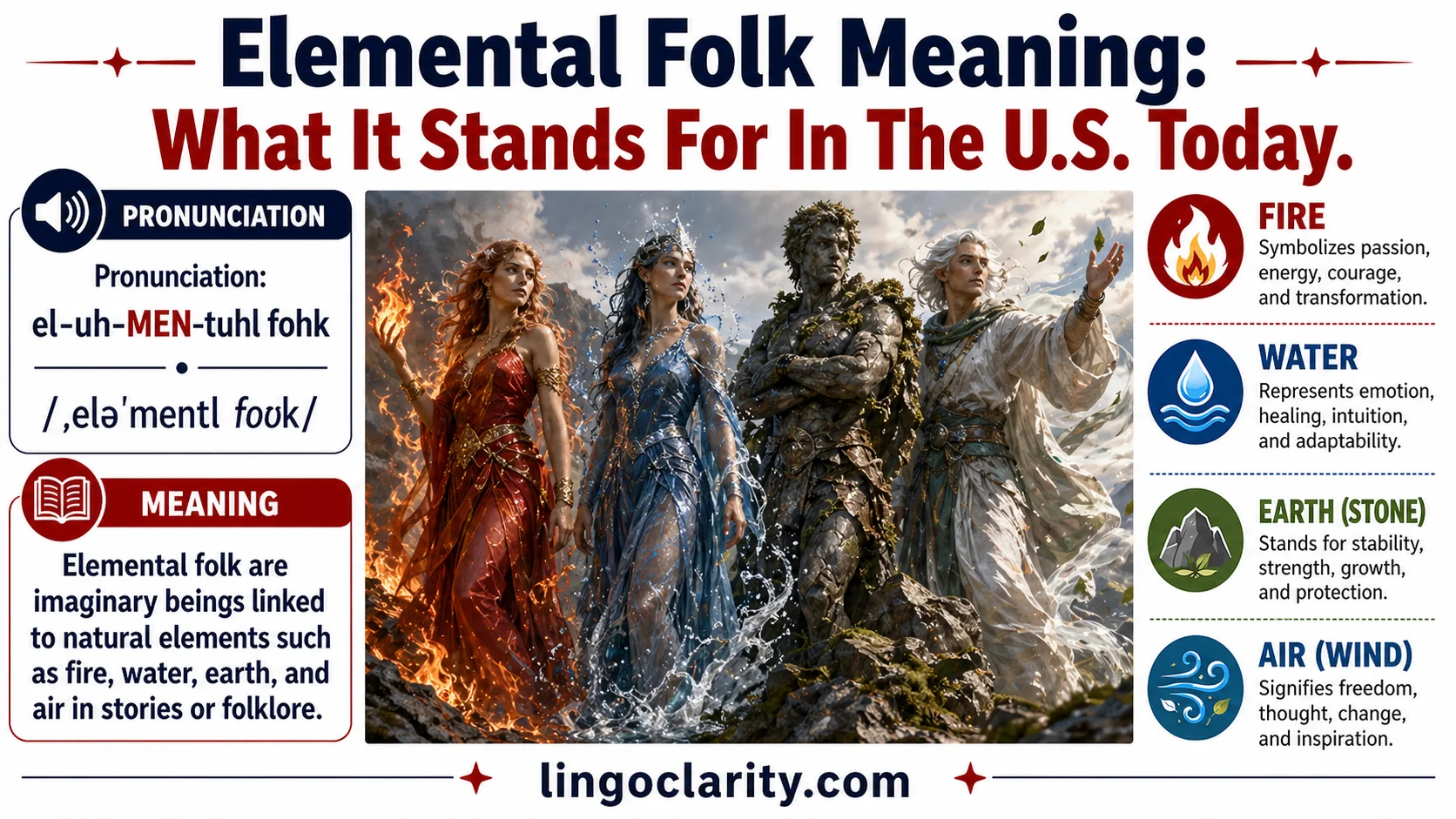
In plain English, Elemental Folk means people, spirits, creatures, or mythical beings connected with nature’s basic forces. Most often, those forces are earth, air, fire, and water. Because the word “folk” refers to a group or community, the phrase usually describes a race, clan, tribe, or type of being rather than one individual creature.
Although the phrase is understandable, it is not common everyday slang. Instead, writers usually use it in creative, magical, or folklore-inspired contexts. For example, a fantasy author might describe fire folk who live near volcanoes, water folk who guard rivers, or earth folk who dwell in mountain caves. Similarly, a game designer might use Elemental Folk for characters with powers linked to wind, stone, flame, or water.
Therefore, this guide explains the meaning of Elemental Folk, how to use it correctly, where the phrase appears, how it relates to elementals and nature spirits, and which common mistakes to avoid.
Quick Answer
Elemental Folk means people, spirits, creatures, or fantasy beings connected with natural elements, especially earth, air, fire, and water.
In other words, the phrase means “folk of the elements” or “beings tied to natural forces.” However, it is not modern slang, and it is not a common everyday phrase. Instead, it appears most often in fantasy, folklore, games, worldbuilding, and spiritual writing.
What Does Elemental Folk Mean?
Elemental Folk refers to beings associated with the basic forces of nature. Usually, those forces are the four classical elements: earth, air, fire, and water. Sometimes, writers may also include lightning, ice, metal, wood, shadow, light, spirit, or storm, depending on the world they are building.
The phrase has two important parts. First, “elemental” means connected with elements, natural forces, or the basic powers of the world. Second, “folk” means people, beings, a community, or a group. Together, the phrase suggests a group of beings whose identity is linked to the elements.
For example, Elemental Folk in a fantasy setting may live near rivers, forests, mountains, volcanoes, oceans, caves, deserts, or storms. Likewise, they may have abilities shaped by their element. Fire folk might control flame. Water folk might heal or move through rivers. Earth folk might shape stone. Air folk might speak with winds or travel through clouds.
As a result, the phrase is flexible. It can describe spirits, magical races, fairy-like beings, nature guardians, clans, tribes, or fictional civilizations. Still, the central idea remains the same: Elemental Folk are connected to nature’s elemental powers.
Plain-English Definition
Elemental Folk means mythical, magical, spiritual, or fictional beings linked to natural elements such as earth, air, fire, and water.
A simple definition is:
Elemental Folk are beings or people connected with the elements.
A more detailed definition is:
Elemental Folk are imagined or mythic groups whose powers, culture, identity, home, or nature is tied to elemental forces such as stone, wind, flame, water, rivers, mountains, storms, forests, or the sea.
Therefore, the phrase is best understood as creative language. Although it sounds traditional, it does not have one strict official meaning. Instead, each author, game, or tradition may define Elemental Folk in its own way.
Is Elemental Folk A Standard Term?
Elemental Folk is understandable English, but it is not a common standard phrase. In fact, you are more likely to see related terms such as elementals, elemental beings, elemental spirits, or nature spirits.
However, that does not make the phrase wrong. Rather, it means the phrase is mainly useful in creative or explanatory contexts. A fantasy writer may use Elemental Folk as the official name for a race of beings. Similarly, a game designer may use it as a category for characters linked to the elements.
By contrast, if you are writing a formal essay or a clear informational article, elemental beings may be easier for readers to understand. Still, Elemental Folk works well when you want a more story-like, magical, or folklore-inspired tone.
Where You May See Elemental Folk
You may see Elemental Folk in many creative and mystical contexts. Most commonly, it appears in fantasy and worldbuilding.
You may find the phrase in:
- Fantasy novels
- Role-playing games
- Video game lore
- Tabletop game settings
- Character descriptions
- Magical worldbuilding notes
- Folklore-inspired stories
- Fairy or fae-related writing
- Spiritual articles
- Nature-based mystical writing
- Mythology-style blogs
- Creative writing prompts
For instance, a fantasy novel might describe the Elemental Folk as ancient guardians of the land. Meanwhile, a role-playing game might divide them into four playable groups: fire folk, water folk, earth folk, and air folk. Likewise, a spiritual article might use similar wording to describe nature spirits connected with elemental forces.
Because the phrase is not common in everyday speech, context matters. Without context, readers may understand the general idea but not the exact meaning. Therefore, writers should explain what kind of Elemental Folk they mean.
The Four Common Elemental Types
Traditionally, elemental beings are often connected with four major elements: earth, water, air, and fire. Although different cultures and stories may use different systems, these four are the most familiar in fantasy, symbolism, and Western elemental traditions.
| Element | Possible Folk Type | Common Fantasy Traits | Common Setting |
|---|---|---|---|
| Earth | Earth Folk, Stone Folk, Mountain Folk | Strong, patient, grounded, protective | Caves, mountains, forests, valleys |
| Water | Water Folk, River Folk, Tide Folk | Fluid, healing, emotional, wise | Rivers, lakes, oceans, rainlands |
| Air | Air Folk, Wind Folk, Sky Folk | Quick, free, clever, elusive | Clouds, cliffs, storms, open plains |
| Fire | Fire Folk, Flame Folk, Ember Folk | Passionate, fierce, bold, transformative | Volcanoes, deserts, forges, hearths |
For example, earth folk may be miners, builders, herbalists, or guardians of stone circles. Meanwhile, water folk may be healers, seers, sailors, or protectors of sacred springs. Similarly, air folk may be messengers, scholars, storm-callers, or travelers. Finally, fire folk may be warriors, smiths, artists, or keepers of ancient flames.
However, these traits are not rules. Instead, they are common creative patterns. A writer can make water folk fierce, fire folk gentle, earth folk restless, or air folk deeply loyal. In fact, strong worldbuilding often becomes more interesting when it avoids obvious stereotypes.
Elemental Folk Vs. Elementals
Elemental Folk and elementals are related terms, but they are not always identical.
Elementals usually means supernatural beings that embody or belong to an element. For example, a fire elemental may be a spirit made of flame, while a water elemental may be a being formed from water. Because this term is more established, it often appears in fantasy games, occult writing, and mythology-inspired discussions.
Elemental Folk, however, sounds more like a people or community. Instead of one spirit of fire or water, it may suggest families, villages, tribes, cultures, or races. Therefore, the phrase can feel more human, social, and story-based.
| Term | Meaning | Best Use |
|---|---|---|
| Elemental Folk | A group or people connected with elements | Fantasy races, clans, tribes, cultures |
| Elementals | Supernatural beings of the elements | Fantasy creatures, occult terms, game monsters |
| Elemental Beings | General beings linked to elements | Clear informational writing |
| Elemental Spirits | Spirits connected with elements | Spiritual or mystical writing |
| Nature Spirits | Spirits connected with nature or places | Broader folklore or spiritual contexts |
| Fairy Folk | Fairy-like magical beings | Fae stories, fairy tales, folklore fantasy |
In short, use elementals when you mean elemental creatures or spirits. However, use Elemental Folk when you want to describe a community, race, or people connected with elemental forces.
Elemental Folk Vs. Nature Spirits
Elemental Folk can overlap with nature spirits, but the two phrases are not always the same.
Nature spirits is a broader term. For example, it can describe spirits of trees, rivers, forests, animals, mountains, flowers, caves, or sacred places. By comparison, Elemental Folk usually points more directly to beings connected with elemental forces such as fire, water, earth, and air.
Therefore, all Elemental Folk may be nature-linked, but not all nature spirits are Elemental Folk. A tree spirit, for instance, may be a nature spirit without being part of an elemental race. Likewise, a river guardian may be a water spirit, but it may not belong to a larger group called Elemental Folk unless the story says so.
Is Elemental Folk Slang?
No, Elemental Folk is not slang. Instead, it is a creative or descriptive phrase.
You would not normally use it in texting, casual conversation, or modern internet slang. For example, someone would not say, “That outfit is Elemental Folk” unless they were making a very specific fantasy-style comment.
Rather, the phrase belongs in contexts where magical beings, folklore, or worldbuilding make sense. So, it works in a fantasy story, a game guide, a myth-inspired article, or a discussion of nature spirits. However, it may sound unusual in everyday conversation.
Is Elemental Folk Religious Or Spiritual?
Elemental Folk can appear in spiritual writing, but it is not automatically religious. In many cases, it is simply fictional.
For example, in a fantasy novel, Elemental Folk may be invented races with no real-world belief attached. Similarly, in a video game, they may be character types with powers based on fire, water, earth, or wind.
However, in spiritual or mystical writing, related terms like elementals, elemental spirits, and nature spirits may refer to beings connected with nature-based belief systems. Therefore, the meaning depends heavily on context.
If the phrase appears in fiction, it probably describes imaginary beings. If it appears in spiritual writing, it may describe a belief, symbol, or mystical concept. As a result, readers should look at the source and surrounding explanation before assuming one meaning.
Pronunciation Of Elemental Folk
Elemental Folk is pronounced:
el-uh-MEN-tuhl fohk
The stress falls on MEN in “elemental.” Also, “folk” rhymes with oak. In American English, the l in “folk” is usually silent or very soft. Therefore, it sounds like fohk, not “fall-k.”
Part Of Speech And Grammar
Elemental Folk is a noun phrase.
In this phrase, “elemental” works as an adjective because it describes the kind of folk. Meanwhile, “folk” works as a noun because it names a group of people or beings.
Examples:
- The Elemental Folk guarded the ancient forest.
- A village of elemental folk stood beside the silver river.
- She wrote a fantasy novel about Elemental Folk and star-born kings.
- The game includes humans, elves, giants, and Elemental Folk.
- Each group of Elemental Folk draws power from a different force of nature.
Generally, “folk” can be singular or plural depending on how it is used. However, when it refers to a people or group, it often behaves like a collective noun.
Should Elemental Folk Be Capitalized?
Capitalize Elemental Folk when it is the official name of a race, group, faction, species, or title in a fictional world.
For example:
- The Elemental Folk formed four ancient kingdoms.
- The treaty between humans and the Elemental Folk lasted for centuries.
Use lowercase when speaking generally.
For example:
- The story includes elemental folk who live near rivers and mountains.
- Many fantasy settings include elemental folk, nature spirits, and magical creatures.
In short, capitalization depends on whether the phrase is a proper name. If it names a specific group, capitalize it. If it is only a description, use lowercase.
Examples Of Elemental Folk In Sentences
Here are natural examples that show how the phrase works:
- The Elemental Folk lived between the forest and the sea.
- According to the old legend, the Elemental Folk taught humans how to read the wind.
- Each clan of Elemental Folk served a different force of nature.
- The fire folk worked with volcanic glass, while the water folk shaped coral and pearl.
- In the game, the Elemental Folk can speak to storms, stones, rivers, and flames.
- The mountain village believed the Elemental Folk lived inside caves and old trees.
- Although they looked human, the Elemental Folk aged like forests and remembered like rivers.
- Her novel presents the Elemental Folk as guardians rather than monsters.
- For clearer wording, a school essay might use “elemental beings” instead of “Elemental Folk.”
- Because the phrase sounds creative, it fits fantasy better than everyday speech.
Common Mistakes To Avoid
One common mistake is assuming Elemental Folk has one official definition. However, the phrase is flexible. Its meaning depends on the writer, setting, game, or tradition.
Another mistake is confusing elemental with elementary. Elementary means basic or simple. Elemental can also mean basic, but in this phrase it usually means connected with natural elements.
A third mistake is reading folk as a music term. Although “folk” can refer to folk music, that is not the likely meaning here. Instead, “folk” means people, beings, or a community.
Also, do not use the phrase without explanation in formal writing. Because many readers may not know it, a clearer term may work better. For example, “elemental beings” is usually easier to understand than “Elemental Folk” in an essay.
Better Alternatives By Context
| Context | Best Phrase | Why It Works |
|---|---|---|
| Fantasy novel | Elemental Folk | Sounds creative, magical, and immersive |
| Game lore | Elemental race or Elemental Folk | Helps describe character groups |
| School essay | Elemental beings | Clearer and more formal |
| Mythology article | Elementals | More established term |
| Spiritual article | Elemental spirits | Fits mystical or spiritual discussion |
| Casual explanation | Nature spirits | Easier for most readers |
| Worldbuilding notes | Elemental clans or elemental peoples | More specific and flexible |
Therefore, the best phrase depends on the audience. If your readers enjoy fantasy, Elemental Folk may sound natural. However, if your readers need quick clarity, elemental beings or nature spirits may be better.
Related Terms
Elementals are supernatural beings associated with the elements. Generally, this is the most important related term.
Elemental beings is a clear, general phrase for beings linked to earth, air, fire, or water. Because it is straightforward, it works well in informational writing.
Elemental spirits usually suggests spiritual or mystical beings connected with the elements. Therefore, it fits better in spiritual, occult, or folklore-inspired contexts.
Nature spirits is broader. For example, it may include tree spirits, river spirits, mountain spirits, animal guardians, forest beings, or place-based spirits.
Fairy folk refers to fairy-like magical beings or fae. Although some fairy folk may overlap with Elemental Folk, the terms are not identical.
Gnomes, undines, sylphs, and salamanders are traditional elemental types often associated with earth, water, air, and fire. However, modern fantasy may reinterpret these beings in many different ways.
How To Use Elemental Folk In Writing
Use Elemental Folk when you want a phrase that feels magical, nature-linked, and group-based. However, make the meaning clear through description.
Weak example:
- The Elemental Folk arrived.
Stronger example:
- The Elemental Folk arrived at dawn: stone-skinned elders from the mountains, river-eyed healers from the marshes, wind-runners from the cliffs, and ember-cloaked smiths from the volcanic south.
As you can see, the stronger version gives the reader details. It shows the elements, the groups, and the worldbuilding. Therefore, the phrase becomes meaningful instead of vague.
If you use Elemental Folk in a story, explain their culture, powers, limits, appearance, and relationship with humans. For instance, do they protect nature, fear cities, trade with humans, rule hidden kingdoms, or avoid mortal lands? Also, consider whether each elemental group has different customs, conflicts, strengths, and weaknesses.
FAQ
What does Elemental Folk mean?
Elemental Folk means people, spirits, creatures, or fantasy beings connected with natural elements. Most often, those elements are earth, air, fire, and water. In simple terms, the phrase means “folk of the elements” or “beings tied to natural forces.”
Is Elemental Folk a common phrase?
No, Elemental Folk is not a common everyday phrase. Instead, it is mostly used in fantasy, folklore-inspired writing, games, worldbuilding, and spiritual contexts. For clearer general writing, “elemental beings” may be easier for readers.
Is Elemental Folk slang?
No, Elemental Folk is not slang. Rather, it is a creative noun phrase. Because it sounds magical and old-world, it fits stories, games, and folklore-style writing better than casual conversation.
Is Elemental Folk the same as elementals?
Not exactly. Elementals usually refers to supernatural beings of the elements. Elemental Folk, however, sounds more like a group, race, tribe, or community of beings connected with the elements.
What are examples of Elemental Folk?
Examples may include fire folk, water folk, earth folk, and air folk. For example, fire folk might live near volcanoes, while water folk might guard rivers or oceans. Similarly, earth folk might dwell in mountains, and air folk might live among cliffs, clouds, or stormlands.
Is Elemental Folk the same as nature spirits?
Sometimes, but not always. Nature spirits is a broader phrase that can include spirits of trees, rivers, animals, forests, and places. By comparison, Elemental Folk usually refers more directly to beings tied to elemental forces.
Should Elemental Folk be capitalized?
Capitalize Elemental Folk when it is the official name of a specific race, group, faction, or people. However, use lowercase when the phrase is only a general description.
Can I use Elemental Folk in a story?
Yes, Elemental Folk works well in fantasy writing. However, you should show what makes them elemental. For example, describe their powers, homes, customs, appearance, and connection to earth, air, fire, or water.
What is another word for Elemental Folk?
Good alternatives include elemental beings, elementals, elemental spirits, nature spirits, magical folk, and nature-linked beings. However, each term has a slightly different meaning, so choose the one that fits your context.
Conclusion
Elemental Folk means beings or people connected with natural elements, especially earth, air, fire, and water. Although the phrase is not common everyday English, it is easy to understand in fantasy, folklore, gaming, spiritual writing, and worldbuilding.
In most cases, the phrase suggests a group or community rather than a single creature. Therefore, it works especially well for magical races, elemental clans, nature-linked tribes, or fictional cultures shaped by natural forces.
However, because the phrase does not have one fixed official meaning, context is important. If you use Elemental Folk in writing, explain who they are, what element they are tied to, where they live, and how their powers or culture work. As a result, readers will understand the phrase clearly and enjoy the richer world behind it.
