You may see erudite in book reviews, class discussions, opinion essays, or profiles of thoughtful people. You may also hear it in interviews, podcasts, or speeches. In many cases, it appears when someone wants a more exact word than smart or knowledgeable.
That matters because erudite has a specific tone. In particular, it points to deep learning, often built through reading or study. As a result, it usually sounds more formal than everyday speech. This article explains the meaning of erudite in plain English. In addition, it covers pronunciation, part of speech, examples, close synonyms, antonyms, and the best times to use or avoid it.
Quick Answer
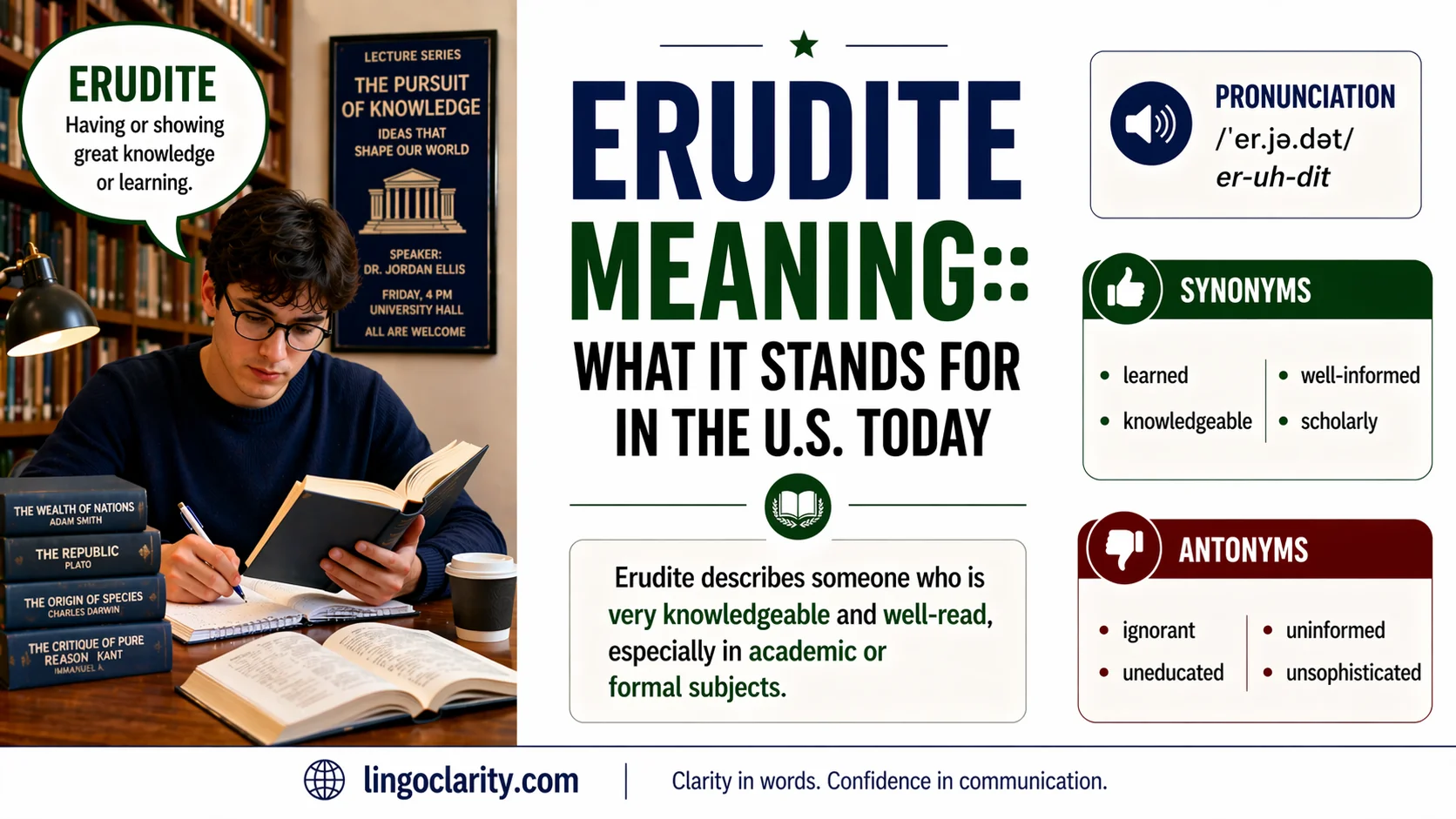
Erudite means very learned or showing deep knowledge gained through study. In most cases, it is a formal, positive adjective for a person, comment, lecture, or piece of writing.
TL;DR
- Erudite usually means very learned.
- In general, it is a formal, positive word.
- Today, it is mainly used as an adjective.
- More specifically, it often suggests knowledge from study or reading.
- So, it is stronger and narrower than smart.
What Does Erudite Mean?
At its core, erudite describes a person or thing that shows deep, serious learning. Most often, it suggests knowledge built through reading, study, or long practice. For example, an erudite lecture feels informed, while an erudite writer sounds widely read.
The word is usually approving. In other words, it is often used as praise. Still, it belongs more to formal English than to casual talk.
Definition in Plain English
In plain English, erudite means very learned. However, it does not just mean bright. Instead, it points more specifically to knowledge gained through study, reading, or serious interest in a subject.
It is not slang. So, you would not normally use it in texting the way you use words like cool or genius. Rather, it fits essays, reviews, speeches, and thoughtful descriptions.
Pronunciation
A simple American guide is AIR-yuh-dyte. However, you may also hear a version closer to AIR-uh-dyte.
If you are unsure, stress the first part clearly and end with -dyte. That way, it usually sounds natural in American English.
Part of Speech
In modern English, erudite is mainly an adjective. For example, you can use it before a noun, as in an erudite professor, or after a linking verb, as in Her talk was erudite.
Historical dictionaries also record noun uses. Even so, that is not the normal pattern for everyday learners. For practical purposes, treat erudite as an adjective in modern writing and speech.
When to Use Erudite
Use erudite when you want to praise deep learning in a formal or thoughtful way. For instance, it works well for people, comments, lectures, essays, criticism, and discussions.
Good times to use it:
- describing a professor, critic, speaker, or historian
- praising a lecture, essay, review, or discussion
- writing in a formal, academic, or cultural tone
For example, you might say: The judge gave an erudite overview of the case history.
Similarly, you could write: Her erudite review connected music, politics, and literature.
When Not to Use Erudite
On the other hand, do not force erudite into very casual talk. If you are chatting with friends, smart, well-read, or knowledgeable may sound more natural.
Likewise, avoid it when the idea is only practical skill. A person can know a lot about fixing engines, but erudite mechanic may sound odd unless you mean broad, scholarly knowledge too.
Common mistake:
He’s erudite at video games.
Better:
He’s very skilled at video games.
He’s knowledgeable about gaming history.
Common Contexts and Examples
You will often see erudite in these contexts:
- school or university writing
- book, film, or cultural reviews
- profiles of scholars, writers, or speakers
- thoughtful commentary in magazines or newspapers
Here are a few natural examples:
- The senator gave an erudite speech on constitutional history.
- Her podcast sounds relaxed, but the research is deeply erudite.
- The museum guide was warm, funny, and erudite.
- That article is erudite without being hard to follow.
- He made an erudite comment about jazz and civil rights.
Overall, a useful pattern is this: erudite + person, erudite + lecture, erudite + comment, or erudite + discussion. As a result, those combinations sound natural in American English.
Erudite vs. Smart vs. Scholarly
These words overlap, but they are not identical. For starters, smart is broad and everyday. By contrast, erudite is narrower and more formal. Meanwhile, scholarly often points to academic work, research, or style.
| Context | Best Choice | Why |
|---|---|---|
| Everyday praise for quick thinking | smart | Broad, common, and casual |
| Praise for deep learning from study | erudite | Formal and specific |
| Academic work, research, or tone | scholarly | Strong academic feel |
So, if someone solves a problem fast, smart may fit best. By comparison, if someone shows deep learning in history, law, or literature, erudite is stronger. Finally, if you are talking about journals, articles, or research style, scholarly may be the cleanest choice.
Synonyms and Antonyms
Close synonyms for erudite include:
- learned
- scholarly
- well-read
- knowledgeable
- cultured
These are useful, but none matches every context perfectly. For example, well-read stresses reading. Meanwhile, scholarly leans academic. By contrast, knowledgeable is broader and less formal.
Useful antonyms include:
- ignorant
- uninformed
- uneducated
- unscholarly
Even here, you should be careful with illiterate. Some thesauruses list it among opposites, but it is more specific because it refers to reading ability. Therefore, it is not always the best opposite in every sentence.
Common Mistakes
One common mistake is using erudite as a simple replacement for smart. However, that is too broad. Usually, erudite suggests learned knowledge, not just sharp thinking.
Another mistake is using it in very casual speech. Of course, you can do that, but it may sound stiff. A third mistake is confusing the word family:
- erudite = adjective
- erudition = noun
- eruditely = adverb
- eruditeness = noun, but less common
Origin and Word Family
Erudite comes from Latin eruditus, linked to erudire, meaning to instruct, teach, or polish. So, the history helps explain the tone of the word. In fact, it carries the idea of learning that has been shaped and refined.
Related word family:
- erudition — deep learning or scholarship
- eruditely — in a learned way
- eruditeness — the quality of being erudite
FAQ
What does erudite mean in simple words?
In simple words, erudite means very learned. More specifically, it usually describes someone or something that shows deep knowledge from study or reading.
Is erudite a compliment?
Yes, it is usually a compliment. In most contexts, it sounds respectful and admiring, especially in formal writing or speech.
How do you pronounce erudite?
A simple American guide is AIR-yuh-dyte. However, you may also hear AIR-uh-dyte.
Is erudite formal or casual?
It is mostly formal. Although it can appear in conversation, it sounds more natural in essays, reviews, speeches, and thoughtful praise.
Is erudite the same as intelligent?
Not exactly. In general, intelligent is broader. By contrast, erudite points more clearly to learned knowledge and scholarship.
Can erudite describe writing, not just people?
Yes. For example, it can describe comments, essays, lectures, discussions, and similar things.
Mini Quiz
Which sentence sounds more natural?
A. She gave an erudite lecture on Roman law.
B. She is erudite at texting fast.
Next, ask yourself: is erudite usually casual or formal?
Which word is the noun form?
A. eruditely
B. erudition
C. erudite
Finally, true or false: erudite usually suggests deep learning from study.
Answer Key
- A
- Formal
- B
- True
Conclusion
Now you know the meaning of erudite in plain English.
Overall, it usually means deeply learned, and it works best in formal praise. So, when you use it carefully, your writing sounds more precise. At the same time, it still helps you sound natural when the context is thoughtful or academic.
