
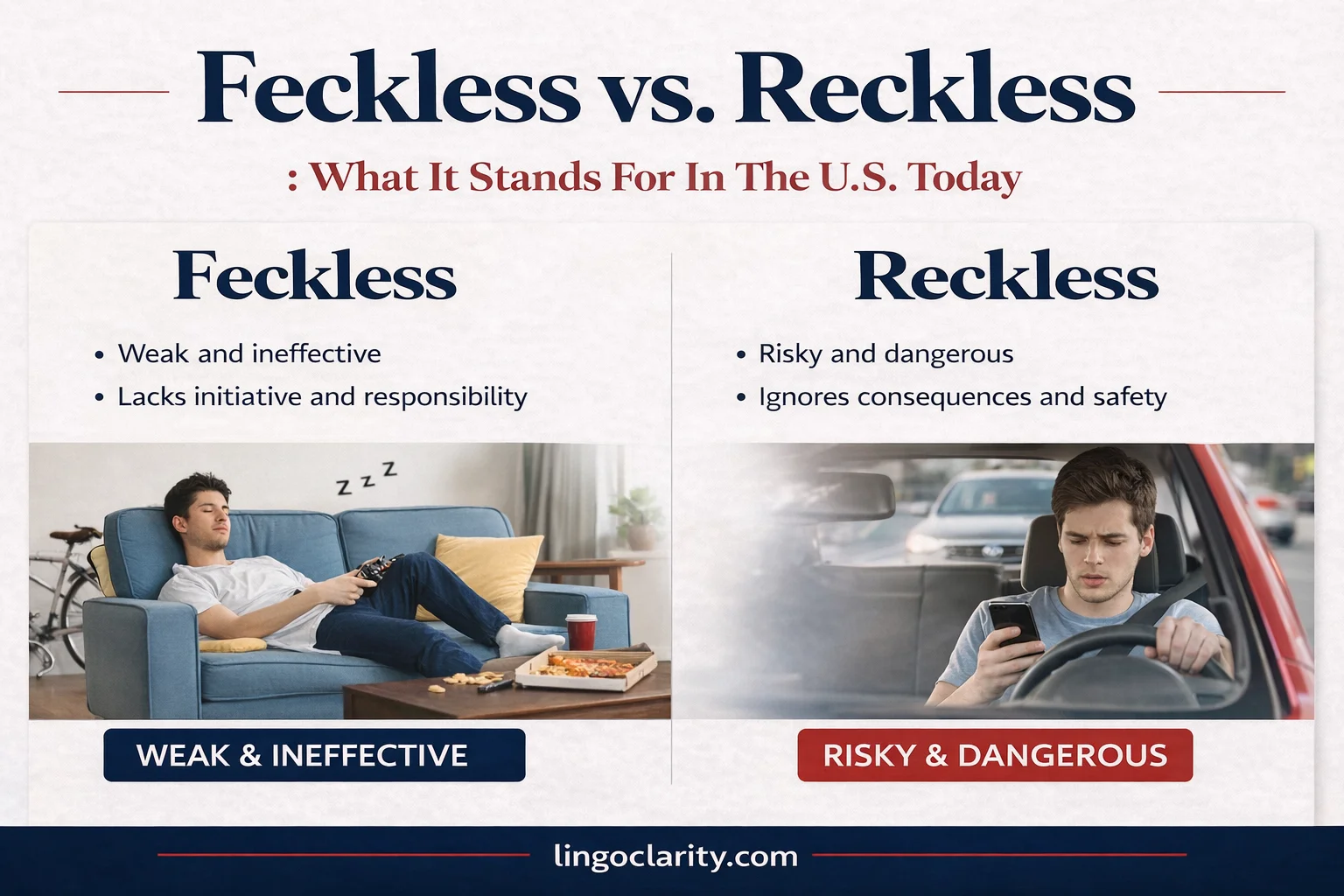
If the problem is weakness, ineffectiveness, or failure to step up, use feckless. If the problem is danger, rashness, or disregard for consequences, use reckless. That is the real difference. Authoritative dictionary sources define feckless around weakness, ineffectiveness, irresponsibility, or lack of determination, while reckless centers on lack of caution, danger, and disregard for consequences.
The two words sound similar, and both are negative, which is why people mix them up. But they criticize different kinds of bad judgment. A feckless person fails by being weak, passive, ineffectual, or irresponsibly inadequate. A reckless person fails by doing something risky, careless, or dangerous.
Quick Answer
Use feckless when someone or something is weak, ineffective, spineless, or irresponsibly incapable.
Use reckless when someone or something acts without proper caution and ignores likely harm.
A simple test helps:
- If your sentence is really about poor follow-through, choose feckless.
- If your sentence is really about risk and danger, choose reckless.
The Core Difference
At the center of the confusion is this:
Feckless is about a lack of force, competence, will, or responsibility.
Reckless is about a lack of caution.
That difference matters in real writing.
A feckless manager misses deadlines, avoids decisions, and lets problems drift.
A reckless manager pushes an untested product live, ignores warnings, and creates preventable risk.
A feckless response to a crisis is weak, empty, or inadequate.
A reckless response is one that makes the crisis worse by acting rashly.
So although both words can sound harsh, they are not harsh in the same direction. One blames ineffective weakness. The other blames dangerous carelessness.
Pronunciation And Why People Mix Them Up
The words are close in sound: feckless is typically pronounced FEK-luhs, and reckless is REK-luhs. That near rhyme makes them easy to confuse in speech and in memory.
They are also both adjectives with a negative tone, and both can describe bad judgment. But the overlap stops there. Once you ask whether the problem is weakness or risk, the right choice usually becomes obvious.
When To Use Feckless
Use feckless when the problem is lack of backbone, lack of effectiveness, or lack of responsible action.
This word often fits contexts like:
- leadership
- government or policy responses
- planning and execution
- work ethic
- parenting
- personal reliability
Examples:
- The board’s feckless response did nothing to restore confidence.
- Voters were tired of feckless leadership and vague promises.
- His feckless handling of the project left the team behind schedule.
- The apology sounded feckless because it admitted nothing and fixed nothing.
Notice what these examples do not suggest. They do not suggest thrill-seeking or danger. They suggest drift, weakness, incompetence, or inadequate responsibility.
That is also why feckless often sounds more editorial than conversational. It is a more deliberate word choice. Cambridge frames it as weak in character and lacking determination, while Merriam-Webster emphasizes weak and ineffective.
When To Use Reckless
Use reckless when the problem is danger, disregard, or risk-taking without proper caution.
This word naturally fits contexts like:
- driving
- spending
- physical safety
- legal or quasi-legal language
- accusations and claims
- impulsive decisions
Examples:
- It was reckless to text while driving in heavy rain.
- Her reckless spending left her deep in debt.
- The company made a reckless decision to skip safety checks.
- He showed reckless disregard for other people’s time and safety.
This is the everyday word in the pair. It appears in widely recognized phrases such as reckless driving, reckless disregard, and with reckless abandon, and Merriam-Webster even includes a legal definition that centers on creating substantial and unjustifiable risk.
Tone And Register
This is where good writers separate themselves from merely correct writers.
Reckless is common, direct, and easy to understand. It works in everyday conversation, journalism, professional writing, and legal or regulatory contexts. You do not need to worry that readers will miss it.
Feckless is correct, but it is less common in casual American English. It tends to sound more pointed, more literary, and more editorial. It often carries a sharper sense of contempt because it suggests that someone failed not by boldness, but by weakness, uselessness, or failure to rise to the moment. That makes it powerful when used well, but it also means you should use it deliberately.
In plain terms:
- reckless sounds like a warning
- feckless sounds like a judgment
Common Pairings And Natural Usage
The easiest way to sound natural is to pay attention to the nouns each adjective usually modifies.
Feckless commonly pairs with words like:
- leadership
- response
- effort
- management
- government
- handling
- son
- approach
Those pairings match the word’s weakness-and-ineffectiveness meaning. Merriam-Webster and Collins examples lean heavily in that direction.
Reckless commonly pairs with words like:
- driving
- disregard
- abandon
- spending
- behavior
- decision
- charge
- endangerment
Those pairings match the word’s risk-and-consequence meaning and show why reckless often appears in safety, crime, and public-conduct contexts.
That is why some phrases sound natural and others do not.
Natural:
- reckless driving
- reckless disregard
- feckless leadership
- feckless response
Unnatural or misleading:
- feckless driving
- reckless leadership, if you really mean weak and ineffective leadership rather than dangerously rash leadership
The second point matters. Reckless leadership is not wrong, but it means a leader is taking dangerous risks. Feckless leadership means the leader is weak, ineffectual, or irresponsibly inadequate. Those are different accusations.
Can Someone Be Both Feckless And Reckless?
Yes, but not in the exact same sense at the exact same moment.
A person can be feckless in one way and reckless in another.
For example, a founder might be feckless about daily management because he avoids hard decisions and lets deadlines slip. The same founder might also be reckless with investor money if he approves high-risk spending without basic controls.
A government can look feckless when it responds too weakly to a crisis. The same government can look reckless if it then rolls out a rushed, untested solution that creates new harm.
This is a useful nuance because it shows the words are not opposites. They can even describe the same person from different angles. But they still do different jobs.
Think of it this way:
- Feckless = not enough responsible force
- Reckless = too little caution
Common Mistakes To Avoid
One common mistake is using feckless as a fancy substitute for any strong criticism. That weakens your writing. Feckless should point to weakness, ineffectiveness, or inadequate responsibility, not just general badness.
Another mistake is using reckless when the real complaint is that someone failed to act effectively. If the issue is indecision, drift, empty promises, or weak leadership, feckless is probably the better choice.
A third mistake is flattening the distinction into “both mean irresponsible.” That is partly true, but too vague to help. Feckless irresponsibility looks like failure to step up. Reckless irresponsibility looks like dangerous action.
Examples of the difference:
- “The committee was feckless.”
This suggests weakness, incompetence, or inability to get anything done. - “The committee was reckless.”
This suggests it made dangerous or rash choices. - “His feckless apology solved nothing.”
The problem is inadequacy. - “His reckless apology exposed the company to new legal risk.”
The problem is hazardous carelessness.
A Simple Memory Trick
Use this memory line:
Feckless fails. Reckless risks.
It is not a full dictionary definition, but it is a fast and reliable way to choose the right word under pressure.
You can also remember the common anchors:
- feckless leadership
- reckless driving
If your sentence feels closer to the first, choose feckless. If it feels closer to the second, choose reckless.
Word Origins
The history of the words reinforces the difference.
Feckless comes from Scots feck, related to effect, which helps explain why the word developed the sense of lacking force or effectiveness. Merriam-Webster traces it to Scots forms tied to value and efficacy.
Reckless comes from older English reck, meaning to care or heed. Dictionary.com traces it to Old English forms meaning careless, and Merriam-Webster notes that the word is about lack of caution, not anything to do with wreck.
That last point matters because many people assume reckless is connected to wreck. It is not. A reckless driver may cause a wreck, but the words are not etymologically related.
FAQ
Is feckless stronger than reckless?
Not exactly. Feckless can sound more cutting because it feels more deliberate and more contemptuous, but reckless often sounds more urgent because it implies danger. One is not universally stronger. They are strong in different ways.
Can I use feckless for dangerous behavior?
Usually no. If the behavior is dangerous, rash, or shows disregard for likely harm, reckless is the natural choice. Feckless would only fit if your real point is that the behavior shows weakness, incompetence, or failure of responsibility rather than risk-taking.
Can I use reckless for weak leadership?
Only if the leadership is actively dangerous. If the leader is indecisive, ineffective, or spineless, feckless is the better word. If the leader is making rash, high-risk calls, reckless works.
Is feckless old-fashioned?
It is not wrong or obsolete, but it is less common and more marked than reckless in everyday American English. That is why it often feels more literary, political, or editorial when it appears.
What is the most common modern phrase with reckless?
Very likely reckless driving is among the most familiar fixed phrases in modern usage, and authoritative dictionary sources also highlight reckless disregard and with reckless abandon.
What is the easiest way to remember the difference?
Remember this: feckless fails, reckless risks. That one line gets you most of the way there.
The Bottom Line
If you mean weak, ineffective, or irresponsibly inadequate, use feckless.
If you mean careless, rash, or dangerous, use reckless.
They are both real words, and both can be sharp. But they are not interchangeable. Feckless criticizes failure of force or responsibility. Reckless criticizes failure of caution.
When you want clean, natural usage in modern US English, that distinction is the one that matters most.
