
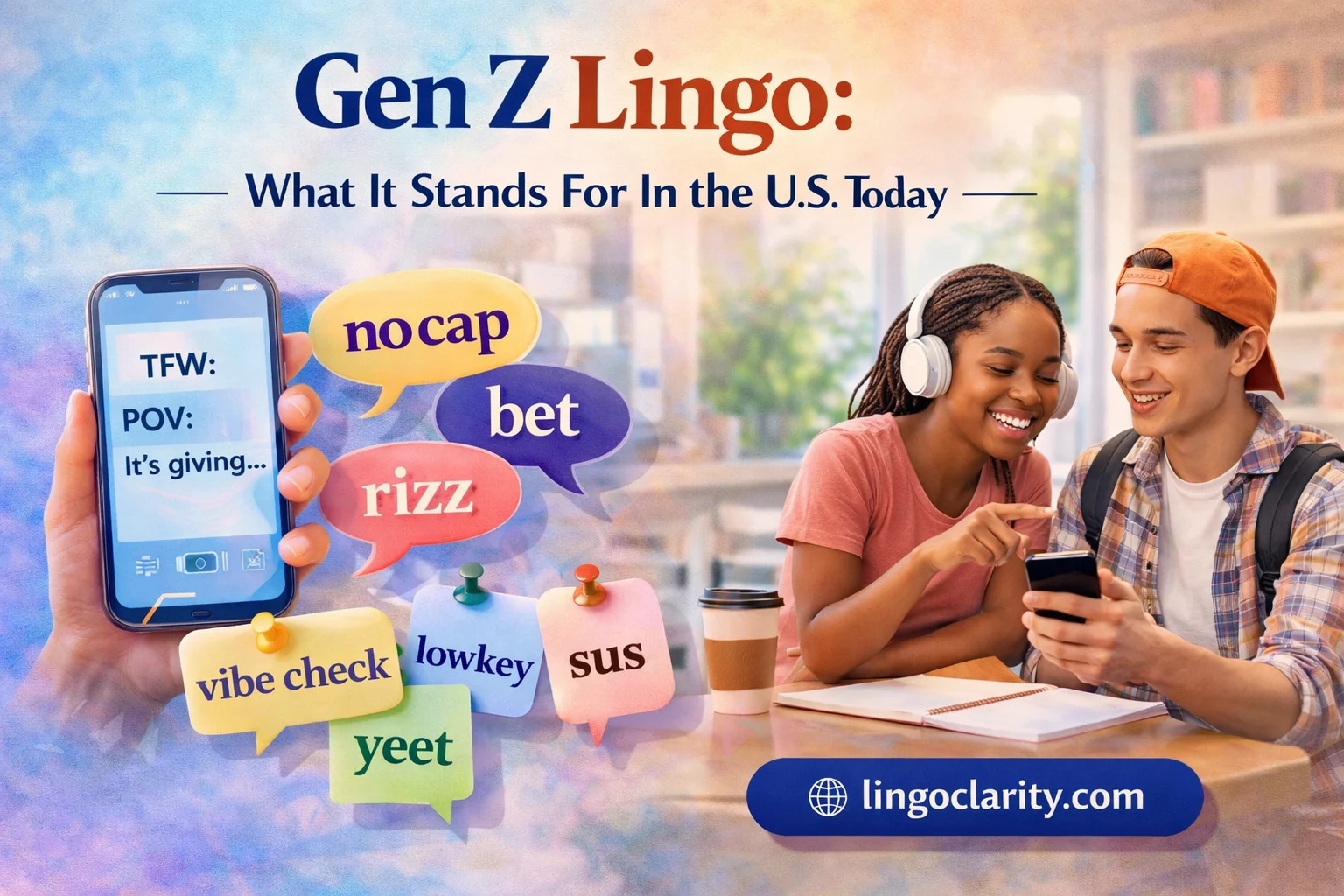
You see Gen Z lingo everywhere now. It shows up in texts, TikTok captions, memes, gaming chats, comment sections, and everyday conversation. Even people who do not use it still hear it often enough to wonder what it means. In plain English, the phrase usually refers to the slang, reactions, and casual wording linked with Gen Z speakers and online culture. The exact examples change quickly, but the idea stays the same.
The phrase matters because it is broader than a single slang word. It does not mean one fixed term. Instead, it points to a style of expression. That style is usually informal, fast-moving, playful, and shaped by group identity, internet culture, and social context. Slang often works differently across communities, and the same word can sound funny, friendly, sharp, or awkward depending on who says it and where.
This guide explains the gen z lingo meaning in a clear, practical way. You will learn what the phrase means, how to pronounce it, where it is used, when it sounds natural, when it does not, and why many so-called Gen Z terms are older than people assume. You will also get real-life examples, sentence patterns, synonyms, opposites, and common mistakes to avoid.
Quick Answer
Gen z lingo means the informal words, phrases, and expression style commonly linked with Generation Z, especially in online and casual communication. In U.S. discussions, Gen Z is commonly used for people born from 1997 onward, though exact date ranges can vary by source, and lingo means a type of language or special vocabulary. Put together, the phrase means “Gen Z-style slang or speech.”
TL;DR
• Gen z lingo means Gen Z-style slang and casual expression.
• It is informal language, not a good default for formal writing.
• The phrase is broad, so it can include single words, reaction phrases, meme talk, and online habits.
• Some terms called Gen Z slang are older than Gen Z and come from earlier speech communities.
• Meaning depends heavily on context, audience, and tone.
• The safest use is casual, natural, and limited.
Simple Definition
A simple definition is this: gen z lingo is the informal language style associated with Gen Z communication. It is not one official dictionary headword with one narrow meaning. It is a descriptive phrase people use when talking about slang, meme-based wording, internet expressions, and reaction-heavy speech linked with younger speakers and digital culture.
That broad meaning is why the phrase is useful. You can use it to describe a single word like rizz, a response word like bet, or a wider speech style that sounds playful, ironic, exaggerated, or very online. The phrase does not tell you which word is being used. It tells you what kind of speech you are dealing with.
What “Gen Z” And “Lingo” Mean In This Phrase
In this phrase, Gen Z refers to Generation Z, a generational label commonly used in U.S. research and media. Pew Research Center uses 1997 as the starting point for Gen Z in its earlier framework, while Britannica notes that many sources use a range such as 1997 to 2012, although exact boundaries are debated. That means the “Gen Z” part of the phrase is about a generation label, not a dictionary meaning of slang itself.
The word lingo is an informal noun meaning a type of language or a special vocabulary used by a group, field, or community. Merriam-Webster and Cambridge both define it as a kind of language or specialized vocabulary. So when you combine Gen Z and lingo, the phrase naturally means the kind of language associated with Gen Z speakers or Gen Z-coded communication.
Grammatically, gen z lingo works as a noun phrase. Lingo is the noun, and Gen Z identifies the type. So in sentences like “I do not understand Gen Z lingo,” the whole phrase functions as the name of a kind of language. That is a grammar-based inference from standard dictionary entries for lingo and the way generational labels modify nouns in English.
How To Pronounce Gen Z Lingo
In American English, Gen Z is pronounced roughly jen zee, and lingo is pronounced roughly LING-goh. Put together, the full phrase sounds like jen zee LING-goh. Cambridge provides U.S. pronunciation for both Gen Z and lingo, and the natural combined pronunciation follows directly from those entries.
What Counts As Gen Z Lingo
People often use the phrase to cover several kinds of casual language at once. That may include short slang words, strong reaction words, ironic phrases, meme wording, repeated sound effects, clipped responses, and expressions that spread through social apps, gaming spaces, and online communities. Slang is group-based, informal, and socially marked, so it is normal for these terms to change fast and mean slightly different things in different places.
Some current examples often mentioned in mainstream slang guides include rizz, bet, cap, no cap, and aura. Merriam-Webster defines rizz as romantic appeal or charm, bet as an informal affirmative, cap as lie or make an untrue statement, no cap as “for real” or “truthfully,” and slang aura as cool factor or star power.
Here is a simple guide:
| Term | Plain Meaning | Common Tone |
|---|---|---|
| rizz | charm or flirting skill | playful |
| bet | okay, sure, sounds good | casual |
| cap | lie or false claim | skeptical |
| no cap | honestly, for real | emphatic |
| aura | cool energy or strong presence | admiring |
These meanings come from current dictionary and slang references, but real use can still shift by platform, age group, and community.
Real-Life Example
Imagine this short group chat after a class presentation:
Amina: “You really owned that room.”
Jay: “No cap, she had insane aura.”
Maya: “Yeah, she slayed.”
Amina: “Bet, now let’s go get food.”
In plain English, that exchange means: the speaker did very well, looked confident, and impressed the group. The slang adds energy and group tone. A more formal version would be: “You gave a strong presentation. You seemed very confident. Let’s go eat.” The core message stays the same, but the style changes. The slang meanings here line up with current dictionary guidance for no cap, aura, and the broader description of slang as very informal and group-based.
Sentence Usage
Here are natural ways to use the phrase gen z lingo in sentences:
• “I know the words individually, but I still do not always understand Gen Z lingo.”
• “That teacher explains Gen Z lingo in simple English.”
• “Some Gen Z lingo spreads so fast that adults hear it before they learn what it means.”
• “You can use Gen Z lingo in a text, but it may sound odd in a work email.”
• “Not every trendy word is actually Gen Z lingo.”
These are natural usage patterns because gen z lingo behaves like a singular noun phrase naming a type of language.
When To Use Gen Z Lingo
Gen Z lingo fits best in relaxed settings. Good examples include group chats, texts with friends, casual social posts, jokes, gaming talk, and light conversation with people who already know the expression. In those settings, slang can feel fast, warm, funny, and socially natural. Cambridge notes that slang is very informal and is usually used more in speaking than in formal writing.
A good rule is to match the audience. If the people around you use the word naturally, a small amount of slang may sound normal. If they do not, plain English is usually stronger. Slang depends on shared understanding, and Britannica notes that slang often carries attitude, in-group feeling, and social meaning that shift across users and settings.
When Not To Use It
Do not force Gen Z lingo into formal communication. It is usually a poor fit for job applications, academic essays, official emails, legal writing, and serious workplace messages. Even when the meaning is understandable, the tone can sound too casual, too online, or too performative. Cambridge’s usage guidance on slang and formal versus informal language supports that distinction clearly.
You should also be careful when a term comes from a community or speech tradition you do not fully understand. Britannica notes that a significant part of so-called “Gen Z speak” is rooted in African American Vernacular English, and Merriam-Webster identifies cap and no cap as rooted in African American English use. That means not every word is simply “random youth slang,” and copying terms without context can sound off or flatten their history.
Why Gen Z Lingo Changes So Fast
Slang changes quickly because it spreads socially, not just grammatically. It grows inside groups, gets picked up by wider audiences, changes meaning, and can lose its edge once it becomes too common. Britannica’s overview of slang explains that slang is tied to attitude, group identity, and social use, which helps explain why it moves fast and why old terms can return with new meanings.
Social media speeds that cycle up. A phrase can move from one community to millions of users in a very short time. Once that happens, people may reuse it ironically, loosely, or incorrectly. That is one reason dictionary-style meanings are helpful, but they still do not capture every shade of live internet tone.
Are All Gen Z Terms Actually New?
No. One of the biggest mistakes people make is assuming that every term labeled “Gen Z slang” was invented by Gen Z. Britannica’s guide to how Gen Z speaks says many such expressions are not as new as they seem and that a significant portion is rooted in AAVE. Merriam-Webster also traces cap and no cap to older African American English use rather than treating them as entirely new creations.
That does not make the phrase gen z lingo wrong. It just means the label describes current association, not always original invention. A word may become strongly associated with Gen Z because Gen Z uses it widely online, even if the term existed earlier or came from another speech community first.
Synonyms And Close Alternatives
Depending on context, you can use several close alternatives to gen z lingo:
• Gen Z slang
• Gen Z speak
• Gen Z expressions
• youth slang
• internet slang
• online slang
• casual Gen Z language
These are not perfect matches in every situation, but they are close. Merriam-Webster’s thesaurus also lists slang among close synonyms for lingo and gives related words such as vocabulary, dialect, idiom, and terminology.
Opposites And More Formal Alternatives
There is no single perfect opposite of gen z lingo, but the nearest useful opposites are:
• formal language
• standard English
• plain language
• neutral wording
• professional wording
Merriam-Webster lists antonyms of slang such as literary, formal, and learned, which supports the idea that the opposite depends on setting rather than one exact single word. In everyday writing advice, plain language or formal language is usually the clearest opposite.
Common Mistakes
A lot of weak explanations of this phrase make the same mistakes. First, they treat gen z lingo as if it were one official vocabulary list. It is not. It is a broad label for a style of informal expression. Second, they assume all such terms are brand-new. Many are not. Third, they use slang in formal writing where simple wording would work better.
Another common mistake is using a trendy word only to sound current. That often backfires. Natural slang sounds effortless. Forced slang sounds like performance. Since slang depends on tone and group meaning, even a technically correct word can feel wrong in the wrong voice or context.
A smart fix is simple: before using a term, ask three questions. What does it mean? Who says it? Where does it sound natural? If you cannot answer those, use plain English instead.
Mini Quiz
- Does gen z lingo usually describe formal language or informal language?
- Is gen z lingo a noun phrase or a verb phrase?
- Which fits better in a job application: bet or certainly?
- Can a slang term sound different across groups and contexts?
- Are all Gen Z-linked terms newly invented by Gen Z?
Answer Key
- Informal language
- Noun phrase
- Certainly
- Yes
- No
FAQs
What does Gen Z lingo mean?
Gen z lingo means the slang, casual wording, and expression style commonly associated with Gen Z, especially in online and everyday informal communication. It is a broad phrase, not one single fixed vocabulary list.
Is Gen Z lingo the same as slang?
Almost, but not exactly. Slang is the bigger category. Gen Z lingo is a narrower label people use for slang and expression styles associated with Gen Z communication.
Are Gen Z slang words okay in formal writing?
Usually no. Cambridge notes that slang is very informal and is more typical in speaking than in formal writing. In professional or academic settings, standard wording is usually the safer choice.
Are all Gen Z terms actually new?
No. Britannica says many expressions linked with Gen Z speech are not as new as they seem, and some have roots in AAVE. Merriam-Webster also traces terms like cap and no cap to older African American English usage.
Why does Gen Z lingo change so quickly?
It changes quickly because slang is social, group-based, and highly sensitive to trend cycles, tone, and identity. Social media speeds up that spread and change.
What are some common Gen Z lingo examples?
Common examples often listed in current slang references include rizz, bet, cap, no cap, and aura. Their exact popularity can shift over time, but those are clear modern examples with current reference entries.
Should older adults use Gen Z lingo?
They can, but only when it feels natural and the audience understands it. Forced use often sounds awkward. Clear, plain language is still the best choice when tone is uncertain.
Conclusion
Gen z lingo means the informal language style associated with Gen Z speech, especially in digital and casual settings. It is a broad label for slang, quick reactions, meme-based wording, and online expressions, not a single word with one fixed list behind it. The best way to understand it is to think of it as Gen Z-style casual language.
Use it when the context is relaxed, the audience understands it, and the tone feels natural. Skip it when clarity, professionalism, or precision matters more. That balance is the real key: understand the phrase, respect where terms come from, and use plain English whenever slang would distract instead of help.
