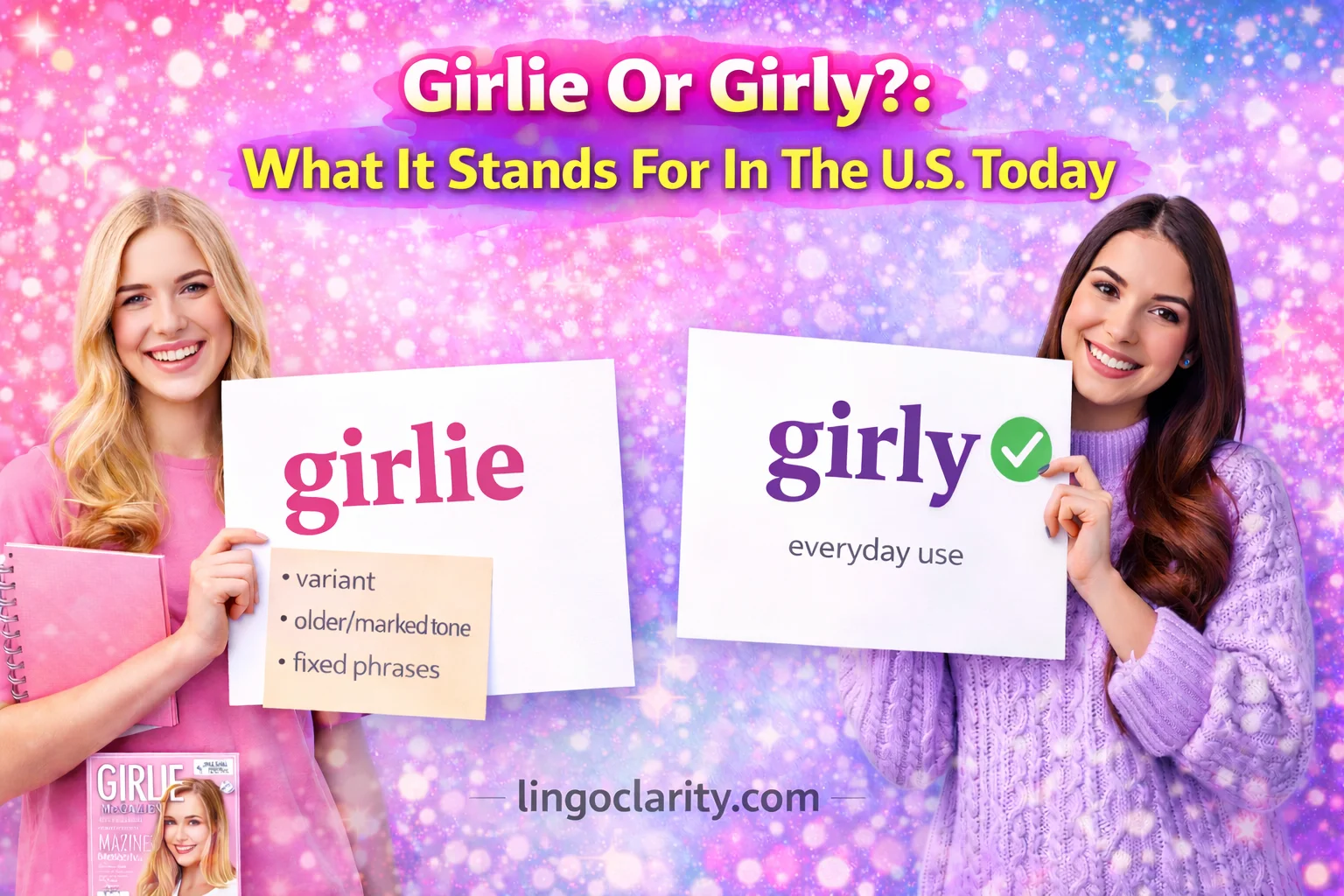
If you are trying to choose between girlie and girly, the best everyday answer in US English is usually girly. Both forms appear in major dictionaries, so girlie is not a made-up error. Still, the two forms do not feel equally natural in modern writing. In most ordinary descriptions, girly reads more current and less marked, while girlie often appears as a variant, in older-feeling wording, or in narrower set phrases.
That difference matters because spelling is not only about correctness. It is also about tone. A word can be dictionary-approved and still sound dated, playful, patronizing, or more loaded than you intended. That is exactly why this pair confuses writers.
Quick Answer
Use girly for most everyday adjective use in US English.
Use girlie only when you want a marked tone, when you are echoing a recorded phrase such as girlie magazine, or when a special noun sense is clearly intended. Major dictionary entries treat the forms as overlapping, but they also show that some senses are more strongly tied to girlie than to girly.
• girly → safer for modern everyday description
• girlie → real variant, but often more marked, older-feeling, or tied to fixed phrases
Simple Definition
Girly usually means “typical of girls” or “feminine in a stereotypical or playful way.” Cambridge defines it broadly as involving women and girls or being considered typical of women or girls, while Oxford describes it as suitable for or typical of girls.
Girlie can mean nearly the same thing in some adjective uses, because Merriam-Webster lists it with the variant girly. But dictionary entries also connect girlie more directly to older or marked senses, especially phrases involving sexualized entertainment or certain noun uses.
So the simplest working rule is this:
Girly = the safer everyday adjective
Girlie = a real variant, but one that often carries extra tone or narrower usage
Why People Confuse These Spellings
People mix up girlie and girly for a good reason: dictionaries really do show overlap. Merriam-Webster gives girlie with “variants or girly,” and Oxford’s main adjective entry for girly says “also girlie.” That tells you the connection is real, not imagined.
The confusion gets stronger because the words are pronounced the same in standard dictionary entries, so sound does not help you choose. You hear one form, then guess at the spelling. On top of that, both words can describe something seen as feminine, youthful, or associated with girls.
Still, overlap does not mean perfect interchangeability. Once you look closely at the entries, girly handles more of the broad everyday adjective work, while girlie shows up more in marked senses and specific phrases.
Key Differences At A Glance
| Context | Best Choice | Why |
|---|---|---|
| Everyday style or design description | girly | It looks more natural to most modern US readers. |
| A broad adjective meaning “typical of girls” | girly | That is the cleaner default spelling for ordinary use. |
| Fixed or older-feeling phrase such as girlie magazine | girlie | Dictionaries often preserve this sense under girlie or note it as “usually girlie.” |
| Playful, patronizing, or offensive noun use | girlie | Dictionaries attach those noun uses more directly to girlie or list girly as an alternate. |
| Writing where you want the least distracting spelling | girly | It is usually the safer everyday choice. |
This is not a case where one spelling is fully correct and the other is fully wrong. It is a case where one spelling is generally better for modern neutral prose.
Are They The Same Word?
Mostly, yes. In adjective use, both forms can point to the same core idea: something associated with girls, femininity, or a traditionally feminine style. That is why dictionaries treat them as variants or alternate spellings in at least some senses.
But in real-life use, they are not perfect twins. Girlie carries more baggage. Merriam-Webster reserves one sexualized adjective sense as “usually girlie,” Oxford does the same, and Collins also records girlie magazine and related uses. Meanwhile, Oxford’s noun entry shows that girly/girlie can be an informal and often offensive way to refer to a girl or young woman.
That is why writers often feel a difference even when both forms are technically listed. Dictionary overlap tells you both exist. Usage tone tells you which one fits better.
What Major Dictionaries Actually Suggest
Merriam-Webster treats girlie as an adjective with the variant girly, meaning “girlish,” but it also marks the “featuring scantily clothed women” sense as “usually girlie.” That alone shows the forms are related but not identical in feel.
Oxford’s learner entry centers the everyday adjective under girly, with girlie shown as an alternate spelling. In the same entry, Oxford marks the sexualized magazine sense as “usually girlie” and labels it old-fashioned. That is strong evidence for using girly as the default everyday adjective and saving girlie for narrower contexts.
Collins also shows overlap. In British English, it lists girlie or girly, including both “a little girl” and adjective meanings like “suited to or designed to appeal to young women.” In American English, Collins records noun and adjective uses for girlie, including playful, patronizing, and offensive senses.
Taken together, the dictionary pattern is clear: girlie is real, but girly is usually the cleaner choice for general modern description.
US Vs UK Preference
This is not a neat regional split like color/colour. The available dictionary evidence does not support a simple rule that Americans use one spelling and British writers use the other. Oxford and Collins both show overlap rather than a clean US-versus-UK divide.
What the sources do support is a difference in usage feel. In modern everyday description, girly is the smoother and safer choice. In older or marked senses, especially expressions like girlie magazine, dictionaries still record girlie more directly.
So if you are writing for a US audience and want the least distracting option, choose girly unless you have a clear reason not to.
Which Spelling Should You Use In Everyday US English?
Choose girly in sentences like these:
She wanted a girly bedroom without making it look childish.
The brand leans girly, with bows, pastel colors, and floral details.
The movie has a girly energy, but it still feels sharp and modern.
In these uses, girly does what most readers expect. It is direct. It is familiar. And it does not pull attention away from your meaning.
Choose girlie only when you want a special tone or you are deliberately using a recorded phrase:
The article used the older phrase girlie magazine.
The character’s language sounded dated and patronizing when he said girlie.
That does not make girlie wrong. It just makes it more context-sensitive.
Real-Life Example
Imagine a fashion editor writing this sentence:
“The new collection has a girly look, with ribbons, satin flats, and soft pink shades.”
That feels smooth and current. Most readers will accept it immediately.
Now change the sentence:
“The new collection has a girlie look, with ribbons, satin flats, and soft pink shades.”
This version is still understandable. But many US readers will pause. Some will read it as older. Some will hear a playful edge. Others will feel that the spelling looks less standard for straightforward description.
That is the heart of the difference. The meaning may stay close, but the reader reaction changes.
When Either Word Can Sound Tricky
Even girly is not always neutral. Oxford marks the adjective as “sometimes disapproving,” and American Heritage also notes derogatory or negative use in some contexts, especially when the word is used to judge men as weak or effeminate.
So the best editing advice is not simply “use girly.” It is this:
Use girly when you truly mean a feminine, playful, or girl-coded style.
Avoid girly when it sounds dismissive, stereotyped, or lazy.
Avoid girlie even more carefully when tone matters, because that form is more likely to sound old-fashioned, patronizing, or loaded.
Synonyms And Opposites
No synonym is perfect, because each choice shifts the tone a little.
Useful synonyms for girly or girlie in the adjective sense include:
• feminine
• girlish
• ladylike in some contexts
• cute in very casual style writing
• pink-and-pretty in informal descriptive copy
Merriam-Webster’s thesaurus groups girlie with words such as feminine, girlish, and womanly, while common opposites include masculine, boyish, and unfeminine.
In most modern editing, feminine is the cleaner substitute if you want a broader, less playful tone. Girlish can work too, but it often feels a bit more literary or old-fashioned than girly.
Sentence Usage
Using Girly In A Sentence
Girly works best when you are describing style, taste, mood, or presentation.
• She likes a girly color palette with blush pink and cream.
• The packaging feels girly without looking childish.
• He said the ad looked too girly for the brand.
• Their apartment has a girly touch, but it still feels grown-up.
Using Girlie In A Sentence
Girlie usually needs more care.
• The old article used the phrase girlie show.
• Calling a coworker “girlie” can sound patronizing.
• Some older sources still record girlie magazine as a standard phrase.
• In plain product copy, girlie often feels more marked than girly.
These examples match the broader dictionary pattern: girly is easier to use safely, while girlie is more limited.
Common Mistakes
One common mistake is treating this pair like a strict regional split. It is not. The evidence does not show a clean US spelling versus UK spelling rule. It shows overlap with differences in tone and preferred context.
Another mistake is assuming girlie is always just a harmless alternate spelling. In some noun uses, dictionaries label it as playful, patronizing, or offensive. That means writers should avoid using it casually for a person unless they deliberately want that effect.
A third mistake is assuming girly is always flattering. It can sound dismissive if you use it to belittle someone’s taste, identity, or behavior. Good editing is not only about correct spelling. It is also about respectful tone.
A fourth mistake is forcing girlie into ordinary product, fashion, or lifestyle writing where girly would sound smoother. If your goal is clear modern US prose, girly is usually the better pick.
Word History And Usage Note
It is safer not to oversell the history here. The dictionary record shows that the two forms have coexisted and overlapped, but the cleanest modern guidance comes from current usage labels, not from a neat historical timeline. Merriam-Webster, Oxford, and Collins all show related meanings, yet they also preserve certain senses more strongly under girlie.
For writers today, that is the real takeaway. You do not need a long etymology lesson to make the right choice. You need the tone rule:
If you want the safest everyday adjective, use girly.
Conclusion
So, which spelling should you use in US English?
For most everyday writing, choose girly. It is the clearer, smoother, and safer option for describing a feminine or girl-coded style. Girlie is not wrong, but it is more marked. It often feels older, narrower, or more tied to set phrases and loaded noun uses.
That makes this a real spelling-choice issue, but not a simple right-versus-wrong one. Both forms exist. One simply does more of the everyday work.
FAQs
Is girly better for everyday US writing?
Yes. For most modern US contexts, girly is the safer everyday adjective. Dictionary evidence shows overlap, but girly is the smoother default in general description.
Is girlie a misspelling?
No. Girlie is a real dictionary form. It is better understood as a variant spelling with narrower or more marked uses, not as a spelling mistake.
Do girlie and girly mean exactly the same thing?
Not always in practice. They overlap in adjective meaning, but girlie is more strongly tied to fixed phrases, older-feeling wording, and certain noun uses.
Is one American and the other British?
No clear dictionary evidence supports a strict US-versus-UK split. Both spellings appear across major English dictionaries, with differences more in tone and context than in national ownership.
Can I call a person girlie?
You should be careful. Dictionary entries show that using girlie for a person can sound playful, patronizing, or offensive, depending on context.
What is the safest editing rule to follow?
Use girly for ordinary descriptive writing. Use girlie only when you want a specific tone or when you are intentionally keeping a recorded phrase such as girlie magazine.
