
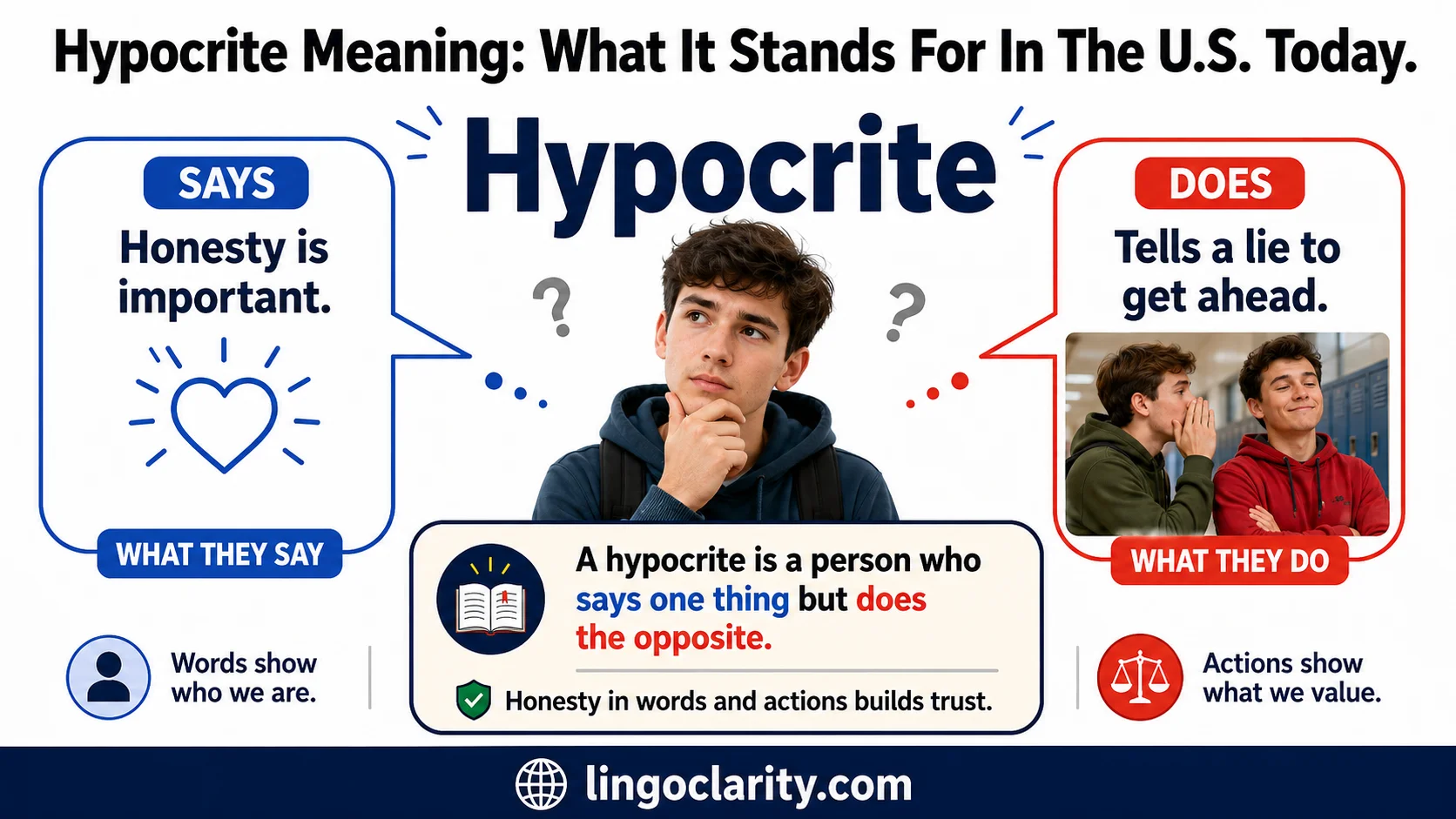
Hypocrite meaning in English refers to a person whose actions do not match the beliefs, values, or rules they claim to support. In simple English, a hypocrite says one thing but does another, especially when they judge other people for behavior they also do themselves.
The word is negative and usually sounds serious. It is not a curse word, but it can feel insulting because it questions someone’s honesty, fairness, or sincerity.
For example, if someone tells others not to lie but then lies to avoid blame, people may call that person a hypocrite. The problem is not just the lie. The problem is the gap between the person’s stated standard and their own behavior.
Quick Answer
Hypocrite meaning: A hypocrite is a person who pretends to have certain beliefs, values, or moral standards but behaves in a way that contradicts them.
Simple meaning: Someone who does not practice what they preach.
Part of speech: Noun.
Tone: Negative, critical, and often accusatory.
Pronunciation: HIP-uh-krit.
Adjective form: Hypocritical.
Noun for the behavior: Hypocrisy.
Hypocrite Meaning in Simple English
A hypocrite is someone whose words and actions do not line up.
They may criticize others for doing something, while secretly or openly doing the same thing. They may also claim to care about honesty, kindness, fairness, religion, equality, or responsibility but act in the opposite way.
For example:
A student says cheating is wrong, but then cheats on a test.
A boss tells employees to be on time, but the boss is late every day.
A person posts about kindness online, but treats people cruelly in private.
A friend complains about gossip, but spreads rumors about others.
In each case, the person claims one standard but follows another. That mismatch is what makes the behavior hypocritical.
Hypocrite Definition and Part of Speech
Hypocrite is a noun. It names a person.
You can say:
A hypocrite
The hypocrite
Those hypocrites
He is a hypocrite.
She called him a hypocrite.
They acted like hypocrites.
Major dictionaries define “hypocrite” as a disapproving noun for someone who pretends to have virtues, beliefs, or standards that their behavior does not support.
| Word | Part of Speech | Meaning | Example |
|---|---|---|---|
| Hypocrite | Noun | A person whose actions contradict claimed beliefs | He is a hypocrite. |
| Hypocrisy | Noun | The behavior or practice of being hypocritical | That rule exposed their hypocrisy. |
| Hypocritical | Adjective | Describes a person, action, comment, or rule | That was a hypocritical excuse. |
| Hypocritically | Adverb | Describes doing something in a hypocritical way | She spoke hypocritically about fairness. |
How To Pronounce Hypocrite
In American English, hypocrite is pronounced:
HIP-uh-krit
The stress is on the first syllable: HIP.
Do not pronounce it as “hy-PO-crite.” The natural stress comes at the beginning. Cambridge and Oxford list the pronunciation with first-syllable stress: /ˈhɪpəkrɪt/.
Break it into three parts:
HIP
uh
krit
Example sentence:
“Don’t call someone a HIP-uh-krit unless their actions truly contradict their stated values.”
How To Use Hypocrite in a Sentence
Use hypocrite when a person’s behavior clearly conflicts with what they claim to believe or expect from others.
Common sentence patterns include:
| Pattern | Example |
|---|---|
| be + a hypocrite | He is a hypocrite for judging others while doing the same thing. |
| call someone a hypocrite | She called him a hypocrite after he broke his own rule. |
| sound like a hypocrite | I do not want to sound like a hypocrite, so I follow the same advice I give. |
| act like a hypocrite | You act like a hypocrite when you criticize gossip but spread rumors. |
| make someone look like a hypocrite | His private behavior made him look like a hypocrite. |
Examples of Hypocrite in Everyday Situations
At school:
“She called him a hypocrite because he complained about cheating but copied someone else’s homework.”
At work:
“The manager looked like a hypocrite after warning everyone about deadlines and then missing his own.”
In family life:
“He tells his children not to yell, but he yells during every argument. That makes him sound like a hypocrite.”
In friendships:
“She says loyalty matters, but she talks badly about her closest friends. People may see that as hypocritical.”
On social media:
“He posts about kindness every day, yet insults strangers in the comments. Many users called him a hypocrite.”
In public life:
“A leader who demands sacrifice from ordinary people but refuses to follow the same rules may be accused of hypocrisy.”
Hypocrite, Hypocrisy, and Hypocritical
These words are related, but they are not interchangeable.
Hypocrite means the person.
Correct: “He is a hypocrite.”
Incorrect: “He is hypocrisy.”
Hypocrisy means the behavior, practice, or situation.
Correct: “That is hypocrisy.”
Incorrect: “That is a hypocrite.”
Hypocritical describes a person, action, statement, rule, or attitude.
Correct: “That was a hypocritical comment.”
Incorrect: “That was a hypocrite comment.”
Here is a simple way to remember the difference:
A hypocrite does hypocrisy and acts in a hypocritical way.
When Someone Is a Hypocrite
Someone may be called a hypocrite when three things are true.
First, the person claims to believe in a rule, value, or standard.
Second, the person breaks that same rule or acts against that value.
Third, the contradiction is clear enough to seem unfair, false, or insincere.
For example, a person who loudly judges others for wasting money but secretly spends recklessly may be seen as a hypocrite. The issue is not only bad spending. The issue is judging others while doing the same thing.
When Not To Call Someone a Hypocrite
Not every mistake makes someone a hypocrite.
A person can fail, forget, change their mind, or struggle without being dishonest. For example, someone may say they want to eat healthier but eat cake at a party. That may show weakness or inconsistency, but it does not automatically make them a hypocrite.
Use hypocrite carefully when the situation involves a clear double standard or false moral image.
Softer alternatives include:
“That seems inconsistent.”
“That feels unfair.”
“You are not following your own advice.”
“That sounds like a double standard.”
“Your actions do not match what you said.”
These phrases are less harsh than “You are a hypocrite.”
Tone and Politeness
Hypocrite is a strong word. It can quickly turn a conversation into an argument because it labels the person, not just the behavior.
Direct and harsh:
“You are a hypocrite.”
Softer and more specific:
“You told everyone not to interrupt, but you interrupted me several times.”
Even softer:
“I’m confused because your actions do not match what you said earlier.”
In serious writing, public debate, or personal conflict, it is often better to describe the contradiction first. Then, if needed, you can say the behavior seems hypocritical.
Synonyms of Hypocrite
Synonyms can help, but they do not all mean exactly the same thing.
| Word | Meaning and Tone |
|---|---|
| Pretender | Someone acting as if they are something they are not; softer than fraud |
| Phony | Informal word for someone fake or insincere |
| Fake | Common, direct, and negative |
| Fraud | Stronger; suggests serious deception |
| Deceiver | Someone who misleads others |
| Two-faced person | Someone who acts one way with one person and another way with someone else |
| Faker | Informal; someone pretending |
| Charlatan | Formal; often used for someone pretending to have special knowledge or skill |
Merriam-Webster lists related synonyms such as liar, deceiver, faker, impostor, fraud, and fake, while antonyms include truthful, honest, open, and sincere.
Antonyms of Hypocrite
Antonyms describe someone whose words and actions seem to match.
Useful antonyms include:
Honest person
Sincere person
Genuine person
Truthful person
Straight shooter
Consistent person
Open person
For example:
“She is not a hypocrite. She is honest about her flaws and tries to live by the same standards she expects from others.”
Hypocrite vs. Two-Faced
Hypocrite and two-faced are related, but they are not always the same.
A hypocrite acts against the beliefs or standards they claim to support.
A two-faced person acts one way with one person and another way with someone else.
Example of a hypocrite:
“He says gossip is cruel, but he spreads gossip every day.”
Example of a two-faced person:
“She praises her coworker in person but insults her behind her back.”
A person can be both hypocritical and two-faced, but the words focus on different kinds of dishonesty.
Hypocrite vs. Double Standard
A double standard is a rule that is applied unfairly to different people.
A hypocrite is a person who uses or benefits from that unfairness while pretending to support fairness.
Example:
A teacher punishes students for being late but arrives late every day.
The unfair rule is a double standard. The teacher may be called a hypocrite if they demand punctuality from others while refusing to follow the same standard.
Origin of Hypocrite
The word hypocrite comes through older languages from Greek. It is linked to hypokritēs, meaning an actor or stage player. Merriam-Webster explains that the word originally connected to acting and later developed the meaning of pretending to be virtuous or sincere.
That history helps explain the modern meaning. A hypocrite is not simply someone who makes a mistake. A hypocrite appears to play a role, claiming one set of beliefs while acting against them.
Common Mistakes With Hypocrite
Incorrect: “He is hypocrisy.”
Correct: “He is a hypocrite.”
Incorrect: “That was a hypocrite rule.”
Correct: “That was a hypocritical rule.”
Incorrect: “She did hypocrisy.”
Correct: “She showed hypocrisy.”
Incorrect: “He spoke hypocrite.”
Correct: “He spoke hypocritically.”
Incorrect: “Everyone who fails is a hypocrite.”
Correct: “A hypocrite claims a standard but acts against it, especially in a way that seems false or unfair.”
Mini Quiz
Choose the best answer.
What part of speech is hypocrite?
Person, action, or adjective?
Which sentence is correct?
“He is hypocrisy.”
“He is a hypocrite.”
What is the adjective form?
Hypocrite
Hypocrisy
Hypocritical
Is hypocrite usually positive or negative?
Which sentence is softer?
“You are a hypocrite.”
“That seems inconsistent.”
Answer Key
Hypocrite is a noun.
It names a person.
“He is a hypocrite” is correct.
The adjective is hypocritical.
The word is usually negative.
“That seems inconsistent” is softer.
FAQs About Hypocrite Meaning
What does hypocrite mean?
A hypocrite is a person whose actions do not match the beliefs, values, or standards they claim to have. The word often suggests insincerity, false virtue, or a double standard.
What is a hypocrite in simple words?
In simple words, a hypocrite is someone who does not practice what they preach. They may criticize others for doing something while doing the same thing themselves.
Is hypocrite a bad word?
Hypocrite is not a curse word, but it is a strong negative label. Calling someone a hypocrite can sound harsh because it attacks their sincerity and character.
Is hypocrite slang?
No. Hypocrite is standard English. It appears in dictionaries, books, articles, speeches, and everyday conversation. However, people may also use it casually online.
What part of speech is hypocrite?
Hypocrite is a noun. It names a person. The related noun for the behavior is hypocrisy, and the adjective is hypocritical.
How do you pronounce hypocrite?
Pronounce hypocrite as HIP-uh-krit. The first syllable is stressed.
What is another word for hypocrite?
Another word for hypocrite is pretender. Other options include phony, fake, fraud, deceiver, and two-faced person. The best choice depends on tone and context.
What is the difference between hypocrite and hypocrisy?
A hypocrite is the person. Hypocrisy is the behavior or situation.
Example:
“He is a hypocrite.”
“That is hypocrisy.”
Can someone be a hypocrite by accident?
Usually, hypocrite suggests some level of contradiction that appears insincere or unfair. However, people can make mistakes without being hypocrites. It is better to look at the pattern, seriousness, and context before using the word.
Is hypocrite the same as two-faced?
Not exactly. A hypocrite acts against their stated beliefs or standards. A two-faced person acts differently with different people, often by being nice in person and unkind behind someone’s back.
Final Takeaway
A hypocrite is someone whose behavior contradicts the beliefs, values, or rules they claim to support. The word is a noun, and it usually has a negative tone.
Use it when the contradiction is clear and meaningful. For everyday disagreements, softer phrases like “That seems inconsistent” or “Your actions do not match your words” may be more accurate and less insulting.
